Thank you for visiting nature.com. You are using a browser version with limited support for CSS. To obtain
the best experience, we recommend you use a more up to date browser (or turn off compatibility mode in
Internet Explorer). In the meantime, to ensure continued support, we are displaying the site without styles
and JavaScript.
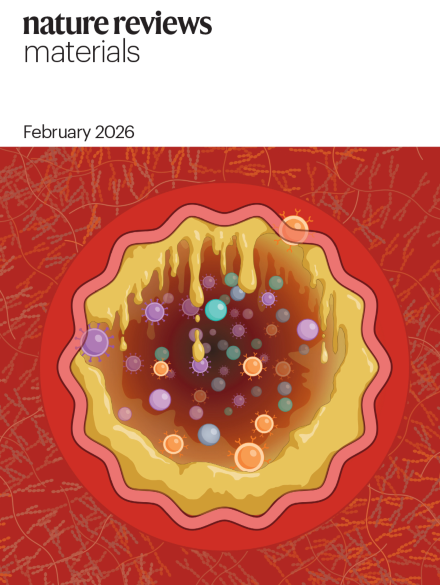
Airway mucus is a dynamic protective barrier that shapes responses to inhaled pathogens and therapeutics. Advances in materials and biologics are enabling strategies that either strengthen its function or modulate its properties to improve the performance of inhaled treatments. The cover shows a stylized illustration of the mucus barrier and its role in regulating the movement of biologics and engineered particles. See S.W. Zhang et al.
Recycling rarely fails for simple reasons. New York City’s system is a case study in the dynamics and compromises that shape urban recycling, and why cities cannot optimize everything at once.
High-entropy alloys were once thought to owe their exceptional properties to complete chemical disorder, but advances over the past decade revealed that subtle forms of atomic order are widespread and often essential. Recognizing how order and disorder work together is now reshaping alloy design and opening new routes to stronger, tougher and more reliable materials.
Zeolites are widely used in catalysis and separation, yet their crystallization process remains poorly understood. Emerging tools have the potential to enable a multiscale understanding of how crystallization influences the structural features of zeolite materials, unlocking their precise control.
An article in Nature Communications reports a synthesis that can grow out-of-plane conductive 2D covalent organic framework films directly on substrates, thanks to an induced Marangoni effect.
An article in Nature Communications reports high-performance intrinsically stretchable n-type transistors based on MoS2 flakes, achieving mobilities up to 12.5 cm2 V–1 s–1 and on/off ratios above 10⁷ under 20% strain.
Airway mucus complicates treatment of respiratory disease by both defending the lungs and hindering inhaled drugs to cross the barriers. This Review explores translational advances in inhalable materials and biologics that enhance mucus protection or drug penetration.
Sodium-ion batteries are promising low-cost alternatives to lithium-ion systems yet limited by underperforming anodes. This Review highlights advances and challenges in hard carbon and alloy-based anodes, outlining design strategies to boost capacity, stability and commercial viability of next-generation high-energy sodium-ion batteries.
The implementation of low-dimensional perovskite capping layers is a promising strategy for enhancing the performance of perovskite solar cells; however, their thermal stability and reproducibility remain inadequately understood. This Review examines these underlying challenges, emphasizing ligand design and fabrication techniques to achieve high-quality, high-purity capping layers.
Broken and tailored symmetries have a fundamental role in wave phenomena and their applications. This Review surveys the recent progress in the domain of artificial phononic media with an emphasis on the role of symmetry breaking, in both space and time, for advanced wave phenomena.