
Thank you for visiting nature.com. You are using a browser version with limited support for CSS. To obtain the best experience, we recommend you use a more up to date browser (or turn off compatibility mode in Internet Explorer). In the meantime, to ensure continued support, we are displaying the site without styles and JavaScript.

Volume 43 Issue 6, June 2025

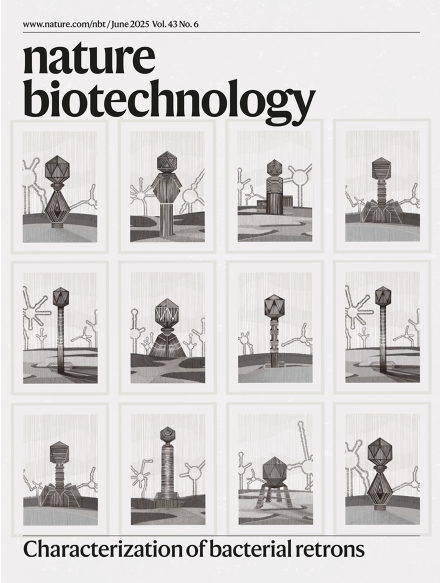
Characterization of bacterial retrons

Inspired by photographs by Bernd and Hilla Becher of industrial structures, Khan et al. replaced these with representations of phages and structures of retrons, noncoding RNA elements from a bacterial immune system. The authors present a molecular census of retrons, performing the same battery of tests across many distinct systems to identify similarities and differences.

See Khan et al.

Image: Jodie Lesman. Cover design: Erin Dewalt
Editorial

  • The gutting of US research funding represents a once-in-a-generation opportunity for Europe to boost world-class research deprioritized by the Trump administration.

    Editorial

    Advertisement

Top of page ⤴

News

Top of page ⤴

Correspondence

Top of page ⤴

Comment

  • Producing goods, such as foods and fuels, with minimal environmental impacts is urgently needed. Although advances in bioproduction are promising, there is often a noticeable gap in our understanding of whether and where new processes can compete with existing methods on an economic and environmental basis. Transparent lower bound calculations from basic principles highlight potential benefits of producing foods, but not fuels, from electro-microbial production of biomass.

    • Samuel J. Lovat
    • Roee Ben-Nissan
    • Ron Milo
    Comment
  • 23andMe’s bankruptcy serves as a moment of reflection for the direct-to-consumer (DTC) genomics industry. We analyzed 23andMe financial data and business practices to reveal the factors behind the fall of the company, once valued at US $6 billion and now being considered for acquisition by Regeneron for merely $250 million. Key challenges faced by 23andMe in monetizing its genomic data reveal that this information, at least in a typical DTC setting, is simply not worth that much.

    • Yaniv Erlich
    • Dina Zielinski
    Comment
Top of page ⤴

Features

Top of page ⤴

Research Highlights

Top of page ⤴

News & Views

  • Two CRISPR tools harness DNA-dependent polymerases for genome editing — and may overcome some limitations of prime editors.

    • Quinn T. Cowan
    • Alexis C. Komor
    News & Views
Top of page ⤴

Research Briefings

  • Satellite cells, the stem cells of skeletal muscle, are responsible for muscle development and regeneration. Although low in abundance, satellite cells can be isolated from muscle but cannot be propagated successfully in culture in numbers needed for therapeutic use. We developed a method to generate cells with satellite cell characteristics from skeletal muscle organoid cultures.

    Research Briefing
  • We developed click editors, comprising HUH endonucleases, DNA-dependent DNA polymerases and CRISPR–Cas9 nickases, which together enable programmable precision genome engineering from simple DNA templates.

    Research Briefing
  • We have discovered an effect, termed stacking-induced intermolecular charge transfer-enhanced Raman scattering (SICTERS), that enhances the Raman signal intensities of small molecules by relying on their self-stacking rather than external substrates. This effect enables the design of substrate-free small-molecule probes for high-resolution, non-invasive transdermal Raman imaging of lymphatic drainage and microvessels.

    Research Briefing
  • The therapeutic principle of allogeneic hematopoietic cell transplantation, one the most common forms of cancer immunotherapy, is alloreactivity, yet its molecular determinants remain largely unknown. An analytical framework now enables personalized assessment of alloreactivity from whole-exome sequencing of donor–recipient pairs, to help with prognostication of disease relapse and immune-mediated complications.

    Research Briefing
  • To handle increasingly large protein databases, a new ultrafast, highly sensitive method — Dense Homolog Retriever (DHR) — detects remote homologs using dense retrieval and protein language models. Its alignment-free nature makes it much faster than traditional approaches, and the newly found remote homologs benefit our understanding of protein evolution, structure and function.

    Research Briefing
Top of page ⤴

Research

Top of page ⤴

Amendments & Corrections

Top of page ⤴

Careers & Recruitment

Top of page ⤴

Search

Quick links