
Thank you for visiting nature.com. You are using a browser version with limited support for CSS. To obtain
the best experience, we recommend you use a more up to date browser (or turn off compatibility mode in
Internet Explorer). In the meantime, to ensure continued support, we are displaying the site without styles
and JavaScript.
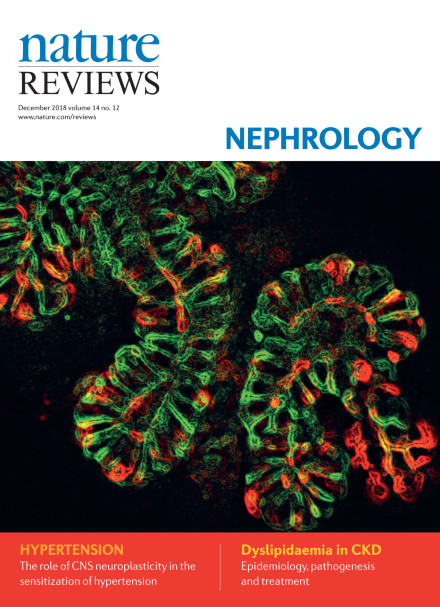
A mouse renal tubule expressing the mTmG reporter, which was grown ex vivo from primary cell organoids using a new 3D culture system for modelling pathogenesis in autosomal dominant polycystic kidney disease.
Cover image provided by Eryn E. Dixon of the Woodward Laboratory in the Department of Physiology and the Baltimore PKD Research and Clinical Core Center at the University of Maryland School of Medicine, Baltimore, MD, USA.
A new study reports that genome-wide polygenic risk scores can identify individuals at risk of common complex diseases, such as coronary artery disease or type 2 diabetes, with comparable performance to that of monogenic mutation screens. These findings support the potential clinical utility of genome-wide association study (GWAS)-based risk stratification; however, several issues need to be addressed before this approach can be applied to kidney disease.
The polycystin complex structure has been solved at near-atomic resolution. Its surprising architecture provides new insights into the transient receptor potential (TRP) family of cation channels and the pathogenesis of autosomal dominant polycystic kidney disease. This discovery should have a transformative impact on the development of treatment strategies to cure the disease.
This Review focuses on the epidemiology, pathogenesis and treatment of dyslipidaemia in patients with chronic kidney disease (CKD) and end-stage renal disease. The authors discuss emerging clinical data on the use of novel lipid-lowering agents and reappraise the 2013 KDIGO Guidelines for Lipid Management in CKD.
Here, Johnson and Xue describe various physiological and psychosocial challenges that lead to the sensitization of hypertension. These challenges drive neuroplasticity in the brain network controlling sympathetic tone and blood pressure, and provide a new paradigm for understanding essential hypertension.
The complement system has a key role in inflammatory reactions that occur before, during and after transplantation. Here, the authors discuss this role and highlight current and future strategies to regulate complement activation and potentially improve outcomes in kidney transplantation.