
Thank you for visiting nature.com. You are using a browser version with limited support for CSS. To obtain the best experience, we recommend you use a more up to date browser (or turn off compatibility mode in Internet Explorer). In the meantime, to ensure continued support, we are displaying the site without styles and JavaScript.

Volume 16 Issue 10, October 2020

A focus issue on innovations in dialysis, with Reviews on the current landscape of dialysis therapy and vascular access techniques plus commentaries on the patients’ perspective, regulatory considerations and innovative dialysis technologies. Also a Perspectives on ethical challenges in nephrology and commentaries on COVID-19 in nephrology and structural cells in organ immune responses.

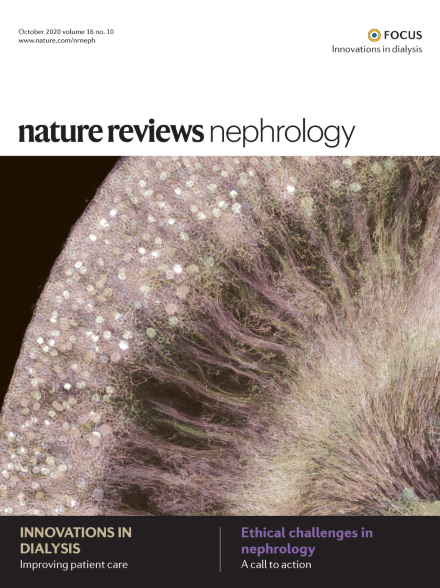
Image: In-depth fluorescence imaging of renal blood vessels in a mouse kidney, achieved by kidney perfusion with lectin-dye conjugates before optically clearing the tissue for deep-tissue microscopy. The rainbow colours represent the blood vessels and glomeruli at different focal depths. Cover image supplied by Chih-Yung (Daniel) Lin in the SunJin Lab and Shiue-Cheng (Tony) Tang at the Department of Medical Science, National Tsing Hua University, Taiwan. Cover design: Lara Crow.
Editorial

  • Advertisement

Top of page ⤴

Comment

  • The need for innovation in dialysis is long overdue. As past and present users of dialysis we are fully aware of the limitations of current dialysis modalities. The time for complacency is over — developers must engage with dialysors to ensure that our needs are met so that we can live the best life possible. Let us share our dream for devices that will enable us to enjoy life.

    • Nieltje Gedney
    • Wim Sipma
    • Henning Søndergaard
    Comment
  • Regulations for market access and reimbursement of medical devices vary across jurisdictions, complicating the development of innovative technologies for world-wide use; however, several converging regulatory principles are now emerging. Here we discuss approaches by which regulatory and related agencies can promote innovation and boost the effectiveness of regulatory processes to expedite patient access to innovative technologies, including renal replacement therapies.

    • Fokko P. Wieringa
    • Murray I. Sheldon
    • Ana Hidalgo-Simon
    Comment
  • Peritoneal dialysis (PD) is the dialysis modality of choice for many regions. The application of innovative technology has led to the development of new PD devices that reduce the environmental and economic costs of the therapy, as well as miniaturized devices that provide greater freedom for patients.

    • Marjorie W. Y. Foo
    • Htay Htay
    Comment
  • Haemodialysis is a life-saving therapy. However, in comparison with the healthy kidney, it removes only a small fraction of the uraemic toxins produced, does not function continuously and cannot replicate biological kidney functions. Innovations in membrane design hold promise to overcome these limitations with potential to improve patient outcomes.

    • Ilaria Geremia
    • Dimitrios Stamatialis
    Comment
  • Kidney failure is associated with the retention and subsequent accumulation of uraemic toxins, which have detrimental effects on various physiological processes. The removal of these toxins by current dialysis modalities is inadequate, highlighting the need for innovative approaches to enhance their clearance and/or suppress their generation to improve outcomes for patients with kidney disease.

    • Rosalinde Masereeuw
    • Marianne C. Verhaar
    Comment
  • Peritoneal dialysis and haemodialysis are lifesaving but intrusive treatments that are associated with high morbidity and mortality. Despite the considerable time patients with kidney failure spend tied to their life-saving therapies, relatively few vital signs are monitored. Smart, unobtrusive approaches to track clinical parameters could help to individualize treatments and improve patient outcomes.

    • Fokko P. Wieringa
    • Jeroen P. Kooman
    Comment
  • The most common treatment option worldwide for persons with kidney failure is in-centre haemodialysis; however, this treatment has remained largely unchanged over decades owing to a lack of true patient-centred technological innovation. The development of safe and effective wearable forms of dialysis has the potential to transform the lives of these patients.

    • Jonathan Himmelfarb
    • Buddy Ratner
    Comment
  • Continuous kidney replacement therapy (CKRT) can be a lifesaving intervention for critically ill patients; however, mortality remains high. The adaptation of existing innovations, including anti-clotting measures; cloud-computing for optimized treatment prescribing and therapy monitoring; and real-time sensing of blood and/or filter effluent composition to CKRT devices has the potential to enable personalized care and improve the safety and efficacy of this therapy.

    • Balazs Szamosfalvi
    • Lenar Yessayan
    Comment
  • The COVID-19 pandemic has placed a tremendous strain on sustaining the clinical research enterprise and will also likely affect key study outcomes; these effects must be considered during data analysis and interpretation. Nevertheless, the responses to the pandemic have also introduced innovations that will advance the conduct of clinical research.

    • Katherine R. Tuttle
    Comment
  • Reports of collapsing glomerulopathy in patients of African ancestry and high-risk APOL1 genotype infected with SARS-CoV-2 have emerged during the COVID-19 pandemic. This new entity, which we term COVID-19-associated nephropathy (COVAN), may particularly impact individuals in some regions of the world. Awareness of this potentially ominous complication of COVID-19 must be raised.

    • Juan Carlos Q. Velez
    • Tiffany Caza
    • Christopher P. Larsen
    Comment
  • Management of kidney transplant recipients requires a sustainable infrastructure that can provide reliable medical care both before and after transplantation. The COVID-19 pandemic has disrupted transplant referral and listing processes, led to decreases in the numbers of transplant procedures and resulted in changes in practice for pre- and post-transplantation management and follow-up.

    • Sami Alasfar
    • Robin K. Avery
    Comment
Top of page ⤴

News & Views

  • The generation of local immune responses in organs requires a coordinated effort, not just from immune cells, but also from ‘structural’ cells such as epithelial cells, endothelial cells and fibroblasts. New insights gained from profiling these cells across organs in the mouse emphasizes the important contribution of this structural cell network to organ immunity.

    • Zewen Kelvin Tuong
    • Menna R. Clatworthy
    News & Views
Top of page ⤴

Reviews

  • Dialysis is a life-saving therapy; however, costs of dialysis are high, access is inequitable and outcomes are inadequate. This Review describes the current landscape of dialysis therapy from an epidemiological, economic, ethical and patient-centred framework, and describes initiatives that are aimed at stimulating innovations in the field to one that supports high-quality, high-value care.

    • Jonathan Himmelfarb
    • Raymond Vanholder
    • Marcello Tonelli
    Review Article
  • Effective treatment of kidney failure depends on reliable vascular access; however, options for chronic vascular access for haemodialysis have remained unchanged for decades. This Review evaluates the key existing challenges in establishing and maintaining vascular access and describes novel and innovative technologies under development that address these issues.

    • Jeffrey H. Lawson
    • Laura E. Niklason
    • Prabir Roy-Chaudhury
    Review Article
Top of page ⤴

Perspectives

  • Here, the ASN-ERA-EDTA-ISN Joint Working Group on Ethical Issues in Nephrology highlights ten areas of ethical concern as priority challenges that require collaborative action and discusses the need for development of ethical training and guidance tools to manage these issues.

    • Dominique E. Martin
    • David C. H. Harris
    • Raymond Vanholder
    Perspective
Top of page ⤴

Amendments & Corrections

Top of page ⤴

Search

Quick links