
Thank you for visiting nature.com. You are using a browser version with limited support for CSS. To obtain
the best experience, we recommend you use a more up to date browser (or turn off compatibility mode in
Internet Explorer). In the meantime, to ensure continued support, we are displaying the site without styles
and JavaScript.
Reviews on autophagy, purinergic signalling and plant-based diets to manage the risks and complications of CKD; plus commentaries on the impact of coronavirus in Brazil and cell therapy in transplantation.
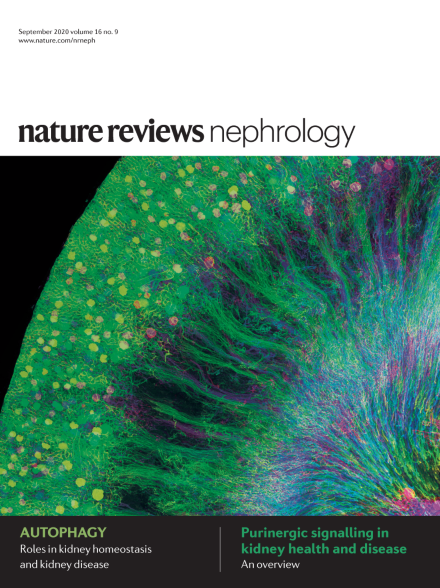
In-depth fluorescence imaging of renal blood vessels in a mouse kidney, achieved by kidney perfusion with lectin-dye conjugates before optically clearing the tissue for deep-tissue microscopy. The rainbow colours represent the blood vessels and glomeruli at different focal depths. Cover image supplied by Chih-Yung (Daniel) Lin in the SunJin Lab and Shiue-Cheng (Tony) Tang at the Department of Medical Science, National Tsing Hua University, Taiwan. Cover design: Lara Crow.
Brazil has been severely affected by the novel coronavirus. At a time when the country needs to concentrate on controlling and fighting the virus, President Bolsonaro has minimized the importance of the pandemic and focused on political battles.
Long-term immunosuppression in transplant recipients is associated with important adverse effects including increased risk of infection and malignancy. New data from the ONE Study suggests that use of cell-based medicinal products containing regulatory immune cells is a potentially useful therapeutic strategy to enable minimization of immunosuppression in these patients.
In this Review, the authors summarize the basics of autophagy and the signalling pathways involved in its regulation, and examine the multiple roles of autophagy in kidney cells, from its involvement in kidney maintenance and responses to injury, to its potential contribution to glomerular and tubulointerstitial disease.
Purinergic signalling in the kidney maintains homeostasis and mediates injury-induced inflammation. The extracellular conversion of ATP into adenosine is critical for modulating these processes. Here, the authors discuss the pathological conditions associated with extracellular ATP metabolism and novel strategies for their treatment.
Emerging evidence suggests that plant-based diets could help to prevent chronic kidney disease (CKD), manage its symptoms and metabolic complications and delay disease progression. Here, the authors discuss the potential risks and benefits of these diets in patients with CKD, as well as implementation strategies and knowledge gaps.