
Thank you for visiting nature.com. You are using a browser version with limited support for CSS. To obtain
the best experience, we recommend you use a more up to date browser (or turn off compatibility mode in
Internet Explorer). In the meantime, to ensure continued support, we are displaying the site without styles
and JavaScript.
Reviews on Genomic profiling in RCC and cognitive dysfunction in CKD; a Consensus guidelines for the management of hyperammonaemia in paediatric patients receiving CKRT; and commentaries on glomerular filtration mechanisms, renal effects of SGLT2 inhibitors and GLP1 agonists, nomenclature for kidney function and disease, and the mental health of health-care workers in the COVID-19 era.
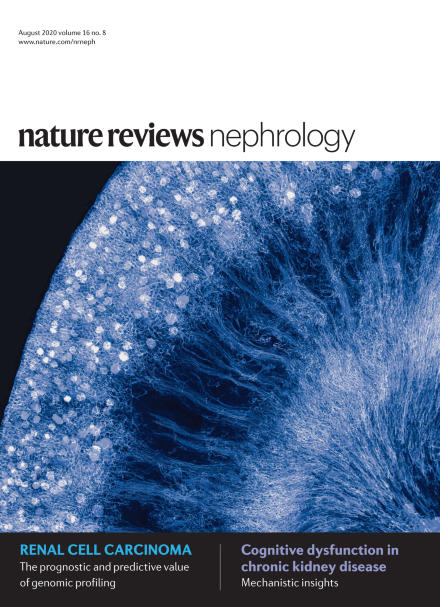
Image: In-depth fluorescence imaging of renal blood vessels in a mouse kidney, achieved by kidney perfusion with lectin-dye conjugates before optically clearing the tissue for deep-tissue microscopy. The rainbow colours represent the blood vessels and glomeruli at different focal depths. Cover image supplied by Chih-Yung (Daniel) Lin in the SunJin Lab and Shiue-Cheng (Tony) Tang at the Department of Medical Science, National Tsing Hua University, Taiwan. Cover design: Lara Crow.
Health-care workers involved in the response to the COVID-19 pandemic are often required to work in highly challenging conditions and may therefore be at increased risk of experiencing mental health problems. This Comment sets out a practical approach to protecting the mental health of health-care workers based on contemporary evidence.
An obligation of medical journals is the responsible, professional and expeditious delivery of knowledge from researchers and practitioners to the community. The task of editors, therefore, rests not merely in selecting what to publish, but in judging how it might best be communicated. The challenge of improving descriptions of kidney function and disease in medical publishing was the impetus for a KDIGO consensus conference. The conference goals included standardizing and refining kidney-related nomenclature and developing a glossary to be used by journals.
The mechanism underlying glomerular filtration barrier selectivity has not been resolved. A new study that reports an inverse correlation between slit diaphragm density and proteinuria in a genetic mouse model of focal segmental glomerulosclerosis suggests that podocytes function to compress the glomerular basement membrane (GBM) and that failure of this process results in GBM stretching and increased permeability.
Clinical trials of sodium–glucose cotransporter 2 (SGLT2) inhibitors and glucagon-like peptide 1 (GLP1) receptor agonists have shown beneficial effects of these agents on kidney outcomes in patients with type 2 diabetes mellitus. Two new cohort studies now demonstrate that these findings are generalizable to the broad range of patients seen in clinical practice.
Genomic profiling of renal cell carcinoma has demonstrated the clinical relevance of several genetic alterations in different disease subtypes. Pal and colleagues discuss the prognostic and predictive value of these alterations, and how they might help to improve treatment selection and patient outcomes.
Capasso and colleagues provide an overview of cognitive dysfunction resulting from CKD, including mild cognitive impairment and dementia. CKD-associated cognitive impairment seems to be caused by the effects of uraemic neurotoxins and kidney neurotrophins on specific neurons and regions of the brain.
This expert Consensus Statement from the Pediatric Continuous Renal Replacement Therapy (PCRRT) workgroup presents recommendations for the management of hyperammonaemia requiring kidney replacement therapy in paediatric populations. Additional studies are needed to strengthen these recommendations, which will be reviewed every 2 years.