Thank you for visiting nature.com. You are using a browser version with limited support for CSS. To obtain
the best experience, we recommend you use a more up to date browser (or turn off compatibility mode in
Internet Explorer). In the meantime, to ensure continued support, we are displaying the site without styles
and JavaScript.
Although autoimmune rheumatic diseases are more prevalent in women than men, few clinical trials report findings on the basis of sex and gender. Future clinical trials should report sex and gender differences in treatment and safety outcomes in a standardized manner to improve outcomes for all patients.
Despite having a robust drug development pipeline, lupus remains far behind other rheumatic and autoimmune conditions for which dozens of targeted therapies have been developed. Addressing the pervasive, long-standing challenges impeding the field requires a paradigm shift and a patient-powered, community-wide approach, exemplified by the Lupus Accelerating Breakthroughs Consortium (Lupus ABC).
TGFβ compromises T cell responses against Epstein–Barr virus (EBV) and is associated with EBV reactivation in children with multisystem inflammatory syndrome (MIS-C).
Analysis of synovial tissue samples led to the identification of inflammatory and fibrotic subgroups of osteoarthritis, which were associated with distinct fibroblast and macrophage populations.
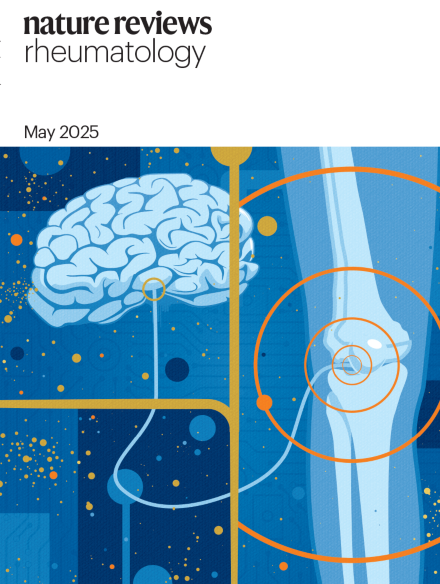
Hasegawa et al. reveal how synovial joints detect systemic inflammation through specialized fenestrated blood vessels at the synovial periphery. Three distinct macrophage populations and nociceptor neurons form a sentinel unit around these vessels, coordinating immune responses and pain signalling through interleukin-1β (IL-1β) and calcitonin gene-related peptide (CGRP) signalling.
Treating people with inflammatory arthritis and cancer is challenging given concerns around suppressing anti-tumour immunity. Targeted therapies, such as TNF inhibitors, can be safely used in patients with cancer who are in remission, but whether these treatments are safe for individuals with newly diagnosed or active cancer remains unclear.
This Review discusses how pain in osteoarthritis might involve adaptations of brain circuits, and suggests that osteoarthritis pain management should consider targeting central mechanisms of pain in addition to nociceptive neuron activity.
IgG4-related disease is a fibro-inflammatory disorder with a complex pathogenesis. Herein the authors review the latest developments in IgG4-related disease clinical phenotyping, pathophysiology and management, with a focus on the main mimics of this disease and how to approach issues related to differential diagnosis.
Insights from the composition, structure and development of articular cartilage are key for long-term therapeutic strategies to restore articular cartilage. The authors emphasize that future therapies should replicate the depth-dependent alignment of collagen and its interactions with the extracellular matrix to produce implants that mimic the biomechanical properties of cartilage.