
Thank you for visiting nature.com. You are using a browser version with limited support for CSS. To obtain the best experience, we recommend you use a more up to date browser (or turn off compatibility mode in Internet Explorer). In the meantime, to ensure continued support, we are displaying the site without styles and JavaScript.

Volume 17 Issue 12, December 2020

Our December issue includes Reviews on optimising use of animal models in stone disease, a comprehensive overview of sarcomatoid renal cancer, and surgery for high-risk localized prostate cancer, as well as Comment articles on urology education, environmental plastics and urological cancer, and epigenetic of urothelial carcinoma.

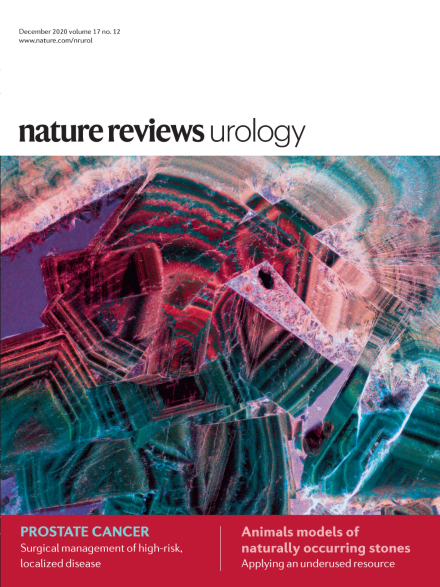
Image shows an SRAF image of a kidney stone thin section. The Image supplied by Bruce Fouke, University of Illinois Urbana-Champaign. Cover design: Patrick Morgan.
Comment

  • Exposure to urology is essential for medical undergraduates to prepare them with the competencies required to manage basic urological conditions and to generate interest in the specialty. However, despite the existence of national curricula, the lack of urological exposure and falling competition ratios indicate a need for an evaluation of urological teaching in medical schools.

    • Alexander Ng
    • Alexander Light
    • Veeru Kasivisvanathan
    Comment

    Advertisement

  • Plastics have an integral role in our daily lives but at a considerable cost to the environment and, as we are now learning, to human health. Increased plastic exposure has been linked to compromised endocrine function, reproductive health and semen quality and, potentially, urological cancers. However, the long-term consequences of plastic exposure remain to be seen.

    • Sunil H. Patel
    • Meredith Metcalf
    • Max Kates
    Comment
  • Cancer sequencing studies have revealed that urothelial carcinomas harbour recurrent mutations in multiple genes that control epigenetics. A major challenge for basic and clinical researchers is to convert this genetic information into biological and pathological insights, as well as to tailor novel therapeutic modalities for individual patients with bladder cancer.

    • Ian J. Frew
    • H. T. Marc Timmers
    • Christian Gratzke
    Comment
Top of page ⤴

Research Highlights

Top of page ⤴

Reviews

  • In this Review, Blum et al. summarize the current knowledge on sarcomatoid renal cell carcinoma, a diagnosis characterized by the presence of sarcomatoid dedifferentiation and a poor prognosis. They discuss the origin, presentation, molecular biology and treatment of this disease.

    • Kyle A. Blum
    • Sounak Gupta
    • A. Ari Hakimi
    Review Article
  • Radical prostatectomy is increasingly used as a first-line treatment for patients with high-risk, localized prostate cancer. Here, Wilkins and colleagues highlight the heterogeneous outcomes of these men and discuss the role of this approach in individualized, multimodal prostate cancer therapy.

    • Lamont J. Wilkins
    • Jeffrey J. Tosoian
    • Yaw A. Nyame

    Nature Outlook:

    Review Article
  • Animal models that naturally and spontaneously form uroliths — including domestic dogs and cats, and a variety of other captive and wild species, such as otters, dolphins and ferrets — are an underused resource in the study of human stone disease and offer many potential opportunities for improving insight into stone pathogenesis. Improved collaboration between urologists, basic scientists and veterinarians is warranted to further our understanding of how stones form and to consider possible new preventive and therapeutic treatment options.

    • Ashley Alford
    • Eva Furrow
    • Jody Lulich
    Review Article
Top of page ⤴

Search

Quick links