Thank you for visiting nature.com. You are using a browser version with limited support for CSS. To obtain
the best experience, we recommend you use a more up to date browser (or turn off compatibility mode in
Internet Explorer). In the meantime, to ensure continued support, we are displaying the site without styles
and JavaScript.
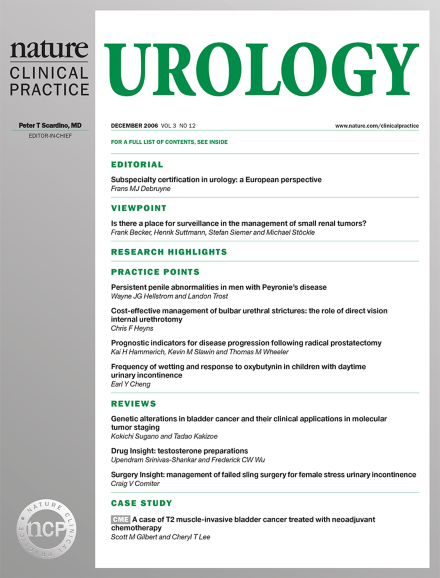
With continually improving imaging techniques, more small renal tumors are detected incidentally, and the management of these tumors is a subject of considerable controversy. In the first of two Viewpoints examining this issue, Beckeret al.discuss the treatment options available and outline the arguments in favor of nephron-sparing surgery as the standard treatment for small renal tumors.
Bladder cancer staging is essential for assisting clinicians and patients in deciding on appropriate treatments. A number of different genetic and epigenetic changes have been linked with bladder cancer and numerous prognostic markers are being developed. This Review discusses the genetic changes associated with transitional cell carcinoma of the bladder and the different biomarkers that are under investigation.
There are a wide variety of testosterone preparations and delivery systems available for men requiring testosterone replacement therapy. The choice of preparation should be made according to patient characteristics, such as age. The authors of this Drug Insight Review discuss the pharmacokinetics of a number of testosterone preparations and their relative advantages and disadvantages in treating different patient groups.
Sling surgery is the most commonly performed procedure for the treatment of female stress urinary incontinence, but can be associated with a number of complications. In this Surgery Insight Review the complications that can arise during and after surgery are discussed and techniques that can be used to either reduce the incidence of complications or to correct resulting morbidities are highlighted.