Thank you for visiting nature.com. You are using a browser version with limited support for CSS. To obtain
the best experience, we recommend you use a more up to date browser (or turn off compatibility mode in
Internet Explorer). In the meantime, to ensure continued support, we are displaying the site without styles
and JavaScript.
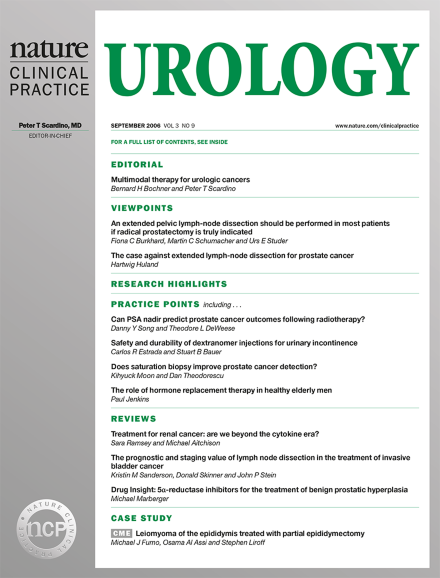
There is considerable controversy regarding the role of extended pelvic lymph-node dissection (PLND) during radical prostatectomy. In the first of a pair of articles discussing this issue, Burkhard et al. speculate on the potential therapeutic benefit of extended PLND, and argue that it should be performed in the majority of patients undergoing radical prostatectomy.
In our second article discussing the role of extended pelvic lymph-node dissection (PLND) during radical prostatectomy, Hartwig Huland argues that extended PLND is not justified in presently selected patients, is rarely used to guide intraoperative decisions, and has little impact on treatment outcomes.
Small molecule inhibitors target growth-receptor signaling, cell-cycle regulation and angiogenesis, and have been the subject of much interest for their potential in treating patients with renal cancer. Although data reported at the 2006 ASCO Annual Meeting have provided further evidence of their potential, it is important that cytokine-based therapies are not forgotten. This review examines the different treatment options for patients with renal cancer.
Lymph node dissection conducted during radical cystectomy is essential for tumor staging in patients with invasive bladder cancer. It might also provide therapeutic benefits for these patients and is, therefore, considered an important part of surgical management. In this Review, the authors discuss standard and extended lymph node dissection in patients with bladder cancer.
There are a number of treatments available for men with BPH, but 5α-reductase inhibitors are the only medical treatment that can prevent BPH progression and avoid the need for surgery. This Drug Insight Review discusses the 5α-reductase inhibitors finasteride and dutasteride, their efficacy, mechanisms of action and use in men with BPH.