Thank you for visiting nature.com. You are using a browser version with limited support for CSS. To obtain
the best experience, we recommend you use a more up to date browser (or turn off compatibility mode in
Internet Explorer). In the meantime, to ensure continued support, we are displaying the site without styles
and JavaScript.
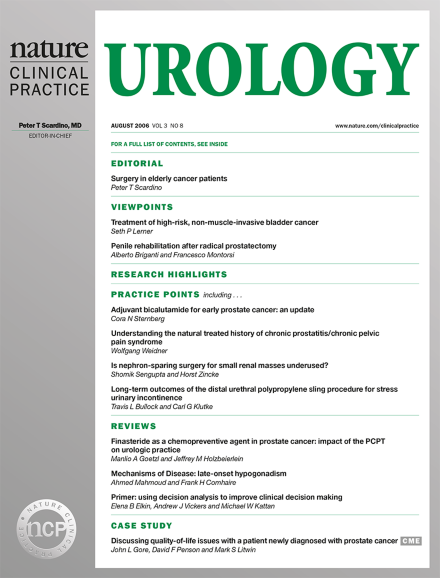
For patients with high-risk superficial bladder cancer, accurate identification of tumor grade and stage, and appropriate treatment are paramount to achieving durable disease control and long-term survival. In this article, the author highlights the important issues relating to the management of this disease.
Erectile dysfunction is common following radical prostatectomy for localized prostate cancer, but there are indications that early pharmacological intervention could promote return of erectile function. The authors discuss preliminary results with postoperative prophylactic erectile therapy, the rationale behind such an approach, and its potential role in clinical practice.
The results of the Prostate Cancer Prevention Trial (PCPT) sparked a debate surrounding the advantages and disadvantages of using the 5-alpha reductase inhibitor finasteride as a chemoprevantative agent against prostate cancer. Over three years after the publication of the PCPT results there is still a reluctance to recommend the use of finasteride in this setting. This Review examines the PCPT data and discusses its results in light of further studies.
As men age, physiological changes take place that can result in late-onset hypogonadism. A number of comorbid conditions are thought to be implicated in the endocrinological changes associated with aging, but their role is yet to be determined. In this Review the authors discuss the pathophysiological mechanisms behind late-onset hypogonadism and age-related endocrinological changes in men.
Deciding on a particular treatment can be difficult when a patient is presented with a range of therapies, each with their own associated chances of cure and risks of adverse effects. Decision analysis provides a more formal way of quantifying the benefits and harms associated with different treatments, which can be helpful in treatment decision making. This Primer Review provides a thorough overview of decision analysis and how it can be incorporated into clinical practice.