
Thank you for visiting nature.com. You are using a browser version with limited support for CSS. To obtain the best experience, we recommend you use a more up to date browser (or turn off compatibility mode in Internet Explorer). In the meantime, to ensure continued support, we are displaying the site without styles and JavaScript.

Volume 7 Issue 12, December 2010

Research Highlight

  • Advertisement

Top of page ⤴

In Brief

Top of page ⤴

Research Highlight

Top of page ⤴

In Brief

Top of page ⤴

Research Highlight

Top of page ⤴

News & Views

  • Transurethral resection (TUR) is widely used to manage early-stage bladder cancer. A recent study has confirmed that a second, or restaging, TUR is associated with a lower risk of progression and cancer-related death. Restaging TUR is therefore recommended as a standard of care in patients with stage T1 bladder cancer.

    • Guido Dalbagni
    News & Views
  • Controversies remain regarding the precise cell type from which prostate cancers originate. In the last 2 years, two separate studies have arrived at apparently conflicting models for the cell type involved in prostate cancer initiation. However, these results are not mutually exclusive: there are potential solutions, and alternative views on the initiating cell derivation of prostate tumors also exist.

    • Angelo M. De Marzo
    • William G. Nelson
    • Srinivasan Yegnasubramanian
    News & Views
Top of page ⤴

Review Article

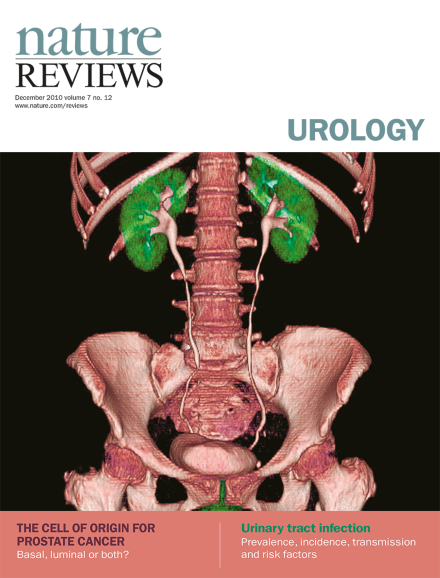
  • Urinary tract infection (UTI) is the most common type of community-acquired and hospital-acquired bacterial infection. In this Review, Prof. Foxman describes the prevalence, incidence and bacteriology of UTI, the transmission mechanisms and the development of antibiotic-resistant strains of uropathogenic bacteria, and discusses whether we need to change the way we treat patients with uncomplicated or catheter-associated UTI.

    • Betsy Foxman
    Review Article
  • Intravesical injection of botulinum toxin-A has been shown to provide effective treatment for patients with detrusor overactivity refractory to first-line treatment with anticholinergics. In this Review, the authors discuss the currently available data regarding repeated injections of botulinum toxin-A to patients with neurogenic and idiopathic detrusor overactivity, and consider the efficacy and clinical considerations of this treatment modality.

    • Christopher Dowson
    • Mohammad Shamim Khan
    • Arun Sahai
    Review Article
  • Epigenetic changes, such as gain and loss of DNA methylation and altered histone modifications, are a hallmark of human cancer. The role of the epigenome in prostate cancer is well recognized. In this Review, the authors discuss the different epigenetic modifications which can contribute to cancer progression, and consider the therapeutic potential of targeting the epigenome in patients with prostate cancer.

    • Antoinette S. Perry
    • R. William G. Watson
    • Donal Hollywood
    Review Article
  • Clinical diagnosis of paraneoplastic syndromes not only leads to detection of the underlying malignancy but can also influence treatment. Here, Hong et al. outline the various syndromes associated with prostate cancer, focusing particularly on the identification of putative markers in prostate cancer tissue that might provide a link to the associated syndrome.

    • Matthew K. Hong
    • Jennifer Kong
    • Niall M. Corcoran
    Review Article
Top of page ⤴

Case Study

  • In this Case Study, the authors describe the successful management of a spontaneously ruptured adrenal artery aneurysm using only interventional radiology techniques. The case highlights the importance of multidetector CT for identifying the bleeding point and the effectiveness of endovascular embolization in the management of this type of vascular emergency.

    • James Manners
    • Rajinder Singh
    • Duncan McLean
    Case Study
Top of page ⤴

Search

Quick links