
Figure 1: Trajectories of light in a three-slit interferometer.
From: Exotic looped trajectories of photons in three-slit interference
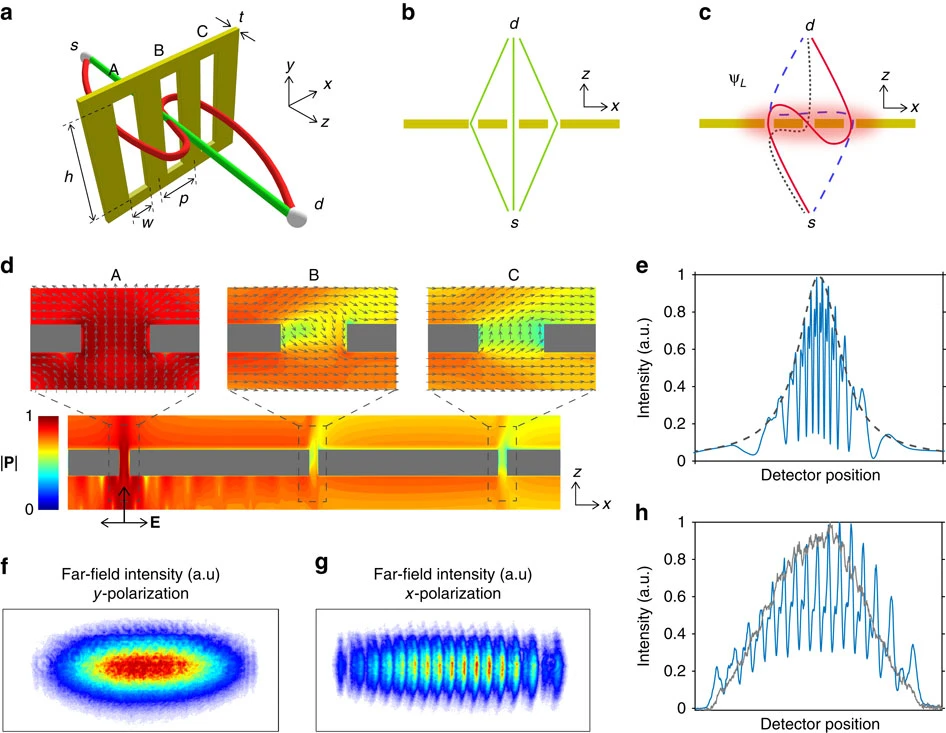
(a) The three-slit structure considered in this study. The red path going from point s to point d illustrates a possible looped trajectory of light. (b) Direct trajectories of light resulting from considering only the first term in equation (8). The widely used superposition principle, that is, equation (1), accounts only for these direct trajectories. (c) Examples of exotic looped trajectories arising from the higher order terms in equation (8). The red cloud in the vicinity of the slits depicts the near-field distribution, which increases the probability of photons to follow looped trajectories. (d) Normalized Poynting vector P in the vicinity of the three slits obtained through full wave simulations at a wavelength λ=810 nm, using a slit width w equals to 200 nm, slit separation p=4.6 μm, sample thickness t equals to 110 nm, and assuming infinite height, h=∞. The simulations consider a Gaussian beam excitation polarized along x, and focused onto slit A. The Poynting vector clearly exhibits a looped trajectory such as the solid path in c. (e) Far-field interference patterns calculated under x-polarized (solid) and y-polarized (dashed) optical excitation. Interference fringes are formed in the far field only when strong near fields are excited (x-polarization), and occur from the interference of light following a direct trajectory and a looped trajectory. (f) Experimental evidence that shows the far-field pattern for a situation in which only one slit is illuminated with y-polarized heralded single-photons. (g) The presence of exotic looped trajectories leads to an increase in the visibility of the far-field pattern. This effect is observed when x-polarized light illuminates one of the slits. (h) The transverse profile of the patterns shown in f,g.
