
Abstract
Membrane separation has been extensively studied as a cost-effective CO2 separation method, and polysilsesquioxane (PSQ)-based membranes are expected to be robust membranes with high thermal and mechanical stability and processability. In this study, a prediction model for CO2 permeance and CO2/N2 permselectivity as target variables was generated by applying machine learning to experimental data collected in our previous studies as explanatory variables. On the basis of this model, two new urea-containing PSQ-based membranes were prepared, and their CO2 separation performance was evaluated. Among them, a membrane synthesized through the 1:1 copolymerization of (3,6-dioxaoctane-1,8-diyl)bis-N-[N’-(triethoxysilylpropyl)urea] and bis(triethoxysilyl)ethane demonstrated high performance, achieving a CO2 permeance of 1.3 × 10⁻⁶ mol m–2s–1Pa–1 (4.0 × 10³ GPU) and a CO2/N2 permselectivity of 13. A membrane was also prepared using (triethylamine-2,2’,2”-triyl)tris-N-[N’-(triethoxysillylpropyl)urea] as a monomer, which resulted in inferior CO2 separation performance. However, increasing the calcination temperature significantly increased the CO2 permeance, whereas the CO2/N2 permselectivity slightly decreased, likely because of the thermal degradation of the urea units, resulting in the formation of void spaces.
Introduction
Reducing CO2 emissions is crucial on a global scale, and membrane separation has been extensively studied as a cost-effective method for CO2 separation. There are various categories of CO2 separation membranes, including organic and inorganic membranes [1,2,3,4,5], mixed-matrix membranes (MMMs), and metal–organic framework (MOF) membranes [6, 7]. Several mechanisms have been recognized for CO2 separation [8,9,10], such as molecular sieving effects, which allow smaller gas molecules to permeate the membrane more rapidly through a porous structure than larger molecules do. Additionally, the diffusion of gas molecules to the pore surface effectively enhances transport in porous membranes, particularly when the pore surface has an affinity for CO2 molecules. For nonporous membranes, the dissolution permeation of CO2 molecules through the membrane facilitates transport, where the CO2 affinity influences membrane performance through its effect on the CO2 dissolution capacity. Generally, the diffusivity and solubility of CO2 molecules are enhanced by membrane CO2 affinity. Therefore, diffusion- and solubility-based CO2 transport accelerates with decreasing operation temperature, although reduced molecular mobility suppresses transport to some extent. However, an excessively high affinity may result in the tight capture of CO2 molecules, which in turn inhibits their transport.
Polysilsesquioxanes (PSQs) have garnered significant attention as durable materials owing to their excellent thermal and mechanical stabilities and ease of processing. This is attributed to their inorganic siloxane network structure combined with organic groups attached to silicon atoms [11,12,13,14]. These materials are readily accessible via the hydrolysis condensation polymerization of trifunctional organosilicon monomers, such as trialkoxysilanes. PSQ-based CO2 separation membranes have also been studied, and it has been demonstrated that their performance is significantly influenced by PSQ organic groups [15,16,17,18,19,20,21,22,23,24,25,26,27,28,29,30]. For example, a membrane prepared from a monomer with a primary amine unit (APTES in Fig. 1) exhibited CO2 separation properties [17,18,19,20,21,22] with PCO2 (CO2 permeance) = 2.6 × 10⁻⁸ mol m–2s–1Pa–1 and CO2/N2 (CO2/N2 permselectivity) = 22, whereas the use of a tertiary amine monomer (DMAPTES) improved the CO2 permeance to a value of 1.72 × 10⁻⁷ mol m–2s–1Pa–1, with CO2/N2 permselectivity remaining at a similar level (CO2/N2 = 21) [17, 18]. Employing secondary amine MAPTES as the monomer resulted in a decrease in both CO2 permeance and CO2/N2 permselectivity (PCO2 = 1.7 × 10⁻⁸ mol m–2s–1Pa–1 and CO2/N2 = 11). Because DFT calculations indicated that the amine initially interacts with CO2 as a base to form N--C(O2) coordination rather than an acid with hydrogen bonding to CO2 in the manner of NH--O(CO), tertiary amines would possess a higher CO2 affinity than primary amines would. However, primary and secondary amines can form ionic complexes with CO2 (RNHCO2- RNH3+ and R2NCO2- R2NH2+), which may hinder CO2 transport [31]. Steric hindrance arising from the methyl group may also affect the performance; however, the reason for the lower performance of the MAPTES membrane than that of the APTES membrane is still unclear. A monomer (MOCMTES) containing an ester unit with a low affinity for CO2 was also examined, and its copolymerization with TEOS provided a membrane with high CO2 permeance (PCO2 = 2.074 × 10⁻⁶ mol m–2s–1 Pa–1) and a moderate level of permselectivity (CO2/N2 = 7.5) [23]. Aromatic rings were also investigated as rigid CO2-philic units. Their rigidity was expected to enhance intramolecular void formation, thus facilitating gas permeation. The membranes obtained by the copolymerization of phenyl-, pyridyl-, and naphthyl-containing triethoxysilane monomers (TESEB, TESEPy, and TESENp) with BTESE at a ratio of 1:1 exhibited good performance depending on the CO2 affinity of the aromatic units, and the TESEB–BTESE and TESEPy–BTESE membranes exhibited good performance, with PCO2 = 1.36 × 10⁻⁷ mol m–2s–1Pa–1 and 3.34 × 10⁻⁷ mol m–2s–1Pa–1, respectively, and CO2/N2 = 16.5 and 27.9, respectively [24]. However, the performance of the TESENp–BTESE membrane was inferior (PCO2 = 2.05 × 10⁻⁸ mol m–2s–1Pa–1 and CO2/N2 = 14.4), presumably because the formation of a π-stacked naphthalene dimeric form reduced the CO2 affinity and densified the membrane. Pinacol borate was also introduced as a nonaromatic rigid unit with moderate CO2 affinity to yield a membrane characterized by high CO2 permeance (PCO2 = 2.10 × 10⁻⁶ mol m–2s–1Pa–1) and relatively high permselectivity (CO2/N2 = 11.1) by 1:2 copolymerization with BTESE [25].
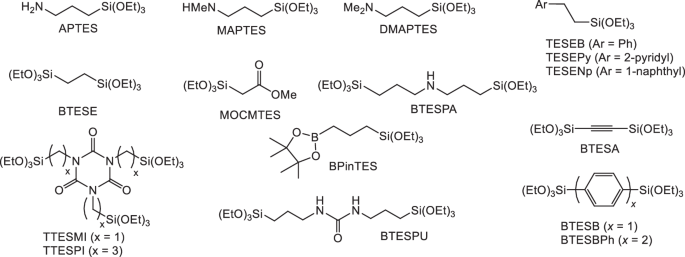
Examples of precursors of PSQ-based CO2 separation membranes
Bridged trialkoxysilanes have also been investigated as monomers, which may enhance the network structure of membranes. Among them, TTESMI and TTESPI, which contain a rigid CO2-philic isocyanurate core, yielded good membranes with PCO2 = 2.0 × 10⁻⁷ and 3.2 × 10⁻⁷ mol m–2s–1Pa–1 and CO2/N2 = 15 and 18, respectively [26]. When TTESPI and BTESE were copolymerized at a 1:1 ratio, the resulting membrane exhibited improved CO2 permeance, although its permselectivity was slightly reduced. These values are slightly higher than those of less rigid BTESPU membranes with urea units [26]. In addition to the appropriately high CO2 affinity of organic units, their rigidity, which enhances void formation, is important for enhancing gas permeation. Additionally, the copolymerization of BTESB and BTESBPh with BTESA resulted in high-performance membranes for CO2 separation. Interestingly, the copolymerization of BTESA with BTESB resulted in an increase in CO2/N2 permselectivity compared with that of the BTESA homopolymer membrane (PCO2 = 1.84 × 10⁻⁶ mol m–2s–1Pa–1, CO2/N2 = 25), whereas the incorporation of BTESBPh increased the CO2 permeance (PCO2 = 3.25 × 10⁻⁶ mol m–2s–1Pa–1, CO2/N2 = 12) [28]. This is likely due to the higher CO2 affinity of the benzene ring than that of the acetylene bond and the rigid biphenylene linkage, which expands the silica network to enhance gas permeation.
These results indicate that the CO2 affinity of the membranes plays a significant role in their performance. However, other characteristics of organic units, such as rigidity, steric bulkiness, and the number of reactive silicon sites, operate synergistically together with CO2 affinity to affect membrane separation performance, and predicting membrane performance by simple molecular design seems difficult. In addition, membrane preparation processes seem to affect performance. Considering the complexity of the performance prediction of PSQ membranes, we examined machine learning using the experimental data collected in our previous studies to create a prediction model for PSQ-based CO2 separation membranes. The resulting model was used to predict the performance of new urea-containing membranes. The prepared membranes exhibited good to high performance. The influence of the calcination temperature on the preparation of PSQ membranes was also studied, and a new method for enhancing CO2 permeability by controlling the thermal decomposition of urea units was proposed.
Materials and methods
Machine learning for the prediction of membrane performance
To predict the performance of PSQ-based membranes with different organic groups, Gaussian process regression was employed with the experimental data collected in our previous studies. The prepared dataset consisted of 132 entries of PSQ-based membranes prepared by homo- and copolymerization of alkoxysilane precursors, as presented in Fig. S1. The CO2 permeance and CO2/N2 permselectivity were defined as the target variables, and the raw data used to obtain the explanatory variables are listed in Table S1: the amount of HCl catalyst (hereafter denoted as HCl), the temperature of the measurement (temp), the molecular weight of the monomer (MW), the CO2 coordination energy for each monomer (H) evaluated at the B3LYP/6-31 G level of calculation on Gaussian 16 revision C.01 (Gaussian, Inc., USA), the number of acidic and basic moieties (an and bn, respectively), the degree of unsaturation in the organic groups (un), and the average distance between Si atoms (Si–Si) evaluated by Chem3D 23.1.2 (PerkinElmer Informatics Inc., USA). The corresponding variables for copolymers were evaluated as weighted averages for composing monomers on the basis of their weight ratio (Table S2). In addition, three binary descriptors, SiNoOne, SiNoTwo, and SiNoThree, were introduced, which have a value of one when the number of Si atoms in the monomer was one/two/three, respectively.
Materials and characterization
BTESE was obtained from Gelest, Inc., and was used as received. Monomers, (3,6-dioxaoctane-1,8-diyl)bis-N-[N’-(triethoxysillylpropyl)urea] (BTESEgU) and (triethylamine-2,2’,2”-triyl)tris-N-[N’-(tri-ethoxysillylpropyl)urea] (TTESPUEA), were prepared as previously reported [29]. Ethanol used for the sol–gel reactions was distilled from magnesium ethoxide under an argon atmosphere and stored on activated molecular sieves in the dark until use. The sol particle sizes were measured by dynamic light scattering (DLS) using a Malvern Zetasizer Nano ZS analyzer at room temperature. Fourier transform infrared (FTIR) spectra were obtained using a Shimadzu IR Affinity-1 spectrometer. Thermogravimetric analysis (TGA) was performed using a Shimadzu DTG-60 thermal analyzer with a heating rate of 10 °C/min under a gentle nitrogen flow (100 mL/min).
Sol preparation
The sols were prepared according to a previously described method [26]. Water was added to stirred ethanol solutions of BTESEgU–BTESE and TTESPUEA–BTESE in a 1:1 weight ratio, and the mixtures were stirred further until the average sol particle sizes reached approximately 2 nm (Table 1). The resulting sols were diluted with ethanol to 0.25 wt% on the basis of the monomers used for the reactions. The sols were stored at 4 °C in tightly sealed screw vials until they were used. Drying the sols by heating at 60 °C in air provided the powders for TGA. For FTIR analysis, the sols were applied to a KBr plate and dried at 50 °C in air. The plates were subsequently heated at various temperatures for 10 min in nitrogen, and the spectra were collected in transmission mode.
Membrane preparation
As described in a previous study [30], the support membrane was prepared using a commercially available porous tubular α-Al₂O₃ substrate (10 mm diameter, 1 μm average pore size). Initially, an aqueous colloidal α-Al₂O₃ sol was coated onto the tubular substrate, and the coated substrate was calcined. Subsequently, an intermediate layer with an approximate pore size of 1.5 nm was prepared by coating the substrate with silica-zirconia sols with different particle sizes, followed by calcination. Finally, a BTESEgU–BTESE or TTESPUEA–BTESE sol was coated onto the intermediate layer surface. The coated substrates were then calcined at 300 °C or 250 °C for 30 min in nitrogen for the preparation of a PSQ top layer (Fig. 2). The procedures of PSQ sol coating and subsequent calcination were conducted twice. Pure gases (He, H2, CO2, N2, and SF6) were fed into the membrane module at approximately 200 kPa. The gas permeance (P) was calculated using Eq. (1). The gas permeances that stabilized several hours after the gas permeation experiments were initiated are summarized in Table 2.
ΔP: difference in pressure between the upstream and downstream sides of the membrane
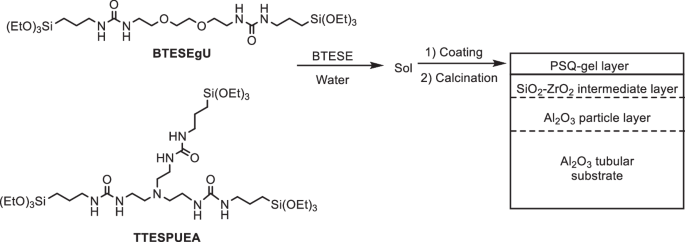
Preparation of the CO2 separation membrane
V: flow rate of the permeated gas
A: effective membrane surface area
Results and discussion
Machine learning
There have been several reports on the construction of prediction models through machine learning for CO2 separation in organic polymer membranes [32,33,34,35]. However, no studies have been conducted on PSQ-based membranes to date. In this study, a new model was created for PSQ-based membranes. The fivefold cross-validated values for CO2 permeance and CO2/N2 permselectivity in the prepared dataset are plotted against the experimental values in Fig. 3. The corresponding R2CV (cross‑validated R‑squared) values indicating the generalization of model performance are 0.763 for CO2 permeance and 0.507 for CO2/N2 permselectivity. CO2 permeance was better modeled than CO2/N2 permselectivity was, while both models tended to underestimate the experimental values in high-performance regions.

Cross-validated values for (a) CO2 permeance [10–7 mol m–2s–1Pa–1] and b CO2/N2 permselectivity
With this trained Gaussian process model, the performance of the five monomer candidates of the precursors (Fig. 2 and Fig. 4) was predicted, as shown in Table 2. These candidates were designed on the basis of our previous study that indicated the potential of urea-based PSQ membranes for CO2 separation [26, 27]. The high rigidity and moderate CO2 affinity of urea were anticipated to enhance CO2 permeation. In addition, the structural rigidity and CO2 affinity of amine [17,18,19,20,21,22], arene [24], and ethylene glycol units [36] were considered in the design of monomer candidates. Compared with those of the training dataset, the CO2 permeance and CO2/N2 permselectivity of the candidates were found to have moderate performance with a trade-off relationship. Given the worse R2CV score for CO2/N2 permselectivity, TTESPUEA:BTESE and BTESEgU:BTESE were concluded to be the best choices among the five candidates.
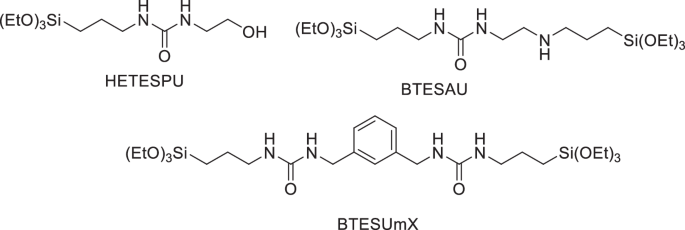
Chemical structures of the monomer candidates: HETESPU, BTESAU, and BTESUmX
When the experimental data obtained for the BTESEgU–BTESE and TTESPUEA–BTESE membranes (vide infra) were added, a revised model was obtained with an improved R2CV score for CO2/N2 permselectivity (0.596), although the score for CO2 permeance was not clearly affected (0.762). Shapley additive explanations (SHAP) were examined for the revised model, and the results are shown in Fig. 5. Interestingly, the CO2 coordination energy (denoted as “H” in Fig. 5) strongly contributed to both the CO2 permeance and CO2/N2 permeselectivity, which were positively correlated with the former and negatively correlated with CO2/N2 with the latter, indicating that the CO2 coordination energy affected the performance as a trade-off factor for these parameters. Among the explanatory variables other than the CO2 coordination energy, the degree of unsaturation of the organic unit (denoted as “un”) and the amount of HCl catalyst for PSQ preparation (denoted as “HCl”) strongly contributed to CO2 permeance, whereas the measurement temperature, Si–Si distance (denoted as “Si–Si”), and degree of unsaturation influenced CO2/N2 permselectivity. The increased degree of unsaturation reflected the enhanced rigidity of the organic unit, which accelerated CO2 permeation. However, the introduction of π-electron systems increased the CO2 affinity to improve the CO2/N2 permselectivity and to suppress the permeation. HCl catalysts have been used for the preparation of amine-containing PSQ to enhance polymerization. However, HCl remains in the membrane as an ammonium salt, which improves the CO2 permeance with reduced CO2/N2 permselectivity [21]. The origin of the HCl effects remains unclear but is in accordance with the SHAP results. The most significant feature for CO2/N2 selectivity was the operation temperature, whose influence was negative at higher temperatures, suggesting that higher molecular mobility could obscure molecular differences. Similar temperature effects have been reported for polyethylene glycol-based membranes [34].

Results of SHAP analysis for (a) CO2 permeance and b CO2/N2 permselectivity. The top 3 significant features for CO2 permeance based on the mean absolute SHAP values are the degree of unsaturation in the organic groups (un), the amount of HCl catalyst (HCl), and the CO2 coordination energy (H), whereas those for CO2/N2 permselectivity are the operation temperature (temp), CO2 coordination energy, and the average distance between Si atoms (Si–Si). The other features are described in the Materials and methods section
Membrane preparation
The urea-containing monomers were copolymerized with BTESE in a 1:1 weight ratio with excess water in ethanol. The reaction mixtures were stirred until the resulting sol particles increased in size slightly beyond the pore size (1.5 nm) of the intermediate layer of the support membrane so that the sol did not penetrate the intermediate layer. The reaction of BTESEgU proceeded less rapidly than that of TTESPUEA did, and its reaction should be carried out at a higher temperature to complete the reaction within a reasonable time. The lower reactivity of BTESEgU is presumably due to the smaller number of reactive triethoxysilyl units and the lack of an amine unit that would catalyze hydrolysis/condensation. The obtained sols were applied to the intermediate layer of the support membrane, and the coated sols were dried and subjected to calcination in nitrogen to form a gel separation layer. To determine the calcination temperature, TGA was performed on the BTESEgU–BTESE and TTESPUEA–BTESE gels prepared by drying the sols (Fig. 6). FTIR spectra of the gels were also obtained after heating at various temperatures for 10 min in nitrogen (Fig. 7).

TGA curves of BTESEgU–BTESE and TTESPUEA–BTESE gels in nitrogen

IR spectra of (a) BTESEgU–BTESE and b TTESPUEA–BTESE gel films prepared on KBr plates after heating at different temperatures for 10 min in nitrogen
The TGA curves indicated that the BTESEgU–BTESE and TTESPUEA–BTESE gels underwent a two-step weight loss: the first occurred up to 250–300 °C, and the second occurred at higher temperatures extending up to 500–600 °C. Their FTIR spectra revealed that the intensities of the stretching peaks of O–H and Si–OH bonds at approximately 3350 cm–1 and 950 cm–1, respectively, weakened with increasing calcination temperature. An increase in the band at approximately 1000 cm-1, ascribed to Si–O–Si stretching, was also observed, indicating that the dehydration condensation of silanols to form siloxanes occurred. For the TTESPUEA–BTESE gel, the Si–OH stretching band at approximately 950 cm–1 remained even after heating at 250 °C, in contrast to the BTESEgU–BTESE gel, whose FTIR spectrum showed the disappearance of the Si–OH band after heating at the same temperature. This is likely due to the greater steric hindrance of TTESPUEA than BTESEgU, which suppresses silanol condensation. Two intense signals characteristic of urea C = O and N–H bonds were observed for each sample at approximately 1600 cm–1 [37]. However, the urea signals weakened when the TTESPUEA–BTESE gel was heated to 300 °C, suggesting that thermal decomposition occurred at this temperature to some extent, whereas the spectrum of the BTESEgU–BTESE gel heated to 300 °C did not show significant changes in the urea signals. Notably, the Si–OH band at approximately 950 cm-1 almost disappeared in the TTESPUEA–BTESE spectra after heating at 300 °C, including silanol condensation. On the basis of these results, the membranes were prepared by calcination at 300 °C and 250 °C in nitrogen for the preparation of the BTESEgU–BTESE and TTESPUEA–BTESE separation membranes, respectively. TTESPUEA–BTESE was also calcined at 300 °C to elucidate how the thermal degradation of urea units affects membrane performance.
Evaluation of CO2 separation properties
Pure gas permeation experiments were conducted at 200 °C for the BTESEgU–BTESE (300 °C) and TTESPUEA–BTESE (250 and 300 °C) membranes, where the values in parentheses denote the respective calcination temperatures. The resulting gas permeances are plotted against the gas kinetic diameter in Fig. 8a. The normalized permeation data and theoretical Knudsen diffusion line are presented in Fig. 8b. Relative to the Knudsen line, the observed permeances were more significantly suppressed when the gas kinetic diameter increased from H₂ to SF₆. This trend clearly suggests that gas transport through the membranes is influenced by molecular size, which is indicative of molecular sieving effects. Notably, the CO₂ permeances of the BTESEgU–BTESE (300 °C) and TTESPUEA–BTESE (300 °C) membranes exceeded the values predicted by the Knudsen model, implying a preferential interaction between the CO₂ molecules and the membrane structures. The CO₂ permeance and CO₂/N₂ permselectivity determined at 50 °C are listed in Table 3. The literature data for membranes synthesized via the homopolymerization of BTESE [25] and the 1:1 copolymerization of BTESPU and BTESE are also presented [26].

a Plots of pure gas permeances of urea-containing PSQ membranes measured at 200 °C versus gas kinetic diameter. b Normalized data and Knudsen prediction based on helium gas permeance
To further elucidate the gas transport mechanism, temperature-dependent gas permeation measurements were performed to determine the activation energies of CO₂ and N₂ permeation through the membranes (Fig. 9 and Table 3). Compared with N₂, all the present membranes demonstrated lower activation energies for the permeation of CO₂, which is consistent with an adsorption-controlled transport mechanism. Reduced operating temperatures increase CO₂ absorption by the membrane, thereby facilitating its permeation. Generally, lower activation energies are observed for inorganic membranes than for organic membranes because of the higher rigidity of inorganic structures, which are relatively unaffected by temperature. In contrast, the vibration of more flexible organic networks is readily enhanced at elevated temperatures compared with that of inorganic membranes to accelerate gas transport. The activation energy of N2 permeation of the BTESEgU–BTESE (300 °C) membrane was nearly the same as that of the BTESPU–BTESE and BETSE membranes, indicating similar network rigidity. The higher activation energy of N2 permeation for TTESPUEA–BTESE (250 °C) is likely due to the lower calcination temperature, leading to incomplete condensation, as indicated by the IR spectral analysis (vide supra). However, the value decreased for the TTESPUEA–BTESE (300 °C) membrane, indicating enhanced network formation by higher-temperature calcination. In terms of the CO2 separation performance, the BTESEgU–BTESE (300 °C) membrane exhibited the best data, with the highest CO2 permeance (PCO2 = 1.3 × 10⁻⁶ mol m–2s–1Pa–1) and moderately high CO2/N2 permselectivity (CO2/N2 = 13). This seems to be partly due to the enhanced siloxane network formation, as evidenced by the disappearance of the Si–OH bands in the IR spectrum after calcination at 300 °C (Fig. 7a). The presence of multiple CO2-philic urea and ethylene glycol sites with appropriate CO2 affinity could also explain the high performance of this membrane. Notably, the CO2 permeance of the BTESEgU–BTESE (300 °C) membrane was much greater than that of the BTESPU–BTESE and BTESE membranes. In contrast, the TTESPUEA–BTESE (250 °C) membrane exhibited lower CO2 permeance. As observed for the DMAPTES membrane, tertiary amine units have the potential to realize high CO2 separation properties because of their appropriately high CO2 affinity [17, 18]. However, the steric bulkiness of the tertiary amine unit in TTESPUEA overrides the effects of its CO2 affinity, suppressing permeation (vide infra). Incomplete network formation is also a reason for the low CO2 permeance. Interestingly, the permeation was markedly improved by calcination at 300 °C, and the PCO2 value of the TTESPUEA–BTESE (300 °C) membrane was 27 times greater than that of TTESPUEA–BTESE (250 °C), although the permselectivity decreased from CO2/N2 = 11 to 8.1. It has been reported that N,N’-disubstituted urea undergoes thermal degradation to form primary amine and isocyanate units [38]. The isocyanate group reacts with moisture to provide another primary amine unit and CO2 (Fig. 10). As the membrane contains hydrophilic urea units, it is not unexpected for the membrane to retain moisture even after calcination. Consequently, the membrane becomes looser, accelerating CO2 permeation [39].

Plots of gas permeances of (a) N2 and b CO2 versus operating temperatures for urea-containing membranes

Thermal degradation of N,N’-disubstituted urea followed by hydrolysis
To compare the performance, the PCO2 and CO2/N2 values of the presently and previously prepared PSQ-based membranes are plotted in Fig. 11. As shown in Fig. 11, the CO2 separation performance of the BTESEgU–BTESE (300 °C) membrane was superior to that of most PSQ-based membranes reported thus far, approaching the highest level of performance achieved by the BPinTES–BTESE, BTESB–BTESA, and BTESBPh–BTESA membranes.

Plots of PCO2 versus CO2/N2 for PSQ-based membranes. Red plots indicate the data of the membranes prepared in this study
CO2 affinity
To evaluate the CO2 affinity of the BTESEgU- and TTESPUEA-based membranes, the coordination energies of CO2 with the BTESEgU and TTESPUEA (BSEgU and TSPUEA) models were calculated at the B3LYP/6-31 G level. The optimized geometries of the complexes and their coordination energies are shown in Fig. 12, indicating that they possess appropriately high CO2 affinity. For BSEgU, a geometry with NH--O intramolecular hydrogen bonding was found to be the most stable among those examined, and CO2 coordinates either the urea or the ethylene glycol unit. The coordination to urea was calculated to be more favorable than that to ethylene glycol, and the heat of the former reaction was used as an explanatory variable for prediction by the model. However, in a real system, the presence of multiple coordination sites affects CO2 permeation, as mentioned above. Further studies may be necessary to understand these effects in detail.

Optimized geometries of CO2 complexes of model compounds: a BSEgU coordinated at the urea site, b ethylene glycol unit site, and c TSPUEA, in which (triethoxysilyl)propyl groups of BTESEgU and TTESPUEA are replaced by methyl groups. The reaction heats for complex formation from the models and CO2 molecules are also shown
For TSPUEA, two of the urea units were calculated to possess an intramolecular dimeric form by hydrogen bonding, making the coordination of CO2 to this dimeric site difficult. Therefore, only the coordination to the unpaired urea site shown in Fig. 12c was considered, and the data were used as the explanatory variable. No stable CO2 complexes coordinated to the tertiary amine unit of TSPUEA were obtained, likely because of steric repulsion between CO2 and the substituents on the nitrogen atom.
Conclusions
In conclusion, two new urea-containing PSQ membranes were prepared, and their CO2 separation performance was evaluated. Among them, the BTESEgU–BTESE (300 °C) membrane exhibited high performance, with PCO2 = 1.3 × 10⁻⁶ mol m–2s–1Pa–1 and a CO2/N2 = 13. In contrast, the TTESPUEA–BTESE (250 °C) membrane exhibited a significantly lower PCO2 value. A prediction model for CO2 permeance and CO2/N2 permselectivity as target variables was generated using machine learning based on experimental data collected in our previous studies as explanatory variables. The model has potential application for the design of the chemical structure of membranes, although the accuracy of the prediction model is not very high. The accuracy is improved by the addition of more experimental explanatory variables. Notably, the calcination of TTESPUEA–BTESE at higher temperatures resulted in a drastic improvement in membrane performance. This seems to be an effective methodology for optimizing the chemical structure of membranes. The CO₂ separation performance of the BTESEgU–BTESE (300 °C) membranes ranks in the top tier of PSQ-based membranes. Given the high stability and facile film-forming properties of PSQ materials, these results merit significant attention. Optimizing the membrane preparation process, monomer ratio, and comonomer structure is in progress.
Supplementary information
Supplementary information is available at the Polymer Journal website, which includes structures of precursors (Fig. S1), lists of raw data, and explanatory and target variables (Tables S1 and S2) for machine learning.
References
Robeson LM. The upper bound revisited. J Memb Sci. 2008;320:390–400.
Brunetti A, Scura F, Barbieri G, Drioli E. Membrane technologies for CO2 separation. J Memb Sci. 2010;359:115–25.
Ma C, Wang M, Wang Z, Gao M, Wang J. Recent progress on thin film composite membranes for CO2 separation. J CO2 Util. 2020;42:101296.
Dai Y, Niu Z, Luo W, Wang Y, Mu P, Li J. A review on the recent advances in composite membranes for CO2 capture processes. Sep Purif Technol. 2023;307:122752.
Kamio E, Yoshioka T, Matsuyama H. Recent advances in carbon dioxide separation membranes: A review. J Chem Eng Jpn. 2023;56:2222000.
Tien-Binh N, Rodrigue D. Kliaguine S. In-situ cross interface linking of PIM-1 polymer and UiO-66-NH2 for outstanding gas separation and physical aging control. J Memb Sci. 2018;548:429–38.
Duan K, Wang J, Zhang Y, Liu J. Covalent organic frameworks (COFs) functionalized mixed matrix membrane for effective CO2/N2 separation. J Memb Sci. 2019;572:588–95.
Zito PF, Caravella A, Brunetti A, Drioli E, Barbieri G. Knudsen and surface diffusion competing for gas permeation inside silicalite membranes. J Memb Sci. 2017;523:456–69.
Wang H, Wang M, Liang X, Yuan J, Yang H, Wang S, et al. Organic molecular sieve membranes for chemical separations. Chem Soc Rev. 2021;50:5468–516.
Fan Y, Yu W, Wu A, Shu W, Zhang Y. Recent progress on CO2 separation membranes. RSC Adv. 2024;14:20714–34.
Abe Y, Gunji T. Oligo- and polysiloxanes. Prog Polym Sci. 2004;29:149–82.
Gon M, Tanaka K, Chujo Y. Recent progress in the development of advanced element-block materials. Polym J. 2018;50:109–26.
Du Y, Liu H. Cage-like silsesquioxanes-based hybrid materials. Dalton Trans. 2020;49:5396–405.
Kim J, Park Y, Kwon MS. Recent progress in ladder-like polysilsesquioxane: synthesis and applications. Mater Chem Front. 2024;8:2689–726.
Woo RK, Lee AS, Park SH, Baek KY, Lee KB, Lee SH, et al. Free-standing, polysilsesquioxane-based inorganic/organic hybrid membranes for gas separations. J Memb Sci. 2015;475:384–94.
Park S, Lee AS, Do YS, Hwang SS, Lee YM, Lee JH, et al. Rational molecular design of PEOlated ladder-structured polysilsesquioxane membranes for high performance CO2 removal. Chem Commun. 2015;51:15308–11.
Yu L, Kanezashi M, Nagasawa H, Tsuru T. Role of amine type in CO2 separation performance within amine functionalized silica/organosilica membranes: A review. Appl Sci. 2018;8:1032.
Yu L, Kanezashi M, Nagasawa H, Tsuru T. Fabrication and CO2 permeation properties of amine-silica membranes using a variety of amine types. J Memb Sci. 2017;541:447–56.
Paradis GG, Kreiter R, van Tuel MM, Nijmeijer A, Vente JF. Amino-functionalized microporous hybrid silica membranes. J Mater Chem. 2012;22:7258–64.
Xomeriakis G, Tsai CY, Brnker CJ. Microporous sol–gel derived aminosilicate membrane for enhanced carbon dioxide separation. Sep Purif Technol. 2005;42:249–57.
Ohshita J, Okonogi T, Kajimura K, Horata K, Adachi Y, Kanezashi M, et al. Preparation of amine- and ammonium-containing polysilsesquioxane membranes for CO2 separation. Polym J. 2022;54:875–82.
Karimi S, Mortazavi Y, Khodadadi AA, Holmgren A, Korelskiy D, Hedlund J. Functionalization of silica membranes for CO2 separation. Sep Purif Technol. 2020;235:116207.
Karimi S, Korelskiy D, Mortazavi Y, Khodadadi AA, Sardar K, Esmaeili M, et al. High flux acetate functionalized silica membranes based on in-situ co-condensation for CO2/N2 separation. J Memb Sci. 2016;520:574–82.
Yoshio T, Horata K, Adachi Y, Tsuru T, Kanezashi M, Ohshita J. Effects of aryl substituents on the performance of polysilsesquioxane-based CO2 separation membranes. J Sol -Gel Sci Technol. 2025;116:849–58.
Adachi Y, Yoshio T, Kajimura K, Sasaki K, Hara K, Kanezashi M, et al. Pinacol boronate ester-containing polysilsesquioxane membranes for CO2 separation. ACS Appl Polym Mater. 2024;6:9744–51.
Kajimura K, Horata K, Adachi Y, Kanezashi M, Tsuru T, Ohshita J. Preparation of urea- and isocyanurate-containing polysilsesquioxane membranes for CO2 separation. J Sol -Gel Sci Technol. 2023;106:149–57.
Mizumo T, Muragishi H, Yamamoto K, Ohshita J, Kanezashi M, Tsuru T. Preparation and separation properties of oxalylurea-bridged silica membranes. Appl Organomet Chem. 2015;29:433–8.
Guo M, Zhang Y, Xu R, Ren X, Huang W, Zhong J, et al. Ultrahigh permeation of CO2 capture using composite organosilica membranes. Sep Purif Technol. 2022;282:120061.
Ohshita J, Horata K, Kaneko T, Adachi Y, Kanezashi M. Preparation of polysilsesquioxane-based RO membranes with urea units for water desalination. Membranes. 2025;15:322.
Tsuru T, Nakasuji T, Oka M, Kanezashi M, Yoshioka T. Preparation of hydrophobic nanoporous methylated SiO2 membranes and application to nanofiltration of hexane solutions. J Memb Sci. 2011;384:149–56.
Ben Said R, Kolle JM, Essalah K, Tangour B, Sayari B. A unified approach to CO₂–amine reaction mechanisms. ACS Omega. 2020;5:26595–606.
Barnett JW, Connor B, Wang Y, Benicewicz B, Murdock LA, Bereau T, et al. Designing exceptional gas-separation polymer membranes using machine learning. Sci Adv. 2020;6:eaaz4301.
Zheng G, Zhang S, Meng L, Zhang S, Wang X. Machine learning-guided design and synthesis of eco-friendly polyethylene oxide membranes for high-efficacy CO₂/N₂ separation. Adv Funct Mater. 2024;34:2410075.
Basdogan Y, Pollard DR, Shastry T, Carbone MR, Kumar SK, Wang ZG. Machine learning-guided discovery of polymer membranes for CO₂ separation with genetic algorithm. J Membr Sci. 2024;712:123169.
Abdollahi F, Khosravi A, Karagöz S, Keshavarz A. A systematic review of recent advances in the application of machine learning in membrane-based gas separation technologies. Appl Energy. 2025;125203.
Park S, Lee AS, Do YS, Hwang SS, Lee YM, Lee JH, et al. Rational molecular design of PEOlated ladder-structured polysilsesquioxane membranes for high performance CO2 removal. Chem Commun. 2015;51:15308.
Kamitani T, Ishida A, Imoto H, Naka K. Supramolecular organogel of polyureas containing POSS units in the main chain: dependence on POSS and co-monomer structures. Polym J. 2022;54:161–7.
Honorien J, Fournet R, Glaude PA, Sirjean B. Theoretical study of the thermal decomposition of urea derivatives. J Phys Chem A. 2022;126:6264–77.
Horata K, Yoshio T, Miyazaki R, Adachi Y, Kanezashi M, Tsuru T, et al. Preparation of polysilsesquioxane-based CO2 separation membranes with thermally degradable succinic anhydride and urea units. Separations. 2024;11:110.
Funding
Open Access funding provided by Hiroshima University.
Author information
Authors and Affiliations
Corresponding authors
Ethics declarations
Conflict of interest
The authors declare no competing interests.
Additional information
Publisher’s note Springer Nature remains neutral with regard to jurisdictional claims in published maps and institutional affiliations.
Supplementary information
Rights and permissions
Open Access This article is licensed under a Creative Commons Attribution 4.0 International License, which permits use, sharing, adaptation, distribution and reproduction in any medium or format, as long as you give appropriate credit to the original author(s) and the source, provide a link to the Creative Commons licence, and indicate if changes were made. The images or other third party material in this article are included in the article’s Creative Commons licence, unless indicated otherwise in a credit line to the material. If material is not included in the article’s Creative Commons licence and your intended use is not permitted by statutory regulation or exceeds the permitted use, you will need to obtain permission directly from the copyright holder. To view a copy of this licence, visit http://creativecommons.org/licenses/by/4.0/.
About this article

Cite this article
Kanematsu, Y., Horata, K., Hara, K. et al. Preparation of urea-containing polysilsesquioxane membranes for CO2 separation designed by model-based research. Polym J (2026). https://doi.org/10.1038/s41428-026-01156-7
Received:
Revised:
Accepted:
Published:
Version of record:
DOI: https://doi.org/10.1038/s41428-026-01156-7
