
Fig. 4: Increasing the transport rate for ΔEF < ΔEP leads to non-equilibrium kinetic selection of furanose beyond thermodynamic equilibrium, as the energy harvested at the hot end is dissipated at the cold end causing population inversion.
From: Equilibrium and non-equilibrium furanose selection in the ribose isomerisation network
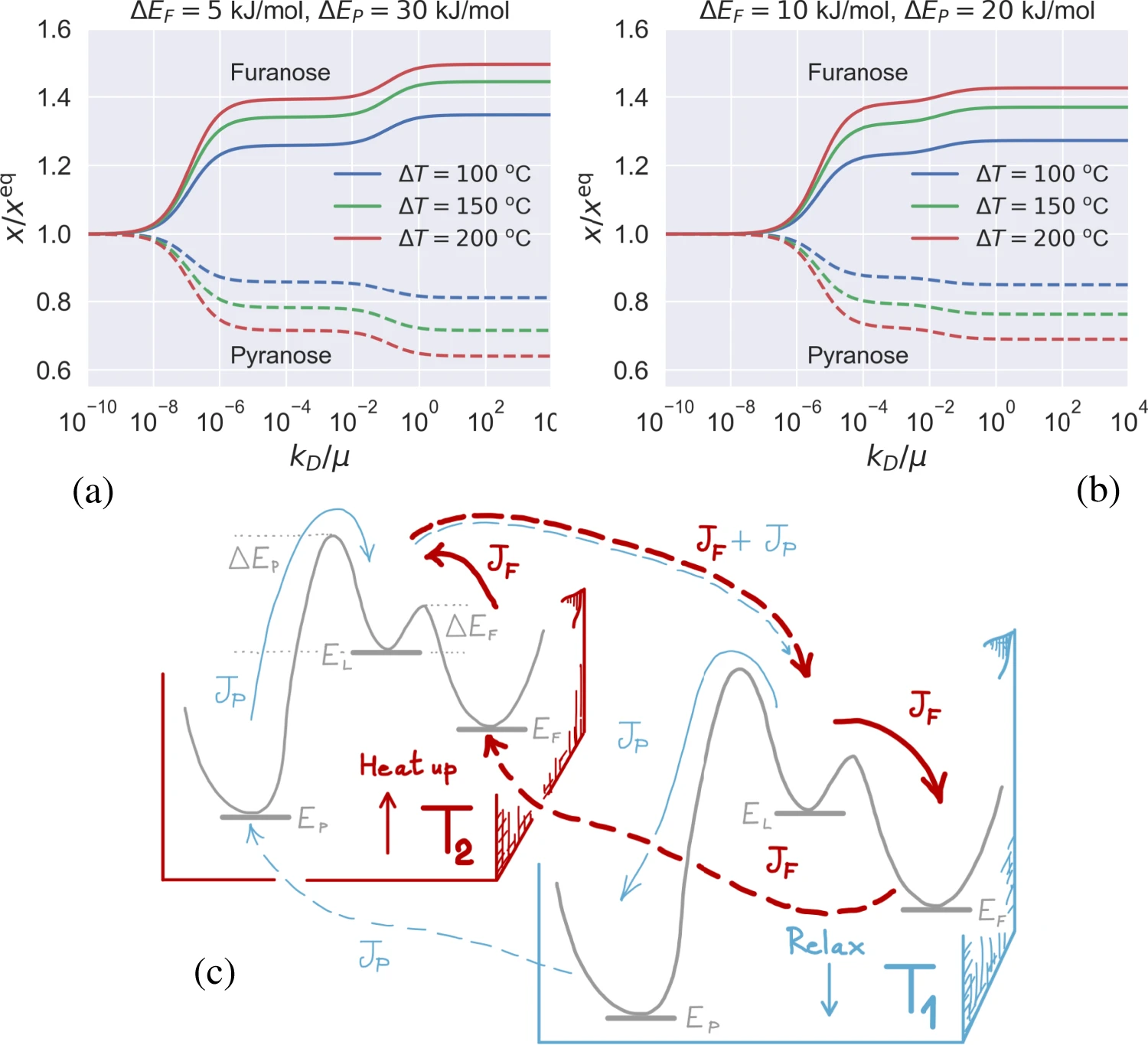
a, b The steady-state molar fractions of furanose (solid lines) and pyranose (dashed lines) computed for the two-box model illustrated in Fig. 3 are plotted against the transport rate for different choices of the temperature gradient ΔT = T2 − T1 and two choices of energy barriers (see Supplementary Note 4 for the mathematical details). Populations are normalised to the equilibrium values, i.e. \({x}^{{\rm{eq}}}\equiv ({x}_{F}^{{\rm{eq}}}({T}_{1})+{x}_{F}^{{\rm{eq}}}({T}_{2}))/2\). c Illustration of the steady system of currents (JF, JP) that sustain the non-equilibrium stabilisation of furanose for ΔEP > ΔEF (see also Supplementary Note 6). Dashed arrows denote mass transport, solid lines stand for chemical transformations. The current JP is much smaller than JF in the fast-transport limit, Da ⪅ 1. Parameters used in the two-box model are: T1 = 60 °C, ηF = 29.34, ηP = 1.94, EL = 19 kJ/mol, EF = 13.6 kJ/mol, EP = 3.1 kJ/mol, corresponding to the average values for the two furanose and pyranose enantiomers measured from our equilibrium NMR experiments (see Table 1).
