
Fig. 2: LSC17 in pediatric AML.
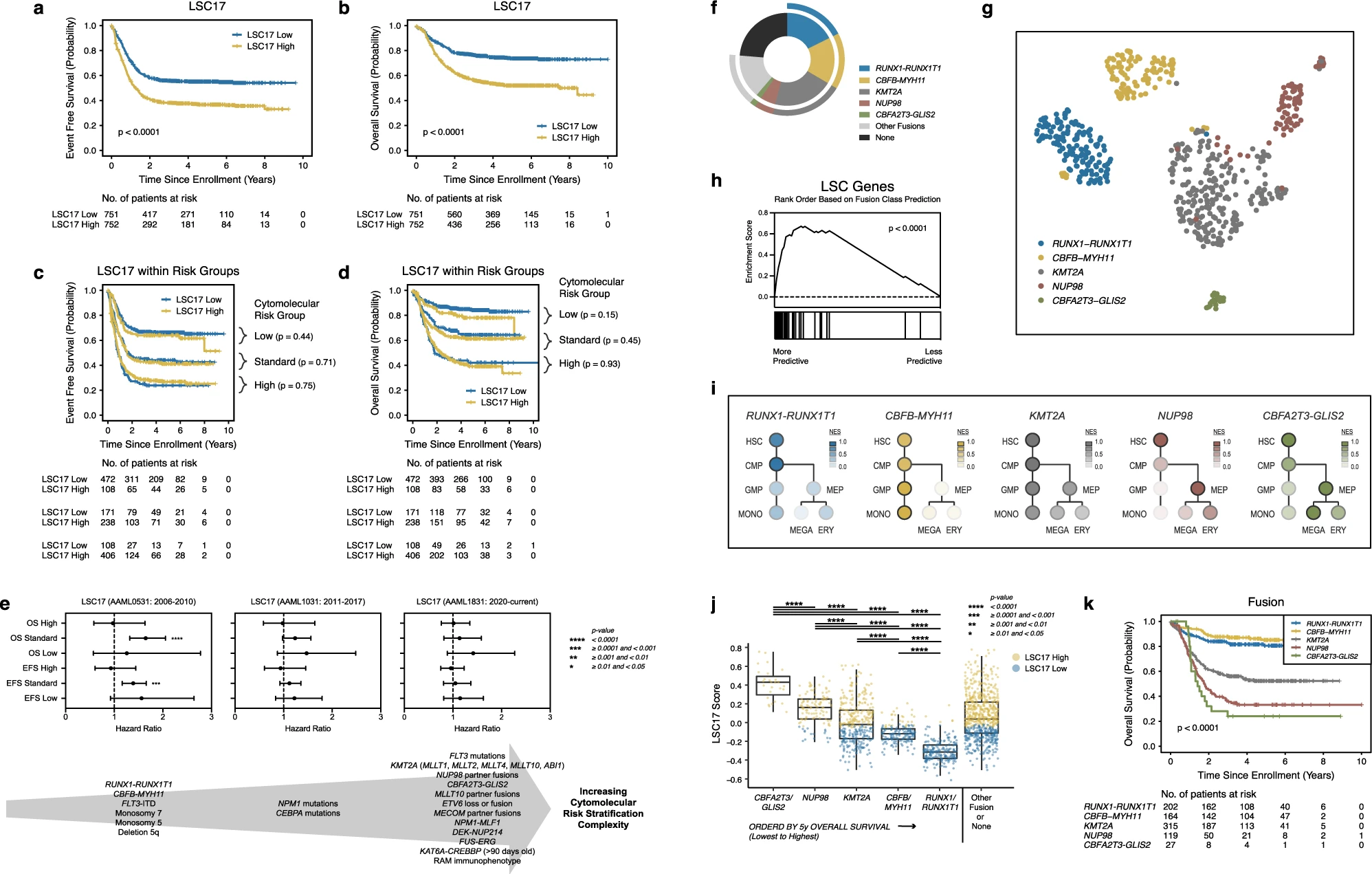
Kaplan–Meier estimates for the probability of a EFS and b OS in patients within our entire cohort (n = 1503) stratified based on low versus high LSC17 scores. LSC17 scores significantly predict survival for the entire non-stratified cohort. Conversely, LSC17 scores do not improve upon previously established risk stratification models based on cytogenetic and molecular alterations in regards to either c EFS or d OS. e Hazard ratios with 95% confidence intervals for EFS and OS as a function of LSC17 risk group (high versus low) across historical clinical trial cytomolecular risk stratification schema (n = 1503 patients). f Driver gene fusion frequencies within our entire study cohort (n = 1503). g Uniform manifold approximation and projection (UMAP) performed on selected genes based on the nearest shrunken centroids approach clearly discriminates fusion classes. h Gene set enrichment analysis on a 47 LSC gene signature reveals that LSC genes are significantly enriched among fusion-predictive genes. GSEA p-values are calculated by permutation (n = 1000) across the gene set of interest combined with every gene set within the Broad Institute Molecular Signature Database v6.2. i Normalized enrichment scores based on hematopoietic hierarchical cell populations reveal that gene fusion transcriptional signatures align with distinct hematopoietic stem cell and myeloid progenitor cell population states. NES normalized enrichment score. j Box plot of LSC17 scores categorized based on cytogenetic or fusion status reveal that LSC17 scores significantly correlate with underlying alteration (n = 1503 patients). Box plot data are presented as median values with hinges corresponding to the 25th or 75th percentiles and whiskers corresponding to 1.5 times the inter-quartile range. P-values were calculated based on two-sided t-tests. Source data are provided as a Source Data file. k Survival outcomes stratified based on fusion status. Survival differences were determined using the log-rank test (two-sided and without multiple-testing adjustments).
