
Fig. 1: Mental health outcomes and immune mediators of stressed individuals.
From: Stress-induced red nucleus attenuation induces anxiety-like behavior and lymph node CCL5 secretion
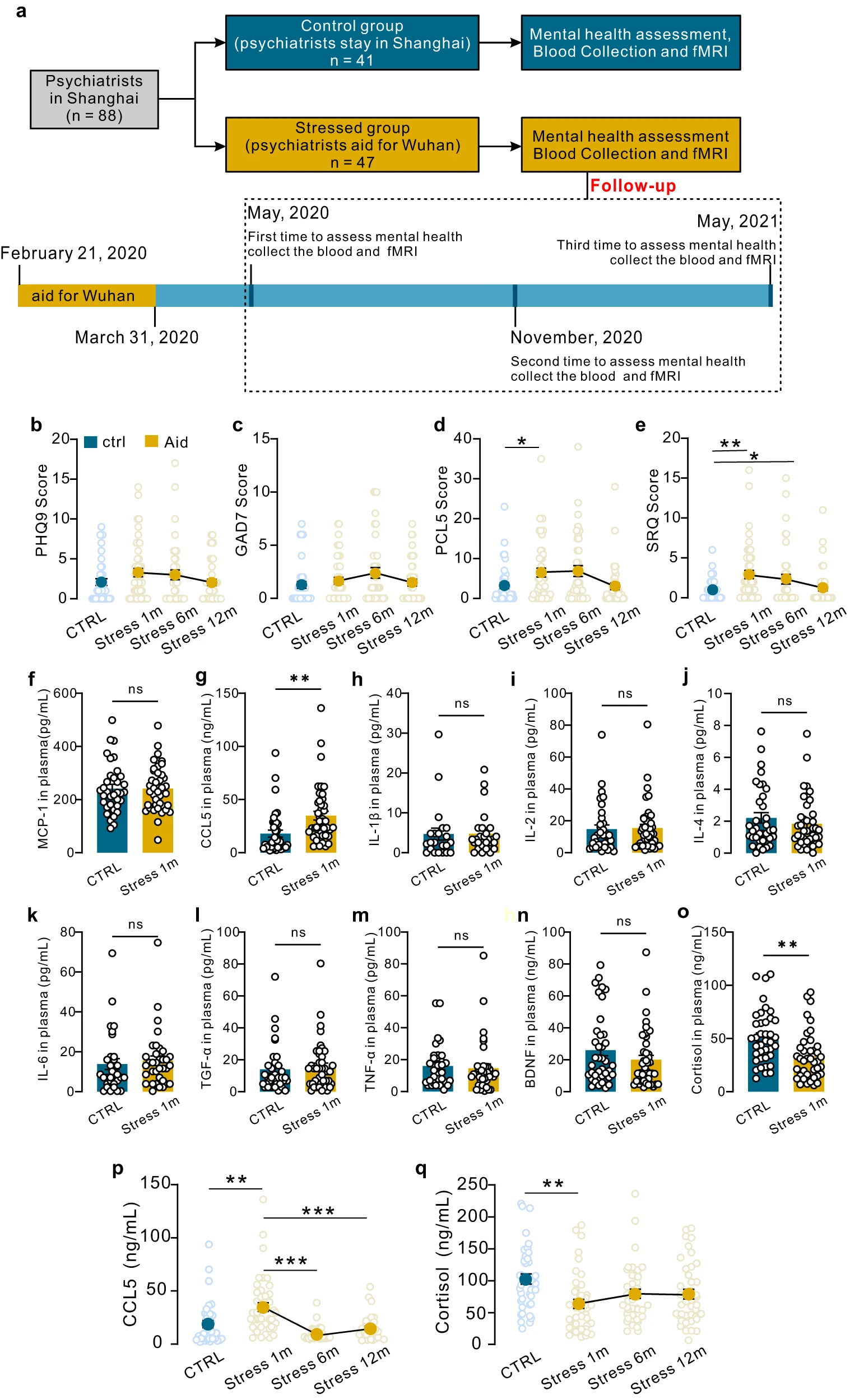
a Flowchart of the stress period and blood collection of stressed individuals. b PHQ9 scores. c GAD7 scores. d PCL-5 scores (one-way ANOVA, F3,165 = 3.689, *P = 0.0190). e SRQ-20 scores (one-way ANOVA, F3,165 = 3.234, **P = 0.0013, *P = 0.0404) of stressed individuals. (n = 41 for control, n = 47 for stress 1 m, n = 40 for stress 6 m, n = 41 for stress 12 m). f–o Plasma levels of MCP-1, CCL5 (two-sided unpaired t test, **P = 0.0022, t = 3.167, df = 79; n = 38 for control, n = 43 for stress), IL-1β, IL-2, IL-4, IL-6, TGF-α, TNF-α, BDNF and cortisol (two-sided unpaired t test, **P = 0.0020, t = 3.273, df = 79; n = 38 for control, n = 43 for stress) in stressed individuals 1 month after leaving the stressful environment. p, q, Plasma CCL5 (n = 38 for control, n = 43 for stress 1 m, n = 39 for stress 6 m, n = 33 for stress 12 m) and cortisol levels (n = 39 for control, n = 43 for stress 1 m, n = 41 for stress 6 m, n = 41 for stress 12 m) in stressed individuals 6 months later and 1 year later (one-way ANOVA, F3,165 = 10.800, **P = 0.0012, ***P < 0.0001. ctrl control individuals without stressful experience, stress 1 m: stressed individuals 1 month after leaving the stressful environment, stress 6 m: stressed individuals 6 months after leaving the stressful environment, aid 12 m: stressed individuals 12 months after leaving the stressful environment. Data are presented as the mean ± SEM. *P < 0.05, **P < 0.01, ***P < 0.001. Source data are provided as a Source Data file.
