
Fig. 1: Map of Turkana Basin with the Namorotukunan Archeological Site and timeline of currently known events in the Plio-Pleistocene.
From: Early Oldowan technology thrived during Pliocene environmental change in the Turkana Basin, Kenya
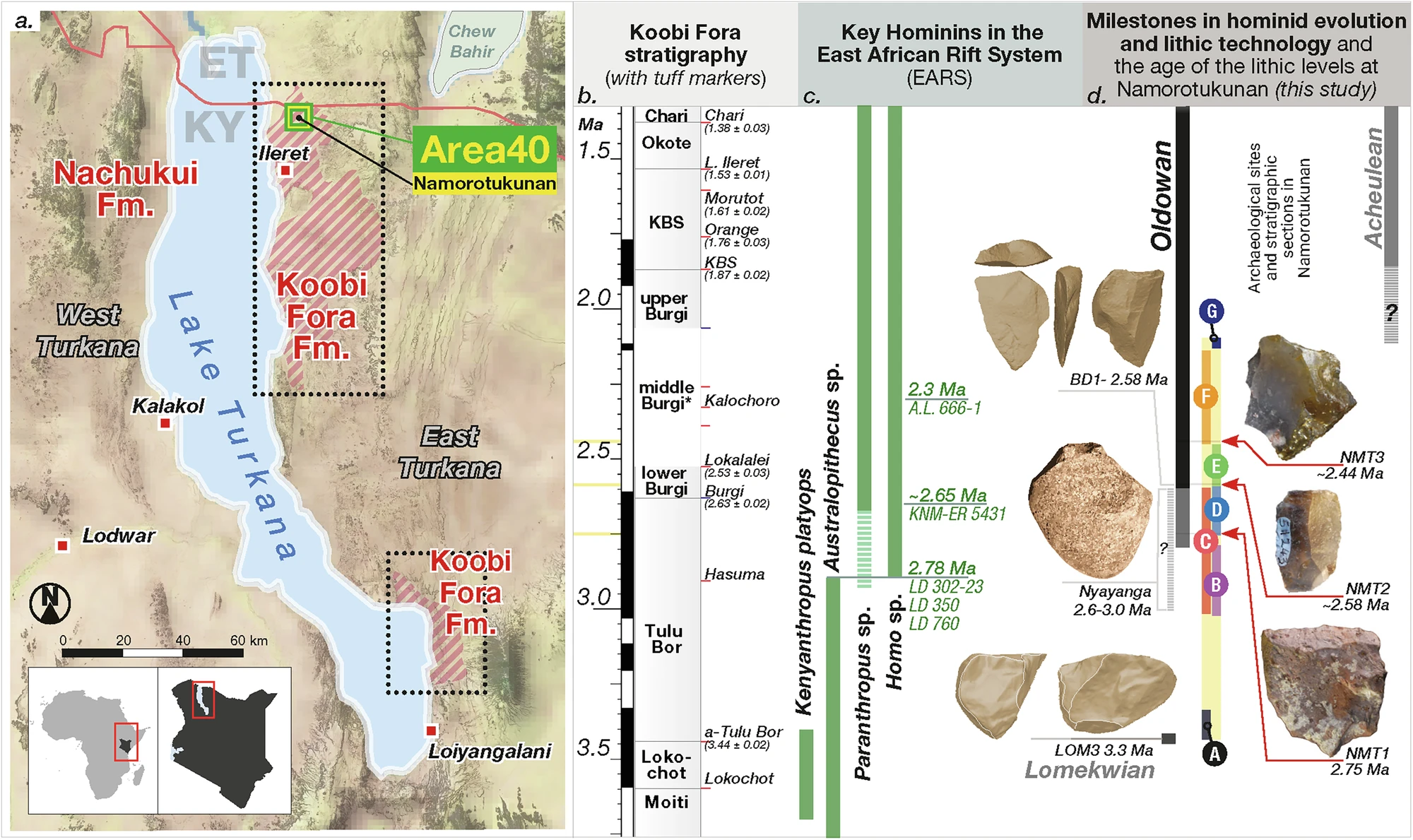
a Geographical context of the Koobi Fora Formation (red stripes), the paleontological collection area 40 (green square), and the location of the site of Namorotukunan (black dot); [map produced Natural Earth and NOAAA ETOPO 202295]; b Stratigraphic context of the Koobi Fora Formation highlighting members and key volcanic ash marker levels, yellow bars refer to the age of archeological horizons (tephrostratigraphy after McDougall et al.96); c A chronology of key Plio-Pleistocene hominins from the East African Rift System (EARS)11,74,97,98 d A chronology and key localities associated with hominin lithic technology3,6,12 (images of Nyayanga provided by E. Finestone; images of Lomekwi and BD1 based on 3D models; artifact images are for representation and not to scale) and the investigations at Namorotukunan: red arrows represent the artifact levels in the archeological excavations (photos DRB), and colored circles (lettered A-G) represent geologic sections investigated to develop a synthetic stratigraphic column (presented in Figs. 2 and 3).
