
Abstract
We develop a gauge-invariant renormalized mean-field theory (RMFT) to reliably find the quantum spin liquid (QSL) states and their field response for realistic Kitaev materials under strong magnetic fields and described by the generalized Kitaev J-K-Γ-\({\Gamma }^{{\prime} }\) model. Remarkably, while our RMFT reproduces previous results based on using more complicated numerical methods, it also predicts several new stable QSL states. In particular, since Kitaev spin liquid (KSL) is no longer a saddle point solution, a new exotic 2-cone state distinct from the KSL is found to describe experimental observations well, and hence should be the candidate state realized in the Kitaev material, α-RuCl3. We further explore the mechanism for the suppression of the observed thermal Hall conductivity at low temperatures within the fermionic framework, and show that the polar-angle dependence of the fermionic gap can distinguish the found 2-cone state from the KSL state in further experiments.
Introduction
The quantum spin liquid (QSL) is a state of quantum spins without spin ordering but spins are highly entangled1. The original idea that interacting spins may form a liquid phase was first proposed by P. W. Anderson2. It was later brought up by Anderson to construct the parent state that fosters superconductivity for doped cuprate superconductors3. The realization of Anderson’s idea has been pursued in many interacting spin systems. In particular, the quantum spin liquid phase has been demonstrated to be the ground state for a number of theoretical models. Notably, the Kitaev model on honeycomb lattice is an exactly solvable model with the quantum spin liquid phase being the ground state4.
Being an exactly solvable model, the Kitaev model provides a platform to understand gapped and gapless quantum spin-liquid (QSL) states with distinct anyon statistics. The gapless Kitaev spin-liquid (KSL) state possesses two kinds of basic excitation, cone-like gapless fermionic excitation formed by Majorana fermions and gapped excitation formed by flux excitations, termed as vison. Under weak magnetic fields, the Majorana-fermion excitations open up a gap with their bands possessing finite Chern number ν = ±14,5,6,7. The associated Majorana edge states give rise to half quantized thermal Hall conductivity4,8 which is claimed to be observed in some experiments9,10,11. The gapped visons together with Majorana bound states at their core obey non-Abelian statistics4,6,12, thus providing a potential platform for topological quantum computation.
On experimental side, due to the unusual spin-spin interaction involved, it is difficult to realize the Kitaev model in pure spin systems. Instead, it was pointed out that super-exchange interactions of pseudospins formed by the combination of orbital and spin degree of freedom for d electrons may realize the required spin-spin interaction13,14. However, in real systems, other exchange interactions are also present; the resulting model usually contains many other spin-spin interactions. The typical model that includes the Kitaev spin-spin interaction is the so-called the generalized Kitaev \(J\,\text{-}K\text{-}\Gamma \text{-}\,{\Gamma }^{{\prime} }\) model in which K is the strength of the Kitaev spin-spin interaction, J is the isotropic super-exchange interaction, Γ and \({\Gamma }^{{\prime} }\) are interactions of off-diagonal components of pseudospins15,16,17,18,19,20. Material candidates for realizing the model are mainly in iridium oxides, ruthenium and cobalt compounds21,22,23,24.
Recently, a key feature of QSL was observed in the candidate Kitaev material α-RuCl3. By applying magnetic fields, it is found that the antiferromagnetic phase in α-RuCl3 evolves into a phase with half-integer quantized thermal Hall conductivity in some samples at a given temperature range9,10,11. However, some other experiments reported non-quantized thermal Hall conductivity at low temperatures25,26,27. It is also suggested that phonons make the major contribution to the thermal Hall conductivity28. Although it is still under debate on whether this phase is a spin-liquid phase and on the bosonic or fermionic origin of the observed thermal Hall phenomenon25,26,27,29, the field-angle-dependent specific heat measurement seems to support fermionic scenario, as the sign-changing of thermal Hall conductivity and the fitted band gap seem to agree with predictions by the KSL under weak field30,31,32. Theoretically, these predictions are based on features of original KSL. As indicated in the above, however, except for the dominant ferromagnetic Kitaev interaction K, the effective spin model for α-RuCl3 contains a large first-neighbor off-diagonal Γ interaction, possible small J and \({\Gamma }^{{\prime} }\) interactions, and third-neighbor Heisenberg interaction15,16,17,18,19,20. It is known that the KSL is unstable with the presence of these extra interactions33,34,35,36,37,38. Therefore, it calls for a theoretical explanation of the observed phenomenon.
On the theoretical side, to study fermionic spin liquid state, a widely-used method is first employing the Kitaev Majorana-fermion decomposition of spin to construct quadratic mean-field (MF) Hamiltonian, and then rewriting the Hamiltonian back to standard Schwinger-Fermion form. With the general variational parameters of MF Hamiltonian provided by projective symmetry group (PSG) analysis39,40,41, the corresponding Gutzwiller projected variational wave-function is used to optimize the variational energy by variational Monte Carlo (VMC) method35,42,43. Such a mathematical procedure, however, may become cumbersome once one wants to study the effect of external magnetic fields in arbitrary orientations, as many relevant terms arise due to the broken symmetries of the Hamiltonian. The VMC method is also limited by the system size and would not be able to find results in the thermodynamic limit. In addition, though the Kitaev Majorana-fermion decomposition works well in the Kitaev model, it suffers from the problem of being gauge non-invariant in the general spin interaction model. As we will show, the generalized Kitaev \(J\,\text{-}K\text{-}\Gamma \text{-}\,{\Gamma }^{{\prime} }\) model would unphysically yield the same QSL solution in the mean-field level for both positive and negative parameters, (±J, \(\pm K\pm \Gamma \pm {\Gamma }^{{\prime} }\)) (as an example, one may consider the J → ∞ limit). Therefore, it also calls for a new theoretical approach to account for the observed phenomenon.
To overcome the above mentioned difficulty encountered in VMC, in this work, we apply the renormalized mean-field theory (RMFT) to find the quantum spin liquid states in the presence of magnetic fields. The renormalized mean-field theory was a reliable method introduced to find correlated electronic phases in the Hubbard model after the high Tc cuprate superconductors were discovered44,45,46,47. The theory has achieved great success for systems being spin-SU(2) invariant and was originally aimed to replace the rigorous approach based on VMC method by a simplified approximation in which effects of the Gutzwiller projection are approximated by classical weights —namely, by the renormalized factors (such as gJ and gm defined in in the following sections) for the coupling constants of various operators in the Hamiltonian. It was later generalized to include local order parameters and correlations in the renormalization factor48,49. Here we shall further generalize RMFT by computing the renormalized factor directly and extend RMFT to systems without spin-SU(2) symmetry. For this purpose, we first employ the gauge invariant decomposition of the spin operator50,51. Adopting this decomposition, a gauge invariant MF theory that includes quantum averages over all allowed local clusters of operators is derived. By comparing with the exact solution of the Kitaev model, we find that if the coupling constant is renormalized by a renormalized factor gJ, the MF solution can reproduce all results of the ground state that is based on the exact solution. We rigorously prove that gJ is exactly equal to 4 for the Kitaev model. The Kitaev’s exact solution provides an excellent example of the renormalized mean-field theory, in which we have generalized it by replacing the classical weighting factors with factors determined by quantum averages over local clusters of operators. When the interaction J,Γ,\({\Gamma }^{{\prime} }\) or magnetic moments are present, the gJ factor needs to be replaced by a bond-dependent tensor \({g}_{J,ij}^{\alpha {\alpha }^{{\prime} }}\), and the magnetic moments \({m}_{i}^{\alpha }\) also acquire an approximated renormalized factor \({g}_{m,i}^{\alpha }\). The resulting RMFT reproduces several results previously obtained by other numerical methods, such as density matrix renormalization group(DMRG) and VMC study of Kitaev model under field43,52, and in particular, reproduces the 8-,14-,20-cone quantum spin-liquid (QSL) states and the band Chern number under fields in the VMC study of K-Γ model35,42. Therefore, our RMFT approach provides an economic way in the thermodynamic limit to investigate the MF spinon band properties and the vortices structure in \(J\,\text{-}K\text{-}\Gamma \text{-}\,{\Gamma }^{{\prime} }\) model under field in arbitrary orientations. Here, the vortices structure refers to the vortices state generalized from the exact solution of Kitaev model4.
Note that a recent review article lists various types of ground states that were predicted by various numerical methods on the K-Γ model53. We would like to point it out that even though these various advanced numerical methods, including DMRG and tensor network approaches, have proposed a number of ground states for K-Γ model, a definitive conclusion still remains elusive. Furthermore, to our knowledge, these methods have not yet been able to reproduce key experimentally observed spin-liquid features under experimental magnetic field orientation, such as chiral edge channels and the six-fold angular dependence of the fermionic gap. While some of the methods capture a spin-liquid ground state34,53, they inherently struggle to describe such features due to their 2 × 2 spin representation and are limited to system sizes or geometries. For instance, the K-Γ spin-liquid reported in ref. 34, where the Chern number under field is lacking. In addition, they do not report on other characterization of the phases, e.g., excitations, etc. In addition, to describe realistic Kitaev materials, one should adopt the generalized Kitaev J-K-Γ-\({\Gamma }^{{\prime} }\) model instead of the K-Γ model compared in ref. 53. Therefore, in the following, we direct our efforts toward identifying the robust spin-liquid phase within the J-K-Γ-\({\Gamma }^{{\prime} }\) model under experimental magnetic field orientation, with all parameters chosen within the realistic material range. We then examine the magnetic response of these states to compare with experimental observation9,10,11,30,31. More detailed descriptions of our results are shown in below.
Based on this new RMFT approach, we obtain several new results that were not found before. The main results from our RMFT are as follows: Under zero field and K = −1, Γ ≳ 0.25 there are several new stable QSL states: Z2 2-, 4-, 8-, 14-, 20-, 26-cone QSL states, SU(2) 16-, 32-cone QSL states and other high number cones QSL states. Some of these states remain robust in the parameter regime with large Γ(> 0.5) and small \(| {\Gamma }^{{\prime} }|\), ∣J∣(< 0.1), which corresponds to the typical range for α-RuCl3. Since their energies per site are very close to each other with difference ≲ 0.02∣K∣(2 ~ 4 K), we futher examine their low field band structure, Chern numbers, and angle-dependent gap under magnetic fields to compare with the experimental results. Remarkably, we find that only the Z2 2-cone state yields the Chern number ν = ±1 at low fields, and at the same time it gives the same azimuthal angle-dependent gap observed by the experiment under magnetic fields. Since this 2-cone state possesses negative Wilson loop value, it is distinct from the Kitaev spin-liquid state. When the applying field is in the \(\hat{a}\)-\(\hat{b}\) plane, this 2-cone state exhibits opposite Chern numbers in comparison to KSL. By further examining the ground state degeneracies, we also find this 2-cone state is a topological QSL with long-range entanglement54. Since the Kitaev spin liquid is not stable in the presence of large J, Γ, and \({\Gamma }^{{\prime} }\)33,34,35,36,37,38, it implies that what the experiments observed is the 2-cone state obtained in our RMFT. We further illustrate that this 2-cone state can be distinguished from the Kitaev spin-liquid state by looking into the angle-dependent gap in the polar angle (in contrast to the azimuthal angle currently observed in experiment). Finally, we discuss possible mechanism for the suppression of the observed thermal Hall conductivity at low temperatures within the Majorana-fermion framework and conclude.
Results
Theoretical model and Gauge invariant decomposition of spin
We start from the generalized Kitaev \(J\,\text{-}K\text{-}\Gamma \text{-}\,{\Gamma }^{{\prime} }\) model on the honeycomb lattice17,18, which under magnetic field \(\vec{h}\), is given by
Here \({\overrightarrow{S}}_{j}\) is not a real spin operator and represents pseudo spin-1/2 operators at site j, γl denotes xl, yl or zl bonds shown in Fig. 1 (a) with (α, β, γ) being the cyclic permutation of the indices (x, y, z), K is the strength of the Kitaev spin-spin interaction, J is the isotropic super-exchange interaction, and Γ and \({\Gamma }^{{\prime} }\) are interactions of off-diagonal components of pseudospins. The Hamiltonian can be cast in a more concise form as
where all spin-spin interactions are lumped into (including the 1/4 factor) an appropriate tensor \({J}_{ij}^{\alpha {\alpha }^{{\prime} }}\) and we have made use of the relation \({\overrightarrow{S}}_{j}=\frac{1}{2}{\overrightarrow{\sigma }}_{j}\).

a The schematic honeycomb lattice with labeled links, where \(\hat{a}=[11\bar{2}]\), \(\hat{b}=[\bar{1}10]\), \(\hat{c}=[111]\) and all are unit vectors. b Linking cluster used to calculate \({g}_{J,ij}^{\alpha {\alpha }^{{\prime} }}\). c Linking cluster used to calculate \({g}_{m,i}^{\alpha }\).
Now we need to decompose the spin operator into Majorana fermions. In the standard second quantization of the spin operator in terms of fermionic operators, \({f}_{\alpha }^{\dagger }\) and fα, we have \(\overrightarrow{\sigma }={\sum }_{\alpha ,\beta }{f}_{\alpha }^{\dagger }{\overrightarrow{\sigma }}_{\alpha \beta }{f}_{\beta }\), where α and β are indices corresponding to either ↑ or ↓. To faithfully represent the spin, a projection to the Fock space with each site being singly occupied by fermions is implemented through gauge fields so that \(\overrightarrow{\sigma }\) and H are gauge invariant55. From \({f}_{\alpha }^{\dagger }\) and fα, one can form four Majorana fermions as \({b}^{x}={f}_{\uparrow }^{\dagger }+{f}_{\uparrow }\), \({b}^{y}=-i{f}_{\uparrow }^{\dagger }+i{f}_{\uparrow }\), \({b}^{z}=-({f}_{\downarrow }^{\dagger }+{f}_{\downarrow })\), \({b}^{0}=i{f}_{\downarrow }^{\dagger }-i{f}_{\downarrow }\). We find that the spin decomposition of Majorana fermions at site j reads41,51
where α, β, and γ are cyclic permutation of x, y, and z. Note that in the Kitaev Majorana-fermion decomposition of spin, the spin operator is expressed as \({\tilde{\sigma }}^{\alpha }=i{b}^{\alpha }{b}^{0}\) with the constraint bxbybzb0 = 1, where α = x, y, or z. For the Kitaev spin-spin interaction HK, as only the same component of spins are involved for each bond (i, j) of the lattice, the associated Majorana bilinear product \({b}_{i}^{\alpha }{b}_{j}^{\alpha }\) commutes with HK. This reduces the problem to diagonalization of a quadratic Hamiltonian and the problem is thus exactly solvable4. Clearly, in the presence of J, Γ, or \({\Gamma }^{{\prime} }\), the Kitaev decomposition no longer has the advantage and the Hamiltonian is not exactly solvable. Furthermore, since for general spin-spin interaction on bond (i, j), \({\sum }_{\alpha \beta }{J}^{\alpha \beta }{\sigma }_{i}^{\alpha }{\sigma }_{j}^{\beta }={\sum }_{\alpha \beta }{J}^{\alpha \beta }(i{b}_{i}^{\alpha }{b}_{i}^{0})(i{b}_{j}^{\alpha }{b}_{j}^{0})\), hence for − Jαβ, the minus sign can be absorbed into \({b}_{i}^{0}\) by redefining a new Majorana fermion as \({\tilde{b}}_{i}^{0}=-{b}_{i}^{0}\), while maintaining the constraint \({b}_{i}^{x}{b}_{i}^{y}{b}_{i}^{z}{b}_{i}^{0}=1\) at the mean-field level if no moment term presents. The Kitaev decomposition would unphysically yield the same solution in the mean-field level for both positive and negative parameters. In addition, since \({\tilde{\sigma }}^{\alpha }\) can be expressed as σα − Qα with \({Q}_{i}^{\alpha }\) being the pseudospin operator given by \({Q}_{i}^{\alpha }=({f}_{i,\uparrow }^{\dagger },{f}_{i,\downarrow }){\tau }^{\alpha }{({f}_{i,\uparrow },{f}_{i,\downarrow }^{\dagger })}^{T}\), it is clear that \({Q}_{i}^{\alpha }\) rotates covariantly with the pseudospin SU(2) rotations55 and hence \({\tilde{\sigma }}^{\alpha }\) is not gauge invariant.
From above, we conclude by using Eq.(3) that the Hamiltonian H is also gauge invariant. It is thus favorable to use Eq.(3) for the spin decomposition. So far, the consideration is for the exact Hamiltonian. In practice, one needs to keep the gauge invariance when approximations are taken. In this case, it should be kept in mind that the average of spin-spin interaction, \({\sigma }_{i}^{\alpha }{\sigma }_{j}^{{\alpha }^{{\prime} }}\), is gauge invariant only if all allowed Wick’s decompositions are taken
where \({\chi }_{ij}^{\mu {\mu }^{{\prime} }}=\langle i{b}_{i}^{\mu }{b}_{j}^{{\mu }^{{\prime} }}\rangle\), and \({m}_{i}^{\alpha }=\langle {\sigma }_{i}^{\alpha }\rangle\). Based on the gauge-invariant decomposition of spin, we shall derive the gauge-invariant renormalized mean field theory (RMFT), which is done in the section of methods.
Comparison with early numerical works
Before presenting results for the generalized Kitaev model, we shall first compare solutions based on our RMFT with results based on other numerical results for the Kitaev model under field.
In Fig. 2, we compare our results with those based on methods of density matrix renormalization group (DMRG) and variational Monte Carlo (VMC). Clearly, good agreement is obtained for the magnetization curve in Fig. 2(a) and energy in Fig. 2(b) of Kitaev model under field. Furthermore, for some range of Γ ’s, Wang35 found a 14 cone states, and therefore we would like to compare with their results in Fig. 2(c). In particular, our RMFT results also show the same pattern of changing for the topological Chern number under the magnetic field along \(\hat{c}\) direction, though the exact boundary of change is different due to the energy comparison between different states. Detailed comparison of the band gap and Chern number is shown in Supplementary Fig. 6. Results in Fig. 2 and Supplementary Fig. 6 indicate that this gauge-invariant RMFT is a reliable method.

a Comparison between RMFT and DMRG52 for calculated spin magnetization of the ferromagnetic or antiferromagnetic Kitaev model under field \(\overrightarrow{h}=h\hat{c}\), where \(\hat{c}\) is the unit vector along [111] direction. b Energy comparison between RMFT, KMF and VMC43 of the K > 0 (antiferromagnetic) Kitaev model under field \(\overrightarrow{h}=h\hat{c}\). The KMF denotes using Kitaev’s decomposition to do MF. c Comparison between RMFT and VMC35 for calculated cone positions of the 14-cone QSL state of K-Γ model when K = −1 and Γ = 0.3. d Comparison between RMFT and VMC35 of the Chern number evolution of 14-cone state under field \(\overrightarrow{h}=h\hat{c}\) when K = −1 and Γ = 0.3.
It is worth to mention, if one uses MF based on Kitaev’s decomposition (KMF) in K-Γ model, one would not get listed stable QSL found by VMC or RMFT; only GKSL survives; while if one uses MF based on the gauge invariant decomposition but without including the cluster renormalization effect, for K < 0 Kitaev model, one would get a negative spin susceptibility, which is clearly wrong.
In Fig. 3, we compare our RMFT results with the well-established results of the J-K model56. It is evident that RMFT yields relatively poor energy in the magnetically ordered phases. This discrepancy arises from the fact that the RMFT approach employs the representation in which spinons are deconfined in the sense that the spin operator is broken into two unbinded spinons. Physically, however, in a magnetically ordered phase or a polarized phase where large magnetic moments are present, spinons are expected to be confined so that two spinons recombine into the spin operator. As a result, fluctuations of the confinement potential (represented by the introduced Lagrange multipliers) cannot be neglected, and treating them merely at the mean-field level is insufficient. On the other hand, most advanced numerical methods are based on representations in terms of spin (which confines two spinons into the spin operator) and it would be more difficult for these methods to find spin-liquid. Note that in the ordered phase, the classical mean-field solution in which χij vanishes is always a solution to our RMFT theory. However, it does not imply that at zero magnetic field, our RMFT solution coincides with the classical mean field solution. Instead, what we found is that at zero magnetic field, our RMFT solution does not coincide with the classical mean-field solution by the presence of finite χij in the ordered phase. This is because in ordered phase, the presence of finite χij makes the energy of our RMFT solution even lower than that of the classical mean-field solution. Hence even though the classical mean-field solutions in are solutions to our RMFT, they are only local minima and are not the true ground states.

Here “classical” denote the classical mean-field solution in which all χij's are set to zero, “ED” represents exact diagonalization, and “LSWT” refers to linear spin wave theory. Other numerical results presented in ref. 56 are close to the ED data and are therefore not shown here.
In Fig. 4, we compare our RMFT results with the DMRG results of the K-Γ model under field34. Noted that the DMRG results were obtained on a two-leg honeycomb strip—i.e., with only two unit cells in one direction—which may lead to the differences in the phase boundaries. An important similarity is that both their study and ours identify a spin-liquid phase in the large Gamma region: their KΓ spin-liquid and our 2-cone spin-liquid(see next section), respectively. Moreover, the Wilson loop value W of their K-Γ spin-liquid is approximately −1/3, while the value of W of our 2-cone spin-liquid is approximately −0.35 (see Table 2).
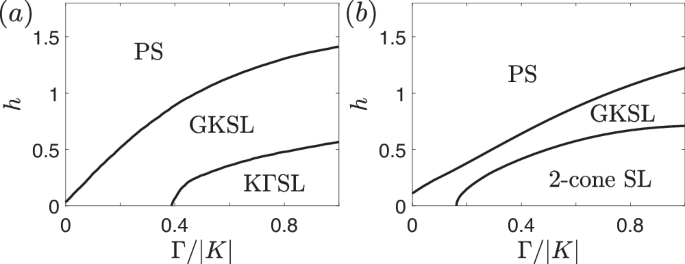
a DMRG34. b RMFT. Here the couplings are parameterized as K < 0, K2 + Γ2 = 1, and the magnetic field is applied along the \(\hat{c}\) axis (\(\overrightarrow{h}=h\hat{c}\)). “GKSL” denotes the generalized Kitaev spin-liquid state, and “PS” denotes the polarized state.
QSL states with full symmetries
The symmetry group for the Hamiltonian in zero field and the corresponding projective symmetry group are analyzed in Secs. I and V of the Supplemental Material. Only six irreducible MF parameters are allowed if we require a spin liquid state to possess full symmetries; they are given by
on zl-link, where \({\chi }_{{z}_{l}}^{0b}\equiv {\chi }_{{z}_{l}}^{0x}=-{\chi }_{{z}_{l}}^{0y}\).
In refs. 35,42 they claimed there are two terms (their η3,5) that couple b0 to bμ≠0. However, one can check that their sum results in a term that does not couple these two sets of operators. Hence, there is only one linear independent term that couples b0 to bμ≠0, as in ours. Note that our number of irreducible parameters (six) is the same as Wang’s PRL work35. Though in their later PRB work42 they claim there are seven irreducible parameters, by examining their PRB result, there are only six linear independent terms in it. Therefore, six is the correct number, also as in ours.
To search the stable quantum spin-liquid states in the accepted parameter region of α-RuCl3 with K = −1, Γ > 0.3,\(| J| ,| {\Gamma }^{{\prime} }| < 0.1\), we start from the KSL state with K = −1 and Γ = 0. When a small value of Γ is turned on, the KSL state becomes GKSL (generalized KSL). The GKSL then continuously evolves to one of 20-cone states (denoted as 201−) when Γ ≳ 0.25 (details in Sec. VII A of the Supplemental Material). Since the GKSL is not stable when Γ ≳ 0.25, we search for all stable QSL states in the vicinity of transition point in large systems (On a 144 × 144 × 2 lattice, where 144 × 144 corresponds to the momentum resolution, and the factor of 2 accounts for the A and B sublattice points). Note that there are two kinds of PSG setting in MF parameters that give rise to full symmetries in projected spin state. These are the homogeneous setting (all parameters are position independent) and π-flux setting which originated from the vortex-free and full-vortex state in the Kitaev’s exact solution.
For homogeneous setting and with Γ = 0.3, the stable QSL states are given by
and for π-flux setting, the stable QSL states are given by
where Z2 and SU(2) refers to the invariant gauge group (IGG)39 for the solution, 2, 8, 14. . . denote number of cones in the first Brillouin zone(FBZ), π-4, 40, . . . denote number of cones in the folded reduced Brillouin zone due to π-flux setting, and the subscript labels the different type QSL states with the same number of cones. The IGG determines weak gapless gauge fluctuations of the solution39, where the calculation of IGG of each state is shown in Sec. V B of the Supplemental Material.
By increasing Γ, it is shown that 8-cone state are not stable when Γ is greater than 0.6, 204-cone state are not stable when Γ is greater than 0.53, 141, 26-cone states are not stable when Γ is greater than 0.43, and 201,3-cone, π-28-cone with 2 fermi ring state are not stable when Γ is greater than 0.38.
The other states survive for large Γ up to 1. We further examine the stability of 2-,142-,16-,202-,204-, 32-, π-41,2 states when small values of J and \({\Gamma }^{{\prime} }\) are turned on (\(| J| ,| {\Gamma }^{{\prime} }| < 0.1\)), and found that they are all still stable solutions.
In Fig. 5, we show the lowest fermionic energy spectrum of some of the stable QSL states we found in the homogeneous setting. The \({\chi }_{{z}_{l}}^{\mu \nu }\) of each QSL state is shown in Sec. VII B of the Supplemental Material.

a 2- b 142- c 16- d 202- (e)204- f 32-cone. Here, a is the lattice constant for the honeycomb lattice, the color scale represents the energy in unit of ∣K∣, and the region enclosed by dash line is the first Brillouin zone.
Comparison of energy obtained by RMFT and Monte-Carlo method
To verify the validity of our RMFT results, we compare our RMFT results with those obtained by using Monte-Carlo (MC) method for projection via the following procedure:
For a given RMFT solution with the RMFT energy EMC and the corresponding RMFT Hamiltonian HRMT in Eq. (8), we map HRMF back to ordinary fermion basis, and obtain the corresponding ground state \(\left\vert {\psi }_{0}\right\rangle\). Then we use method of Monte-Carlo to treat the projection PG and compute \({E}^{{\rm{MC}}}=\frac{\langle {\psi }_{0}| {P}_{G}H{P}_{G}| {\psi }_{0}\rangle }{\langle {\psi }_{0}| {P}_{G}| {\psi }_{0}\rangle }\). Similarly, we can also calculate the Wilson loop value of ψ0 by using the MC method as \({W}_{{\rm{MC}}}=\frac{\langle {\psi }_{0}| {P}_{G}\hat{W}{P}_{G}| {\psi }_{0}\rangle }{\langle {\psi }_{0}| {P}_{G}| {\psi }_{0}\rangle }\), where \(\hat{W}\) is the product of six spin operators through hexagon edges4.
The ratio EMC/ERMF and WMC of GKSL with different Γ ’s for lattice size 7 × 7 × 2 are presented in Table 1. The error is about 1% which shows that RMFT works excellently with high precision. In Table 2, we show the ratio EMC/ERMF and WMC of different QSL states with homogeneous setting at Γ = 0.3. Finally, in Fig. 6(a), we show how energies of QSL states change versus Γ by plotting ERMF relative to energy of 2-cone state versus Γ for different QSL states. The comparison of EMC and ERMF of different QSL states with Γ/∣K∣ = 0.3 is shown in Fig. 6 (b). It is clear that for either the RMFT energies or the MC energies, they differ only by ~0.02∣K∣. In Fig. 6 (c), the phase diagram for \({\Gamma }^{{\prime} }=-0.08\) is shown to illustrate the phase transitions between the zigzag ordered state, 2-cone spin liquid state, and the polarized state.

a Energy of various QSL states relative to the 2-cone state, plotted as a function of Γ/K, calculated using RMFT. Here ΔE = E − E2−cone. Note that π − 41 state at Γ = 0 corresponds to the full-vortex state in the Kitaev’s exact solution. b Energy comparison of each QSL state computed using both RMFT and Monte Carlo (MC) methods at Γ/∣K∣ = 0.3. c RMFT-calculated phase diagram for \({\Gamma }^{{\prime} }=-0.08\), with a magnetic field applied along the \(\hat{a}\) axis (\(\overrightarrow{h}=h\hat{a}\)). Here, “zigzag” denotes the zigzag magnetically ordered state, and “PS” denotes the polarized state.
Symmetry dictated QSL states with homogeneous setting
The quantum spin liquid phases obtained may contain Dirac cones at various \(\overrightarrow{k}\) points. Here we summarize the analysis of positions and shapes for Dirac cones from symmetry point of view. We first note that since the Majorana fermions mix particle and hole equally, any Hamiltonian composed by quadratic Majorana fermion terms possesses the particle-hole symmetry (PHS). Hence, energy eigenstates for particles at \(-\overrightarrow{k}\) are exactly the same as the energy eigenstates for anti-particles at \(\overrightarrow{k}\) with the eigen-energies satisfying \({E}_{-\overrightarrow{k}}=-{E}_{\overrightarrow{k}}\). Therefore, in the following, we shall focus on properties at \(\overrightarrow{k}\) with the understanding that the same properties hold at \(-\overrightarrow{k}\) as well.
In Fig. 7(a), we show the momentum \({\overrightarrow{k}}_{D}\) at which the typical found Dirac cones are located for QSL states with homogeneous setting. It is clear that these locations are either at the high symmetry points such as \({\overrightarrow{k}}_{K}\) and \({\vec{k}}_{\Gamma }\) or on high symmetry axes such as \({\vec{k}}_{M;n}^{** }\) and \({\vec{k}}_{M;n}^{**}\) with n = 1, 2, 3. Furthermore, by using the full PSG transformation, it can be proved that the QSL states characterized by Eq.(4) must have zero energy excitation at \({\overrightarrow{k}}_{K}\)(see sec. VIII B of the Supplemental Material in details). In addition, we find that when \({\chi }_{{z}_{l}}^{0b}=0\), the zero energy eigenstates are formed by b0; while if \({\chi }_{{z}_{l}}^{0b}\,\ne\, 0\), the zero energy eigenstates are formed by the b0 and \({b}^{c}\equiv \overrightarrow{b}\cdot \hat{c}=({b}^{x}+{b}^{y}+{b}^{z})/\sqrt{3}\). This reflects the change of the power law of field versus gap when \(\hat{h}\parallel \hat{c}\).

a Schematic plot of typical locations of Dirac cones in momentum space for QSL states. b Exact momentum positions of the Dirac cones from 142-cone state under zero field, where Γ = 0.3. Note that cones at \(-\overrightarrow{k}\) are omitted due to PHS. c Azimuthal angle-dependent minimum gap near \({\overrightarrow{k}}_{K}\). d Azimuthal angle-dependent minimum gap near \(\vec{{{k}}^{{*}}}_{\!\!M;1,2,3}\). e Azimuthal angle-dependent minimum gap near \(\vec{{{k}}^{{**}}}_{\!\!\!\!M;1,2,3}\). Here \(\overrightarrow{h}=h(\cos \varphi \hat{a}+\sin \varphi \hat{b})\) and h = 0.01.
For the Dirac cones at \({\overrightarrow{k}}_{K}\) and \({\overrightarrow{k}}_{\Gamma }\), since they possess the \({C}_{3}^{\hat{c}}\) rotational symmetry with respect to c-axis and the mirror symmetry \({M}^{\hat{b}}\) with respect to the \(\hat{a}\)-\(\hat{c}\) plane, the low energy effective Hamiltonian is given by vF(qaτa + qbτb), where τa,b,c are the x, y, z components of Pauli-matrices formed by two low energy effective states, and \(\overrightarrow{q}=\overrightarrow{k}-{\overrightarrow{k}}_{D}\). On the other hand, for the Dirac cones at \(\vec{{{k}}^{{\,*}}}_{\!\!M;1}\) or \(\vec{{{k}}^{{\,**}}}_{\!\!\!\!M;1}\), the \({C}_{3}^{\hat{c}}\) symmetry is broken but the \({C}_{2}^{\hat{b}}\) symmetry is preserved, hence the low energy effective Hamiltonian is given by \({v}_{F}^{a}{q}_{a}{\tau }^{a}+{v}_{F}^{b}{q}_{b}{\tau }^{b}\) with \({v}_{F}^{a}\,\ne \,{v}_{F}^{b}\). Note that the global \({C}_{3}^{\hat{c}}\) symmetry is still preserved. In this case, \(\vec{{{k}}^{{\,*}}}_{\!\!M;n}\) with n = 1, 2, 3 are included as a whole so that under the \({C}_{3}^{\hat{c}}\) rotation, \(\vec{{{k}}^{{\,*}}}_{\!\!M;1}\), \(\vec{{{k}}^{{\,*}}}_{\!\!M;2}\), and \(\vec{{{k}}^{{\,*}}}_{\!\!M;3}\) are cyclically permuted. The low energy Hamiltonians of the Dirac cones at \(\vec{{{k}}^{{\,*}}}_{\!\!M;2,3}\) are thus generated by \({C}_{3}^{\hat{c}}\) rotations of the effective Hamiltonian at \(\vec{{{k}}^{{\,*}}}_{\!\!M;1}\). For the Dirac cones at other low symmetry points, all qaτa, qaτb, qbτa, and qbτb terms are allowed. For more details, see sec. VIII B of the Supplemental Material.
Symmetry dictated excitation gap-field relations
In this subsection, we summarize the analysis of the shift in the location \({\overrightarrow{k}}_{D}\) of the Dirac cones and the behaviour of fermionic excitation gap under weak magnetic fields \(\overrightarrow{h}\). For this purpose, we shall denote \({h}^{a}=\overrightarrow{h}\cdot \hat{a}\), \({h}^{b}=\overrightarrow{h}\cdot \hat{b}\), \({h}^{c}=\overrightarrow{h}\cdot \hat{c}\), and \({\Delta }_{M}(\overrightarrow{k})\) as the fermionic excitation gap at \(\overrightarrow{k}\). For more details, see sec. VIII C of the Supplemental Material.
Dirac cones located at \({\overrightarrow{k}}_{K}\) point
For \(\overrightarrow{h}\parallel \hat{c}\), the magnetic field does not cause any shift \({\overrightarrow{k}}_{D}={\overrightarrow{k}}_{K}\) and simply opens a fermionic gap \({\Delta }_{M}({\overrightarrow{k}}_{K})\). We find that if \({\chi }_{{z}_{l}}^{0b}=0\), \({\Delta }_{M}({\overrightarrow{k}}_{K})\propto {({h}^{c})}^{3}\), while if \({\chi }_{{z}_{l}}^{0b}\,\ne\, 0\), \({\Delta }_{M}({\overrightarrow{k}}_{K})\propto {h}^{c}\).
For \(\overrightarrow{h}\parallel \hat{b}\), \({\overrightarrow{k}}_{D}\) gets shifted along \(\hat{a}\) axis by the fields such that \(\vec{{{k}}^{{\prime}}}_{\!\!D}\propto {\vec{k}}_{D}+{c}_{1}{({h}^{b})}^{2}\hat{a}\), where c1 is a constant. However, the fermionic gap is not opened until two Dirac cones merge.
For \(\overrightarrow{h}\parallel \hat{a}\), \({\overrightarrow{k}}_{D}\) also gets shifted along \(\hat{a}\) axis such that \(\vec{{{k}}^{{\prime}}}_{\!\!D}\propto {\vec{k}}_{D}-{c}_{1}{({h}^{a})}^{2}{\hat{a}}\) with c1 being the same coefficient as in \(\overrightarrow{h}\parallel \hat{b}\) case. We found that the fermionic gap follows \({\Delta }_{M}(\vec{{{k}}^{{\prime}}}_{\!\!D})\propto {({h}^{a})}^{3}\). Note that for the applied weak fields along \(\hat{a}\), in solving self-consistent solution in RMFT, we find that additional terms along c-axis such as \({g}_{m,i}^{c}\), and mc will be generally induced.
By combining results obtained for \(\overrightarrow{h}\parallel \hat{a}\) and \(\overrightarrow{h}\parallel \hat{b}\) and using \({C}_{3}^{\hat{c}}\) symmetry, we find that for \(\overrightarrow{h}=h(\cos \varphi \hat{a}+\sin \varphi \hat{b})\), \({\Delta }_{M}(\vec{{{k}}^{{\prime}}}_{\!\!D})\propto {h}^{3}\), and when φ = π/2, \({\Delta }_{M}(\vec{{{k}}^{{\prime}}}_{\!\!D})=0\). Thus, the azimuthal angle-dependent gap ΔM(φ) must possess six-fold symmetry with the nodal line along \(\hat{b}\).
When both ha and hc exist, we find that \({\Delta }_{M}(\vec{{{k}}^{{\prime}}}_{\!\!D})\) are composed by \({({h}^{a})}^{3}\), \({({h}^{a})}^{2}{h}^{c}\), \({({h}^{c})}^{2}{h}^{a}\), and \({({h}^{c})}^{3}\). Note that \({({h}^{c})}^{2}{h}^{a}\) is forbidden by symmetry analysis at \({\overrightarrow{k}}_{K}\), but it can be generated by the shifted of Dirac momentum \({\vec{{{k}}^{{\prime}}}_{\!\!D}}-{\vec{k}}_{D}\propto {h}^{a}{h}^{c}\), in which \(\vec{{{k}}^{{\prime}}}_{\!\!D}\) breaks the \({C}_{3}^{\hat{c}}\) symmetry.
Dirac cones located at \(\vec{{{k}}^{{\,*}}}_{\!\!M;1,2,3}\) or \(\vec{{{k}}^{{\,**}}}_{\!\!M;1,2,3}\)
Since at \(\vec{{{k}}^{{\,*}}}_{\!\!M;1}\) or \(\vec{{{k}}^{{\,**}}}_{\!\!M;1}\), the \({C}_{3}^{\hat{c}}\) symmetry is broken but the \({C}_{2}^{\hat{b}}\) symmetry is preserved, there are more h term-dependence allowed for the gap \({\Delta }_{M}(\vec{{{k}}^{{\,\prime}}}_{\!\!D})\). Here we shall focus on \({\vec{k}}_{D}=\vec{{{k}}^{{\,*}}}_{\!\!M;1}\) and find:
For \(\overrightarrow{h}\parallel \hat{c}\), the location of the Dirac cone is shifted along \(\hat{a}\) axis with \({\vec{{{k}}^{{\prime}}}_{\!\!D}}-{\vec{k}}_{D}\propto {({h}^{c})}^{2}\) and the electronic excitation gap follows as \({\Delta }_{M}(\vec{{{k}}^{{\prime}}}_{\!\!D})\propto {h}^{c}\).
For \(\overrightarrow{h}\parallel \hat{b}\), the location of the Dirac cone is shifted along \(\hat{a}\) axis with \({\vec{{{k}}^{{\prime}}}_{\!\!D}}-{\vec{k}}_{D}\propto {({h}^{b})}^{2}\). However, the fermionic gap is not opened until two Dirac cones merge.
For \(\overrightarrow{h}\parallel \hat{a}\), the location of the Dirac cone is shifted along \(\hat{a}\) axis with \({\vec{{{k}}^{{\prime}}}_{\!\!D}}-{\vec{k}}_{D}\propto {({h}^{a})}^{2}\). We found that the fermionic gap follows \({\Delta }_{M}(\vec{{{k}}^{{\prime}}}_{\!\!D})\propto {h}^{a}\).
For \(\overrightarrow{h}=h(\cos \varphi \hat{a}+\sin \varphi \hat{b})\), we find that \({\Delta }_{M}(\vec{{{k}}^{{\prime}}}_{\!\!D})\propto h\) and when φ = π/2, \({\Delta }_{M}(\vec{{{k}}^{{\prime}}}_{\!\!D})=0\). Furthermore, due to the broken \({C}_{3}^{\hat{c}}\) symmetry, the azimuthal angle-dependent gap ΔM(φ) possess two-fold reflection symmetry through \(\hat{b}\) with the nodal line being along \(\hat{b}\). Note that the global \({C}_{3}^{\hat{c}}\) symmetry is restored if we treat the gap at \(\vec{{{k}}^{{*}}}_{\!\!M;2,3}\) as a whole. These three gaps give rise to the six-fold symmetry versus the azimuthal angle.
Dirac cones at low symmetry points
Generally, \({\Delta }_{M}(\vec{{{k}}^{{\prime}}}_{\!\!D})\) is proportional to h. For individual Dirac cone at low symmetry point, there is no special symmetry pattern in the corresponding azimuthal angle-dependent gap ΔM(φ). However, if we include all Dirac cones at all \({C}_{3}^{\hat{c}}\) and M symmetry partner points of \(\vec{{{k}}^{{\,\prime}}}_{\!\!D}\), the symmetry will restore.
Verification of symmetry dictated gap-field relations in RMFT
To illustrate the symmetry dictated gap-field relations in RMFT, we first choose the 142-cone state and examine the angle-dependent gap of each Dirac cone under weak field. As shown in Fig. 7(b–e), when all \({C}_{3}^{\hat{c}}\) and M symmetry partner points to \(\vec{{{k}}^{{\prime}}}_{\!\!D}\) are included, the fermionic gaps \({\Delta }_{M}(\vec{{{k}}^{{\prime}}}_{\!\!D})\) exhibit the six-fold symmetry pattern, in agreement with the analysis.
To check the gap-field relation, we consider the 8-cone state and the 2-cone state, in which \({\chi }_{{z}_{l}}^{0b}\,\ne\, 0\) for 8-cone state and \({\chi }_{{z}_{l}}^{0b}=0\) for 2-cone state. As shown in Fig. 8(a), for \(\overrightarrow{h}\parallel \hat{c}\), we find that \({\Delta }_{M}(\vec{{{k}}^{{\prime}}}_{\!\!D})\) from the 2-cone state is proportional to \({({h}^{c})}^{3}\), while for other cone state, \({\Delta }_{M}(\vec{{{k}}^{{\prime}}}_{\!\!D})\) is proportional to hc. On the other hand, as shown in Fig. 8(b), for \(\overrightarrow{h}\parallel \hat{a}\), we find that the fermionic gap for both states are proportional to \({({h}^{a})}^{3}\), for other cone-states, \({\Delta }_{M}(\vec{{{k}}^{{\prime}}}_{\!\!D})\) is proportional to ha. These and all other RMFT results are consistent with the symmetry analysis.

a \(\overrightarrow{h}\parallel \hat{c}\), b \(\overrightarrow{h}\parallel \hat{a}\). Here, Γ = 0.5, h = 0.01 ~ 0.05, h0 = 0.01, ΔM,0 is the gap value when h = h0.
The observed QSL state under magnetic fields in the \(\hat{a}\)-\(\hat{b}\) plane
To explain the experimental observation on the QSL state in the candidate Kitaev material α-RuCl39,10,11, we investigate the band Chern number and fermionic excitation gap for different QSL states under general magnetic fields \(\overrightarrow{h}\).
We first note that, for a given magnetic field, different fermionic gaps may open at different \(\overrightarrow{k}\) points, but the low-temperature behavior of the specific heat is governed by the smallest gap. For example, from symmetry analysis on a single cone, only the gap of cone at \({\overrightarrow{k}}_{K}\) is proportional to \({({h}^{a})}^{3}\), all other cones’ gaps is proportional to ha. The experimentally observed gap, however, is well fitted by \({({h}^{a})}^{3}\)30. Hence it may seem that multi-cone states are excluded. However, as explained, the low temperature behaviour of specific heat is dominated by the minimum gap in FBZ, hence, if the gap near \({\overrightarrow{k}}_{K}\) is much smaller than gaps of other cones, the specific heat that is proportional to \({({h}^{a})}^{3}\) is still possible. Since in the real material, the strength of Kitaev’s interaction is estimated in 100–200 K18,57, the half-quantized thermal Hall phase occurs around h/∣K∣ ≈ 0.05–0.110,58. We examine gaps of cones from multi-cone QSL states, and find that around this field range the different cones’ gap are in the same order. Hence, multi-cone states are generally excluded (except for π-41,2-cone state).
Secondly, we find that when the applied field is along \(\hat{a}\) direction, only the 2-cone state has non-trivial topology with Chern number ν = 1. At Γ = 0.3, the ν = 1 phase of the 2-cone state is present in the range h/∣K∣ ≲ 0.1, and for h/∣K∣ > 0.1, the system becomes a polarized state. We have also checked these properties under small ∣J∣ and \(| {\Gamma }^{{\prime} }|\) (<0.1), where only minor quantitative differences are observed. For the real material, the upper boundary of half-quantized thermal Hall phase is also around h/∣K∣ ~ 0.159. Furthermore, as shown in Fig. 9(a), the field-azimuthal-angle dependence of the fermionic gap for the 2-cone state also shows good agreement with the experimental observation30. While for other QSL states, the field-azimuthal-angle dependence does not show simple patterns. Therefore we conclude that the system should be in this 2-cone state we found. We further characterize the found 2-cone state by examining its ground state degeneracy (GSD) on a torus. The GSD on a torus refers to the fact that inserting a global Z2π-flux into either hole of a torus costs no energy in the thermodynamic limit54. This procedure is equivalent to changing the boundary condition of the mean-field Hamiltonian from periodic to anti-periodic. Accordingly, we can label the corresponding many-body states as \(\left\vert {\psi }_{\pm \pm }\right\rangle\), where the subscripts denote the boundary conditions along the x- and y-directions, respectively. After projecting these four states into the physical spin Hilbert space, the number of linearly independent states determines to the GSD on a torus. In practical computations, we first transform the Majorana fermion mean-field Hamiltonian into an ordinary fermionic basis. We then obtain the Gutzwiller-projected many-body spin states corresponding to the four boundary conditions on the 8 × 8 × 2 lattice and compute the GSD. For the 2-cone state under a weak magnetic field, the GSD on a torus is found to be 3, since \(\left\vert {\psi }_{++}\right\rangle\) has odd fermionic parity and thus vanishes after Gutzwiller projection. This result indicates that the 2-cone state is a topologically ordered quantum spin liquid with long-range entanglement35,54.

a Fermionic gap of 2-cone state versus orientation of magnetic fields in the \(\hat{a}\)-\(\hat{b}\) plane. b Chern number of GKSL versus orientation of magnetic fields in the \(\hat{a}\)-\(\hat{b}\) plane. c Chern number of 2-cone state versus orientation of magnetic fields in the \(\hat{a}\)-\(\hat{b}\) plane. d Spectrum of GKSL at Γ = 0.16. e Spectrum of 2-cone state at Γ = 0.16.
Because only GKSL and the found 2-cone state hold Chern number ν = ±1, and both states show simple patterns of the field-azimuthal-angle dependence of the gap, we will focus on further comparisons of these two states. As shown in Fig. 9 (e), the found 2-cone state has different lowest spinon spectrum from that of the GKSL 2-cone state analytically continued from the original Kitaev solution shown in Fig. 9(d). Furthermore, as shown in Fig. 9(b) and (c), while the found 2-cone state gives the same angle-dependent energy gap observed by experiments, the Chern number pattern for six sectors of angles is opposite in sign in comparison to those of the original Kitaev spin liquid. In addition, the value of the Wilson loop for the found 2-cone state with Γ = 0.3 is −0.353 in contrast to the positive values of the Wilson loop of GKLS state (see Table 2).
Experimentally, the sign of the Chern number determines the sign of the thermal Hall conductivity κxy. Hence when the applied field is along \(\hat{a}\), while our theory predicts a negative κxy for GKSL, it predicts a positive κxy for the found 2-cone state. This difference should serve as a check point in experiments. Nonetheless, the determination of sign for experimentally observed κxy is ambiguous. In particular, when the applied field is along \(\hat{a}\), some experiments reported negative κxy10, while some experiments reported positive κxy26,27. The difference may result from that either the applied field is not in the correctly aligned in the \(+\hat{a}\) direction or when extracting the thermal Hall conductivity from experimental data, some additional minus sign might be included. Hence, the correct sign of the Chern number is an issue to be clarified by future experiments.
Finally, we investigate how gaps close nearby the polarized phase boundary for these two states. As shown in Fig. 10, we find that the fermionic gap for the GKSL state closes at \({\overrightarrow{k}}_{\Gamma }\), while as shown in Fig. 11, the fermionic gap for the found 2-cone state closes at \({\overrightarrow{k}}_{M}\) and \({\overrightarrow{k}}_{Y}\). At the fields beyond those plotted in Figs. 10 and 11, the states are topologically trivial, ν = 0 and with no long range entanglements, so they are just trivial states, similar to the spin-polarized state. Clearly, we find that the critical field for the GKSL state is much smaller than that for the 2-cone state, which can be attributed the fact that the GKSL state is unstable when Γ ≳ 0.25. Therefore, being different from the original Kitaev spin liquid, the 2-cone state predicted by our RMFT theory is a new state emerging for Kitaev materials in external magnetic fields for large Γ.

a, b Γ = 0.16 and the corresponding spinon spectrum near the critical field when \({\Delta }_{M}^{min} \sim 0\) at \({\overrightarrow{k}}_{\Gamma }\). c, d Γ = 0.2 and the corresponding spinon spectrum near the critical field. e, f Γ = 0.24 and the corresponding spinon spectrum near the critical field.

a, b = 0.16 and the corresponding spinon spectrum near the critical field when \({\Delta }_{M}^{min} \sim 0\) at \({\overrightarrow{k}}_{M}\) and \({\overrightarrow{k}}_{Y}\). c, d Γ = 0.3 and the corresponding spinon spectrum near the critical field. e, f Γ = 0.5 and the corresponding spinon spectrum near the critical field.
The above analysis suggests that instead of the GKLS state being the state observed in experiments, the found 2-cone state should be the state observed by experiments. To further check and confirm this conclusion, we propose to check the field-direction-dependence of the fermionic excitation gap in polar angles. In Fig. 12(a), we compare the polar-angle θ dependence of fermionic gap for the 2-cone state and the GKLS state. Clearly, the polar-angle dependence for the 2-cone state is more symmetric, while the asymmetric feature of GKSL state is originated from the KSL state. In Fig. 12(b), we show how the polar-angle dependence for the 2-cone state change for large field and different Γs, which can serve as an important check in experiments.

a the GKSL state and the 2-cone state with Γ = 0.16 and h = 0.02, where the black dot line denotes the schematic fermionic gap of the KSL state, which is proportional to ∣hxhyhz∣ under the field. b 2-cone state with different Γ at h = 0.08.
Discussion
Although many experimentally observed features such as sign-changing of thermal Hall conductivity and the fitted band gap can be naturally explained in terms of quantum spin liquids formed by Majorana fermions30,31, the key feature, the half-integer thermal Hall conductivity, was only observed in certain magnetic-field and temperature regimes. In particular, excessive thermal Hall conductivity was observed in high temperatures, while the thermal Hall conductivity is suppressed in low temperature regime. Theoretically, while excess thermal Hall conductivity could be attributed to additional channels of contribution from phonons or magnons, the suppression of the thermal Hall conductivity in low temperatures requires an explanation25,26,27,28,29. The phonon-edge channel decoupling mechanism was proposed to explain the non-quantized thermal Hall conductivity at very low temperature60,61. In this scenario, the measured thermal Hall conductivity can be either larger or smaller than the half-quantized value, depending on the thermal contact properties. However, this mechanism does not provide a quantitative description that can be directly compared with experimental data. In contrast, both experimental groups reported a suppression of the thermal Hall conductivity in the 3–10 K temperature range25,26. While the decoupling effect might emerge below 3 K, as the measurements become relatively unreliable in this regime. In the fermion-interpretation scenario, the suppression could be due to the opening of a fermionic gap in the edge states. Here we provide an explanation to quantitatively describe the observed thermal Hall conductivity in the 3 ~ 10K temperature range. Indeed, the thermal Hall current is given by IE = ∫ϵ(q)≥0n(q)ϵ(q)v(q)dq/2π4, where \(n(q)=1/(1+{e}^{\epsilon (q)/{k}_{B}T})\) is the Fermi-Dirac distribution function and \(v(q)=\frac{d\epsilon (q)}{dq}\) with ϵ(q) being the energy of the quasi-particle in the edge state. If the energy dispersion of the edge state opens a gap Δ and the edge state is cutoff by the bulk state at ϵ = Λ, the finite temperature thermal Hall current is given by
After performing the integration and using \({\kappa }_{xy}^{2D}=\frac{d{I}_{E}}{dT}\), we find that the thermal Hall conductance is given by
where \(F(x)=\frac{6}{{\pi }^{2}}\left[L{i}_{2}\left.(-{e}^{-x})\right)-x\ln (1+{e}^{-x})-\frac{1}{2}\frac{{x}^{2}}{1+{e}^{x}}\right]\). As shown in Fig. 13 (a),(b) experimental \({\kappa }_{xy}^{exp}/T\) data from two different groups26,27 both can be well fitted by using Eq.(6) plus T2 contribution from phonons28,61,62,63,64, even though the fitted gap is a bit large and the fitted phonon contribution could also be overestimated in current theory suggestion. We speculate therefore that, due to enhanced density of Majorana fermions and additional interactions not included in the present paper such as interlayer coupling, edge states become gapped with thermal Hall conductivity suppressed at low temperatures, while the bulk gap for thermodynamics remains the one described by the model described in the main text. Note that the fitted Λ values exhibit non-monotonic behavior versus magnetic fields, which can understood by examining how the minimum gap at kK, kM and kY points vary versus magnetic fields in Fig. 11 and Supplementary Fig. 14. Since Λ is determined by how the edge state merges into the bulk bands and are determ,ined by the bulk gap. The non-monotonic behavior originates from the non-monotonic behavior of the bulk gap determined by the minimum gap at kK, kM and kY of the found 2-cone state.

Here we fit the data by using the expression \(({\kappa }_{xy}/T)/(\pi {k}_{B}^{2}/6\hslash)=F(\Lambda /{k}_{B}T)-F(\Delta /{k}_{B}T)+\alpha {T}^{2}\). Experimental data taken from a Czajka’s group27, b Bruin’s group26. To exhibit data points and the curves clearly, data points and curves are shifted by 0.1 in y-axis successively for each B field in (a), and are shifted by 0.3 for each B field in (b). The detail of fitting parameter is shown in sec.X of the Supplemental Material.
In conclusion, we develop a gauge-invariant renormalized mean-field theory that is applicable to realistic Kitaev materials and yields reliable phase diagram in thermodynamic limit. In particular, while our RMFT reproduces previous results based on numerical methods, it also predicts several new stable QSL states with energies being very close and differing by about 0.01–0.02∣K∣. Among those stable QSL states, we find that a new exotic 2-cone state can account for the major experimental observations. This 2-cone state holds negative values for the Wilson loop and in the presence of magnetic fields in the \(\hat{a}\)-\(\hat{b}\) plane, it gives rise to the same field-angle-dependent energy gap observed by experiments. However, the Chern number for six sectors of angles that it holds has opposite sign pattern in comparison to those of the original Kitaev spin liquid. The found 2-cone state also displays non-Abelian statistics in weak magnetic fields when gap is opened and thus appears to be the state observed by experiments. We further explore more connections of our results with experiments and speculate that due to enhanced density of Majorana fermions and additional interactions not included, such as interlayer coupling, edge states become gapped so that the thermal Hall conductivity gets suppressed at low temperatures, as observed in experiments. In addition, we show that the polar-angle dependence of fermionic gap can be used to distinguish the found 2-cone state from the KSL state.
Methods
As mentioned in the introduction, the method of the renormalized mean-field theory was a reliable method introduced to find correlated electronic phases in the Hubbard model for high-Tc cuprate superconductors. The theory has achieved great success for systems being spin-SU(2) invariant. Here we shall further generalize RMFT to systems without spin-SU(2) symmetry by combining RMFT with the gauge-invariant decomposition of spin, and derive a gauge-invariant RMFT that goes beyond the usual approach based on the Gutzwiller approximation, using local classical weight factors44. The idea is to replace classical weights by quantum averages over local clusters of operators. More precisely, the quantum average is performed in the unprojected Fock space so that the effects of the projection are included in the effective Hamiltonian in unprojected Fock space through renormalized factors. If \(\left\vert {\psi }_{0}\right\rangle\) is in the class of wavefunctions in the unprojected Fock space that we look for optimizing the ground state energy, the average of the Hamiltonian \(\frac{\langle {\psi }_{0}| {P}_{G}H{P}_{G}| {\psi }_{0}\rangle }{\langle {\psi }_{0}| {P}_{G}| {\psi }_{0}\rangle }\) in the projected Fock space is approximated by
Here \({{g}^{{\prime} }}_{O}s\) are renormalized factors defined as the ratio of the average of the corresponding operator O in projected Fock space to the average in unprojected Fock space as 〈O〉/〈O〉0, where the average in 〈O〉0 is the average over unprojected state \(\left\vert {\psi }_{0}\right\rangle\), while the average in 〈O〉 is the average over projected state \({P}_{G}\left\vert {\psi }_{0}\right\rangle\) with PG being the Gutzwiller projector given by \({P}_{G}=\mathop{\prod }\nolimits_{j = 1}^{{N}_{s}}\frac{1+{D}_{j}}{2}\) with Ns being number of sites and \({D}_{j}={b}_{j}^{x}{b}_{j}^{y}{b}_{j}^{z}{b}_{j}^{0}=(2{n}_{j\uparrow }-1)(1-2{n}_{j\downarrow })\) 65,66. The self-consistent RMFT Hamiltonian HRMF is obtained by the minimization of \({E}_{v}^{{\rm{RMF}}}\)67 with constraint \(\langle {Q}_{i}^{\alpha }\rangle =0\)39, given by
where \({\chi }_{ij}^{\mu v}={\langle {\hat{\chi }}_{ij}^{\mu v}\rangle }_{0}\), \({\hat{\chi }}_{ij}^{\mu v}=i{b}_{i}^{\mu }{b}_{j}^{v}\), \({m}_{i}^{\alpha }={\langle {\sigma }_{i}^{\alpha }\rangle }_{0}\), and \({\lambda }_{i,Q}^{\alpha }\) are the Lagrangian multipliers that enforce \({\langle {Q}_{i}^{\alpha }\rangle }_{0}=0\). Note that taking \(\left\vert {\psi }_{0}\right\rangle\) as the ground-state wavefunction of the mean-field Hamiltonian in the absence of magnetization, it generally has the property that averages of unpaired Majorana Fermion \({\langle {b}_{i}^{\alpha }\rangle }_{0}\) and pairing on the same site \({\langle {b}_{i}^{\mu }{b}_{i}^{\nu }\rangle }_{0}\) vanish.
To find the renormalized gO factors, we note that using the identity \({D}_{j}{\sigma }_{j}^{\alpha }={\sigma }_{j}^{\alpha }{D}_{j}\), we have \({P}_{G}{\sigma }_{i}^{\alpha }{\sigma }_{j}^{{\alpha }^{{\prime} }}{P}_{G}\) = \({\sigma }_{i}^{\alpha }{\sigma }_{j}^{{\alpha }^{{\prime} }}{P}_{G}\), and thus \({g}_{J,ij}^{\alpha {\alpha }^{{\prime} }}\) and \({g}_{m,i}^{\alpha }\) factors can be expressed as
where \({m}_{i}^{\alpha }={\langle {\sigma }_{i}^{\alpha }\rangle }_{0}\). We note in passing that in general, the renormalized gO factors are combinations of more fundamental renormalization of the field σα and the spin-spin interaction J.
As an illustration, we will first evaluate \({g}_{J,ij}^{\alpha {\alpha }^{{\prime} }}\) in the Kitaev model. First, by using the Wick’s theorem, the average of products of Dj on any finite subset of the lattice, \(\langle {\psi }_{0}| {\prod }_{{j}_{1},{j}_{2},...}{D}_{{j}_{1}}{D}_{{j}_{2}}...| {\psi }_{0}\rangle\), must contain \({\langle {b}_{i}^{\mu }{b}_{i}^{\nu }\rangle }_{0}\), \({\langle {b}_{i}^{\alpha }\rangle }_{0}\), \({\langle {b}_{i}^{0}{b}_{j}^{\alpha }\rangle }_{0}\), \({\langle {b}_{i}^{\alpha }{b}_{j}^{{\alpha }^{{\prime} }}\rangle }_{0}\)(\(\alpha \ne {\alpha }^{{\prime} }\)), and thus they must vanish. Only the average 〈ψ0∣D∣ψ0〉 survives and is equal to \(\langle {\psi }_{0}| \mathop{\prod }\nolimits_{j}^{{N}_{s}\to \infty }{D}_{j}| {\psi }_{0}\rangle =1\)66. This results from D is the total fermion parity operators, and thus commutes with Kitaev model under Kitaev’s decomposition, gives D = ±1 for eigenstates and then gives D = 1 for physical spin ground state. Hence \({\langle {P}_{G}\rangle }_{0}=(1+\langle {\psi }_{0}| D| {\psi }_{0}\rangle)/({2}^{{N}_{s}})=1/({2}^{{N}_{s}-1})\). To evaluate \({\langle {\sigma }_{i}^{\alpha }{\sigma }_{j}^{{\alpha }^{{\prime} }}{P}_{G}\rangle }_{0}\), we focus on projection operators Di and Dj and the projection operators on complementary lattice points \(\bar{{D}_{i}}\) and \(\bar{{D}_{j}}\) (complementary lattice points to lattice point i is the collection of whole lattice points that removes lattice point i)so that PG can be generally rewritten as
where \({R}_{G}\equiv {\sum }_{\{{i}_{1},{i}_{2},\cdots \}}{\prod }_{i1,i2,...\ne i,j}{D}_{{i}_{1}}{D}_{{i}_{2}}\cdots \,\) is the remaining products of Dj operators and the second equation follows by using \(D{D}_{i}={D}_{i}D=\overline{{D}_{i}}\) and \(D{D}_{i}{D}_{j}={D}_{i}{D}_{j}D=\overline{{D}_{i}{D}_{j}}\). For the gauge-invariant decomposition of spin, we have \({\sigma }_{i}^{\alpha }{D}_{i}={\sigma }_{i}^{\alpha }\). Therefore, we obtain
Clearly, by using the Wick’s theorem to decompose the second term on the right-hand side into linked clusters that contain the factor \({\langle {\sigma }_{i}^{\alpha }{\sigma }_{j}^{{\alpha }^{{\prime} }}\rangle }_{0}\), the coefficient to \({\langle {\sigma }_{i}^{\alpha }{\sigma }_{j}^{{\alpha }^{{\prime} }}\rangle }_{0}\) contains averages of products of Dj on finite subset of the lattice and thus must vanish. Therefore, we obtain
where \({\langle {\sigma }_{i}^{\alpha }{\sigma }_{j}^{{\alpha }^{{\prime} }}{R}_{G}\rangle }_{c}\) denotes terms with projectors Dj connected to σi or σj in the decomposition through the Wick’s theorem. For the Kitaev model, because RG excludes \(\overline{{D}_{i}}\), \(\overline{{D}_{j}}\) and \(\overline{{D}_{i}{D}_{j}}\), products of Dj that connect to σi or σj only occupy on finite subset of the lattice and their averages contain \({\langle {b}_{i}^{\mu }{b}_{i}^{\nu }\rangle }_{0}\) or \({\langle {b}_{i}^{\alpha }\rangle }_{0}\), and thus they must vanish. As a result, we find that \({g}_{J,ij}^{\alpha {\alpha }^{{\prime} }}=4\) for the Kitaev model. The above evaluation of \({g}_{J,ij}^{\alpha {\alpha }^{{\prime} }}\) for the Kitaev model can be generalized to evaluate \({g}_{J,ij}^{\alpha {\alpha }^{{\prime} }}\) for the generalized Kitaev model in the presence of magnetic field. In this case, \({\langle {b}_{i}^{\mu }{b}_{i}^{\nu }\rangle }_{0}\) is nonzero due to the presence of magnetization but \({\langle {b}_{i}^{\alpha }\rangle }_{0}\) still vanishes. Furthermore, \({\langle {\sigma }_{i}^{\alpha }{\sigma }_{j}^{{\alpha }^{{\prime} }}{R}_{G}\rangle }_{c}\) in Eq. (12) no longer vanishes. To take it into account, we include more lattice points in PG such that in the minimum inclusion, nearest neighboring points shown in Fig. 1 (b) and (c) are included. As a result, after rearranging PG, Eq. (10) is rewritten as
where the first equation is for the evaluation of \({g}_{J,ij}^{\alpha {\alpha }^{{\prime} }}\) and the second equation is for the evaluation of \({g}_{m,i}^{\alpha }\). Hence by using \({\sigma }_{i}^{\alpha }{D}_{i}={\sigma }_{i}^{\alpha }\), \({g}_{J,ij}^{\alpha {\alpha }^{{\prime} }}\) and \({g}_{m,i}^{\alpha }\) are given by
By using the Wick’s theorem, \({g}_{J,ij}^{\alpha {\alpha }^{{\prime} }}\) and \({g}_{m,i}^{\alpha }\) are evaluated in details in Sec. IV E of the Supplemental Material and are given by
where \({m}_{i}^{\alpha }\) is the bare moment, \({\rho }_{i}=1+{m}_{i}^{2}={\langle 1+{D}_{i}\rangle }_{0}\) is twice of the bare local spin wave-function weight,
are the renormalized moment \({\tilde{m}}_{i}^{\alpha }\) and the renormalized local spin wave-function weight \({\tilde{\rho }}_{i}\) by including the correlation from all adjacent sites. \({\langle {\sigma }_{i}^{\alpha }{\sigma }_{j}^{{\alpha }^{{\prime} }}\rangle }_{0}={\langle {\sigma }_{i}^{\alpha }{\sigma }_{j}^{{\alpha }^{{\prime} }}\rangle }_{{\chi }^{2}}+{m}_{i}^{\alpha }{m}_{j}^{{\alpha }^{{\prime} }}\), and \({\langle {\sigma }_{i}^{\alpha }{D}_{j}\rangle }_{\bar{\chi }}=2{\sum }_{{\alpha }^{{\prime} }}{m}_{j}^{{\alpha }^{{\prime} }}{\langle {\sigma }_{i}^{\alpha }{\sigma }_{j}^{{\alpha }^{{\prime} }}\rangle }_{{\chi }^{2}}\) with
The \({m}_{ij}^{dc}\) and \({\rho }_{ij}^{dc}\) denotes the double-counting and high χ order (χ6, χ8, . . . ) term. Note that the above averages \({\langle {\sigma }_{i}^{\alpha }{\sigma }_{j}^{{\alpha }^{{\prime} }}\rangle }_{0}\), \({\langle {\sigma }_{i}^{\alpha }{D}_{j}\rangle }_{\bar{\chi }}\), and \({\langle {D}_{i}{D}_{j}\rangle }_{\bar{\chi }}\) are all gauge invariant, hence \({g}_{J,ij}^{\alpha {\alpha }^{{\prime} }}\) and \({g}_{m,i}^{\alpha }\) are also gauge invariant. In QSL phase under zero magnetic field without spontaneous magnetic ordering, the \({g}_{J,ij}^{\alpha {\alpha }^{{\prime} }}\) factor becomes simpler and is independent of \(\alpha {\alpha }^{{\prime} }\) as follows
Clearly, it reduces back to 4 for the Kitaev model since all \({\langle {D}_{i}{D}_{j}\rangle }_{\bar{\chi }}\) equal to zero for Kitaev’s exact ground state.
Data availability
Experimental data extracted from refrences for Fig. 13 are available at https://github.com/ChouPoHao/ExtractedThermalHallData.
Code availability
Codes are available onrequest from the corresponding author.
References
Savary, L. & Balents, L. Quantum spin liquids: a review. Rep. Prog. Phys. 80, 016502 (2017).
Anderson, P. W. Resonating valence bonds: a new kind of insulator? Mater. Res. Bull. 8, 153 (1973).
Anderson, P. W. The resonating valence bond state in La2CuO4 and superconductivity. Science 235, 1196 (1987).
Kitaev, A. Anyons in an exactly solved model and beyond. Ann. Phys. 321, 2–111 (2006).
Nasu, J., Kato, Y., Kamiya, Y. & Motome, Y. Successive Majorana topological transitions driven by a magnetic field in the Kitaev model. Phys. Rev. B 98, 060416(R) (2018).
Gohlke, M., Moessner, R. & Pollmann, F. Dynamical and topological properties of the Kitaev model in a [111] magnetic field. Phys. Rev. B 98, 014418 (2018).
Zhang, S.-S., Halász, G. B. & Batista, C. D. Theory of the Kitaev model in a [111] magnetic field. Nat. Commun. 13, 399 (2022).
Nasu, J., Yoshitake, J. & Motome, Y. Thermal transport in the Kitaev model. Phys. Rev. Lett. 119, 127204 (2017).
Kasahara, Y. et al. Majorana quantization and half-integer thermal quantum Hall effect in a Kitaev spin liquid. Nature 559, 227–231 (2018).
Yokoi, T. et al. Half-integer quantized anomalous thermal Hall effect in the Kitaev material candidate α-RuCl3. Science 373, 568–572 (2021).
Kasahara, Y. et al. Quantized and unquantized thermal Hall conductance of the Kitaev spin liquid candidate α-RuCl3. Phys. Rev. B 106, L060410 (2022).
Hickey, C. & Trebst, S. Emergence of a field-driven U(1) spin liquid in the Kitaev honeycomb model. Nat. Commun. 10, 530 (2019).
Jackeli, G. & Khaliullin, G. Mott insulators in the strong spin-orbit coupling limit: from Heisenberg to a quantum compass and Kitaev models. Phys. Rev. Lett. 102, 017205 (2009).
Chaloupka, J., Jackeli, G. & Khaliullin, G. Kitaev-Heisenberg model on a honeycomb lattice: possible exotic phases in iridium oxides A2IrO3. Phys. Rev. Lett. 105, 027204 (2010).
Rau, J. G., Lee, E. K.-H. & Kee, H.-Y. Generic Spin Model for the Honeycomb Iridates beyond the Kitaev Limit. Phys. Rev. Lett. 112, 077204 (2014).
Rau, J. G. & Kee, H.-Y. Trigonal distortion in the honeycomb iridates: proximity of zigzag and spiral phases in Na2IrO3. ArXiv: 1408.4811v1 (2014).
Janssen, L., Andrade, E. C. & Vojta, M. Magnetization processes of zigzag states on the honeycomb lattice: Identifying spin models for α-RuCl3 and Na2IrO3. Phys. Rev. B 96, 064430 (2017).
Laurell, P. & Okamoto, S. Dynamical and thermal magnetic properties of the Kitaev spin liquid candidate α-RuCl3. npj Quantum Mater. 5, 2 (2020).
Katukuri, V. M. et al. Kitaev interactions between j = 1/2 moments in honeycomb Na2IrO3 are large and ferromagnetic: insights from ab initio quantum chemistry calculations. N. J. Phys. 16, 013056 (2014).
Yamaji, Y., Nomura, Y., Kurita, M., Arita, R. & Imada, M. First-principles study of the honeycomb-lattice iridates Na2IrO3 in the presence of strong spin-orbit interaction and electron correlations. Phys. Rev. Lett. 113, 107201 (2014).
Takagi, H., Takayama, T., Jackeli, G., Khaliullin, G. & Nagler, S. E. Concept and realization of Kitaev quantum spin liquids. Nat. Rev. Phys. 1, 264 (2019).
Kim, C. et al. Antiferromagnetic Kitaev interaction in Jeff = 1/2 cobalt honeycomb materials Na3Co2SbO6 and Na2Co2TeO6. J. Phys. Condens. Matter 34, 045802 (2021).
Lin, G. et al. Field-induced quantum spin disordered state in spin-1/2 honeycomb magnet Na2Co2TeO6. Nat. Commun. 12, 5559 (2021).
Yao, W., Iida, K., Kamazawa, K. & Li, Y. Excitations in the ordered and paramagnetic states of honeycomb magnet Na2Co2TeO6. Phys. Rev. Lett. 129, 147202 (2022).
Czajka, P. et al. Oscillations of the thermal conductivity in the spin-liquid state of α-RuCl3. Nat. Phys. 17, 915–919 (2021).
Bruin, J. A. N. et al. Robustness of the thermal Hall effect close to half-quantization in α-RuCl3. Nat. Phys. 18, 401–405 (2022).
Czajka, P. et al. Planar thermal Hall effect of topological bosons in the Kitaev magnet α-RuCl3. Nat. Mater. 22, 36–41 (2023).
Lefrançois, É. et al. Evidence of a phonon Hall effect in the Kitaev spin liquid candidate α-RuCl3. Phys. Rev. X 12, 021025 (2022).
Kee, H.-Y. Thermal Hall conductivity of α-RuCl3. Nat. Mater. 22, 6–7 (2023).
Tanaka, O. et al. Thermodynamic evidence for a field-angle-dependent Majorana gap in a Kitaev spin liquid. Nat. Phys. 18, 429–435 (2022).
Imamura, K. et al. Majorana-fermion origin of the planar thermal Hall effect in the Kitaev magnet α-RuCl3. Sci. Adv. 10, eadk3539 (2024).
Hwang, K., Go, A., Seong, J.-H., Shibauchi, T. & Moon, E.-G. Identification of a Kitaev quantum spin liquid by magnetic field angle dependence. Nat. Commun. 13, 323 (2022).
Gohlke, M., Wachtel, G., Yamaji, Y., Pollmann, F. & Kim, Y. B. Quantum spin liquid signatures in Kitaev-like frustrated magnets. Phys. Rev. B 97, 075126 (2018).
Gordon, J. S., Catuneanu, A., Sørensen, E. S. & Kee, H.-Y. Theory of the field-revealed Kitaev spin liquid. Nat. Commun. 10, 2470 (2019).
Wang, J., Normand, B. & Liu, Z.-X. One proximate Kitaev spin liquid in the K-J-Γ model on the honeycomb lattice. Phys. Rev. Lett. 123, 197201 (2019).
Lee, H.-Y. et al. Magnetic field induced quantum phases in a tensor network study of Kitaev magnets. Nat. Commun. 11, 1639 (2020).
Luo, Q., Zhao, J., Kee, H.-Y. & Wang, X. Gapless quantum spin liquid in a honeycomb Γ magnet. npj Quantum Mater. 6, 57 (2021).
Yılmaz, F., Kampf, A. P. & Yip, S. K. Phase diagrams of Kitaev models for arbitrary magnetic field orientations. Phys. Rev. Res. 4, 043024 (2022).
Wen, X.-G. Quantum orders and symmetric spin liquids. Phys. Rev. B 65, 165113 (2002).
Burnell, F. J. & Nayak, C. SU(2) slave fermion solution of the Kitaev honeycomb lattice model. Phys. Rev. B 84, 125125 (2011).
You, Y.-Z., Kimchi, I. & Vishwanath, A. Doping a spin-orbit Mott insulator: topological superconductivity from the Kitaev-Heisenberg model and possible application to (Na2/Li2)IrO3. Phys. Rev. B 86, 085145 (2012).
Wang, J., Zhao, Q., Wang, X. & Liu, Z.-X. Multinode quantum spin liquids on the honeycomb lattice. Phys. Rev. B 102, 144427 (2020).
Jiang, M.-H. et al. Tuning topological orders by a conical magnetic field in the Kitaev model. Phys. Rev. Lett. 125, 177203 (2020).
Zhang, F. C., Gros, C., Rice, T. M. & Shiba, H. A renormalised Hamiltonian approach to a resonant valence bond wavefunction. Supercond. Sci. Technol. 1, 36 (1988).
Edegger, B., Muthukumar, V. N. & Gros, C. Gutzwiller-RVB theory of high-temperature superconductivity: Results from renormalized mean-field theory and variational Monte Carlo calculations. Adv. Phys. 56, 927 (2007).
Ogata, M. & Himeda, A. Superconductivity and antiferromagnetism in an extended Gutzwiller approximation for t-J model: effect of double-occupancy exclusion. J. Phys. Soc. Jpn. 72, 374 (2003).
Anderson, P. W. et al. The physics behind high-temperature superconducting cuprates: the ’plain vanilla’ version of RVB. J. Phys.: Condens. Matter 16, R755 (2004).
Fukushima, N. Grand canonical Gutzwiller approximation for magnetic inhomogeneous systems. Phys. Rev. B 78, 115105 (2008).
Choubey, P., Tu, W. L., Lee, T. K. & Hirschfeld, P. J. Incommensurate charge ordered states in the t-t’-J model. N. J. Phys. 19, 013028 (2017).
Chen, G., Essin, A. & Hermele, M. Majorana spin liquids and projective realization of SU(2) spin symmetry. Phys. Rev. B 85, 094418 (2012).
Fu, J., Knolle, J. & Perkins, N. B. Three types of representation of spin in terms of Majorana fermions and an alternative solution of the Kitaev honeycomb model. Phys. Rev. B 97, 115142 (2018).
Zhu, Z., Kimchi, I., Sheng, D. N. & Fu, L. Robust non-Abelian spin liquid and a possible intermediate phase in the antiferromagnetic Kitaev model with magnetic field. Phys. Rev. B 97, 241110 (2018).
Rousochatzakis, I., Perkins, N. B., Luo, Q. & Kee, H.-Y. Beyond Kitaev physics in strong spin-orbit coupled magnets. Rep. Prog. Phys. 87, 026502 (2024).
Wen, X.-G. Colloquium: zoo of quantum-topological phases of matter. Rev. Mod. Phys. 89, 041004 (2017).
Lee, P. A., Nagaosa, N. & Wen, X.-G. Doping a Mott insulator: physics of high-temperature superconductivity. Rev. Mod. Phys. 78, 17 (2006).
Gotfryd, D. et al. Phase diagram and spin correlations of the Kitaev-Heisenberg model: importance of quantum effects. Phys. Rev. B 95, 024426 (2017).
Do, S.-H. et al. Majorana fermions in the Kitaev quantum spin system. Nat. Phys. 13, 1079 (2017).
Li, H. et al. Identification of magnetic interactions and high-field quantum spin liquid in α-RuCl3. Nat. Commun. 12, 4007 (2021).
Suetsugu, S. et al. Evidence for a Phase Transition in the Quantum Spin Liquid State of a Kitaev Candidate α-RuCl3. J. Phys. Soc. Jpn. 91, 124703 (2022).
Ye, M., Halász, G. B., Savary, L. & Balents, L. Quantization of the thermal Hall conductivity at small Hall angles. Phys. Rev. Lett. 121, 147201 (2018).
Aviv, Y. V. & Rosch, A. Approximately quantized thermal Hall effect of chiral liquids coupled to phonons. Phys. Rev. X 8, 031032 (2018).
Qin, T., Zhou, J. & Shi, J. Berry curvature and the phonon Hall effect. Phys. Rev. B 86, 104305 (2012).
Chen, J.-Y., Kivelson, S. A. & Sun, X.-Q. Enhanced thermal Hall effect in nearly ferroelectric insulators. Phys. Rev. Lett. 124, 167601 (2020).
Yip, S.-K. Coupling of acoustic phonons to spin-orbit entangled pseudospins. Phys. Rev. B 108, 165116 (2023).
Pedrocchi, F. L., Chesi, S. & Loss, D. Physical solutions of the Kitaev honeycomb model. Phys. Rev. B 84, 165414 (2011).
Zschocke, F. & Vojta, M. Physical states and finite-size effects in Kitaev’s honeycomb model: Bond disorder, spin excitations, and NMR line shape. Phys. Rev. B 92, 014403 (2015).
Tu, W.-L., Schindler, F., Neupert, T. & Poilblanc, D. Competing orders in the Hofstadter t-J model. Phys. Rev. B 97, 035154 (2018).
Acknowledgements
This work gets support from Taiwan Consortium of Emergent Crystalline Materials (TCECM) project that is sponsored by National Science and Technology Council (NSTC) in Taiwan. We also acknowledge support from the Center for Quantum Science and Technology (CQST) within the framework of the Higher Education Sprout Project by the Ministry of Education (MOE) in Taiwan.
Author information
Authors and Affiliations
Contributions
S.Y. and C.C.H. coordinated the project. P.H.C., C.Y.M., and S.Y. conducted the computation and developed the theory. P.H.C., C.Y.M., and S.Y. wrote the manuscript with the input from C.C.H.
Corresponding author
Ethics declarations
Competing interests
The authors declare no competing interests.
Additional information
Publisher’s note Springer Nature remains neutral with regard to jurisdictional claims in published maps and institutional affiliations.
Supplementary information
Rights and permissions
Open Access This article is licensed under a Creative Commons Attribution-NonCommercial-NoDerivatives 4.0 International License, which permits any non-commercial use, sharing, distribution and reproduction in any medium or format, as long as you give appropriate credit to the original author(s) and the source, provide a link to the Creative Commons licence, and indicate if you modified the licensed material. You do not have permission under this licence to share adapted material derived from this article or parts of it. The images or other third party material in this article are included in the article’s Creative Commons licence, unless indicated otherwise in a credit line to the material. If material is not included in the article’s Creative Commons licence and your intended use is not permitted by statutory regulation or exceeds the permitted use, you will need to obtain permission directly from the copyright holder. To view a copy of this licence, visit http://creativecommons.org/licenses/by-nc-nd/4.0/.
About this article

Cite this article
Chou, PH., Mou, CY., Chung, CH. et al. Quantum spin liquid phases in Kitaev materials. npj Quantum Mater. 10, 90 (2025). https://doi.org/10.1038/s41535-025-00811-1
Received:
Accepted:
Published:
Version of record:
DOI: https://doi.org/10.1038/s41535-025-00811-1

