
Abstract
This paper presents a pioneering approach to bolstering network security and privacy by implementing chaotic optical communication with a hybrid optical feedback system (HOFS). The current baseline methods in network security are often less feasible for hybrid feedback systems, including limited robustness, compromised security, and synchronization challenges. Therefore, this paper proposes a hybrid approach to address these shortcomings by integrating the HOFS into chaotic optical communication systems (HOFS-COCS) to overcome the baseline challenges. This paper aims to improve network security while significantly maintaining efficient communication channels. Moreover, We designed two algorithms, one for chaotic maps generation and another for text encryption and decryption, to improve security in the hybrid feedback system. Our findings demonstrate through rigorous experimentation and analysis that the proposed (HOFS-COCS) method significantly improves network security by enabling reliable chaos generation, synchronization, and secure message transmission in chaotic optical communication systems. This research represents a significant advancement towards enhanced secrecy and synchronization in chaotic optical communication systems, promising a paradigm shift in network security protocols.
Introduction
Improving network protection through chaotic optical communication with hybrid feedback systems is particularly efficient in managing and optimizing chaotic systems’ inherent instability and complexity1,2. By capitalizing on chaos’s inherent unpredictability, chaotic optical communication makes eavesdropping and signal interception some distance extra challenging3,4. The inherent unpredictability of the device is both an advantage and an affliction because it makes the unauthorized right of entry extra tough simultaneously, necessitating tight control and synchronization of the transmitter and receiver5. In the study6, hybrid comment systems are crucial to stabilize those chaotic alerts for realistic communication, as they include numerous comment mechanisms. However, maintaining the whole system in sync and the alerts intact when integrating several comment loops adds every other level of complexity that demands intricate algorithms and changes made in real-time7,8,9. The requirement for high-speed and precise optical components and massive amounts of computing power for real-time processing are only two examples of the technical and financial challenges that arises when applying such systems in practical settings10,11. These things make it tough for chaotic optical verbal exchange structures to scale and become extensively used in network safety12. Robust requirements and protocols are required to ensure that diverse devices and structures can image collectively reliably with modern technology13.
Although chaotic optical communication with hybrid remarks structures looks like a great way to make networks extra secure, numerous technical and sensible hurdles must be overcome before they may be used and included in cutting-edge networks14,15. Modern strategies are critical to enhancing network security through chaotic optical communication with hybrid comments mechanisms16. Optical remarks with laser diodes are one method for growing chaotic alerts; feedback loops are then used to stabilize the signals and produce the transmitter and receiver into sync17. The intrinsic function of fiber optics is to maintain signal integrity over lengthy distances; every other way utilizes optical fiber cables to broadcast chaotic indicators18.
On the other hand, to enhance balance and control, the hybrid remarks structure regularly integrates electronic and optical feedback loops19. This permits the short reaction of electronic feedback with the robust traits of optical feedback20,21,22. There are many obstacles that these techniques need to triumph over. The major impediment is getting the chaotic alerts from the sender and the receiver perfectly synchronized, which is crucial for conversation. However, it is tough to do because chaotic systems depend on their starting conditions23. Furthermore, hybrid feedback structures are computationally disturbing due to their complexity, which demands classy algorithms and the capacity to deal with records in real time. Another technical assignment guarantees the stableness and integrity of chaotic indicators over extended distances and varied environments24. Optic additives are costly and specific, which, in addition, complicates practical utility. Robust error-correction algorithms are needed to lessen the impact of noise and signal degradation. In the hyperconnected world, the demand for secure and reliable communication systems is escalating rapidly, driven by increasing cyber threats and the need for data confidentiality. However, existing chaotic communication systems face significant challenges, including limited robustness, synchronization difficulties, and attack vulnerabilities that can compromise security. As per the above discussion, the motivation of the proposed work is to introduce a novel approach to enhancing network security. Our proposed methodology HOFS-COCS, aims to overcome the shortcomings of traditional methods by providing a robust solution that improves data security and maintains efficient communication channels. Moreover, our work advances the chaotic optical communication field, addressing theoretical gaps and practical applications in secure communications. Moreover, the main contributions of this paper are discussed below.
-
1.
We designed a hybrid approach for an optical feedback system. The HOFS-COCS promises significant network security protocol improvements, including resilient chaos generation, better security, and effective parameter variation control.
-
2.
We develop an integrated framework with a hybrid approach HOFS-COCS for chaos generation.
-
3.
We designed algorithms for generating chaotic maps and improving hybrid systems’ security.
-
4.
To identify the scalability and performance of the proposed approach with baseline methods, we designed a comprehensive analysis and simulation.
The rest of the paper is organized as follows: Sect. “Related Works” discusses related works, and the problem formulation is discussed in Sect. “Problem Formulation”. The proposed method is presented in Sect. “Proposed Method HOFS-COCS”, and the comprehensive evaluation and results are discussed in Sect. “Performance Evaluation”. Finally, we conclude this work in Sect. “Conclusion”.
Related works
The utilization of chaotic systems for fiber-optic transmission has attracted considerable interest in the ever-changing realm of secure communication owing to their capacity for strong security and reliable performance. To improve the safety and effectiveness of these systems, numerous fresh ideas have been put out, such as using cutting-edge tools and techniques25. The developments in secure data transmission, synchronization algorithms, and key distribution mechanisms this investigation highlights.
major contributions from current research in chaotic optical communication26. The secure fiber-optic communication system (SF-OCS)27 with 10 Gb/s signal transmission over 100 km of fiber proposed that used the chaos and Optisystem 7.028. An erbium-doped fibre amplifier and chirped fiber-Bragg grating were used to achieve a transmission distance of 104 km, a Q-factor of 4.2, and a low bit error rate. Another study presents a chaotic synchronization technique that uses electro-optic hybrid (CSS-EOH)29 entropy sources for reliable long-distance optical transmission. It passes all NIST tests, shows strong resilience, and has the ability for secure communication; it achieves 200 km synchronization, supports a 1.25 Gb/s correlated random bit generation system, and uses a low-complexity data encryption method.
On the other hand, the author proposes a chaotic optical coherent secure communication strategy, which encrypts 5 Gbaud 16QAM messages using a hybrid optical chaos system (HOCS)30. By optimizing launch power and employing digital-signal-induced chaos synchronization, the system achieves BER ≤ FEC after 1600 km while reducing distortion and guaranteeing good security with minimal nonlinear effects. A deep learning chaotic synchronization (DL-CS)31 system and a pilot-based DSP scheme are proposed for coherent chaotic optical communication. Effectively addressing transmission deficiencies and promoting realistic chaotic optical communications with high security, our technology achieves 100 Gb/s QPSK over 800 km and enhances security with 40 Gb/s real-time encryption utilizing FPGA.
The author proposed secure optical communication utilizing synchronized chaotic systems (SOC-SCS)32 based on fiber channel BER properties as an accelerated key distribution mechanism. This solution is dependable, secure, and cost-effective; it achieves 100 Gbit/s key distribution with 100% key consistency, displays long-term synchronization, and is secure according to NIST testing. It is also robust against attacks. Moreover, high bandwidth and low latency are provided using optical fiber, while the security aspects are implemented using the chaos masking approach33,34. In order to increase data rate while maintaining secure optical communication, another study proposed a hybrid technique that makes use of both optical chaos and modulation schemes35. However, the comparison summary of existing approaches is depicted in Table 1.
Chaotic optical communication systems have emerged as a promising solution for enhancing network security by leveraging the inherent randomness and complexity of chaotic signals. Various research efforts have explored different facets of these systems to develop robust mechanisms for secure communication. For instance, Yang et al.36 introduced a robust semantic segmentation network combining contextual and geometric features, which can be instrumental in refining chaotic communication systems by improving anomaly detection and response. Additionally, Dai et al.37 proposed a prioritized slice admission control in 5G networks, highlighting the importance of dynamic resource allocation strategies that can be applied to the chaotic optical communication framework to optimize performance under varying conditions. Sun et al.38,39 explored game-theoretic approaches and profit maximization in data transmission for 5G vehicular networks, presenting strategies that can be integrated into chaotic optical systems for enhancing their adaptability and efficiency.
Furthermore, the role of hybrid feedback systems in chaotic optical communication has gained traction, as they promise improved synchronization, stability, and resistance to external disturbances. Zhao et al.40 reviewed multi-function radar modeling techniques, emphasizing the significance of hybrid feedback mechanisms in managing complex signal environments, which is crucial in optical communications. The work of Tian et al.41 on chaotic systems with synchronization control further illustrates how such mechanisms can ensure reliable data transmission, reducing the risks associated with desynchronization. The necessity of robust synchronization in optical communications is echoed by Ni et al.42, who analyzed UAV-to-ground channels, highlighting the importance of managing path loss and shadowing effects for maintaining signal integrity. Their findings align with those of Fang et al.43 and Yue et al.44, who proposed multimodal computing methods and channel estimation techniques that can be applied within chaotic optical systems to ensure stable signal transmission.
In terms of encryption within optical communications, Gong et al.45 discussed various computation offloading and quantization schemes in satellite-ground graph networks. Although their focus was on satellite communication, the proposed techniques are applicable to chaotic optical networks, where encryption and offloading methods enhance data security. Similarly, Li et al.46 investigated device-to-device communication within wireless networks, introducing encryption mechanisms that can be adapted to protect chaotic optical communication from interception and eavesdropping. The significance of encryption algorithms in these systems is further underscored by the work of Chen et al.47 and Xu and Guo48, who proposed control strategies and calibration methods that enhance the secure transmission of chaotic signals.
Moreover, improving the reliability of chaotic communication systems has been a topic of extensive research. Gao et al.49 validated energy models for UAV communications, suggesting methods for maintaining signal quality over varying conditions, which is crucial for chaotic optical communication’s effectiveness. Similarly, Zhang et al.50 introduced algorithms with high noise immunity, essential for chaotic optical systems where managing environmental noise is a key factor in maintaining communication integrity. Jiang et al.51 extended this by implementing physics-informed neural networks for path loss estimation, demonstrating how machine learning can optimize chaotic optical communication by enhancing its sensitivity to parameter variations. In the same vein, Sheng et al.52 proposed feature learning networks incorporating co-occurrence attention mechanisms, which can be employed to identify and mitigate anomalies in chaotic optical signals, thus strengthening overall network security.
The advancements in chaotic optical communication systems further include the development of novel antenna designs and configurations. Research by Wang et al.53 and Zha et al.54 on reflector antennas with surface-mounted conductors provides insights into how signal propagation in optical networks can be optimized to improve robustness and reduce transmission errors. Additionally, Yang et al.55 focused on simultaneous information and power transfer systems, introducing techniques that enhance signal modulation in optical communication. These techniques contribute to the dynamic adaptability of chaotic optical networks, allowing them to maintain secure and efficient data transmission across various conditions.
As per the above discussion, there are still bottlenecks for better communication and chaos creation, safety, and parameter variation control. Therefore, to mitigate these issues, we present the HOFS-COCS methods to improve the overall network security in the HOFS.
Problem formulation
In this section, we address the challenges in chaotic optical communication and define the problem mathematically as follows:
Security enhancement
Let C be the security coefficient of the communication system, where an increase in C corresponds to improved security against eavesdropping. We aim to maximize C under the constraints of the feedback loop parameters:
Where S represents the level of synchronization, and R represents the robustness of the feedback mechanism.
Synchronization reliability
Define Δt as the time delay in synchronization between the transmitter and receiver. We seek to minimize Δt such that:
This relationship indicates that as security C and synchronization S improve, the time delay Δt approaches zero, ensuring reliable communication with maximum security via Eq. 3.
Hybrid Feedback System Dynamics: The dynamics of the hybrid feedback system can be represented as:
Here, Oin(t) is the input optical signal, Oout(t) is the output signal, and F represents the set of feedback functions that regulate the chaotic behavior of the system. By formulating the problem, we highlight the interdependencies between security, synchronization, robustness, and performance metrics, setting a clear mathematical foundation for our proposed HOFS-COCS.
Proposed method HOFS-COCS
This section discussed our proposed method. We designed the following five models for hybrid systems: system model, feedback model, and chaotic map generation model. We also discussed the secured models for the hybrid system and the intensity modulating and direct detection system.
System model
This study presents a new approach to community safety and privacy to address the continued problems with conventional strategies. Inadequacies, compromised security, and lack of synchronization are commonplace reasons cutting-edge strategies fail. The suggested method carries strong chaotic generation, improves safety, and handles parameter fluctuations to conquer those constraints. This paper aims to enhance network protection while maintaining green communication channels by combining HOFS with chaotic optical communication systems.
This schematic Fig. 1 depicts a system model for chaotic optical communication, which uses chaotic indicators to soundly transport facts over a community of linked components. The data supply is the first step because it components the entry necessary to generate a chaotic signal C(t) using a chaotic system. For.

System model for chaotic optical communications.
report phrases to create a modulated sign that can be expressed as M(t) = S(t) ×C(t), the Chaotic Signals.
generates and modifies these chaotic alerts earlier than combining them with the facts. The modulated sign is.
first interfaced with the laser diode Ochannel (t) = f (M(t)) by the modulator to prepare the modulated sign for transmission through the optical transmitter. The optical signals are dispatched to the optic receiver R(t) = g(Ochannel (t)), which demodulates through the optical fiber channel and optical transmitter using Ochannel(t) = Olaser(t)e˘αL, where α is the attenuation coefficient, and Lis the length of the fiber. After the demodulation technique D(t) = R(t)/C(t), the records can be recovered using the Chaotic Pattern.
Decoding module Sdecrypted (t) = h(D(t)) to decode the chaotic alerts. At the end, the Data Sink receives the decrypted records by Data − Sink(Sdecrypted (t)) and sends them to the subsequent processing stage. This integration uses chaotic dynamics’ inherent unpredictability to improve information transmissionsecurity and privacy by using chaotic signals. This era provides a sturdy approach for transmitting encrypted information, ideal for uses that call for absolute secrecy and authenticity, combining optical communique methods with chaotic signal production. Various communications scenarios and networks may be easily accommodated using the device’s modular layout, making it scalable.
The dynamic character is shown by the Eq. 5. It represents the delicate balancing act that occurs when different operational variables affect efficiency (\(\:e{F}_{TM}(u\)), uncertainty (\(\:eu\)), and overall effectiveness of the system \(\:1+j\forall\:\), \(\:{H}_{TM}\), and \(\:{F}_{PK}\left(u\right)\). It can optimize industrial processes while guaranteeing safety and sustainability by adaptively managing these variables through integrating logic \(\:\propto\:\partial\:\complement\:\:\).
The Eq. 6 depicts the interplay of several system variables \(\:{I}_{2}\left(\propto\:\right)\). In this context, \(\:fyq\) and \(\:{C}_{1}\left({\forall\:-{\partial\:}_{0})}^{2}\right]\) represents certain criteria for performance that are affected by external factors \(\:fG\) and internal factors (\(\:1+2t\)). The exponential terms show ways the Non-Deterministic Dynamic Capacity Model Framework (N-DMCF) may improve safety and productivity using controlled variation by dynamically adjusting to these variances.
Moreover, the Eq. 7 represents the change in the decision variable \(\:{F}_{qu}\left(u\right)\). Here, the starting decision state is denoted by \(\:{F}_{RT}\), and the universal, process-specific, and global uncertainties are represented by \(\:u\:\left(fyq\right)\), \(\:k\partial\:{L}_{mp}(\forall\:-{\partial\:}_{p})\) respectively.
Equation 8 shows the connection between KPIs. In this context, process parameters \(\:{F}_{w3}\left(u\right)\) impact performance metrics \(\:n\:\left(u\right)\) and \(\:{F}_{out1}\). The system’s reaction to changing operational demands \(\:1-n\left(u\right)\) and time-related factors \(\:{F}_{out2}\) is underscored by the expressions \(\:{F}_{t1}\left(r\right)+\left(u+1\right)\).
Feedback model
This section discussed the chaotic optical communication system’s feedback model, illustrated in Fig. 2. The process starts with creating chaotic signals and continues with data input into the Chaos Signal Generator. The data and these chaotic signals are modulated in the modulator before the Optical Transmitter’s Laser Diode turns them into optical signals. The Optical Receiver demodulates optical signals after they have been sent via the Optical Fiber Channel. After the demodulation technique, the statistics may be recovered using the module to decode the chaotic alerts. The Data Sink also processes and analyzes the statistics simultaneously. The HOFS-COCS, which improves security and resilience, makes this system unique. The HOFS-COCS uses photonic and visual feedback strategies to regulate parameter fluctuations and assure sturdy chaos creation. Data integrity and confidentiality are critical in communication systems, leading to better synchronization and secure message transport. The device’s general balance and dependability are better through comment loops that alter optoelectronic and optical characteristics. Incorporating chaotic optical verbal exchange into a feedback device boosts overall performance, flexibility, and protection. This all-encompassing approach of steady verbal exchange gives an encouraging answer for uses that necessitate reliable and fairly secure statistics transmission.

Feedback model for chaotic optical communications.
The output variable \(\:{F}_{u}\left(u\right)\:\)in respect to different influencing factors that are described by the equation \(\:{G}^{-1}\left(G\:\left[{F}_{q2}\left(u\right)\right]\right)\). A performance level is represented by \(\:u+1\), a dynamic adjustment factor is denoted by \(\:{G}_{2}\), and a weighting parameter is denoted in this context. The variable indicates discrete operational states \(\:k-mn\), which range from adapting operational outputs to maximizing performance.
The Eq. 10 variables \(\:{F}_{q3}\left(u\right)\), \(\:F{g}_{2}\left(u\right)\), and \(\:fyq\) represent particular conditions and uncertainties, and the variable\(\:{\:Q}_{ku3}\) represents a gradient factor affected by the operational state P. The fixed contribution of the term enhances the total result \(\:\forall\:\). The optimization of Eq. (10) Fq3(u) is performed using the objective function to improve the accuracy of network security using Algorithm 1 and 2. We also aim to minimize BER, which reflects the performance of the chaotic optical communication system. This function considers Eq. (10) parameters and evaluates their impact on overall system performance. The key parameters in Eq. (10) systematically varied within their operational ranges, including k, Qku3, and v3.
To account for dynamic adjustments and uncertainties, the coefficients \(\:{F}_{s}\left(u\right)\)and \(\:{G}^{-1}\) in the Eq. 11\(\:{F}_{Q3}\left(yu\right)\) are used. In response to these factors \(\:{I}_{3}\left(p\right)\}\), the framework adaptively incorporates the gradient component \(\:u+1\).
The particular efficiency levels influenced by the system parameters \(\:BDE\:\left(\partial\:u\right)\) are indicated by the Eq. 12. The \(\:y\left(u+\partial\:u\right)\) and \(\:y\:\left(u+\forall\:u\right)\left[y\left(z\right)-\:<y\left(z\right)>\right]\), which shows how sensitive the framework is to imperfections. The value of \(\:\left[y\right(z\left)\right]\) scales a basic performance measure, while the term \(\:y(z+\partial\:\forall\:)\) accounts for weighted risk uncertainty.
Chaotic map generation model
The schematic representation of the operating concept of optical communication systems based on chaos is shown in Fig. 3. One of the many existing modulation algorithms encodes information on a coherent optical carrier generated by a semiconductor laser in traditional communication. On the other hand, the suggested approach to chaos-based communications uses an optical carrier with a very broadband spectrum, typically tens of GHz, because the transmitter is just an oscillator induced to operate in the chaotic domain, for example, by providing external optical feedback. Different techniques encode the information on this chaotic carrier, which is usually based on an on-off keying bit stream. Algorithm 1 shows the pseudocode of chaotic map generation.

Chaotic map generation model.
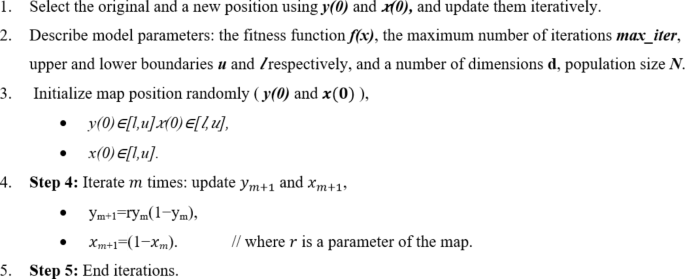
Chaotic maps generation.
One simple and efficient method is to use a separate optical modulator that is electrically motivated by the information bit-stream while the optical disorganized carrier is coupled at its input. It would be extremely difficult, if not impossible, to decipher this encoded information using traditional methods like linear filtering, frequency-domain evaluation, and phase-space reconstruction because the amplitude of the encrypted message is always kept small in comparison to the amplitude fluctuations of the chaotic carrier. The latter, in particular, depends on the chaos dynamics generation process and presupposes a very complicated chaotic carrier. A second chaotic oscillator, which can be used in the transmitter, is employed on the receiving side of the system.
In the equation \(\:{B}_{m}\left(p\right)\), the baseline performance indicator is represented, and the variables \\(\:{U}_{max}\left(p\right)\), \(\:p+qt\), and \(\:{N}_{min}\) are the variables that contribute to the overall performance, which is then aggregated into \(\:{N}_{max}\) .
A ratio of specific variables adjusted by \(\:{U}_{\text{min}(p-q)}\) and \(\:{U}_{\text{max}\left(p-q\right)}\), which are affected by operational variability (\(\:{u}_{p}^{min}\)), is shown by the \(\:{v}_{b}\left(min\right)\). This is balanced on the Eq. 14 by a dynamic correction term and the ratio.
Equation 15 shows how different elements are interdependent on \(\:ERD\). In this case, the aggregate performance metric is denoted as \(\:\frac{1}{P}\) is adjusted by \(\:{P}_{0}-\:{p}_{m}\) and some combination of \(\:y+1p\), \(\:P\left(j,k\right)\), and \(\:100\:\%\), with \(\:j=1\) modulating the adjustment. Additionally, the symbol represents a ratio of performance to control variables.
While \(\:{EF}_{ss}\) accounts for initial circumstances, the system parameter \(\:\frac{1}{NP}\) affects the variable \(\:R\left(j,k\right)\). Both \(\:Q\) and \(\:k=p\) represent ratios that reflect the dynamics of the system and its efficacy \(\:\left(w2+1\right)\), respectively.
Secured model for hybrid system
In this section, we designed a secure combination free space/fiber optic (FSO/FO) system that uses optical chaos in various conditions shown in Fig. 4. Inside the scope of this secure communication system, the chaotic signal conceals anything included within the message through its chaos. The overwhelming majority of individuals believe that this security strategy is preferable to other methods, such as using algorithms for encryption and other relatively equivalent ways. Following the addition of the chaos signal to the message, the data analysis reveals that the transmission distance has been reduced by around one hundred kilometers. The fall in temperature takes place regardless of the meteorological conditions that are currently in effect. Under all circumstances, implementing the dual FSO channels (DFSO) leads to an increase in the hyperlink distance of around 37–40% more than previously.

Secure model for hybrid chaotic optical communications.
The variables \(\:{s}_{yz}\), \(\:1-m\), and \(\:{\left({Y}_{l}-F\left(y\right)\right)}^{2}\) are used to represent different uncertainties and restrictions, whereas the variables \(\:D(z\) and \(\:E\:\left(z\right)\)are used to indicate certain aspects that impact the choice. Highlighting the framework’s flexibility to market dynamics, the expression \(\:q\left(1+p\right)\) indicates the system’s responsiveness to changes in both quantity and price.
Operational parameters are denoted by \(\:E\left(y\right)\) and critical factors impacting the outcome are represented by \(\:{y}_{z}-F\left(y\right)\)and \(\:\frac{1}{P}\). The expression \(\:{z}_{l}-F\left(z\right)\)illustrates the framework’s capacity to adapt to both external \(\:\frac{1}{v}\) and internal factors \(\:{u-pe)}^{2}\).
The variable \(\:{p}_{z+1}\) accounts for operational dynamics and efficiency, whereas the equation \(\:s\:\times\:{g}_{v}\) depicts a quantity affected by the factor \(\:1-{z}_{p}\). The term \(\:FRQW\:\left(\frac{{U}_{old}}{{U}_{new}}-1\right)\) takes planning restrictions into consideration.
Equation 20 elements that analysis of network security is encapsulated by \(\:{y}^{z}\) and \(\:{z}_{x}\left(1-p\right)\), whereas operational dynamics and system variables are adjusted for by \(\:a+bq+c\:heq\:\left(y\right)\). Furthermore, planning limitations and changing parameters are taken into consideration by \(\:y-z\:\left(p+q\right)\).
Secured model for IM/DD system
This section designs the secured model for the intensity modulating and direct detection (IM/DD) system depicted in Fig. 5. This model is implemented on 25 km. In addition, the digital and analog domains were encrypted using phase modulator technology and digital signal processing technology, respectively. Using a sampling rate of 15 GSa/s, the encrypted signal located at the digital end was put into an Arbitrary Waveform Generation (AWG, TekAWG70002A). The photoelectric modulation process was accomplished by injecting the amplification of the analog signal into a Mach–Zehnder modulator (MZM) after it is amplified by an electric amplifier (EA). The laser’s strength and wavelengths were adjusted to be 10 dBm and 1550 nm, respectively. The signal that the MZM produced was sent to Phase Modulation (PM 1) to perform phase encryption perturbation. For the PM, the half-wave voltage was measured to be 6 V. A value of 2 was assigned to the modulation depth. which is the defining characteristic with Multiple System Operator (MSO). The chaotic circuit was responsible for the generation of the driving signal for PM 1. Following its amplification (EDFA), the modulated fiber optic signal was sent into a 25-kilometer short-wave microwave (SSMF) distance using Verband der Automobilindustrie (VDA). It is important to note that the radio frequency, or RF, signals produced by the intensity modulator and the ones generated by the phase generator are independent. As a result, there is no association between the rates produced by the intensity generator and the phase modulator with photodiode (PD). Moreover, the details of other component parameters are discussed in Table 2.

Secured model for IM/DD system.
The analysis of synchronization is represented by the Eq. 17, \(\:a\), which takes into account \(\:pp+q\) in one part and \(\:\frac{1}{{S}_{7}{D}_{3}}\) in the other part, which takes into account the item of \(\:p-q\), \(\:rew\:\left(z\right)\), and \(\:{C}_{v}{d}_{f}\). The phrase further mitigates the effect of systems dynamics on security \(\:{e}_{d}\left(u+k\right)\).
While \(\:{y}_{j}-\:{\forall\:}_{k}\) encompasses productivity in the sensitivity analysis, the Eq. 22\(\:DD\) acts as a multiplier for parameters connected to productivity. The expression \(\:{z}_{l}-{Q}_{s}\) represents extra factors and modifications related to productivity \(\:a-z\). Lastly, systemic impacts on production \(\:e-1\) are considered by the expression \(\:s+q(m-n)\).
Equation 23, in this case, \(\:edf\left(z\times\:12\left(x+1\right),\:2\right)\) denotes an analysis of robustness that is considered baseline, whereas \(\:{G}_{f1}\) takes into consideration particular environmental impacts. Additional considerations and modifications \(\:Z\) related to sustainability are included in the expression \(\:{H}_{jk2}\). Lastly, the impacts on systemic sustainability are captured by \(\:Nbu\).
The analysis of reliability relative to a given reference is represented by the Eq. 24\(\:J\left(p\right)\), and performance limits or deviations are adjusted for by \(\:{\sum\:}_{p=1}^{e}q\:\left(nj\right)log\). The expression \(\:Q\:\:{\left(hj+kpw\right)}_{2}\) represents extra factors and modifications related to performance that consider planning limitations. Finally, the impacts on systemic performance are captured by \(\:ge\). Algorithm 2 shows the Stage-by-Stage message encryption algorithm using a chaotic communication method.

An encryption algorithm using HOFS-COCS method.
Performance evaluation
In this section, we evaluate the performance of our proposed HOFS-COCS method for hybrid chaotic optical communication with other benchmarks27,29,30,31,32. Moreover, this paper explores the analysis of the HOFS-COCS method regarding systems’ network security ratio, synchronization, sensitivity, robustness, and reliability. All the outcomes show that our proposed work outperforms other methods, explicitly achieving the efficiency of a current HOFS.
Simulation setting and dataset description
The OPNET Modeler is used for extensive simulation analysis56. Besides, the optical interconnection network dataset57 examines the performance with baseline methods. We examine our proposed work using the current techniques: traditional HOFS with existing works and our proposed method HOFS-COCS with the existing study. The results show that our proposed method achieved better overall performance than the HOFS method. The details of each result are discussed below against each metric. The objective of this simulation is to evaluate the performance of the HOFS-COCS under varying load conditions, focusing on its synchronization accuracy, security, sensitivity, reliability and robustness to reduce the transmission error ratio and improve the overall performance.
The simulation is set up in OPNET Modeler with two primary nodes: a chaotic optical transmitter and a receiver. The transmitter generates and modulates chaotic signals, while the receiver synchronizes with the transmitter to demodulate and decrypt the data. Specific configurations for chaotic modulation, feedback loop parameters, and encryption algorithms are set within the model.
Results discussion
This section discussed the results of our proposed HOFS-COCS method with traditional HOFS using other baseline studies.
Accuracy of network security
Figure 6 shows the accuracy of the network security results. We notice that the efficiency of the HOFS method is good in Fig. 6a compared to the baseline methods. The baseline methods have the lowest accuracy of network security because these studies have issues with security, vulnerability to parameter fluctuations, and insufficient assault resilience, which are commonplace in traditional network safety solutions, as expressed in Eq. 20. Figure 6b show the results of HOFS-COCS methods that reduce the troubles by making it easier to generate sturdy chaos, which is extra secure against eavesdropping and interception because of its unpredictable nature. The chaotic indicators produced using HOFS-COCS ensure stable communication, which aligns with our calculations and checks of the dynamic behavior of the included semiconductor laser. Even though there are a few modifications to the machine parameters, the communication channel’s safety and integrity are not affected since the device is resilient to commonplace parameter errors. Accurate control and stability in optical communication processes are made feasible by adequately controlling the system’s sensitivity to essential parameters. When coping with inherently chaotic communication networks, this diploma of stability and manipulation is critical for ensuring that all parties involved continue synchronizing. Extensive experimental proof that HOFS-COC substantially improves community safety by ensuring synchronization and reliable chaos introduction, allowing for steady message transmission. This approach strengthens the inspiration for destiny improvements to network protection protocols and fixes the existing troubles. The proposed method, HOFS-COCS, is essential to building more stable and resilient conversation networks since it provides a capacity response to enhance network security in chaotic optical communication systems. However, the overall performance of HOFS-COCS is better than that of HOFS, with the accuracy ratio expressed at 98.7% and 97.9%, respectively, at iteration 100.

(a) Network security accuracy with HOFS. (b) Network security accuracy with HOFS-COCS.
Analysis of synchronization
A vital feature of chaotic communication systems, synchronization, keeps the sender and receiver in sync, facilitating unique message decoding, expressed in Eq. 21. Due to their susceptibility to parameter fluctuations and external disturbances, conventional chaotic communication structures occasionally battle to maintain synchronization. The outcomes of Fig. 7a show the performance of HOFS in comparison with the other benchmark. The HOFS addresses the vulnerability and overcomes the synchronization issues using a hybrid feedback system, stabilizing the chaotic dynamics. On the other hand, we notice that Fig. 7b indicates that the HOFS-COCS method efficiently maintains synchronization even under generous working situations by carrying out significant simulations and experimental exams. The synchronization’s resilience is because of the machine’s capability to manage external perturbations and parameter errors, which are accepted in real-international optical communication situations. The hybrid feedback machine modifies the comments settings dynamically to maintain consistent receiver-transmitter alignment. Applications regarding actual-time conversation, wherein operational and environmental variables can exchange quickly, require this adaptable capability. In addition to achieving honest synchronization, the experimental results show that the HOFS-COCS approach improves the communication device’s protection by fending off synchronization attacks, a standard danger in chaotic communication. The HOFS-COCS approach is an enormous advance in network protection because it guarantees reliable synchronization, making chaotic optical communication systems much more realistic and secure. Finally, HOFS-COCS helps safe and stable optic communication channels by providing a sturdy strategy for synchronization problems in chaotic communication and outperforms with a ratio of 97.1% compared to the HOFS ratio of 95.9% at iteration 100.

(a) Synchronization performance of HOFS compared to baseline methods. (b) Synchronization performance of HOFS-COCS.
Analysis of sensitivity
Chaos systems are characterized by their sensitivity to changes in the initial conditions and the parameters that govern the system, as expressed in Eq. 22. System behaviors may become unpredictable and divergent, whereas sensitivity is high, making providing the stableness and synchronization required for safe communication tougher. With the intention of stabilizing chaotic dynamics and restricting immoderate sensitivity, the HOFS-COCS approach introduces a hybrid comments device. Figure 8 shows the performance of HOFS and HOFS-COCS with the other baseline studies, and we noticed that the performance of the HOFS in Fig. 8a is better than other current studies due to the secured structure in optical communication systems but less practical in real-world scenario and dynamic hybrid systems. To address these issues, our proposed method, HOFS-COCS, ensures safe, dependable, and efficient communication channels and is a robust solution for managing sensitivity in chaotic optical communication exchange structures. Finally, HOFS-COCS adaptive manipulation substantially complements handling sensitivity, improving the security concerning the sensitivity ratio of HOFS-COCS 97%, as shown in Fig. 8b, compared to the HOFS ratio of 94.

(a) Sensitivity analysis of HOFS. (b) Sensitivity analysis of HOFS-COCS.
Analysis of robustness
When confronted with threats, conventional chaotic communication exchange systems are prone to desynchronization and security breaches due to their inherent fragility, which is achieved by Eq. 23. Incorporating a hybrid remarks mechanism that strengthens the system in opposition to unusual interruptions, the HOFS-COCS solution tackles those problems. The research indicates that HOFS-COCS significantly strengthens chaotic optical communication systems’ resilience by undertaking massive communication and actual assessments. The hybrid remarks mechanism adapts dynamically to changing situations to stabilize the chaotic signals and guarantee steady performance. According to Fig. 9a and b, this flexibility is important for maintaining synchronization and steady communication when operational and environmental elements can be exchanged in real-world conditions. According to the effects of the experiments, attacks that take advantage of parameter adjustments or outside disruptions are much less likely to triumph, while the HOFS-COCS method is used due to its accelerated resilience. HOFS-COCS continues to make communication channels stable and secure, regardless of outside factors, to ensure community security’s efficacy and dependability. Finally, HOFS-COCS substantially improves the robustness of chaotic optical communication systems with a ratio of 94% compared to HOFS’ ratio of 92% with the baseline works. Moreover, the proposed method HOFS-COCS provides a resilient approach to stable and reliable communication in unexpected and dynamic conditions.

(a) Robustness analysis of HOFS. (b) Robustness analysis of HOFS-COCS.
Analysis of reliability
Problems with synchronization loss and communication breakdowns are not unusual in conventional chaotic communication systems because chaotic alerts are inherently sensitive to beginning conditions and parameter changes, as expressed in Eq. 24. By implementing a hybrid comments mechanism that dynamically adjusts comments settings to stabilize chaotic dynamics and maintain synchronization, the HOFS-COCS approach circumvents these issues. The results are shown in Fig. 10a and b, by subjecting chaotic optical conversation structures to exhaustive simulations and experimental verification. The results demonstrate that HOFS-COCS significantly enhances the reliability of hybrid systems. The adaptive hybrid comments system continues the consistent and reliable conversation by adjusting to new parameters and overcoming outdoor disturbances. When used within the real world, this flexibility is crucial because of the inherent uncertainty of each environment and operational parameters. The experimental results show that HOFS-COCS protects against verbal exchange failures and security breaches by reliably synchronizing the transmitter and receiver, even in hard situations. Ultimately, traditional systems have errors, and HOFS-COCS is incorporated into chaotic optical communication systems to give a compact and trustworthy answer. A critical development in community safety technology, this improved dependability ensures the constant and uninterrupted operation of the communique channels even as concurrently strengthening their security. The performance of HOFS-COCS and HOFS are discussed in the Figure of 10 with the ratios of 91.9% and 87.0% respectively with the other benchmark. With its dependable, safe, and effective solution for contemporary communication networks, HOFS-COCS stands out as a crucial development in network security. Moreover, the overall results are discussed in Table 3 with traditional HOFS and our proposed work HOFS-COCS.

(a) Reliability analysis of HOFS. (b) Reliability analysis of HOFS-COCS.
Optical time domain representation
In this section, we discuss the optical signal’s time-domain waveform in Table 4, which includes the following:
-
Original Signal: Included the unencrypted, transmitted signal modulated with chaotic properties.
-
Encrypted Data: The chaotic signal during transmission exhibits broadband characteristics due to its chaotic nature, making it appear as noise to external observers.
-
Received Decrypted Signal: After demodulation, the receiver regenerates the original signal, verifying successful synchronization.
The signal waveforms of the original, encrypted, and decrypted data can be visualized to confirm the integrity of transmission at a specific distance. Table 4 visually represents the effectiveness of the proposed approach in maintaining the integrity and security of the communication.
Conclusion
This paper provides groundbreaking research that improves network safety by utilizing a secured approach HOFS-COCS. The research utilizes chaotic optical communication for hybrid systems. By making certain robust chaos technology a prerequisite for secure communication, our results show that the HOFS-COCS method effectively overcomes the shortcomings of current baseline methods and is outperforming in terms of accuracy of network security with 98.7%, synchronization, 97.1%, sensitivity: 97.6%, robustness: 99.3%, and reliability 91.9%. HOFS-COCS are integrated into chaotic optical communication systems to guarantee secure and reliable message transport, which makes them extra resilient to common parameter error rates and more sensitive to critical elements. Our proposed method reduced protracted-standing trouble in the hybrid feedback system by giving a stable foundation for reliable chaos advent and synchronization, which opens the door to more secure and efficient communication routes. Finally, by imparting progressed secrecy and synchronization abilities in chaotic optical communication networks, the proposed HOFS-COCS approach signifies an enormous advancement in network safety and establishes a new benchmark for upcoming protection protocols.
Data availability
The datasets used and/or analyzed during the current study available from the corresponding author on reasonable request.
References
Lu, Y., Wang, H., Ji, Y. & Zhang, Y. Security-enhanced electro-optic chaotic communication system based on the logistic map feedback and dynamic key. JOSA B. 40, 1131–1140 (2023).
Zhu, J., Zhuang, G., Chen, G. & Xie, X. Static output feedback quantized dissipative security control of singular hybrid systems subject to multiple cyber attacks: a dynamic-memory event-triggered strategy. Commun. Nonlinear Sci. Numer. Simul. 128, 107652. https://doi.org/10.1016/J.CNSNS.2023.107652 (2024).
Qamar, F., Islam, M. K., Farhan, R. & Ali, M. Ali Shah, S. Z. secure optical qam transmission using chaos message masking. J. Opt. Commun. 43, 421–428 (2022).
Li, M. et al. Chaotic radio frequency fingerprint masking against identity attacks. IEEE Wirel. Commun. Lett. 1–1. https://doi.org/10.1109/LWC.2024.3434453 (2024).
El-Meadawy, S. A. et al. Efficient and secure bit-level chaos security algorithm for orbital angular momentum modulation in free-space optical communications. IEEE Access. 9, 74817–74835 (2021).
Zhong, Q. et al. Analog–digital combined high-secure optical communication system based on chaotic circuit driving. Photonics. 9, 669 (2022).
Gao, Z. et al. 32 gb/s physical-layer secure optical communication over 200 km based on temporal dispersion and self-feedback phase encryption. Opt. Lett. 47, 913–916 (2022).
Hasan, M., Kashinath, A., Chen, C., Mohan, S. & Sok Security in real-time systems. ACM Comput. Surv. 56 (1–218:31). https://doi.org/10.1145/3649499 (2024).
Wang, D., Li, F., Liu, K. & Zhang, X. Real-time cyber-physical security solution leveraging an integrated learning-based approach. ACM Trans. Sens. Networks. 20(1–27:22), 3582009. 10.1145/ (2024).
Wang, L. et al. Scheme of coherent optical chaos communication. Opt. Lett.45, 4762–4765 (2020).
Lin, L., Li, Q. & Xi, X. Asynchronous secure communication scheme using a new modulation of message on optical chaos. Opt. Quantum Electron. 55, 15 (2023).
Chen, F., Wei, Y., Ji, H. & Xu, G. A multiplex network based analytical framework for safety management standardization in construction engineering. Adv. Eng. Inf. 59, 102278. https://doi.org/10.1016/J.AEI.2023.102278 (2024).
Narang, G., Aggarwal, M., Kaushal, H. & Ahuja, S. Enhancing the security of free space optical communication system by employing chaos-based modulation scheme. J. Opt. Commun. (2023).
Zhao, A. et al. Semiconductor laser-based multi-channel wideband chaos generation using optoelec- tronic hybrid feedback and parallel filtering. J. Light Technol. 40, 751–761 (2021).
Aljohani, M. Transforming data-intensive workflows: a cutting-edge multi-layer security and quality aware security framework. Concurr Comput. Pract. Exp. 36 https://doi.org/10.1002/CPE.8068 (2024).
Chen, Q., Fan, Y., Cheng, M. & Gao, X. Secure spread spectrum communication using super- orthogonal optical chaos signals. IEEE Photonics J. 14, 1–6 (2022).
Jiang, L. et al. Chaotic optical communications at 56 gbit/s over 100-km fiber transmission based on a chaos generation model driven by long short-term memory networks. Opt. Lett. 47, 2382–2385 (2022).
Wen, H. et al. Secure dna-coding image optical communication using non-degenerate hyperchaos and dynamic secret-key. Mathematics. 10, 3180 (2022).
Wang, L. et al. Chaos synchronization of semiconductor lasers over 1040-km fiber relay transmission with hybrid amplification. Photonics Res. 11, 953–960 (2023).
Zhang, X. et al. The security in optical wireless communication: a survey. ACM Comput. Surv. 55, 1–36 (2023).
Singh, A., Sandha, K. S. & Rai, M. K. Design and analysis of active feedback rgc-based tran- simpedance receiver circuit for optical interconnects. J. Circuits Syst. Comput. 33 (2450125:24), 2450125:1. https://doi.org/10.1142/S0218126624501251 (2024).
Dabbicco, M., Columbo, L. L. & Perchoux, J. Laser optical feedback turns 60. Sensors. 23, 1176. https://doi.org/10.3390/S23031176 (2023).
Raj, A. A. B. et al. A review–unguided optical communications: developments, technology evolution, and challenges. Electronics. 12, 1922 (2023).
Garg, D. & Nain, A. Next generation optical wireless communication: a comprehensive review. J. Opt. Commun. 44, s1535–s1550 (2023).
Song, Z. et al. High capacity turbulence-resilient free-space chaotic optical communication based on vector optical field manipulation. J. Light Technol. 1–8. https://doi.org/10.1109/JLT.2024.3435076 (2024).
Hao, N. et al. Numerical investigations of m-qam chaotic optical communication with amplitude and phase encryption. J. Light Technol. 42, 5141–5147. https://doi.org/10.1109/JLT.2024.3389036 (2024).
Abdulwahhab, A. W., Abass, A. K., Saleh, M. A. & Rashid, F. F. Enhancing performance of optical chaotic-based secure fiber-optic communication system. Opt. Quantum Electron. 55, 468 (2023).
Optical system design. Software | Optisystem | Optiwave (https://OpticalSystemDesignSoftware| OptiSystem|Optiwave, 2023).
Shao, W., Fu, Y., Cheng, M., Deng, L. & Liu, D. Chaos synchronization based on hybrid entropy sources and applications to secure communication. IEEE Photonics Technol. Lett. 33, 1038–1041 (2021).
Fu, Y. et al. Analog-digital hybrid chaos-based long-haul coherent optical secure communication. Opt. Lett. 46, 1506–1509 (2021).
Xie, Y. et al. 100 gb/s coherent chaotic optical communication over 800 km fiber transmission via advanced digital signal processing. Adv. Photonics Nexus. 3, 016003–016003 (2024).
Guo, H. et al. Accelerated key distribution method for endogenously secure optical communication by synchronized chaotic system based on fiber channel feature. Opt. Fiber Technol. 75, 103162 (2023).
Ali, A. et al. International Conference on Cyber and Design and Analysis of Secure RoF Based Communication in 5G Fronthaul, (ICCWS), Islamabad, Pakistan, 2020, pp. 1–6, (2020). https://doi.org/10.1109/ICCWS48432.2020.9292380
Nazakat, Z., Kaleem, M., Qamar, F. & Shahzadi, R. Secure RoF based 5G backhaul communication using semiconductor laser generated optical chaos. J. Opt. Commun. https://doi.org/10.1515/joc-2023-0296 (2023).
Qamar, F., Islam, M., Shahzadi, R., Ali, S. & Ali, M. 128-QAM dual-polarization chaotic long-haul system performance evaluation. J. Opt. Commun. 44(s1), s1873–s1881. https://doi.org/10.1515/joc-2020-0092 (2023).
Yang, D. et al. A robust light field semantic segmentation network combining contextual and geometric features. Front. Environ. Sci. 1443. https://doi.org/10.3389/fenvs.2022.996513
Dai, M., Luo, L., Ren, J., Yu, H. & Sun, G. PSACCF: prioritized online slice admission control considering fairness in 5G/B5G networks. IEEE Trans. Netw. Sci. Eng.9 (6), 4101–4114. https://doi.org/10.1109/TNSE.2022.3195862 (2022).
Sun, G., Sheng, L., Luo, L. & Yu, H. Game theoretic approach for multipriority data transmission in 5G vehicular networks. IEEE Trans. Intell. Transp. Syst. 23(12), 24672–24685. https://doi.org/10.1109/TITS.2022.3198046 (2022).
Sun, G. et al. Profit maximization of independent task offloading in MEC-enabled 5G internet of vehicles. IEEE Trans. Intell. Transp. Syst. 1–13. https://doi.org/10.1109/TITS.2024.3416300 (2024).
Zhao, Y., Wang, X. & Huang, Z. Multi-function radar modeling: a review. IEEE Sens. J.https://doi.org/10.1109/JSEN.2024.3436877 (2024).
Tian, H. et al. Dynamic analysis and sliding mode synchronization control of chaotic systems with conditional symmetric fractional-order memristors. Fract. Fract. 8 (6), 307. https://doi.org/10.3390/fractalfract8060307 (2024).
Ni, H. et al. Path loss and shadowing for UAV-to-ground UWB channels incorporating the effects of built-up areas and airframe. IEEE Trans. Intell. Transp. Syst. 1–12. https://doi.org/10.1109/TITS.2024.3418952 (2024).
Fang, H. et al. Multimodal in-sensor computing implemented by easily-fabricated oxide-heterojunction optoelectronic synapses. Adv. Funct. Mater. 2409045. https://doi.org/10.1002/adfm.202409045 (2024).
Yue, S., Zeng, S., Liu, L., Eldar, Y. C. & Di, B. Hybrid near-far field channel estimation for holographic MIMO communications. IEEE Trans. Wirel. Commun. https://doi.org/10.1109/TWC.2024.3433491 (2024).
Gong, Y. et al. Computation offloading and quantization schemes for federated satellite-ground graph networks. IEEE Trans. Wirel. Commun. https://doi.org/10.1109/TWC.2024.3409691 (2024).
Li, T., Xiao, Z., Georges, H., Luo, Z. & Wang, D. Performance analysis of co- and cross-tier device-to-device communication underlaying macro-small cell wireless networks. KSII Trans. Internet Inf. Syst. 10(4), 1481–1500. https://doi.org/10.3837/tiis.2016.04.001 (2016).
Chen, B., Hu, J., Zhao, Y. & Ghosh, B. K. Finite-time velocity-free rendezvous control of multiple AUV systems with intermittent communication. IEEE Trans. Syst. Man. Cybern : Syst. 52(10), 6618–6629. https://doi.org/10.1109/TSMC.2022.3148295 (2022).
Xu, B. & Guo, Y. A novel DVL calibration method based on robust invariant extended Kalman filter. IEEE Trans. Veh. Technol. 71(9), 9422–9434. https://doi.org/10.1109/TVT.2022.3182017 (2022).
Gao, N. et al. Energy model for UAV communications: experimental validation and model generalization. China Commun. 18(7), 253–264. https://doi.org/10.23919/JCC.2021.07.020 (2021).
Zhang, H., Xu, Y., Luo, R. & Mao, Y. Fast GNSS acquisition algorithm based on SFFT with high noise immunity. China Commun. 20(5), 70–83. https://doi.org/10.23919/JCC.2023.00.006 (2023).
Jiang, F., Li, T., Lv, X., Rui, H. & Jin, D. Physics-informed neural networks for path loss estimation by solving electromagnetic integral equations. IEEE Trans. Wirel. Commun. https://doi.org/10.1109/TWC.2024.3429196 (2024).
Sheng, H. et al. Discriminative feature learning with co-occurrence attention network for vehicle ReID. IEEE Trans. Circuits Syst. Video Technol. 34(5), 3510–3522. https://doi.org/10.1109/TCSVT.2023.3326375 (2024).
Wang, Q., Sihvola, A. & Qi, J. A novel procedure to hybridize the folded transmitarray and fabry–Perot cavity with low antenna profile and flexible design frequency. IEEE Antennas Wirel. Propag. Lett. 23(8), 2501–2505. https://doi.org/10.1109/LAWP.2024.3398076 (2024).
Zha, S., Qu, Z., Zhang, J., Zheng, D. & Liu, P. A gain-reconfigurable reflector antenna with surface-mounted field-induced artificial magnetic conductor for adaptive HIRF prevention. IEEE Trans. Antennas Propag. 72 (9), 7252–7260. https://doi.org/10.1109/TAP.2024.3434371 (2024).
Yang, Y., Zhang, Z., Zhou, Y., Wang, C. & Zhu, H. Design of a simultaneous information and power transfer system based on a modulating feature of magnetron. IEEE Trans. Microw. Theory Tech. 71 (2), 907–915. https://doi.org/10.1109/TMTT.2022.3205612 (2023).
Opnet modeler. (2023). https://support.riverbed.com/content/support/software/opnet-model/modeler.html
Inancigdem. Optical interconnection network dataset. (2023). https://www.kaggle.com/datasets/inancigdem/optical-interconnection-network
Acknowledgements
The authors would like to acknowledge the Hanjiang Normal University for supporting this research work under Research Stratup Grant: 5080301149.
Author information
Authors and Affiliations
Contributions
M. Wasim Abbas Ashraf, Arvind R. Singh: Conceptualization, Methodology, Software, Visualization, Investigation, Writing- Original draft preparation. A. Pandian, Rajkumar Singh Rathore: Data curation, Validation, Supervision, Resources, Writing - Review & Editing. Mohit Bajaj, Ievgen Zaitsev: Project administration, Supervision, Resources, Writing - Review & Editing.
Corresponding authors
Ethics declarations
Competing interests
The authors declare no competing interests.
Additional information
Publisher’s note
Springer Nature remains neutral with regard to jurisdictional claims in published maps and institutional affiliations.
Rights and permissions
Open Access This article is licensed under a Creative Commons Attribution-NonCommercial-NoDerivatives 4.0 International License, which permits any non-commercial use, sharing, distribution and reproduction in any medium or format, as long as you give appropriate credit to the original author(s) and the source, provide a link to the Creative Commons licence, and indicate if you modified the licensed material. You do not have permission under this licence to share adapted material derived from this article or parts of it. The images or other third party material in this article are included in the article’s Creative Commons licence, unless indicated otherwise in a credit line to the material. If material is not included in the article’s Creative Commons licence and your intended use is not permitted by statutory regulation or exceeds the permitted use, you will need to obtain permission directly from the copyright holder. To view a copy of this licence, visit http://creativecommons.org/licenses/by-nc-nd/4.0/.
About this article

Cite this article
Ashraf, M.W.A., Singh, A.R., Pandian, A. et al. Enhancing network security with hybrid feedback systems in chaotic optical communication. Sci Rep 14, 24958 (2024). https://doi.org/10.1038/s41598-024-76391-0
Received:
Accepted:
Published:
Version of record:
DOI: https://doi.org/10.1038/s41598-024-76391-0
Keywords
This article is cited by
-
A lightweight framework to secure IoT devices with limited resources in cloud environments
Scientific Reports (2025)
-
A hybrid multi-node QKD-ECC architecture for securing IoT networks
Scientific Reports (2025)
-
Image vaccine against steganography in encrypted domain
Scientific Reports (2025)
-
A new model to evaluate the success of service composition method in cloud-based IoT systems using an enhanced swarm-based optimization algorithm
Cluster Computing (2025)
-
A Novel Approach for Computation Offloading Based on a Parallel Collaborative Genetic Algorithm in MEC
Wireless Personal Communications (2025)

