
Abstract
In traditional Chinese living environments, architecture and furniture have long complemented each other, forming a unified spatial aesthetic. However, in contemporary China, a disconnect has emerged between furniture design and architectural styles in terms of form and cultural meaning. This separation from regional architectural contexts disrupts the integration of traditional cultural elements between furniture and buildings, resulting in a lack of harmony between interior and exterior design styles and also weakening the role of furniture as a medium for cultural heritage preservation. To address this issue, this study takes the Lingnan region of China as a case study and aims to propose a comprehensive and systematic design and evaluation methodology for incorporating traditional regional architectural culture into the design of Neo-Chinese style seating. Through interviews, diverse design requirements for Neo-Chinese style seating were identified. On this basis, a KANO questionnaire was developed and distributed to 418 respondents to assess consumer preferences. The must-be, one-dimensional, and attractive attributes identified through the KANO model were structured into a hierarchical model using the Analytic Hierarchy Process (AHP), and the weight and priority of each indicator were calculated. Representative traditional Lingnan buildings were selected based on expert opinions, and their cultural elements were deconstructed for application in seating design. Guided by the analyzed user needs and extracted architectural elements, innovative design practices were conducted. The resulting seating designs were then evaluated using the Technique for Order Preference by Similarity to an Ideal Solution (TOPSIS). Evaluation results confirm the feasibility and effectiveness of the proposed framework in enhancing the quality of Neo-Chinese style seating design and meeting diverse consumer needs. This study offers a practical methodological and design reference for integrating traditional architectural elements into contemporary furniture design and contributes to the innovative expression of traditional regional architectural culture in modern contexts.
Introduction
Architecture and furniture are two fundamental material elements essential for human survival. They depend on and influence each other1. Furniture serves as a key component of architectural interior spaces. It emerged alongside the origins of architecture2. Effective interactions between furniture decoration and architectural arrangements can maintain consistency between furniture and space3. Throughout the history of world architecture and furniture, each country and region’s furniture styles often correspond to contemporary architectural styles4,5. Architecture provides furniture with many design concepts and innovative inspirations. For example, in Rietveld’s Schröder House, architecture and furniture achieve high organic unity in form, color, materials, and design6. The Farnsworth House uses a uniform grid for floor paving. This integrates architecture and furniture into one7. From ancient Egypt’s first chair to China’s Ming-style furniture, all demonstrate deep connections between architecture and furniture8. From the perspective of modern furniture design, the pinnacle of furniture lineages vividly shows shadows of architectural design9. Eero Saarinen, a renowned architect in the international community, once stated: “Design furniture from the perspective of architecture, and design architecture from the perspective of the city”10. In summary, exploring the integration of architectural elements into modern furniture design not only promotes innovation in modern furniture. It also aids the inheritance and development of traditional architectural culture in contemporary times.
With the rise of globalization and modern design trends, the stylistic harmony between architecture and furniture design is seen as key to enhancing spatial experience and cultural identity11. Furniture design and architectural design have historically evolved together. Regional culture shapes both the structural forms of architecture and the aesthetic features of interior furnishings. However, recent studies suggest that this harmonious relationship is increasingly disrupted in contemporary design practices, particularly in regions undergoing rapid urbanization and cultural transformation7,12,13. As a result, furniture with distinct styles is placed in architectural environments with regional characteristics. This clear mismatch often weakens the sense of place and reduces users’ emotional connection14,15
This disconnection between architectural and furniture design styles stems from issues in furniture product design. With China’s growing cultural awareness, Neo-Chinese style furniture has emerged in the current market16,17. Many Neo-Chinese style furniture products merely imitate traditional furniture with minor improvements18. Others blindly simplify to fit modern design trends19. This leads to awkward and mismatched design styles. Some products prioritize market profit maximization. They lack design innovation. As a result, furniture appearances look very similar20 21. Market competition is also intense. Brands imitate each other. This worsens the market environment22. These problems further exacerbate the stylistic disconnect between architecture and furniture. They weaken the inheritance of regional culture and its fusion with contemporary innovation. Therefore, achieving organic integration of tradition and modernity in furniture design is crucial. This ensures Neo-Chinese style furniture aligns with the aesthetic language of regional architectural environments. It has become an important topic in current design research.
Over the course of China’s long cultural history, distinct architectural systems have developed in response to diverse geographical settings, climatic conditions, and regional traditions23. Representative examples include Huizhou, Suzhou, Minnan-Taiwanese, and Lingnan architectural styles. These historical architectural heritages not only reflect the craftsmanship and ingenuity of their time but also serve as vital carriers of regional culture. Among them, Lingnan architecture stands out for its strong cultural identity shaped by the subtropical climate and local customs. It exhibits unique regional characteristics in spatial layout, structural techniques, and decorative elements24. As a significant branch of traditional Chinese architecture, Lingnan architecture holds substantial research value. Aesthetically, it is distinguished by elements such as the qianglong (folding) doors, gray plaster reliefs, Manchurian windows, and courtyard configurations, which embody rich cultural symbolism and a distinct visual language25. These architectural features encapsulate the spatial intelligence and aesthetic philosophy of the Lingnan region. As such, they provide a valuable reservoir of design inspiration for contemporary art and design practices26.
Previous studies have explored the relationship between architecture and furniture design from various perspectives. Mahmoud27 examined how architectural and interior design elements affect the psychological states and behaviors of occupants. His work aimed to enhance designers’ awareness of the interaction between built environments and human psychology. Merrell et al. introduced an interactive furniture layout system that assists users by generating optimized layouts based on interior design guidelines28. This system uses density functions and hardware-accelerated Monte Carlo sampling to achieve high-quality results. Zallio and Clarkson investigated inclusive design in architecture, highlighting how architectural spaces influence individuals’ cognitive and emotional experiences29. These studies provide a solid theoretical foundation for integrating architectural elements into furniture design. However, most of this research is grounded primarily in architectural disciplines, focusing on traditional building typologies, spatial organization, structural techniques, and decorative methods. Interdisciplinary studies that combine architecture, design theory, and semiotics—particularly those exploring the application of traditional Lingnan architectural elements in contemporary furniture design—remain scarce and underdeveloped.
In the field of traditional Chinese architectural elements, several studies have employed advanced technologies to analyze regional styles. Zou et al. proposed a machine learning–based method to quantitatively recognize and evaluate the features and forms of regional architecture, using architectural heritage in Hubei Province as a case study30. Cheng et al. explored scientific approaches to quantify the color features of Hui-style architecture in southern Anhui, offering insight into the visual consistency and aesthetic stability of regional built environments31. Deng et al. employed eye-tracking technology to investigate visual perception behaviors among individuals from different cultural backgrounds when observing traditional Minnan architecture32. Their findings contribute valuable references for integrating multicultural elements into contemporary architectural design. Although China possesses a rich and diverse range of regional architectural styles, little research has specifically addressed the practical application of Lingnan architectural features in furniture design.
In terms of current research methods in furniture design, a range of approaches has been explored. Wei combined fuzzy logic with structured design techniques to develop a furniture design system for children based on fuzzy technology33. Vermeer et al. applied machine learning to generate novel furniture forms34. Li et al. used the evaluation grid method from Miryoku Engineering to guide the design and development of straw-woven furniture35. Matwiej and colleagues employed finite element analysis along with empirical research to optimize the structural design of upholstered furniture frames36. While these studies demonstrate methodological diversity, many still rely heavily on designers’ personal intuition for element selection. They often lack a user-centered design approach, which can result in a mismatch between product features and user needs. As a consequence, the final designs may fall short in effectively addressing user expectations and preferences.
In summary, the concepts, principles, and techniques of traditional Chinese architectural culture have significantly influenced contemporary furniture design. However, there remains a lack of in-depth research on how to effectively extract and apply traditional Lingnan architectural elements to modern furniture design. In particular, few studies offer user-centered design methods that furniture designers can follow. There is also a clear gap in systematic design and evaluation approaches for integrating traditional architectural elements. Therefore, this study aims to develop a comprehensive theoretical framework by deeply exploring traditional Lingnan architectural elements. The goal is to bridge the gap between traditional Chinese architectural culture and the style of modern neo-Chinese furniture design.
Materials and methods
This study does not involve any experimental research related to clinical trials, animals, human tissues, or biological samples. Human participation in this study is limited to interview surveys. Human participants were recruited based on the principle of voluntary participation in this study. Before the study commenced, the researchers informed all participants about the purpose of the research, the survey process, the use of the collected data, and the participants’ rights, obtaining their consent. All participants signed the informed consent form. Interviews with participants in this study were conducted from 10, January, 2025 to 7, February, 2025. This study does not involve any discussion related to personal religious beliefs, racial identity, political views, sexual orientation, financial information, or any other private matters. All data and information were collected, recorded, and stored anonymously and confidentially, without any actions that would infringe upon the privacy, dignity, health, or human rights of the participants. We confirm that all methods and procedures in this paper were carried out in accordance with relevant guidelines and regulations, adhering to ethical oversight requirements. The results presented in this study are original and have not been published or submitted elsewhere. This study has been reviewed and is hereby granted approval for implementation by the Jawatankuasa Etika Penyelidikan Manusia Universiti Sains Malaysia (JEPeM-USM), Human Research Ethics Committee USM (HREC). Ethics Approval Number: USM/JEPeM/PP/24 080,783.
This study proposes a framework for the application and evaluation of traditional Lingnan architectural elements in the design of modern Neo-Chinese style seating. The framework consists of four key stages, as illustrated in Fig. 1.

Design research framework process.
Stage 1: Collection and Analysis of Design Requirements for Neo-Chinese Style Seating.
Interviews were conducted to gather user requirements for Neo-Chinese style seating. The Kano model was then employed to classify these requirements based on their impact on user satisfaction. Subsequently, the Analytic Hierarchy Process (AHP) was used to construct a hierarchical model of design requirements. This allowed for the calculation of the weight of each requirement type. Key user needs were identified by ranking these weights.
Stage 2: Identification of Representative Lingnan Architectural Elements.
Traditional Lingnan architectural elements were collected through literature review and field investigation. An expert panel then selected the most culturally representative elements. These elements served as cultural resources for the design phase.
Stage 3: Innovative Design Practice for Neo-Chinese Style Seating.
Based on the most highly weighted user requirements and the identified Guangfu architectural elements, a series of innovative design proposals for Neo-Chinese style seating were developed.
Stage 4: Evaluation and Validation of Design Proposals.
Experts from relevant fields evaluated the proposed designs using the Technique for Order Preference by Similarity to an Ideal Solution (TOPSIS) method. The evaluation results were used to validate the feasibility and effectiveness of the proposed framework and to identify the most optimal design solution.
Research process
Design requirements acquisition
Selection of interview participant sample
To ensure the comprehensiveness, representativeness, and scientific validity of data collection, this study adopted purposive sampling to select interview participants. A diverse group of respondents was included to reflect a broad perspective on the design needs of new Chinese-style seating. The demographic characteristics of the participants are as follows: (1) Five Neo-Chinese style furniture designers with over ten years of professional experience. Their extensive practical knowledge and long-term industry engagement provided valuable insights into the design needs of Neo-Chinese style seating. (2) Three university professors and three doctoral students specializing in Neo-Chinese style furniture design research. They have rich academic, design, and teaching experience in the field. (3) Three Neo-Chinese style furniture sales managers with more than ten years of sales experience. As front-line professionals interacting with the market and end-users, these managers offered key insights into consumer preferences, market trends, and the popularity of specific design features within regional contexts. (4) Six consumer representatives who had purchased and used Neo-Chinese style seating, selected from various age groups, genders, and educational backgrounds. The participant breakdown is as follows: age groups—18–25 years (1 person), 26–35 years (1), 36–44 years (2), 45–60 years (1), and over 60 years (1); gender—3 males and 3 females; education—high school or below (1), undergraduate (2), master’s degree (2), and doctoral degree (1). Feedback from consumers provided first-hand information on actual user experience, aesthetic preferences, functional expectations, and cultural resonance with Neo-Chinese seating.
This study emphasized diversity, comprehensiveness, and representativeness in sample selection. Each participant category played a distinct role in the study. All participants contributed concrete and valuable insights based on their professional background or personal experience, aiding the construction of design requirement indicators. Through semi-structured interviews with these respondents, the study was able to explore the multidimensional needs embedded in Neo-Chinese style seating design, thereby enhancing the depth and reliability of the findings.
Acquisition of design requirements for Neo-Chinese style seating
This study collected raw data on the design requirements of Neo-Chinese style seating through semi-structured interviews. To ensure the comprehensiveness and depth of the data, four tailored interview guides were developed for different categories of participants, including Neo-Chinese style furniture designers, university professors and doctoral students specializing in Neo-Chinese style furniture design, experienced Neo-Chinese style furniture sales managers, and consumer representatives who had purchased and used Neo-Chinese style seating (see Tables 1, 2, 3 and 4). While the overall objectives of the interviews remained consistent, the specific questions were adjusted according to the participants’ backgrounds to capture key information about design requirements from the unique perspectives of each group.
During the interview process, the researchers followed a rigorous protocol. First, the purpose and procedure of the study were clearly explained to the participants, and informed consent was obtained. Subsequently, face-to-face interviews were conducted with each of the 20 participants using the pre-designed interview guides. The interviews focused on three main aspects: participants’ understanding of the design requirements for Neo-Chinese style seating, their specific feedback based on personal experience, and suggestions for future design improvements. Each interview lasted approximately 30–40 min and was audio-recorded in its entirety for later transcription and systematic analysis. Throughout the process, the researchers encouraged participants to express their views in detail while avoiding leading or suggestive questions, thereby ensuring that the collected data were authentic, reliable, and reflective of the true needs and perspectives of different participant groups.
After completing the interview data collection, the research team transcribed the audio recordings into textual materials and systematically coded them using Nvivo 12 software. To protect the privacy of participants, each interviewee was assigned a unique identification number to ensure the anonymity of information. To improve the scientific rigor and reliability of the coding results, this study adopted a multi-coder cross-coding method. Specifically, each coder independently read the interview transcripts, analyzing and coding them sentence by sentence. Subsequently, the research team collectively reviewed and discussed the coding results, making revisions through negotiation to reduce the impact of individual subjective bias on the results. On this basis, this study invited two expert designers specializing in Neo-Chinese style furniture with extensive practical experience and two professors and researchers in related fields to form an expert panel. The KJ method was then used to further organize and analyze the interview codes. Finally, this study identified 19 diverse design requirement indicators for Neo-Chinese style seating, which were subsequently used as the basis for developing the questionnaire items for the consumer KANO survey.
User demand analysis of Neo-Chinese style seating based on KANO model
The KANO model, proposed by Japanese scholar Noriaki Kano based on the two-factor theory37, is a user needs analysis method aimed at exploring the intricate relationship between product features and user satisfaction38,39. This model has been widely used for categorizing and prioritizing user needs40. The KANO model classifies user requirements into five categories: Must-be (M), One-dimensional (O), Attractive (A), Indifferent (I), and Reverse (R)41,42. As shown Fig. 2 and Table 5. In practical application, the KANO model uses a characteristic evaluation matrix to assess user demand attributes. The evaluation method adopts the highest frequency rule, where the final attribute category is determined by calculating the frequency of each type of demand attribute.

KANO model quality attribute classification diagram.
KANO questionnaire design
Based on the construction principles of the KANO model, the design requirement indicators for the Neo-Chinese style seating were determined through the analysis of stakeholder interviews. Both positive and negative questions were customized to investigate user needs for the Neo-Chinese style seating. A 5-point Likert scale was used in the questionnaire, offering five options for each item: dislike, can live with it, don’t care, accept, and like. Respondents selected the most appropriate answer based on their feelings and understanding to identify the attribute category of each requirement.
To ensure the clarity, reliability, and validity of the questionnaire, a pilot test was conducted on the initial draft, followed by detailed revisions and optimizations based on the feedback received. The final questionnaire included: demographic information, experience in using Neo-Chinese style seating, and KANO model evaluation items (19 pairs of positive–negative questions). An example of the KANO questionnaire is shown in Table 6. The complete KANO questionnaire is shown in “Supplementary material File S1”.
KANO questionnaire data collection and organization
The questionnaire survey in this study was conducted and collected online. It was distributed via local WeChat groups in the Lingnan region and community activity centers. The professional platform “Wenjuanxing” was used for questionnaire design and data collection. Clear screening criteria were set: respondents had to reside long-term in the Lingnan region and possess a certain level of understanding of Neo-Chinese style seating. Questionnaires from respondents living outside the Lingnan region or those who selected “not very familiar” or “completely unfamiliar” with Neo-Chinese style seating were considered invalid. A total of 462 questionnaires were collected. After data cleaning to remove invalid responses, 418 valid questionnaires remained, yielding a valid response rate of 90.87%.
Table 7 presents the demographic characteristics of the respondents. Among the 418 valid samples, 51.91% were male (217 respondents), and 48.09% were female (201 respondents), indicating a balanced gender distribution. The majority of respondents were aged 26–35 (26.32%, 110 respondents) and 36–45 (33.01%, 138 respondents), which aligns with the primary age group of the current Neo-Chinese style furniture consumer market. Regarding education level, 54.06% of participants held a bachelor’s degree or above. This relatively high educational background supports better understanding and accurate responses to questionnaire items, thereby enhancing data reliability. Respondents had diverse occupations, ensuring both variety and representativeness. In terms of monthly income, most respondents fell within the 5,000–10,000 RMB range (41.87%, 175 respondents) and the 10,000–15,000 RMB range (32.06%, 134 respondents).
KANO questionnaire data analysis
To ensure the reliability of the questionnaire data, this study first conducted a reliability test to assess the stability, consistency, and credibility of the results43. Cronbach’s α coefficient, the most commonly used indicator, was employed to measure the internal consistency among the questionnaire items44. As shown in Table 8, both the positively and negatively worded items had Cronbach’s α values above 0.8, indicating high internal consistency. This suggests that the questionnaire is reliable and suitable for further data analysis.
To assess the validity of the questionnaire and determine how accurately it measures the intended constructs, a validity test was conducted. As shown in Table 9, the Kaiser–Meyer–Olkin (KMO) value was 0.825. Bartlett’s test of sphericity yielded an approximate chi-square value of 3030.16 with a p-value of 0.000. Since the p-value is below the 0.05 significance level, the results indicate that the questionnaire has good validity.
This study employed the KANO model to systematically analyze the questionnaire data and categorize user needs for Neo-Chinese style seating. Based on the KANO model analysis, the identified requirements for Neo-Chinese style seating can be clearly classified into four categories: Must-be (M), One-dimensional (O), Attractive (A), and Indifferent (I). Through in-depth analysis of these attribute types, the study enables a more accurate understanding of consumers’ key needs and preference tendencies in seat design.
However, traditional KANO analysis often relies on the “maximum frequency method” to classify user requirement attributes. This approach may have certain limitations in practice, such as low classification accuracy and difficulty in fully capturing the true impact of each requirement on overall user satisfaction. To address this issue, Charles Berger and colleagues proposed the “Better-Worse Coefficient Analysis Method” as an optimization technique45. This method calculates two indices—the Satisfaction Index (SI) and the Dissatisfaction Index (DSI)—based on the response frequency of different attributes. The SI (usually a positive value) reflects the extent to which fulfilling a requirement increases user satisfaction, while the DSI (usually a negative value) indicates the degree of dissatisfaction caused when a requirement is not met.
The SI ranges from 0 to 1. A higher value means the requirement has a stronger positive effect on satisfaction when fulfilled. The DSI ranges from -1 to 0. A larger absolute value indicates a greater negative impact on satisfaction when the requirement is unmet. The Satisfaction Index (Si), Dissatisfaction Index (DSi), and Reverse Requirement Index (SR) are calculated using the following formulas:
By further applying the above formulas to the questionnaire data, the final results of the Kano user requirement analysis are presented in Table 10 and Fig. 3.

Better-worse coefficient analysis visualization.
Prioritizing design requirements for Neo-Chinese style seating using AHP
The Analytic Hierarchy Process (AHP) is a multi-criteria decision-making method proposed by Thomas Saaty in the 1970s46,47. It breaks down complex problems into a hierarchical structure comprising the overall goal, criteria, and sub-criteria. Based on expert judgment, a pairwise comparison matrix is constructed to calculate the relative weights of each factor48. By combining qualitative and quantitative analysis, AHP has been widely applied in priority ranking, resource allocation, and decision analysis49. This method is known for its clear structure, ease of use, and strong practicality. It also includes a consistency check to reduce subjective bias, making the decision-making process more scientific and reliable50. Therefore, AHP was adopted in this study to enhance the rigor and feasibility of the design methodology.
Development of a hierarchical evaluation model for Neo-Chinese style seating design
The key user requirements identified from the KANO questionnaire-Must-be (M), One-dimensional (O), and Attractive (A)-were structured into a hierarchical model, as shown in Fig. 4.

The hierarchical model of demand indicators for Neo-Chinese style seating design.
Construction of the judgment matrix
The construction of the judgment matrix involves pairwise comparisons among the indicators at the same level of the hierarchical model to determine their relative importance51. Based on these comparisons, the weight of each indicator can be calculated. To quantify the comparisons, this study adopted the 1–9 Saaty scale52, which assigns numerical values to indicate the degree of importance between elements. As shown in Table 11.
During implementation, seven experts in relevant fields were invited to evaluate the indicators. Each expert’s judgment matrix was subjected to a consistency test to ensure the validity and reliability of the scoring. The individual matrices were then aggregated using the geometric mean method to form a composite judgment matrix A, which served as the basis for subsequent weight calculation and analysis:
In the formula: \(\text{i},\text{j}=\text{1,2},3,...,\text{n}\); n represents the order of the matrix; \(a_{ij}\) represents the element of the i-th row and j-th column of the matrix;\(a_{ij} = {1 \mathord{\left/ {\vphantom {1 {a_{ji} }}} \right. \kern-0pt} {a_{ji} }}\).
Calculating indicator weights
Based on the comprehensive scoring matrix, SPSS was used to calculate the weight of each demand indicator \(\omega_{i}\). The results are shown in Tables 12, 13, 14, 15, 16.
Consistency check
In order to ensure that the experts have logical consistency and compatibility of thinking in the process of constructing the judgment matrix, after calculating the judgment matrix and the weights of each evaluation index, a consistency test is required. The specific test steps are as follows.
Compute the largest eigenvalue:
In formula (5), n represents the order of the judgment matrix, and \(\left( {A\omega } \right)_{i}\) represents the product of a certain matrix A and a matrix \(\omega_{i}\).
Calculate the consistency index CI:
Calculate the consistency ratio CR:
In Eq. (6), CI represents the consistency index of the judgment matrix, and RI is the random consistency index. The RI values for matrices of different orders are shown in Table 17.
When CR < 0.1, the consistency of the judgment matrix is considered acceptable. Otherwise, the matrix must be reconstructed and the consistency check repeated until it meets the consistency requirement. The results of the consistency check are shown in Table 18.
Based on the calculation results, the CR values of all judgment matrices in the hierarchical model are below 0.1. This indicates that the consistency tests were passed successfully, and the derived weight values are valid and reliable.
Results and discussion
Through the analysis and calculation of user demand indicators for Neo-Chinese style seating design, the weights and priority rankings of each indicator were obtained. As shown in the results from Tables 8, 9, 10, 11, 12, users place the greatest emphasis on the integration of aesthetic form and regional cultural expression in furniture design. This is followed by concerns regarding material quality and craftsmanship, and then emotional value and functional usability.
Specifically, among all design indicators, “Concise and elegant in design (U12)” ranks first with a weight of 0.1156, indicating users’ strong preference for furniture with clean and graceful form language. “Incorporation of traditional or regional cultural elements (U15)” follows closely with a weight of 0.1147, reflecting users’ high regard for the cultural meaning and regional identity conveyed through furniture. This highlights that furniture is viewed not only as a practical object but also as a cultural carrier. In addition, “Natural and high-quality materials (U18)” and “Exquisite craftsmanship (U19)” rank third and fourth, with weights of 0.1033 and 0.0952 respectively, indicating user attention to the physical quality and workmanship of furniture. These findings underscore the importance of material authenticity and refined detail, especially considering furniture’s long-term use. Moreover, “Cultural connotation and sense of identity (U23)” ranks fifth with a weight of 0.0801, suggesting that cultural expression in furniture design should extend beyond surface-level symbols to resonate emotionally with users. When elements of Lingnan architectural culture are effectively integrated into furniture and evoke user empathy and recognition, they significantly enhance the product’s cultural depth and brand value. Additionally, indicators such as “Novel and unique design (U16),” “Harmonious proportions (U14),” and “Comfortable to use (U8)” also rank among the top eight. This shows that while users value traditional cultural expression, they also maintain high expectations for modern aesthetics and ergonomic functionality. In contrast, indicators such as “Easy to clean and maintain (U10)” and “Harmonious color coordination (U17)” receive relatively lower weights, suggesting they have a comparatively minor influence on overall user satisfaction.
In summary, this study, through the KANO-AHP analysis, not only revealed the hierarchical structure of user concerns regarding Neo-Chinese style furniture design, but also provided a clear basis for subsequent innovative design. During the design process, priority should be given to the deep integration of aesthetic form and regional cultural elements, while also taking into account materials, craftsmanship, and user experience, in order to achieve an organic unity of aesthetics, cultural value, and practicality in furniture products.
Design practice
Selection and refinement of Lingnan architectural elements
As one of the most representative regional architectural styles in China, Lingnan architecture is rich in historical heritage and distinct aesthetic characteristics. Its unique identity is reflected in structural forms, decorative details, color schemes, and spatial composition. Integrating Lingnan architectural elements into the design of Neo-Chinese style seating not only contributes to the inheritance and continuation of traditional culture but also enhances the cultural value and market appeal of the product. This approach improves the regional identity and cultural depth of furniture design. Therefore, selecting Lingnan architectural elements as cultural input for Neo-Chinese style furniture is both contextually appropriate and aligned with modern consumers’ pursuit of products that combine cultural meaning with personalized aesthetics.
To minimize subjective bias in the selection of Lingnan architectural elements and solution design, a structured decision-making process was adopted. During the selection stage of Lingnan architectural elements, a panel of seven experts was invited to participate, including two scholars specializing in Lingnan traditional architectural heritage, two senior architects, and three expert designers of Neo-Chinese style furniture products. The selection of these experts was based on their professional experience, academic achievements, and knowledge of Lingnan traditional architecture and contemporary furniture design, ensuring a balanced perspective across the fields of culture, architecture, and product design. The evaluation was conducted using a multi-stage Delphi method to ensure systematic selection and minimize subjective bias. First, through literature research and on-site field investigations in the Lingnan region, more than 30 commonly seen Lingnan architectural elements were collected, such as gray sculptures, wok-handle-shaped gables, Manchurian windows, Lingnan-style columns, and ridge-top decorative totems. Second, the experts independently evaluated each architectural element using a 7-point Likert scale (1 = very low, 7 = very high) across three key dimensions: cultural representativeness, visual communicability, and design adaptability for transformation. The scoring was conducted anonymously to reduce bias and mutual influence. Through multiple rounds of scoring and discussion, only those elements with an overall mean score above 5 across the three evaluation dimensions were retained. Ultimately, a set of highly representative Lingnan architectural cultural elements was selected to serve as the primary cultural inputs and sources of inspiration for the subsequent Neo-Chinese style seating design.
Solution design
Based on the above analysis, innovative design practices of Neo-Chinese style seating were carried out. While traditional Lingnan architectural elements were systematically extracted and transformed, the designs go beyond simple cultural reproduction by introducing contemporary innovations. These include ergonomic optimization for modern users, integration of traditional mortise-and-tenon joinery with advanced manufacturing technologies, and reinterpretation of cultural motifs through minimalist forms. Collectively, these innovations aim to create furniture that bridges tradition and modernity, offering both cultural resonance and practical value for contemporary living spaces.
Scheme 1: The top rail of the chair is inspired by the iconic “dragon boat ridge” commonly found on the roofs of traditional Cantonese architecture. The decorative pattern on the backrest draws from the “pinwheel motif” often seen in window ornaments and the “寿” (longevity) character in gray sculptures, both of which are typical in Lingnan architectural decor. The “short beam” above the arched stretcher features the “square victory pattern”, another classic window decoration in Cantonese buildings. Overall, the design conveys auspicious meanings such as health, longevity, prosperity, and endless good fortune. The pinwheel motifs on both sides of the backrest are crafted using traditional mortise-and-tenon joint techniques and openwork carving, while the center of the backrest is upholstered for comfort without compromising aesthetics. For materials, the main frame is made of high-quality black walnut, known for its durability and elegant grain. The seat and backrest cushions use premium leather combined with high-density memory foam to achieve a balance of softness and support, enhancing overall comfort. The chair legs are finished with high-quality brass sleeves, which not only improve durability and stability but also add a refined decorative touch. The color palette of brown and light green offers a fresh and lively tone beneath a calm, subdued base. When paired with the texture and luster of brass, the overall look becomes more sophisticated and contemporary. In addition to aesthetic innovation, this design integrates traditional Lingnan motifs with ergonomic principles and a lightweight structural frame, creating a seating solution that not only inherits cultural heritage but also meets modern lifestyle needs. The extraction and transformation process of architectural elements is illustrated in Fig. 5.
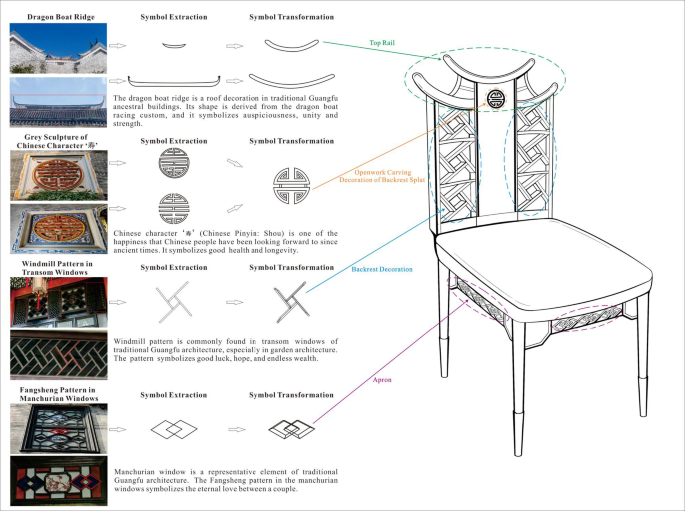
The design element extraction process of solution 1.
Scheme 2: The top headrest design of this chair draws inspiration from the elegant and smooth curves of the wavy gables commonly seen in traditional Cantonese architecture. The shape of the back panel is inspired by the “treasure vase” motif often found in traditional decorative patterns, symbolizing peace and blessings. The overall backrest frame takes reference from the “banana leaf” pattern, while the decorative crossbeam between the chair legs (known as “wangban”) is derived from the “flying eaves” element in Lingnan architectural ornamentation. By incorporating these traditional architectural forms and motifs, the chair conveys rich cultural connotations and auspicious meanings of peace, health, and a promising future. In terms of materials, the main frame is constructed from high-quality black walnut, known for its beautiful grain, strength, and durability. The seat and backrest are upholstered with premium velvet fabric and high-density memory foam, offering a balanced softness for enhanced comfort. The chair legs are finished with high-quality brass sleeves, which not only improve durability and stability but also enhance the overall aesthetic and decorative appeal. The combination of warm walnut brown and cowhide leather creates an elegant visual effect. In addition to the cultural symbolism, this design incorporates ergonomic contouring and a reinforced structural frame to enhance stability and comfort for daily use. Furthermore, by transforming traditional motifs into streamlined and concise and elegant forms, the chair achieves a balance between historical heritage and modern aesthetic trends, thereby offering originality and relevance in contemporary interior settings. The process of extracting and transforming architectural elements is illustrated in Fig. 6.
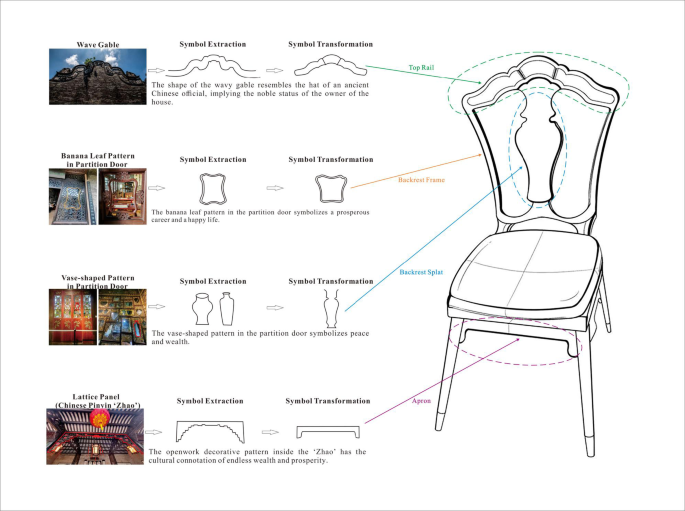
The design element extraction process of solution 2.
Scheme 3: The design inspiration for the headrest of the chair’s backrest is derived from the elegant and flowing curves of the “Wok Ear Wall”, a representative element of traditional Guangfu architecture, which culturally symbolizes happiness and a promising future. The segmented upholstered backrest design is inspired by the “Sliding Lattice Door” , another iconic architectural feature. The hollowed-out armrest decorations draw from the “Persimmon Calyx Pattern” commonly found in the windows and doors of traditional Guangfu buildings, symbolizing auspicious meanings such as prosperity and success. The decorative panel connecting the chair legs is inspired by the “Hanging Drop” , and the leg design references the “Spiral Wooden Railings”, enhancing the fusion of Chinese and Western design elements. This also reflects the inclusive and eclectic spirit of Guangfu architecture. The chair is constructed using high-quality North American black walnut, known for its beautiful grain and durability. It is paired with a comfortable seat cushion and back cushion, made from premium leather and high-density memory foam to enhance seating comfort. The brown tone of the wood and the brownish yellow tone of the upholstery belong to the same color family, conveying a sense of natural warmth, calmness, and harmony. Beyond its visual appeal, this design introduces innovative features such as segmented backrest construction and ergonomic support zones, addressing contemporary comfort requirements while maintaining cultural authenticity. The reinterpretation of Lingnan architectural elements through a fusion of Chinese and Western stylistic cues provides a unique and original design language that distinguishes this chair within modern furniture markets. The extraction and transformation process of architectural elements is illustrated in Fig. 7.
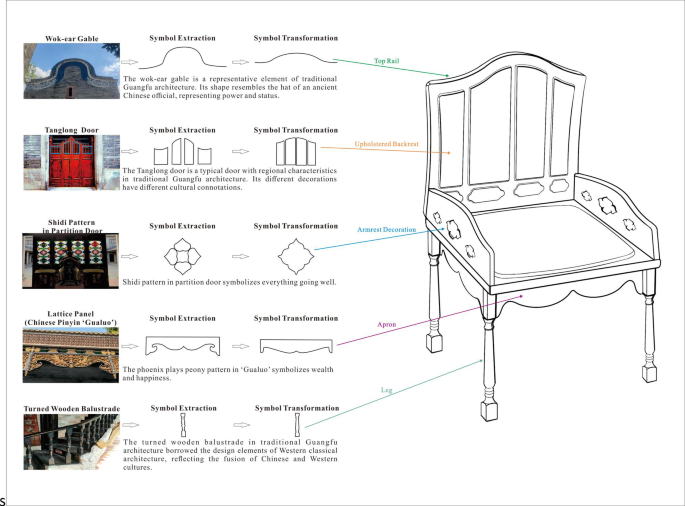
The design element extraction process of solution 3.
Scheme 4: The backrest shape and decorative elements of this chair are inspired by the Floor-Mounted Canopy, a traditional architectural feature in Guangfu buildings. The “Ice Crack Pattern” on the edge of the backrest symbolizes cultural ideals such as perfection and open connectivity (“perfection in all aspects, universal access”). The central motif on the backrest features the “Persimmon Calyx Pattern,” representing prosperity and a harmonious life. The Persimmon Calyx Pattern is positioned centrally on the upholstered backrest, while the Ice Crack Pattern is applied along the edges using traditional mortise-joinery and hollow-carving techniques. These elements complement each other, combining aesthetics and comfort without interference. The lower support element, known as the Short Brace, references the “Falling Flower and Flowing Water” motif commonly found in window decoration. The structural components connecting the seat and legs are derived from traditional Guangfu elements such as the Hanging Drop and the Bracket Arm, enhancing both the structural stability and decorative appeal of the chair. The main frame is constructed from high-quality black walnut, known for its attractive grain and durability. The seat and backrest are upholstered with premium leather and high-density memory foam, providing a well-balanced level of softness and support for enhanced comfort. The natural brown grain of the wood creates a visually pleasing organic aesthetic, while the light brown leather adds warmth and coziness. The harmonious color combination helps create a welcoming and comfortable home atmosphere. At the same time, this design integrates traditional mortise-and-tenon craftsmanship with CNC fabrication technology, preserving the essence of traditional techniques while meeting the modern manufacturing requirements for standardization and mass production. Its innovative interpretation of the floor-mounted canopy and ice crack pattern endows the chair with profound cultural connotations, while also catering to contemporary demands for exquisite craftsmanship and a novel, distinctive modern aesthetic. The fusion of traditional artistry and forward-looking functionality underscores the design’s originality and adaptability in today’s furniture landscape. The process of extracting and transforming architectural elements is illustrated in Fig. 8.
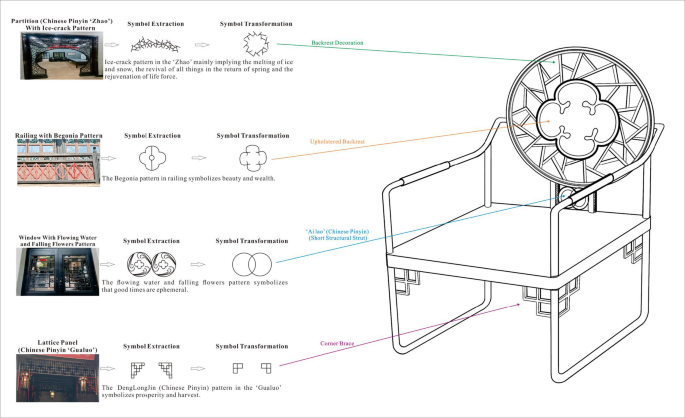
The design element extraction process of solution 4.
The final design renderings of the four Lingnan-style Neo-Chinese chairs are shown in Figs. 9, 10, 11, 12.
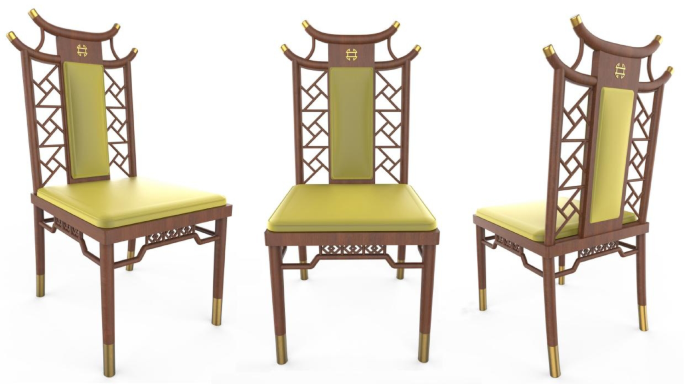
Final model diagram of design scheme 1.
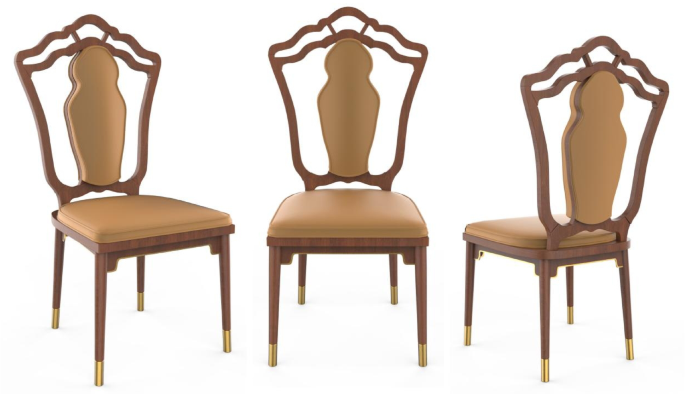
Final model diagram of design scheme 2.
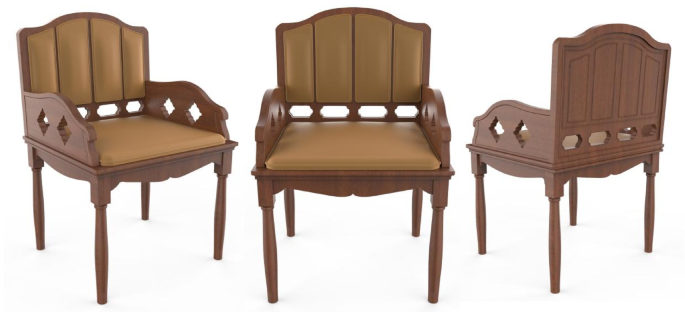
Final model diagram of design scheme 3.
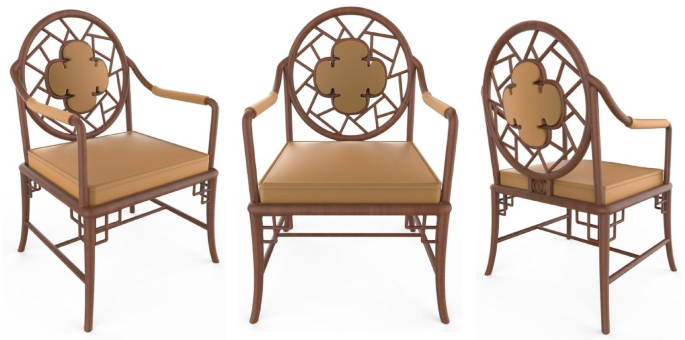
Final model diagram of design scheme 4.
Program evaluation and screening
To verify the feasibility of the proposed designs and identify the optimal solution, this study adopts the Technique for Order Preference by Similarity to Ideal Solution (TOPSIS), also known as the “ideal solution proximity method” or “distance-to-ideal solution method.” TOPSIS is a widely used multi-criteria decision-making (MCDM) tool developed by C.L. Hwang and K. Yoon in 198153. The core idea of TOPSIS is to rank alternatives based on their geometric distances from a positive ideal solution (best case) and a negative ideal solution (worst case). The closer an alternative is to the positive ideal and the farther it is from the negative ideal, the better its overall performance. This method is well-suited for evaluating multiple alternatives under multiple criteria, providing decision-makers with a rational basis for selecting the optimal design.
To ensure the objectivity and validity of the evaluation results, this study invited the expert panel involved in the indicator development to participate in the scheme evaluation. The experts assessed each design scheme based on the following evaluation criteria: ergonomics and comfort design, visual aesthetics, high-quality materials and craftsmanship, skilfully integration of representative Lingnan architectural elements, and innovation and personalized expression54,55,56,57,58. A standardized evaluation form (as shown in “Supplementary material File S2”) was employed to score each design solution, using a 7-point Likert scale. The scoring process was conducted anonymously and independently to ensure the reliability of the data. The specific evaluation process of the design alternatives using the TOPSIS method is detailed as follows:
-
(1)
Constructing the original decision matrix.
The original decision matrix (Table 19) was constructed based on the arithmetic mean of the scores given by the seven experts for the four design solutions across each evaluation criterion. The formula for calculating the initial evaluation matrix is as follows:
In the formula, m represents the number of design alternatives, and n denotes the number of evaluation criteria.
A visual representation of the evaluation results for the four design solutions is provided in Fig. 13.
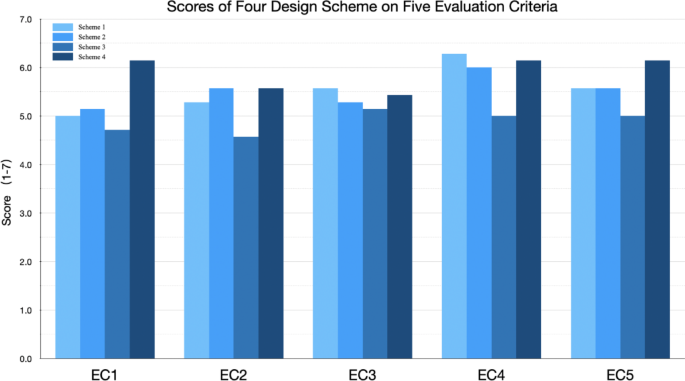
Design scheme evaluation results.
-
(2)
Calculate the weighted normalized decision matrix.
The data collected from the four design proposals were subjected to weighted standardization. The resulting weighted standardized evaluation matrix is shown in Table 20. The initial evaluation matrix (Table 6) was standardized using the vector normalization method (see Formula 9), resulting in the standardized matrix \(Y = \left( {Y_{ij} } \right)_{mn}\). By combining the weights \(\omega\) assigned to each evaluation criterion, the weighted standardized matrix \(Z = \left( {Z_{ij} } \right)_{mn}\) was obtained, as shown in Formula (10):
-
(3)
Determine the positive and negative ideal solutions for the evaluation object.
The computation of the positive ideal solution is presented in Eq. (11), while the negative ideal solution is calculated according to Eq. (12).
According to Eqs. (11) to (12), the positive ideal solution for the evaluated objects is denoted as \(Z^{ + } = \left( {{0}{\text{.419}},{0}{\text{.441}},{0}{\text{.404}},{0}{\text{.406,0}}{.420}} \right)\), while the negative ideal solution is \(Z^{ - } = \left( {{0}{\text{.322}},{0}{\text{.321}},{0}{\text{.355}},{0}{\text{.323,0}}{.326}} \right)\).
-
(4)
Calculate the distance between each solution and the positive and negative ideal solutions.
.
Based on Eqs. (13) to (14), the distances from each design alternative to the positive and negative ideal solutions, denoted as \(D^{ + } ,D^{ - }\) respectively, were calculated. The results are as follows: \(D^{ + } = \left( {{0}{\text{.056}},{0}{\text{.050}},{0}{\text{.093}},{0}{\text{.031}}} \right)\), \(D^{ - } = \left( {{0}{\text{.047}},{0}{\text{.049}},{0}{\text{.000}},{0}{\text{.071}}} \right)\).
-
(5)
Calculate relative closeness.
The relative closeness of each design alternative to the ideal solution, denoted as C, was determined, with the results as follows: C = (0.459, 0.495, 0.000, 0.698). The calculation formula is given in Eq. (15):
The closeness coefficient serves as a key indicator for evaluating how closely a design scheme approaches the ideal solution. When the closeness coefficient approaches 0, it indicates that the scheme is nearer to the negative ideal solution, meaning its performance across multiple evaluation criteria is unsatisfactory and may exhibit significant shortcomings or deficiencies. Conversely, when the closeness coefficient approaches 1, it implies that the scheme performs excellently across various criteria, effectively meeting or even exceeding expected requirements and expectations. Based on the values of the closeness coefficient, the schemes can be ranked accordingly. As shown in Table 21, Scheme 4 achieves the highest closeness coefficient, indicating it is the optimal scheme among all the evaluated alternatives.
Based on the evaluation results, the experts who participated in this assessment highly recognized all five evaluation dimensions. This confirms the strong applicability and effectiveness of the proposed design framework in meeting the diverse needs of users for Neo-Chinese style seating. Therefore, the innovative design approach developed in this study—based on the KANO model and Analytic Hierarchy Process (AHP)—is considered both practical and feasible. This research not only focuses on improving user experience but also skillfully integrates elements from traditional Lingnan architecture into the Neo-Chinese style seating design. This integration enhances the product’s cultural value and design innovation, addressing the longstanding disconnection between traditional architectural and furniture styles. Through this study, we aim to create living spaces that are more comfortable, aesthetically pleasing, and rich in cultural meaning. This responds to the growing demand for higher quality in modern living.
Conclusion
This study addresses the disconnection between architectural styles and furniture design, with a focus on integrating Lingnan architectural elements into Neo-Chinese style furniture. The core objective is to explore systematic design methods that align architectural cultural expression with functional product needs. Through interviews and questionnaires, key user requirements for furniture design were identified. These were classified and structured using the KANO model. The Analytic Hierarchy Process (AHP) was then applied to determine the relative importance of each requirement, resulting in a multi-dimensional evaluation index system. Based on this framework, four Neo-Chinese style furniture design schemes incorporating Lingnan architectural features were developed. Symbolic translation and functional reconstruction were employed to embed architectural elements at the visual, material, and structural levels. The schemes were evaluated and ranked using the TOPSIS method, based on expert assessments. The results indicate that the proposed approach significantly enhances both user alignment and cultural expressiveness in Neo-Chinese style furniture design. This finding provides a clear direction for future stylistic development and offers a practical strategy for translating regional architectural culture into contemporary product design. Notably, previous studies in Neo-Chinese style furniture have primarily focused on traditional imagery, decorative patterns, and form inheritance59. However, there is a lack of systematic analysis on how regional architectural styles can be integrated with furniture design. Existing research often emphasizes the application of traditional patterns in products11. In contrast, this study highlights the concrete transformation of regional architectural features into visual, material, and structural design components. By doing so, it overcomes the limitations of surface-level pattern application and emphasizes the semantic embedding of architectural language in product design. This represents a methodological advancement in the field.
However, this study has certain limitations. First, in the process of identifying regional architectural styles, the selection of “representative architectural elements” by experts may involve subjective judgment, as there is no established unified quantitative standard. Second, the number of user survey participants was limited, and the feedback reflects regional characteristics, which may introduce a certain degree of bias when applied to a broader consumer market. Future research can be improved in the following aspects: (1) integrating computer vision or machine learning techniques to extract large-scale quantitative features of regional architectural styles, thereby enhancing the objectivity of architectural language identification; (2) expanding the participant sample to include a wider range of regions and groups, enabling the collection of more diverse cultural perception data to support a broader and more inclusive user profile for semantic product design.
In the future, the integration of regional architectural styles with furniture design will continue to offer broad opportunities for exploration. This research contributes to bridging the current gap between “architectural space culture” and “interior object culture.” It also provides a potential reference path for the revitalization and practical application of regional culture. With the advancement of AI-assisted design and big data technologies, it is expected that a “style generation system” driven by regional cultural characteristics can be developed. This system would support the seamless integration of design language across architecture, interior spaces, and furniture. Importantly, the application of AI should follow a human-centered design approach, where technology acts as an enabling tool to augment designers’ creativity and support user participation, rather than replacing human decision-making. By aligning AI-driven processes with cultural semantics and user needs, the integration of traditional architectural language across architecture, interior spaces, and furniture can be achieved in a way that preserves cultural value and enhances user experience. Ultimately, it will enhance the cultural value and market recognition of home products.
Data availability
All relevant data that supports the findings of this study are available within the manuscript and supplementary files.
References
MOLS, S. T. Furniture and Architecture. A Cultural History of Furniture in Antiquity. 163 (2022).
Rice, C. The emergence of the interior: Architecture, modernity, domesticity (Routledge, 2006).
Amoian, F. Study on the role of furniture in introducing the identity of the interior architecture. 1–10 (2021).
Ye, J. et al. Neo-Chinese style furniture design based on semantic analysis and connection. KSII Trans. Internet. Inf. Syst. (TIIS) 16(8), 2704–2719 (2022).
Köksaldı, E. & Turkan, Z. Urban furniture in sustainable historical urban texture landscapes: Historical squares in the Walled city of Nicosia. Sustainability 15(12), 9236 (2023).
Luscombe, D. Illustrating architecture: the spatio-temporal dimension of Gerrit Rietveld’s representations of the Schröder House. J. Archit. 22(5), 899–932 (2017).
Fu, X. L. Analysis on the integrated design of architecture and furniture: Taking the Farnsworth House as an example. In Journal of Physics: Conference Series Vol. 1168, No. 3, 032102 (IOP Publishing, 2019).
Ma, T. & Zhang, S. The integrality of architecture and furniture design—Analysis of famous architects’ furniture works. In 2011 International Conference on Multimedia Technology 1311–1313 (IEEE, 2011).
Gürel, M. Ö. Consumption of modern furniture as a strategy of distinction in Turkey. J. Des. Hist. 22(1), 47–67 (2009).
De Long, D., & Ford Peatross, C. Eero Saarinen. Nueva (2008).
Wang, L., Gong, Y. H., Niu, S. F., & Ren, Z. X. Cultural symbols migration and user perception: Innovation in Chinese-style furniture design. BioResources 20(2) (2025).
Zhu, J. Guidelines of Transferring Brutalist Architectural Styles from Mid-20thCentury to Furniture Design Master’s thesis (Auburn University, 2023).
Lang, W., Chen, T. & Li, X. A new style of urbanization in China: Transformation of urban rural communities. Habitat Int. 55, 1–9 (2016).
de Paiva, R. B. F. Phenomenology and emotional design: The conceptual synergy between architecture and design for urban furniture. In Advances in Affective and Pleasurable Design: Proceedings of the AHFE 2016 International Conference on Affective and Pleasurable Design, July 27–31, 2016, Walt Disney World®, Florida, USA 361–373 (Springer, 2016)
Pallasmaa, J. Space, place and atmosphere. Emotion and peripherical perception in architectural experience. Lebenswelt. Aesthetics and philosophy of experience (4) (2014).
Xue, G., Chen, J. & Lin, Z. Cultural sustainable development strategies of Chinese traditional furniture: Taking Ming-style furniture for example. Sustainability 16(17), 7443 (2024).
Xiong, X., Yue, X. & Wu, Z. Current status and development trends of Chinese intelligent furniture industry. J. Renew. Mater. 11(3), 1353 (2023).
Conti, E. & Chiarini, A. Design-driven innovation: exploring new product development in the home appliances and furniture industry. TQM J. 33(7), 148–175 (2021).
Kuang, Y. & Zhang, W. The application of minimalist style in interior design. In 3rd International Conference on Arts, Design and Contemporary Education ICADCE 2017 410–414 (Atlantis Press, 2017).
Smith, P. M. & West, C. D. The globalization of furniture industries/markets. J. Glob. Mark. 7(3), 103–132 (1994).
Wang, T., Hamat, B., Zhang, L., Zhao, Y. & Pang, L. L. L. Study on the application and evaluation method of Zen aesthetic style in furniture design under the background of sustainability. Sci. Rep. 15(1), 9236 (2025).
Jiang, B., Wang, S., Zhao, X., & Fu, J. Research on innovative elements of product appearance design in international intellectual property rights-taking furniture design as an example. In 2021 14th International Symposium on Computational Intelligence and Design (ISCID) 242–245 (IEEE, 2021).
Wang, Y., Woods, P. C. & Koo, A. C. Exploring the evolution and inheritance of traditional Chinese architectural forms in Jiehua. Int. J. Technol. 14(6), 1196–1205 (2023).
Tang, Q., Zheng, L., Chen, Y., Chen, J. & Yang, S. Innovative design method for Lingnan region veranda architectural heritage (Qi-Lou) façades based on computer vision. Buildings 15(3), 368 (2025).
Li, Y., Zhao, M., Mao, J., Chen, Y., Zheng, L., & Yan, L. Detection and recognition of Chinese porcelain inlay images of traditional Lingnan architectural decoration based on YOLOv4 technology. Herit. Sci. 12(1) (2024).
Zhang, Y., Li, W. & Cai, X. A cultural geography study of the spatial art and cultural features of the interior of Lingnan ancestral halls in the Ming and Qing dynasties. J. Asian Archit. Build. Eng. 22(6), 3128–3140 (2023).
Mahmoud, H. T. H. Interior architectural elements that affect human psychology and behavior. ARCHive-SR 1(1), 10–10 (2017).
Merrell, P., Schkufza, E., Li, Z., Agrawala, M. & Koltun, V. Interactive furniture layout using interior design guidelines. ACM Trans. Gr. (TOG) 30(4), 1–10 (2011).
Zallio, M. & Clarkson, P. J. Inclusion, diversity, equity and accessibility in the built environment: A study of architectural design practice. Build. Environ. 206, 108352 (2021).
Zou, H., Ge, J., Liu, R. & He, L. Feature recognition of regional architecture forms based on machine learning: A case study of architecture heritage in Hubei Province, China. Sustainability 15(4), 3504 (2023).
Cheng, G. et al. Similarity and stability: A study on the color features of regional built spaces-taking Chinese Hui-style architecture as an example. J. Asian Arch. Build. Eng. 1–29 (2024).
Deng, J., Chen, J. & Lei, Y. A study on the visual perception of cultural value characteristics of traditional southern Fujian architecture based on eye tracking. Buildings 14(11), 3529 (2024).
Wei, P. & Madina, Z. Application of environmentally friendly materials in the design of children’s furniture based on fuzzy technology. Math. Probl. Eng. 2022(1), 5165699 (2022).
Vermeer, N., & Brown, A. R. Generating novel furniture with machine learning. In International Conference on Computational Intelligence in Music, Sound, Art and Design (Part of EvoStar) 401–416 (Springer, 2022).
Li, H. & Wen, K. H. Research on design of stalk furniture based on the concept and application of Miryoku engineering theory. Sustainability 13(24), 13652 (2021).
Matwiej, Ł, Wieruszewski, M., Wiaderek, K. & Pałubicki, B. Elements of designing upholstered furniture sandwich frames using finite element method. Materials 15(17), 6084 (2022).
Mikulić, J. & Prebežac, D. A critical review of techniques for classifying quality attributes in the Kano model. Manag. Serv. Qual. Int. J. 21, 46–66. https://doi.org/10.1108/09604521111100243 (2011).
Shahin, A., Pourhamidi, M., Antony, J. & Hyun Park, S. Typology of Kano models: A critical review of literature and proposition of a revised model. Int. J. Qual. Reliab. Manag. 30, 341–358 (2013).
Madzík, P. Increasing accuracy of the Kano model—A case study. Total Qual. Manag. Bus. Excell. 29, 387–409 (2018).
Xu, Q. et al. An analytical Kano model for customer need analysis. Des. Stud. 30, 87–110 (2009).
Shahin, A. & Zairi, M. Kano model: A dynamic approach for classifying and prioritising requirements of airline travellers with three case studies on international airlines. Total Qual. Manag. Bus. Excell. 20, 1003–1028 (2009).
Reichenbach, R., Jutz, G., Eberl, C. & Lindenmeier, J. Regression approaches for Kano classification: An empirical analysis of the classification of quality attributes according to Kano. Total Qual. Manag. Bus. Excell. 33, 884–906 (2022).
Agbo, A. A. Cronbach’s alpha: Review of limitations and associated recommendations. J. Psychol. Afr. 20, 233–239 (2010).
Kember, D. & Leung, D. Y. P. Establishing the validity and reliability of course evaluation questionnaires. Assess. Eval. High. Educ. 33, 341–353 (2008).
Berger, C. et al. Kano’s methods for understanding customer-defined quality. Cent. Qual. Manag. J. 2, 3–35 (1993).
Saaty, T. L. What Is the Analytic Hierarchy Process? (Springer, 1988).
Saaty, T. L. Decision making with the analytic hierarchy process. Int. J. Serv. Sci. 1(1), 83–98 (2008).
Golden, B. L., Wasil, E. A. & Harker, P. T. The analytic hierarchy process. Appl. Stud. 2(1), 1–273 (1989).
Hu, S. et al. An evaluation method for product design solutions for healthy aging companionship. Front. Public Health 10, 919300–919300 (2022).
Li, M. & Gong, B. A dynamic evaluation model of university brand value based on analytic hierarchy process. Sci. Progr. 2022, 1–10 (2022).
Wu, F. et al. Research on multiobjective topology optimization of diesel engine cylinder block based on analytic hierarchy process. Mathe. Prob. Eng. https://doi.org/10.1155/2019/6194634 (2019).
Golden, B. L., Wasil, E. A. & Harker, P. T. The analytic hierarchy process. Appl. Stud. 2(1), 1–273. https://doi.org/10.1007/978-3-642-50244-6 (1989).
Behzadian, M., Otaghsara, S. K., Yazdani, M. & Ignatius, J. A state-of the-art survey of TOPSIS applications. Expert. Syst. Appl. 39(17), 13051–13069 (2012).
Yongjun, Y. & Azahari, M. H. B. The Construction Principles and Processes of Design Evaluation Index System for Cantonese-Style Chairs (2024).
Li, Y., Xiong, X. & Qu, M. Research on the whole life cycle of a furniture design and development system based on sustainable design theory. Sustainability 15(18), 13928 (2023).
Liu, Z., Yi, X., Zhang, C. & Yao, J. A study on the design of new Chinese-style seating based on user needs. Furnit. Inter. Décor. 01, 75–81 (2024).
Kong, X., Yan, J. & Liang, Y. Evaluation of new Chinese-style furniture design based on user experience. Ind. Des. 7, 53–54 (2019).
Varol, A. Determining and ordering the basic evaluation criteria in the furniture design process. ICONARP Int. J. Archit. Plan. 11(1), 519–537 (2023).
Dong, R. & Binti Jamali, S. S. The application of ancient Chinese ornamentation in modern furniture design. Herança 8, 56–75 (2025).
Acknowledgements
The authors would like to express their sincere gratitude to all the experts who generously participated in the interviews and provided invaluable insights for this study. We also extend our heartfelt thanks to all participants who completed the questionnaire and offered strong support throughout the research process. All individuals acknowledged in this section have been informed of and have approved their involvement in the research as required by the ethical review protocol.
Author information
Authors and Affiliations
Contributions
Conceptualization: C.L. Data curation: C.L, Y.Z. Formal analysis: C.L. Funding acquisition: C.L. Investigation: C.L. Methodology: C.L. Project administration: C.L. Resources: C.L., Y.Z. Supervision: S. S. S. Validation: C.L., S. S. S., Y.Z. Visualization: C.L. Writing—original draft: C.L. Writing—review & editing: C.L. All authors reviewed the manuscript.
Corresponding authors
Ethics declarations
Competing interests
The authors declare no competing interests.
Ethical approval
This study does not involve any experimental research related to clinical trials, animals, human tissues, or biological samples. Human participation in this study is limited to interview surveys. Human participants were recruited based on the principle of voluntary participation in this study. Before the study commenced, the researchers informed all participants about the purpose of the research, the survey process, the use of the collected data, and the participants’ rights, obtaining their consent. All participants signed the informed consent form. Interviews with participants in this study were conducted from 10, January, 2025 to 7, February, 2025. This study does not involve any discussion related to personal religious beliefs, racial identity, political views, sexual orientation, financial information, or any other private matters. All data and information were collected, recorded, and stored anonymously and confidentially, without any actions that would infringe upon the privacy, dignity, health, or human rights of the participants. We confirm that all methods and procedures in this paper were carried out in accordance with relevant guidelines and regulations, adhering to ethical oversight requirements. The results presented in this study are original and have not been published or submitted elsewhere. This study has been reviewed and is hereby granted approval for implementation by the Jawatankuasa Etika Penyelidikan Manusia Universiti Sains Malaysia (JEPeM-USM), Human Research Ethics Committee USM (HREC). Ethics Approval Number: USM/JEPeM/PP/24 080783.
Additional information
Publisher’s note
Springer Nature remains neutral with regard to jurisdictional claims in published maps and institutional affiliations.
Supplementary Information
Below is the link to the electronic supplementary material.
Rights and permissions
Open Access This article is licensed under a Creative Commons Attribution-NonCommercial-NoDerivatives 4.0 International License, which permits any non-commercial use, sharing, distribution and reproduction in any medium or format, as long as you give appropriate credit to the original author(s) and the source, provide a link to the Creative Commons licence, and indicate if you modified the licensed material. You do not have permission under this licence to share adapted material derived from this article or parts of it. The images or other third party material in this article are included in the article’s Creative Commons licence, unless indicated otherwise in a credit line to the material. If material is not included in the article’s Creative Commons licence and your intended use is not permitted by statutory regulation or exceeds the permitted use, you will need to obtain permission directly from the copyright holder. To view a copy of this licence, visit http://creativecommons.org/licenses/by-nc-nd/4.0/.
About this article

Cite this article
Li, C., Suhaily, S.S. & Zhou, Y. The influence of traditional regional architectural culture on Neo-Chinese style furniture design: a case study of the lingnan region in China. Sci Rep 15, 38002 (2025). https://doi.org/10.1038/s41598-025-21950-2
Received:
Accepted:
Published:
Version of record:
DOI: https://doi.org/10.1038/s41598-025-21950-2

