
Abstract
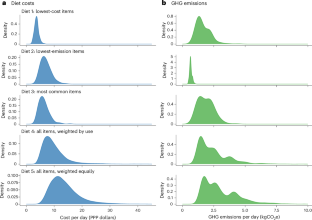
Using real-world food price and greenhouse gas emissions data for locally available food items in 171 countries, we measure how healthy diets could be obtained with the lowest possible emissions, compared with costs and emissions of the least expensive options and foods most commonly consumed. We find that foods with the lowest greenhouse gas emissions for a healthy diet would emit 0.67 kgCO2e. A healthy diet using the least expensive items in each country would emit 1.65 kgCO2e and cost US$3.68 in 2021, while using foods most commonly consumed would emit 2.44 kgCO2e and cost US$9.96. Animal-source foods and starchy staples account for 91% of the difference in emissions between the lowest-cost and lowest-emission diets. Other food groups, especially fruits and vegetables, vary widely in cost but not in emissions. Results show how changes in food policy and choice can most cost-effectively support healthier and more sustainable diets worldwide.
This is a preview of subscription content, access via your institution
Access options
Access Nature and 54 other Nature Portfolio journals
Get Nature+, our best-value online-access subscription
$32.99 / 30 days
cancel any time
Subscribe to this journal
Receive 12 digital issues and online access to articles
$119.00 per year
only $9.92 per issue
Buy this article
- Purchase on SpringerLink
- Instant access to the full article PDF.
USD 39.95
Prices may be subject to local taxes which are calculated during checkout


Data availability
Individual food item descriptions, availability and prices in each country were obtained through a confidentiality agreement with the World Bank, under the ICP data access and archiving policy (https://www.worldbank.org/en/programs/icp/data#3). Emissions data are available from their source as published in Scientific Data (https://www.nature.com/articles/s41597-021-00909-8), and food use data are available from their source at FAO (https://www.fao.org/faostat/en/#data/FBS). For World Development Indicator and Poverty and Inequality Platform data, access is provided through the World Bank’s data portals (https://databank.worldbank.org/source/world-development-indicators and https://pip.worldbank.org/).
Code availability
Model code for matching item descriptions to food composition and nutritional requirements for computation of diet costs is available from the Food Prices for Nutrition project (https://sites.tufts.edu/foodpricesfornutrition/tools). Code for replication of this study is available at https://doi.org/10.17605/OSF.IO/6TGS4.
References
Cost and Affordability of a Healthy Diet (CoAHD) (FAO, 2024); https://www.fao.org/faostat/en/#data/CAHD
Food Prices for Nutrition DataHub (World Bank, 2024); https://www.worldbank.org/foodpricesfornutrition
Herforth, A. et al. Cost and Affordability of Healthy Diets Across and Within Countries: Background Paper for The State of Food Security and Nutrition in the World 2020. FAO Agricultural Development Economics Technical Study No. 9 Vol. 9 (FAO, 2020); https://doi.org/10.4060/cb2431en
Herforth, A. et al. Monitoring the cost and affordability of a healthy diet within countries: building systems in Ethiopia, Ghana, Malawi, Nigeria, Pakistan, Tanzania, and Viet Nam. Curr. Dev. Nutr. 8, 104441 (2024).
FAO, IFAD, UNICEF, WFP & WHO The State of Food Security and Nutrition in the World 2025 (FAO, 2025); https://doi.org/10.4060/cd6008en
Masters, W. A., Wallingford, J. K., Herforth, A. W. & Bai, Y. Measuring food access as affordability of least-cost healthy diets worldwide. Agric. Econ. 56, 360–372 (2025).
Masters, W. A., Finaret, A. B. & Block, S. A. The economics of malnutrition: dietary transition and food system transformation. Handb. Agric. Econ. 6, 4997–5083 (2022).
Gilbert, R. et al. Trade policy reform, retail food prices and access to healthy diets worldwide. World Dev. 177, 106535 https://doi.org/10.1016/j.worlddev.2024.106535 (2024).
Wallingford, J. et al. Measuring food access using least-cost diets: Results for global monitoring and targeting of interventions to improve food security, nutrition and health. Glob. Food Secur. 41, 100771 https://doi.org/10.1016/j.gfs.2024.100771 (2024).
Costlow, L., Herforth, A. W., Sulser, T. B., Cenacchi, N. & Masters W. A. Global analysis reveals persistent shortfalls and regional differences in availability of foods needed for health. Glob. Food Secur. 44, 100825 https://doi.org/10.1016/j.gfs.2024.100825 (2025).
Crippa, M. et al. Food systems are responsible for a third of global anthropogenic GHG emissions. Nat. Food 2, 198–209 (2021).
Wollburg, P., Hallegatte, S. & Mahler, D. G. Ending extreme poverty has a negligible impact on global greenhouse gas emissions. Nature 623, 982–986 (2023).
Tian, P. et al. Keeping the global consumption within the planetary boundaries. Nature 635, 625–630 (2024).
Martinez, E. M., Blackstone, N. T., Wilde, P. E., Herforth, A. W. & Masters, W. A. Retail prices, environmental footprints, and nutritional profiles of commonly sold retail food items in 181 countries. Am. J. Clin. Nutr. 122, 1265–1274 (2025); https://doi.org/10.1016/j.ajcnut.2025.08.002
Herforth, A., Bai, Y., Venkat, A. & Masters, W. The Healthy Diet Basket is a valid global standard that highlights lack of access to healthy sustainable diets. Nat. Food 6, 622–631 (2024).
Willett, W. et al. Food in the Anthropocene: the EAT-Lancet Commission on healthy diets from sustainable food systems. Lancet 393, 447–492 (2019).
Herforth, A. et al. Methods and Options to Monitor the Cost and Affordability of a Healthy Diet Globally. Background Paper for The State of Food Security and Nutrition in the World 2022. FAO Agricultural Development Economics Working Paper 22-03 (FAO, 2022); https://doi.org/10.4060/cc1169en
ICP The International Comparison Program (The World Bank, 2024); https://www.worldbank.org/en/programs/icp
WHO and FAO Sustainable Healthy Diets: Guiding Principles (WHO, 2019); https://www.who.int/publications/i/item/9789241516648
Springmann, M. et al. The healthiness and sustainability of national and global food based dietary guidelines: modelling study. BMJ 370, m2322 (2020).
Rancilio, G., Gibin, D., Blaco, A. & Casagrandi, R. Low-GHG culturally acceptable diets to reduce individual carbon footprint by 20%. J. Clean. Prod. 338, 130623 (2022).
World Bank PPP Conversion Factor, Private Consumption (World Bank DataBank, 2024); https://databank.worldbank.org/metadataglossary/millennium-development-goals/series/PA.NUS.PRVT.PP
Petersson, T. et al. A multilevel carbon and water footprint dataset of food commodities. Sci. Data 8, 127 (2021).
Food Balance Sheets. FAOSTAT Database (FAO, 2024); https://www.fao.org/faostat/en/#data/FBS
Mahrt, K., Mather, D., Herforth, A., & Headey, D. D. Household Dietary Patterns and the Cost of a Nutritious Diet in Myanmar. Discussion Paper 1854 (IFPRI, 2019); https://ssrn.com/abstract=3430692
Poverty and Inequality Platform (PIP) (World Bank, 2025); https://pip.worldbank.org
Bai,Y. et al. Methods for Monitoring the Affordability of a Healthy Diet. FAO Statistics Working Paper Series, No. 24‑44 (FAO, 2024); https://doi.org/10.4060/cd3703en
Acknowledgements
This study was conducted as part of the Food Prices for Nutrition project (INV-016158) and the Innovative Methods and Metrics for Agriculture and Nutrition Actions project (INV-002962), both funded by the Gates Foundation and UK International Development. We are grateful to all project collaborators for their contributions to this collective effort.
Author information
Authors and Affiliations
Contributions
Y.B. and E.M.M. are co-first authors of this paper. Y.B., E.M.M. and W.A.M. conceptualized the study. Y.B. and E.M.M. designed the study, analysed the data and drafted the paper. W.A.M. obtained funding for the study. Y.B., E.M.M. and W.A.M. accessed and verified the data. All authors interpreted the results, revised the paper for important intellectual content, and read and approved the final paper.
Corresponding authors
Ethics declarations
Competing interests
The authors declare no competing interests.
Peer review
Peer review information
Nature Food thanks Emiliano Lopez Barrera, Jessica Fanzo and the other, anonymous, reviewer(s) for their contribution to the peer review of this work.
Additional information
Publisher’s note Springer Nature remains neutral with regard to jurisdictional claims in published maps and institutional affiliations.
Supplementary information
Supplementary Information
Supplementary Tables 1–8 and Supplementary Figs. 1–3.
Rights and permissions
Springer Nature or its licensor (e.g. a society or other partner) holds exclusive rights to this article under a publishing agreement with the author(s) or other rightsholder(s); author self-archiving of the accepted manuscript version of this article is solely governed by the terms of such publishing agreement and applicable law.
About this article

Cite this article
Bai, Y., Martinez, E.M., Yamanaka, M. et al. Environmental impacts and monetary costs of healthy diets worldwide. Nat Food 6, 1176–1185 (2025). https://doi.org/10.1038/s43016-025-01270-4
Received:
Accepted:
Published:
Version of record:
Issue date:
DOI: https://doi.org/10.1038/s43016-025-01270-4
This article is cited by
-
Cost and climate impact of healthy diets worldwide
Nature Food (2025)

