
Thank you for visiting nature.com. You are using a browser version with limited support for CSS. To obtain the best experience, we recommend you use a more up to date browser (or turn off compatibility mode in Internet Explorer). In the meantime, to ensure continued support, we are displaying the site without styles and JavaScript.

Volume 7 Issue 4, April 2026

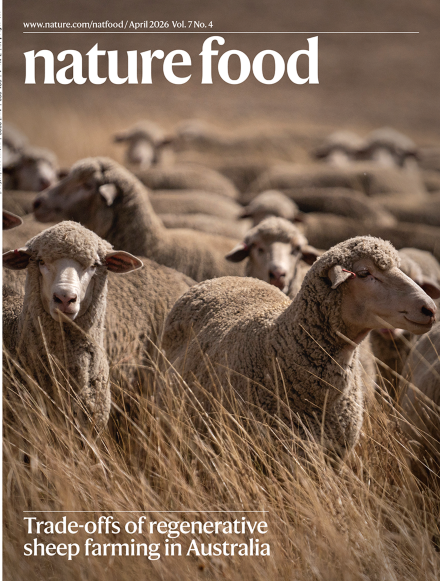
Trade-offs of regenerative sheep farming in Australia

Regenerative agriculture involves practices intended to restore ecological functions while sustaining or enhancing productivity. The effectiveness of these practices is highly context dependent. In Australian sheep farming systems, pasture species composition, antecedent soil organic carbon and adaptive multi-paddock grazing can help to reduce emissions while improving soil health, water infiltration and biodiversity, but they do not always translate into increased yields or profitability. Designing resilient, low-emissions grazing systems requires balancing productivity, profitability and environmental objectives.

See Muleke et al.

Image: The Washington Post / The Washington Post / Getty images. Cover design: Francesca Corra
Correspondence

  • Advertisement

Top of page ⤴

Comment & Opinion

  • Artificial intelligence has recently become an invisible infrastructure shaping how knowledge is produced and applied in food systems. From data pipelines to policy modelling, artificial intelligence-mediated workflows are becoming integral to research practice. An analysis of the intersection of agricultural economics, food systems and digitalization suggests that this transformation is reshaping scientific authority, professional competence and governance in ways that demand deliberate institutional design.

    • Lan van Wassenaer
    Comment
  • Crop productivity under climate stress remains constrained by conventional agricultural approaches that underuse plant–microbiome interactions. A microbiome-centred, climate-responsive framework was proposed to enhance crop resilience and agro-sustainability by prioritizing targeted manipulation of crop-associated microbiomes, offering a scalable and adaptive pathway to buffer climate stresses and stabilize crop performance.

    • Ying Ma
    • Xiang Li
    • Yongming Luo
    Comment
  • The plastic waste generated by ultra-processed foods (UPFs) is a key driver of the global plastics crisis. Recognizing the integral role of plastics in UPF production is essential to developing a more socio-ecological perspective on these food products. This Comment identifies the linkages between the rise of UPFs and the rise of plastic packaging, calling for a renewed research agenda.

    • Rob Ralston
    • Katherine Sievert
    • Jennifer Clapp
    Comment
Top of page ⤴

Research Highlights

Top of page ⤴

News & Views

  • Fishing gear and location influence the nutrient composition of harvests. Fishery nutrient profiles can identify fishing methods that provide multiple nutrients of public health concern, offering an approach to analyse alignment between fishery management and nutrition goals.

    • Julia G. Mason
    • Abigail Bennett
    News & Views
  • Adaptive multi-paddock grazing can improve soil carbon storage, pasture productivity and farm profitability, but enteric methane and the constraints of intensive global farming underscore the need for broader interventions.

    • Zhaohai Bai
    • Lin Ma
    News & Views
  • Data collected over 27 years show that ecological and social sustainability can quietly diverge, driven by factors that fisheries assessments typically overlook. For small-scale reef fishers in Kenya, rising fish prices and higher catches have failed to translate into decent earnings, with fewer than 2% making the national minimum wage.

    • Anna Schuhbauer
    • Louise Teh
    News & Views
Top of page ⤴

Research Briefings

Top of page ⤴

Research

Top of page ⤴

Amendments & Corrections

Top of page ⤴

Search

Quick links