
Abstract
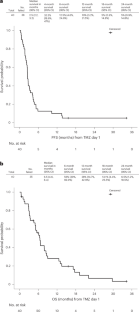
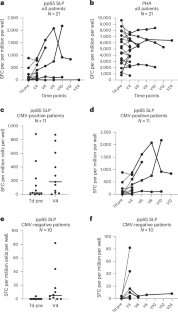
The human cytomegalovirus (CMV) antigen pp65 is expressed in high-grade glioma (HGG) and medulloblastoma but not in the adjacent brain. This single-arm phase 1 trial (NCT03299309) assessed the safety and immunogenicity of a peptide vaccine (PEP-CMV) targeting pp65 in individuals (3–35 years old) with recurrent HGG or medulloblastoma. Thirty-six individuals with HGG received PEP-CMV. The mean age was 22.75 ± 9.34 years. The primary outcome, percentage of unacceptable toxicity, was met. The maximum-grade adverse events (AE) related to PEP-CMV were 17 grade 1 AEs, 15 grade 2 AEs, 1 grade 3 AE (pyramidal tract syndrome) and 1 grade 4 AE (cerebral edema). As a secondary outcome, in 21 individuals with evaluable data, T cell reactivity, measured as change in baseline interferon-γ pp65 enzyme-linked immunospot assay reactivity, had an estimated increase of 46 spots (95% confidence interval (95% CI): 8, 194) after treatment with PEP-CMV. As exploratory endpoints, the median progression-free survival was 2.5 months (95% CI: 2.2, 3.2), and median overall survival was 6.5 months (95% CI: 4.6, 8.4). PEP-CMV is well tolerated and elicits an antigen-specific immune response in individuals with multiply recurrent HGG. Only two individuals with medulloblastoma were enrolled, showing one grade 3 encephalopathy possibly related to PEP-CMV, while neither had postvaccine immune assessments due to progression-free survival and overall survival less than 2 months.
This is a preview of subscription content, access via your institution
Access options
Access Nature and 54 other Nature Portfolio journals
Get Nature+, our best-value online-access subscription
$32.99 / 30 days
cancel any time
Subscribe to this journal
Receive 12 digital issues and online access to articles
$119.00 per year
only $9.92 per issue
Buy this article
- Purchase on SpringerLink
- Instant access to the full article PDF.
USD 39.95
Prices may be subject to local taxes which are calculated during checkout


Data availability
The study protocol is available in the Supplementary Information. The data that support the findings of this study are available within the article and Supplementary Information. All requests for data will be considered on a case-by-case basis under a data use agreement. Access is controlled to maintain participant confidentiality. Deidentified data will not be shared. Data that may be shared include additional patient demographic details. Access requests can be made to D.L. at daniel.landi@duke.edu. Responses to requests are estimated to occur within 10 days. Source data are provided with this paper.
References
Ostrom, Q. T. et al. CBTRUS statistical report: primary brain and oher central nervous system tumors diagnosed in the United States in 2012–2016. Neuro Oncol. 21, v1–v100 (2019).
Thompson, E. M. et al. Prognostic value of medulloblastoma extent of resection after accounting for molecular subgroup: a retrospective integrated clinical and molecular analysis. Lancet Oncol. 17, 484–495 (2016).
Dunkel, I. J. et al. High-dose carboplatin, thiotepa, and etoposide with autologous stem cell rescue for patients with previously irradiated recurrent medulloblastoma. Neuro Oncol. 12, 297–303 (2010).
Jakacki, R. I. et al. Phase 2 study of concurrent radiotherapy and temozolomide followed by temozolomide and lomustine in the treatment of children with high-grade glioma: a report of the Children’s Oncology Group ACNS0423 study. Neuro Oncol. 18, 1442–1450 (2016).
Mitchell, D. A. et al. Sensitive detection of human cytomegalovirus in tumors and peripheral blood of patients diagnosed with glioblastoma. Neuro Oncol. 10, 10–18 (2008).
Cobbs, C. S. et al. Human cytomegalovirus infection and expression in human malignant glioma. Cancer Res. 62, 3347–3350 (2002).
Dziurzynski, K. et al. Consensus on the role of human cytomegalovirus in glioblastoma. Neuro Oncol. 14, 246–255 (2012).
Wakefield, A. et al. Is CMV a target in pediatric glioblastoma? Expression of CMV proteins, pp65 and IE1-72 and CMV nucleic acids in a cohort of pediatric glioblastoma patients. J. Neurooncol. 125, 307–315 (2015).
Schuessler, A., Walker, D. G. & Khanna, R. Cytomegalovirus as a novel target for immunotherapy of glioblastoma multiforme. Front. Oncol. 4, 275 (2014).
Ahmed, N. et al. HER2-specific chimeric antigen receptor-modified virus-specific T cells for progressive glioblastoma: a phase 1 dose-escalation trial. JAMA Oncol. 3, 1094–1101 (2017).
Baryawno, N. et al. Detection of human cytomegalovirus in medulloblastomas reveals a potential therapeutic target. J. Clin. Invest. 121, 4043–4055 (2011).
Malouli, D. et al. Cytomegalovirus pp65 limits dissemination but is dispensable for persistence. J. Clin. Invest. 124, 1928–1944 (2014).
Hotchkiss, K. M. et al. Dendritic cell vaccine trials in gliomas: untangling the lines. Neuro Oncol. 25, 1752–1762 (2023).
Sampson, J. H. et al. Greater chemotherapy-induced lymphopenia enhances tumor-specific immune responses that eliminate EGFRvIII-expressing tumor cells in patients with glioblastoma. Neuro Oncol. 13, 324–333 (2011).
Mitchell, D. A. et al. Tetanus toxoid and CCL3 improve dendritic cell vaccines in mice and glioblastoma patients. Nature 519, 366–369 (2015).
Okada, H. et al. Immunotherapy response assessment in neuro-oncology: a report of the RANO working group. Lancet Oncol. 16, e534–e542 (2015).
Poli, A. et al. CD56bright natural killer (NK) cells: an important NK cell subset. Immunology 126, 458–465 (2009).
Pollack, I. F. et al. Antigen-specific immune responses and clinical outcome after vaccination with glioma-associated antigen peptides and polyinosinic–polycytidylic acid stabilized by lysine and carboxymethylcellulose in children with newly diagnosed malignant brainstem and nonbrainstem gliomas. J. Clin. Oncol. 32, 2050–2058 (2014).
Pollack, I. F. et al. Immune responses and outcome after vaccination with glioma-associated antigen peptides and poly-ICLC in a pilot study for pediatric recurrent low-grade gliomas. Neuro Oncol. 18, 1157–1168 (2016).
Pollack, I. F. et al. Antigen-specific immunoreactivity and clinical outcome following vaccination with glioma-associated antigen peptides in children with recurrent high-grade gliomas: results of a pilot study. J. Neurooncol. 130, 517–527 (2016).
Myers, J. A. & Miller, J. S. Exploring the NK cell platform for cancer immunotherapy. Nat. Rev. Clin. Oncol. 18, 85–100 (2021).
Cooper, M. A. et al. Human natural killer cells: a unique innate immunoregulatory role for the CD56bright subset. Blood 97, 3146–3151 (2001).
Xue, J. S. et al. The prognostic value of natural killer cells and their receptors/ligands in hepatocellular carcinoma: a systematic review and meta-analysis. Front. Immunol. 13, 872353 (2022).
Chan, I. S. & Ewald, A. J. The changing role of natural killer cells in cancer metastasis. J. Clin. Invest. 132, e143762 (2022).
Iglesias-Escudero, M., Arias-Gonzalez, N. & Martinez-Caceres, E. Regulatory cells and the effect of cancer immunotherapy. Mol. Cancer 22, 26 (2023).
Batich, K. A. et al. Long-term survival in glioblastoma with cytomegalovirus pp65-targeted vaccination. Clin. Cancer Res. 23, 1898–1909 (2017).
Schulz, K. F., Altman, D. G. & Moher, D. Group C. CONSORT 2010 Statement: updated guidelines for reporting parallel group randomised trials. BMC Medicine 8, 18 (2010).
Bernstein, D. I. et al. Randomized, double-blind, phase 1 trial of an alphavirus replicon vaccine for cytomegalovirus in CMV seronegative adult volunteers. Vaccine 28, 484–493 (2009).
Thacker, G. et al. Immature natural killer cells promote progression of triple-negative breast cancer. Sci. Transl. Med. 15, eabl4414 (2023).
de Jonge, K. et al. Circulating CD56bright NK cells inversely correlate with survival of melanoma patients. Sci. Rep. 9, 4487 (2019).
Liu, D., Paczkowski, P., Mackay, S., Ng, C. & Zhou, J. Single-cell multiplexed proteomics on the IsoLight resolves cellular functional heterogeneity to reveal clinical responses of cancer patients to immunotherapies. Methods Mol. Biol. 2055, 413–431 (2020).
Sampson, J. H. et al. An epidermal growth factor receptor variant III-targeted vaccine is safe and immunogenic in patients with glioblastoma multiforme. Mol. Cancer Ther. 8, 2773–2779 (2009).
Acknowledgements
This study was funded in part by the Pediatric Brain Tumor Foundation. The Pediatric Brain Tumor Foundation had no role in the conceptualization, design, data collection, analysis, decision to publish or preparation of the manuscript. We wish to thank all the patients and patients’ families who participated in this trial, physicians who referred the patients, B. Perry (Duke University) for administrative support and M. Janampalli (Duke University) and K. Patel (Duke University) for specimen processing assistance.
Author information
Authors and Affiliations
Contributions
Concept and design: E.M.T., G.A., G.V., E.R., J.E.H., D.A.M. and J.H.S. Provision of study materials or patients: E.M.T., D.L., G.A., K.S., A.D., M.O.J., K.P., D.R., M.K., H.F., D.A.M., D.M.A. and J.H.S. Collection and assembly of data: E.M.T., D.L., K.A., P.N., A.W., B.A., C.F., D.J., L.G., L.A.S., K.C., K.H. and S.L.C. Data analysis and interpretation: E.M.T., D.L., G.A., K.A., P.N., J.E.H., E.D.B., D.M.A., A.D., M.K., L.A.S., K.C., K.H., S.L.C. and E.M. Manuscript writing: E.M.T. Manuscript revision: all authors. Final approval of manuscript: all authors.
Corresponding author
Ethics declarations
Competing interests
D.A.M. and J.H.S. hold the patent to PEP-CMV (Compositions, methods and kits for eliciting an immune response, US 11,376,322). A.W. is currently employed by Day One Biopharmaceuticals, G.V. is currently employed by GSK, E.R. is currently employed by Q2 Solutions, L.A.S. is currently employed by Tune Therapeutics, and K.C. is currently employed by Tune Therapeutics. M.K. reports grants or contracts from BMS, AbbVie, BioNTech, CNS Pharmaceuticals, Daiichi Sankyo, Immorna Therapeutics, Immvira Therapeutics, JAX lab for genomic research and Personalis; received consulting fees from AnHeart Therapeutics, Berg Pharma, George Clinical, Manarini Stemline and Servier; received honoraria from GSK and is on a data safety monitoring board for BPG Bio. The other authors declare no competing interests.
Peer review
Peer review information
Nature Cancer thanks Jessica Foster, Rajiv Khanna, Annette Molinaro and Robert Prins for their contribution to the peer review of this work.
Additional information
Publisher’s note Springer Nature remains neutral with regard to jurisdictional claims in published maps and institutional affiliations.
Extended data
Extended Data Fig. 1
CONSORT diagram of the trial.
Extended Data Fig. 2
Kaplan Meier plot of PFS and OS since the time of original diagnosis.
Extended Data Fig. 3 Kaplan Meier plots of all patients by tumor grade, sex, and bevacizumab use.
Kaplan Meier plots of PFS (left column) and OS (right column) by WHO Grade (a, b), sex (c, d), and on-study bevacizumab use (e, f). A two-sided log-rank test was used to generate the p values. P values were not adjusted for mutliple comparisons.
Extended Data Fig. 4 Kaplan Meier plots of HLA-A2 positive patients by CMV serological status.
Kaplan Meier plots of PFS (a) and OS (b) of HLA-A2 positive patients by CMV serological status. A two-sided log-rank test was used to generate the p values. P values were not adjusted for multiple comparisons.
Extended Data Fig. 5 Line graphs of lymphocytes before and after temozolomide and regulatory T cells (Tregs) over time.
Line graphs of % lymphoctes (a) and absolute lymphoctes (b) before and after temozolomide as well as % Tregs (c) and absolute number of Tregs (d) over time by patient. From baseline to Day 20, there was a −0.55% (95% CI −3.5%, 2.35%) estimated change % lymphocytes (A, P = 0.72) and 0.1 (95% CI −0.05, 0.25) estimated change of absolute lymphocytes (B, P = 0.72). From baseline to Vaccine 4, there was a −0.49 (95% CI −3.49, 2.44) estimated changed of % Tregs (C, P = 0.8) and a 0.31 (−0.001, 0.62) change of absolute Tregs (D, P = 0.52). A 2-sided Wilcoxon Signed-rank Test was used for these analyses.
Extended Data Fig. 6 Forest plots of pretreatment immune cell subtypes and their association with survival.
Forest plots of pretreatment immune cell subtypes and their association with PFS (top panel) and OS (bottom panel). Increased pretreatment Treg percent was predictive of worse PFS (HR 1·79 [95%CI 1·03, 3·11]). Lines indicate 95% confidence interval of the hazard ratio (HR). Cox models using the Benjamini-Hochberg correction method to account for multiple tests was used.
Extended Data Fig. 7 Dot plots of CD8 counts over time and OS.
Dot plots at baseline at at vaccine #4 for all patients (a, n = 21), only CMV positive patients (b, n = 11), and only CMV negative patients (c, n = 10) does not demonstrate significant correlation by Pearson’s R between CD8 + T cells and OS. P values are two-sided.
Extended Data Fig. 8 T cell responses to PEP-CMV treatment.
a) Patients with levels of absolute naïve CD8 T cells, as determined by flow cytometry, at the time of their last vaccine above the median had longer PFS than those below the median. b) There was no difference in OS between the two groups. There is no clear association between absolute naïve (c) or percent naïve (d) CD8 + T cells and number of vaccines received as determined by flow cytometry. A two-sided log-rank test was used to generate the p values in A and B. P values were not adjusted for multiple comparisons.
Extended Data Fig. 9 Polyfunctional T cell results of select patients.
Pie graphs of demonstrating T cell polyfunctionality based on INF-γ, TNF-a, and IL-2 phenotype. Increasing number of vaccines corresponded with increasing polyfunctionality. Td Pre = baseline, V = vaccine number.
Supplementary information
Supplementary Information (download PDF )
Supplementary Figs. 1 and 2, Clinical protocol and Deviation log.
Supplementary Table 1 (download XLSX )
Supplementary Tables 1–9.
Supplementary Data 1 (download PDF )
CONSORT checklist.
Source data
Source Data Figs. 1–4 and Extended Data Figs. 2–5, 7 and 8 (download XLSX )
Statistical/plot source data.
Rights and permissions
Springer Nature or its licensor (e.g. a society or other partner) holds exclusive rights to this article under a publishing agreement with the author(s) or other rightsholder(s); author self-archiving of the accepted manuscript version of this article is solely governed by the terms of such publishing agreement and applicable law.
About this article

Cite this article
Thompson, E.M., Ashley, D.M., Ayasoufi, K. et al. A peptide vaccine targeting the CMV antigen pp65 in children and young adults with recurrent high-grade glioma and medulloblastoma: a phase 1 trial. Nat Cancer 6, 1559–1569 (2025). https://doi.org/10.1038/s43018-025-00998-z
Received:
Accepted:
Published:
Version of record:
Issue date:
DOI: https://doi.org/10.1038/s43018-025-00998-z
This article is cited by
-
Vaccine therapy for pediatric high-grade glioma: current landscape, challenges, and future directions
Journal of Neuro-Oncology (2026)
-
Human Cytomegalovirus-Induced Immune Tolerance in Glioma
Current Clinical Microbiology Reports (2025)

