
Microbiomes and their roles in farmed animals
- Submission status
- Open
- Submission deadline
 This Collection supports and amplifies research related to SDG 15.
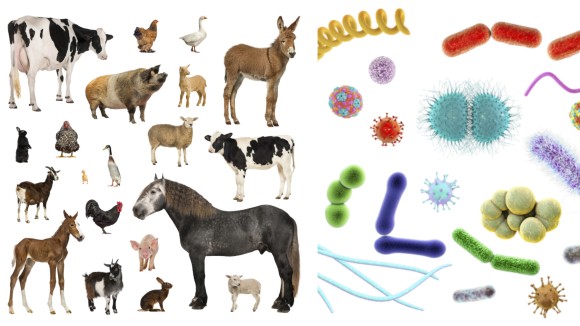
The intricate relationships between animals and their microbiomes have emerged as a focal point of scientific inquiry, unraveling the profound influence these microbial communities have on host health, behavior, and ecology. Recent advancements in high-throughput sequencing technologies and bioinformatics have propelled our understanding of animal-associated microbiomes, allowing for the exploration of diverse ecosystems. Given the escalating concerns regarding animal product amount and quality, there is an urgent need to synthesize current knowledge and uncover new insights into how microbiomes contribute to the host traits in human-associated animals, especially farm animals. This Collection aims to highlight cutting-edge research that bridges fundamental microbiome science with animal production and health efforts, thereby facilitating a holistic understanding of host-microbe interactions.
In this Collection, we invite contributions that explore various dimensions of the animal microbiome, including but not limited to its role in host physiology, performance, behavior, immune response, and disease susceptibility, as well as the implications of microbiome alterations in the face of environmental pollution. We particularly encourage interdisciplinary approaches that integrate molecular biology, ecology, multi-omics and bioinformatics to elucidate the dynamics of microbiome assembly and function across different human-managed animal ecosystems and environments. By fostering dialogue among researchers, veterinarians, agricultural scientists, and policy-makers, this Collection seeks to propel forward the conversation on microbiome research and its vital implications for animal health and ecosystem management.
This is a joint Collection across npj Biofilms and Microbiomes, npj Veterinary Sciences and Scientific Reports. Please see the relevant journal webpages to check which article types the journals consider.
Editors
-
Jianmin Chai, PhD
Foshan University, China
-
Shengru Wu, PhD
Northwest A&F University, China
-
Yongfei Hu, PhD
China Agricultural University, China
npj Biofilms and Microbiomes is edited by a team of external academic editors.
npj Veterinary Sciences is edited by a team of external academic editors.
Scientific Reports is managed by in-house professional editors and edited by Editorial Board Members.
Guest Editor for npj Biofilms and Microbiomes:
Jianmin Chai, PhD, Foshan University, China
Microbiome plays important roles in health and nutrient utilization of animals and humans. Jianmin Chai uses interdisciplinary approaches such as multi-omics (e.g. metagenomics, metatranscriptomics, metabolomics, culturomics), bioinformatics, statistics, and machine learning to understand the roles that animal and human microbiome play in nutrient metabolism, health and different diseases. He focus on ruminants, humans and pigs and am mainly interested in the microbiome of the respiratory and GI-tract.
 Shengru Wu, PhD, Northwest A&F University, China
Shengru Wu is a Associate Professor in College of Animal Science and Technology at Northwest A&F University, with expertise in ruminal and gut microbiome, vaginal microbiome, animal nutrition, epigenetics and genetics research. His research focused on the efficient carbohydrate utilization in ruminants, by exploring integrated nutritional regulation strategies to improve feed conversion efficiency and ensure the health of ruminants at three levels: diet, microorganisms, and host. His research mainly focuses on two aspects: "the mechanism by which microorganisms regulate the health of the gastrointestinal-liver-mammary axis, methane emission reduction, and efficient production in ruminants" and "the identification of key genes and epigenetic mechanisms of rumen microbial colonization related to efficient production in ruminants regulated by the host."
 Yongfei Hu, PhD, China Agricultural University, China
Prof. Hu obtained his Ph.D. in 2010 from the Institute of Microbiology, Chinese Academy of Sciences. In May 2018, he was recruited as a distinguished talent to the College of Animal Science and Technology, China Agricultural University (CAU). His research focuses on the poultry gut microbiome, including: host–microbiota interactions in nutrition metabolism and immune regulation; relationships between gut microbes and host development/performance; discovery and utilization of novel probiotics and enzymes from gut microbes; and studies on bacterial antibiotic resistance and antibiotic-alternative feed biotechnology. He has presided over more than 20 research projects, including those from the National Key R&D Program, National Natural Science Foundation of China, and Shandong Provincial Key R&D Program. He has published over 60 SCI papers as first or corresponding author in journals such as Nature Communications, Microbiome, ISME Journal, npjBiofilms and Microbiomes, The Innovation, and iMeta. His publications have been cited over 7,200 times, with an h-index of 42 (Google Scholar), and he has been consistently ranked among the top 2% of scientists worldwide for the past three years. He currently serves as Deputy Director of the Gastrointestinal Microbiology Academic Group under the Animal Nutrition Branch, and as a Council Member of the Animal Microecology Branch, within the Chinese Association of Animal Science and Veterinary Medicine.
