
Severe Convective Storms in a Changing Climate
- Submission status
- Open
- Submission deadline
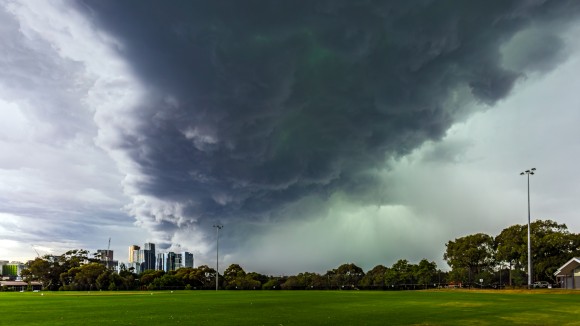
Severe convective storms can produce damaging winds, flash flooding, large hail, and tornadoes, causing extensive damage to the infrastructure and ecosystems and significant losses in economy and human lives. Under a warmer climate, the frequency and intensity of severe convective storms may increase due to the increase in available moisture and atmospheric instability. Accurate short-term predictions and long-term projections of severe convective storms are key for hazard mitigation and climate change preparation. The occurrence and characteristics of these storms may change in response to the changing climate driven by anthropogenic forcing. However, the response of severe convective storms to climate change is complicated and non-uniform across the globe due to the involved multiple processes over a broad range of space and time scales and their interactions with the complex regional environmental factors, which warrant further research.
This Collection aims to address the multiscale interactions between severe convective storms and the global/regional climate system, exploring physical mechanisms underlying the shifts in the occurrence and characteristics of severe convective storms due to climate change.
We welcome Original Research articles as well as Reviews and Perspectives in a broad range of topics, including but not limited to:
- Global/regional climatology and underlying physical mechanisms of severe convective storms such as those produce damaging winds, tornadoes, hail, extreme precipitation, excessive lightning, etc.
- Impacts and attributions of climate change on severe convective storms, e.g., trends of frequency, intensity, duration, behaviors, and structures of these storms.
- Regional variations in the response of severe convective storms to climate change and the underlying controlling factors.
- Interactions between extensive convective storms like mesoscale convective systems and the large-scale circulations and climate events such as El Niño-Southern Oscillation (ENSO) and Madden-Julian Oscillation (MJO).
- Process-based understanding of severe convective storms in current and future climates from multiscale perspectives, i.e., the synoptic scale, the mesoscale, and down to the microphysical scale.
- Advances in numerical weather prediction models and the machine learning/artificial intelligence techniques for nowcasting, warning, and predictions of severe convective storms.
- Future projections of the frequency and characteristics of severe convective storm incorporating emission and land-surface scenarios.
- Socio-economic and environmental impacts of the changes in severe convective storms under anthropogenic climate change.
Editors
-
Weixin Xu, PhD
Sun Yat-sen University, Zhuhai, China
-
Yali Luo, PhD
Nanjing University of Information Science and Technology, Nanjing, China
The Collection will publish original research papers, and articles in various formats (full details on content types can be found here). Papers will be published in npj Climate and Atmospheric Science as soon as they are accepted and then collected together and promoted on the Collection homepage. All Collections are associated with a call for papers and are managed by one or more journal editors and/or Guest Editors.
This Collection welcomes submissions from all authors – and not by invitation only – on the condition that the manuscripts fall within the scope of the Collection and of npj Climate and Atmospheric Science more generally. All submissions are subject to the same peer review process and editorial standards as regular npj Climate and Atmospheric Science articles, including the journal’s policy on competing interests. The Editors declare no competing interests with the submissions which they have handled through the peer review process. The peer review of any submissions for which the Editors have competing interests is handled by another Editor who has no competing interests. For more information, refer to our Collections guidelines.
This Collection is not supported by sponsorship.
