Volume 2
-
No. 12 December 2025
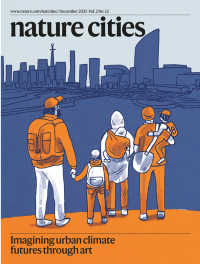
Imagining urban climate futures through artWhat does climate adaptation look like in the minds of those shaping our cities? Lorono and colleagues turn to art to find out, inviting local actors worldwide to imagine their urban futures in the face of climate change. What unfolds is a diverse mosaic of adaptation conceptions, shaped by individual perspectives and local contexts.
See Lorono
-
No. 11 November 2025
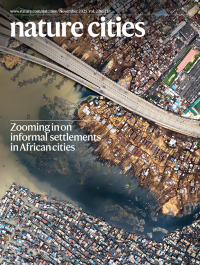
Zooming in on informal settlements in African citiesFocusing on Makoko, an informal settlement floating on the edge of Lagos, Nigeria, reveals that residents’ deep connection to water demands a bottom-up approach to urban renewal. In this Focus issue, we feature primary research, an interview, a news feature and opinion pieces that elevate local voices and perspectives, which underscore the importance of locally grounded insights in understanding and improving informal settlements across African cities.
See Editorial and Focus
-
No. 10 October 2025
Beyond bouncing backResilient cities require more than recovery from crisis; they need to adapt and transform. This issue moves beyond conventional recovery models to explore how cities can actively transform through innovation. From artificial intelligence applications to inclusive policy models to self-healing infrastructure, these advances show how urban systems can develop systemic regenerative capabilities. Featuring Hintz et al. and others, these advances reveal pathways for cities to transform and flourish alongside their communities.
See Hintz et al.
-
No. 9 September 2025
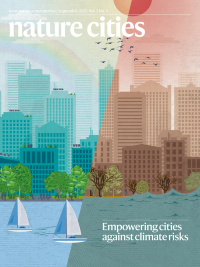
Empowering cities against climate risksAs climate challenges intensify, cities are both on the front lines and are key drivers of solutions. In collaboration with Nature Climate Change, this issue features a Focus on how cities are responding to climate change by transforming into strategic actors in this global effort.
See Editorial , Huang , Kurylyk and AghaKouchak
-
No. 8 August 2025
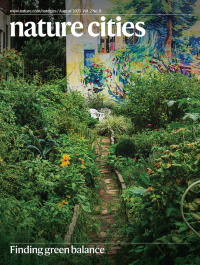
Finding green balanceNot all urban green spaces are equal for mental health. This issue demonstrates how moderate doses of greenness provide the greatest psychological benefits, while exploring the ecological networks and equitable access needed for resilient urban health.
See Jiang et al., Li et al. and Moreno-García et al.
-
No. 7 July 2025
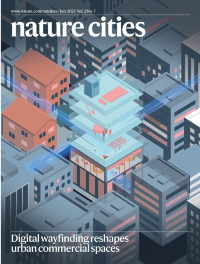
Digital wayfinding reshapes urban commercial spacesIn the digital era, advancing technologies are transforming cities and reshaping how residents interact with urban spaces. Focusing on commercial spaces, Long and colleagues investigate how digitalization has reshaped these spaces in Chinese cities, driving the emergence of less-visible shops located on upper floors or in non-street-facing locations.
See Long
-
No. 6 June 2025
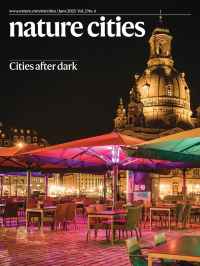
Cities after darkThe city never sleeps. Increasingly, urban research follows. Just as lights illuminate this view of Frauenkirche, in Dresden, Germany, studies by Kyba et al., Tardieu et al. and Meng et al. illuminate urban thinking through citizen science, urban planning and vegetation phenology, respectively. Elsewhere, Seijas argues that following nighttime governance, the next crucial step is to embrace a 24-hour cycle in urban governance.
See Kyba, Tardieu, Meng, Seijas and Effenberger
-
No. 5 May 2025
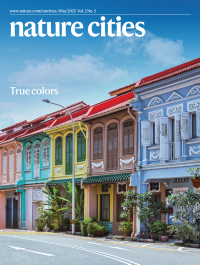
True colorsHistoric conservation seems at odds with the dynamism of today’s global cities. Focusing on historic Singapore shophouses and combining machine learning with archives and fieldwork, Xue and colleagues find the iconic color palette changes meaningfully with evolving sociocultural forces.
See Xue et al.
-
No. 4 April 2025
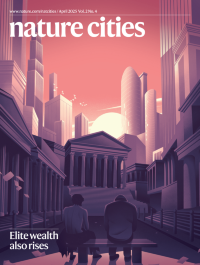
Elite wealth also risesAs the sun shines on cities, expressions of wealth — physical and otherwise — cast growing shadows. Combining archaeology with urban science, Carleton and colleagues find that wealth concentration follows population size characteristically in ancient Roman and modern cities, despite being separated by millennia.
See Carleton et al
-
No. 3 March 2025
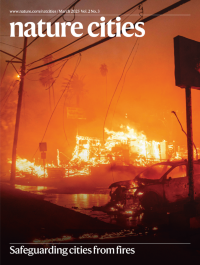
Safeguarding cities from firesUrban fires can cause devastating casualties and substantial economic damage. Shi et al. provide a quantitative perspective on urban fire risks in a warming climate. Anguelovski & Frumkin use the raging fires in Los Angeles in early 2025 as a lesson, and call for immediate and coordinated actions to protect our cities from future fire threats.
See Shi and Anguelovski
-
No. 2 February 2025
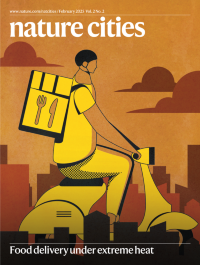
Food delivery under extreme heatUrban residents are adapting to extreme heat through food-delivery services. Li et al. reveal how this adaptation unevenly benefits consumers and presents challenges for food-delivery workers. Their associated research briefing advocates for policy interventions in the food-delivery sector to address these issues.
See Li and Li
-
No. 1 January 2025
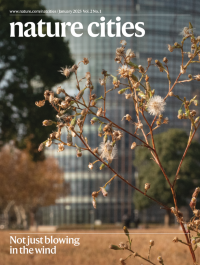
Not just blowing in the windPlants find interesting places in cities, with some planted and some establishing on their own. A study by Kun Song and colleagues considers seed-dispersal modes of this latter group in cities in Yunnan Province, China, and finds that dispersal by self-propulsion and dispersal by animals are more common than by wind, and all are much more common than by water.
See Song et al.