Thank you for visiting nature.com. You are using a browser version with limited support for CSS. To obtain
the best experience, we recommend you use a more up to date browser (or turn off compatibility mode in
Internet Explorer). In the meantime, to ensure continued support, we are displaying the site without styles
and JavaScript.
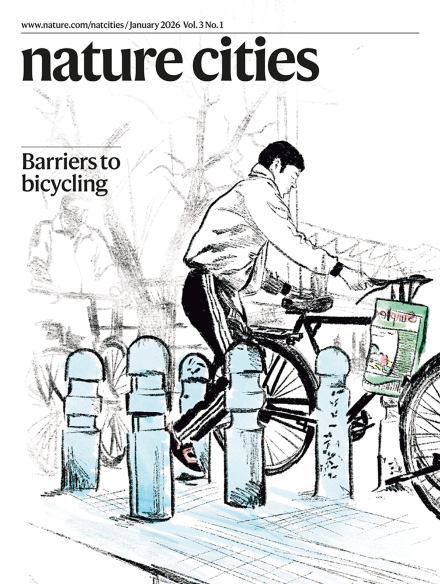
Promoting bicycling helps cities to reduce transport emissions and improve public health, especially in low- and middle-income countries. A study by Kannan and coauthors reveals the state of bicycling and the barriers that riders face in New Delhi, Chennai, Dhaka and Accra. The cover shows Kannan’s field sketch from observations of bicycle commuters crossing bollards on a foot bridge on a cold, foggy morning in Delhi, 2022.
Given the pressures cities faced in 2025, safety and mobility are deeply relevant for 2026. They are also two key themes in this issue of Nature Cities.
As facial recognition becomes widespread in urban spaces, it promises security but deepens social exclusion. Yonghua Zou argues that cities must redesign technology governance to safeguard trust, equity and inclusiveness, and offers insights to address what he calls the ‘safety–segregation paradox’.
Not only are increasing numbers of people in cities suffering from climate change, hotter temperatures, and drought, but so is green infrastructure, which is inherently there for recreation and cooling. This Comment argues that the entire green patina of the city is needed to adapt effectively.
Air connectivity is an important aspect of global business, but what makes a city ‘well connected’ is unclear. We found that, more important than the number of flights between cities, companies choose to locate their subsidiaries in locations that are well integrated within the global air traffic network.
Climate risk is underpriced in US municipal bonds, creating vulnerabilities as insurers retreat and adaptation planning remains disconnected from finance. This Review reveals a climate-debt doom loop and proposes governance reforms and disclosure standards to strengthen municipal resilience.
Participatory trials in India’s informal settlements show that low-cost interventions can lower indoor temperature by up to 1.24 °C, offering a rapid, scalable solution for heat resilience in vulnerable urban communities.
Globalized production and the rise of e-commerce have intensified urban freight activity, amplifying environmental impacts and raising equity concerns. This study examines freight-related emissions at the city level across the USA, uncovering two key factors driving disparities in emissions burdens.
Most cities lack comprehensive health adaptation strategies in climate planning, with no global plans achieving fully integrated holistic approaches. City climate adaptation plans show the awareness of health impacts, but only 11% have strong health strategies.
Urban redevelopment is a key government policy and planning strategy to address various urban challenges. This study investigates where, how and to what extent China’s city hierarchy influences redevelopment activities within China’s rapidly evolving urban landscape.
Bicycling offers great benefits for urban residents in low- and middle-income countries, yet pathways to scale its adoption remain poorly understood. This study reveals the current state of bicycling infrastructure and policy, as well as key barriers, through fieldwork in four cities.
Large informal settlements reflect inequalities in Latin America, where transport interventions can build social capital. TransMiCable increased the probability of individuals transitioning to bridging social capital networks, suggesting an increase in trust among neighbors and an improvement in bridging community networks.
Global air connectivity shapes where multinational firms locate subsidiaries, especially in knowledge-intensive sectors, by reducing coordination frictions. Eigenvector centrality emerges as the strongest predictor of a city’s attractiveness for foreign investment.
The intensity of urban life can amplify that of urban work. Liming Yao reflects on his awakening to the quiet, easily missed comforts of bamboo during years of academic grind in Chengdu.