Volume 1
-
No. 12 December 2022
Strike a poseSubstrate docking into molecular-dynamics-simulated structures of enzyme variants is used to guide the design of mutations, which increases enantioselectivity in a C–H oxidation reaction by disfavouring binding poses leading to the unwanted enantiomer. This enzyme engineering approach enables selective oxidation of unactivated C–H bonds in cyclic amines to deliver high-value alcohol products for drug discovery and synthetic applications.
See Zhang et al.
-
No. 11 November 2022
Stairway to a 1,080-merStarting from monosaccharide building blocks, a linear 1,080-mer arabinan is assembled using an automated synthesis approach. This method is used to prepare homogeneous biomacromolecules with the number of constituent units reaching 1,080, as well as a library of bioactive oligosaccharides.
See Yao et al.
-
No. 10 October 2022
Plastic waste fuels reactionsThe accumulation of plastic waste poses a serious environmental threat. Now, non-recyclable microplastics are used as electron feedstocks that are broken down to produce value-added oxidation products and accelerate various redox biosynthetic reactions. This photoelectrocatalytic approach combines environmental remediation and biocatalytic photosynthesis for sustainable solar-to-chemical synthesis.
See Kim et al.
-
No. 9 September 2022
Aromaticity stabilizedA planar, non-bridged aromatic 10-membered hydrocarbon is reported with the synthesis of a kinetically-stable cyclopropanated dehydro[10]annulene. A double dehydrochlorination-isomerization sequence is instrumental in the final aromatization step.
See Parmar et al.
-
No. 8 August 2022
Gold nanoringsMechanically interlocked gold nanostructures are made using a bottom-up synthetic approach. As a structural analogy of molecular catenanes, the plasmonic gold nanocatenanes show mechanical helical chirality depending on desymmetrization angles. When combined with a thermoresponsive polymer, a plasmonic nanomachine with light-induced thermal actuation and the ability to transform rectilinear force into rotational mechanical motion is reported.
See Kim & Nam.
-
No. 7 July 2022
Carbon nanobelts with a twistFully-fused Möbius carbon nanobelts are synthesized using a bottom-up approach in which the aromatic carbon chain is formed by sequential Wittig reactions. This synthesis may pave the way for the development of nanocarbon materials with complex topological structures.
See Segawa et al.
-
No. 6 June 2022
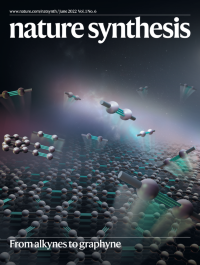
From alkynes to graphyneThe long-pursued carbon allotrope, γ-graphyne, is synthesized by alkyne metathesis. Simultaneous removal of the 2-butyne by-product — the escaping molecule — and self-correction of bonds formed in error, leads to a crystalline polymer product with periodic carbon–carbon double and triple bonds.
See Hu et al.
-
No. 5 May 2022
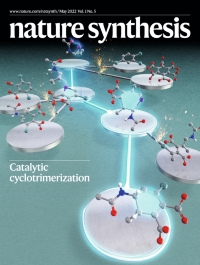
Catalytic cyclotrimerizationCatalytic [2+2+2] cyclotrimerization of three different unsaturated compounds is a major goal in synthetic organic chemistry. Using chiral cationic rhodium(I) catalysts, terminal alkynes, alkynoates and cis-enamides undergo highly stereoselective [2+2+2] cyclotrimerization to give chiral cyclohexadienylamines as a single product.
See Fujii et al.
-
No. 4 April 2022
A win for carbon rings on goldWhen deposited on gold surfaces, isopropyl substituents on arenes can be thermally activated to achieve intermolecular coupling. The coupling is triggered when the activated substituents form a single intermolecular C–C bond. The resulting hexadiene bridge then cyclizes to form a phenylene ring.
See Kinikar et al.
-
No. 3 March 2022
Lignin sees the lightIn plants, lignin is the structural material responsible for cell wall formation, water transportation, seed protection and stress adaptation. Now, distinct from these pivotal roles, lignin is unveiled as a photocatalyst for the synthesis of hydrogen peroxide from water and air, in the presence of solar light. Coupling photocatalysis with biocatalysis using peroxygenases drives enantioselective oxyfunctionalization of C–H bonds.
See Kim et al.
-
No. 2 February 2022
High-entropy materials in a laser pulseLaser scanning ablation creates a library of high-entropy nanoparticles, including alloys, oxides, sulfides, phosphides, nitrides and borides, at atmospheric temperature and pressure. The laser ablates metal salt precursors, enabling the formation of nanoparticles within nanoseconds. The confinement of laser energy to microregions enables nanoparticles to form on various substrates, even thermally-sensitive substrates.
See Wang et al.
-
No. 1 January 2022
Iterative sequences decodedUsing a broad knowledge base of individual reactions, a computer algorithm evaluates putative, but chemically plausible, sequences and discovers numerous iterative sequences. Some of these iterative sequences are validated experimentally and enable the syntheses of useful motifs in natural product targets. The cover image depicts networks which, from a handful of starting materials, lead to products after one or several types of iterations.
See Molga et al.