
Thank you for visiting nature.com. You are using a browser version with limited support for CSS. To obtain the best experience, we recommend you use a more up to date browser (or turn off compatibility mode in Internet Explorer). In the meantime, to ensure continued support, we are displaying the site without styles and JavaScript.

Volume 3 Issue 7, July 2025

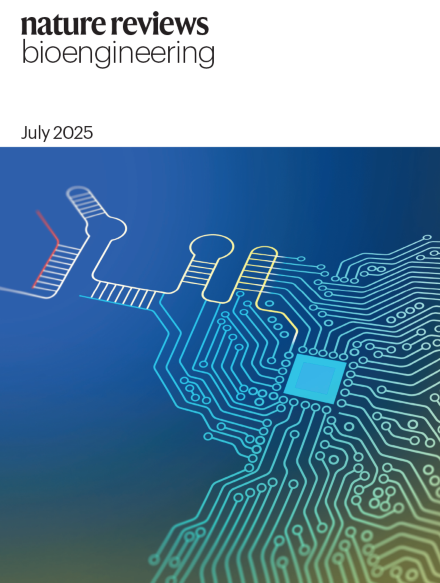
DNA-based biocomputing units, such as switches, logic gates, amplifiers and neurons, can be integrated into circuits that use molecular interactions to process information. These DNA biocomputing circuits offer high parallelism and biocompatibility, making them well-suited for a range of biomedical applications. See Sisi Jia et al.

Cover image: Simon Bradbrook
Editorial

  • The immune system is plastic, adaptable and context dependent. To effectively leverage its therapeutic potential and understand immune responses to bioengineered interventions, our scientific models and frameworks must reflect this same flexibility.

    Editorial

    Advertisement

Top of page ⤴

Comment

  • Immune responses are complex, often defying rigid classifications. Instead of interpreting results according to reductionist categories, researchers should rely on comprehensive single-cell data to guide analysis and should remain open to unexpected immunological complexity.

    • Jessica L. Stelzel
    • Jonathan P. Schneck
    • Joshua C. Doloff
    Comment
  • The lack of structural definition in nanomedicines limits therapeutic efficacy and complicates regulatory approval. Here, we emphasize that defining, designing and optimizing the structures of nanomedicines are critical  to developing effective therapies because their architectures — not just the identity of their components — determines potency.

    • Chad A. Mirkin
    • Milan Mrksich
    • Natalie Artzi
    Comment
  • Microgravity accelerates ageing-like changes in cells and tissues. By integrating bioengineering technologies, researchers can uncover pathways to mitigate ageing and develop therapeutic interventions for age-related diseases both on Earth and in space.

    • Mei ElGindi
    • Jeremy Teo
    Comment
  • Achieving effective collaboration in bioengineering is an art and a science. Here we outline strategies for building and sustaining interdisciplinary partnerships, and outline challenges, opportunities and funding options for establishing and strengthening collaborative research.

    • Nicolas H. Voelcker
    • Andy Tay
    • Roey Elnathan
    Comment
Top of page ⤴

Research Highlights

Top of page ⤴

Reviews

  • DNA computing takes advantage of DNA molecular interactions to achieve information processing for liquid-phase computing. This Review discusses designing rules, implementation strategies and biomedical applications of DNA computing circuits.

    • Sisi Jia
    • Hui Lv
    • Fei Wang
    Review Article
  • The function and fate of T cells are dictated by their various dynamic interactions with cells and tissues. This Review discusses the recreation of key T cell interfaces using nanotechnologies and microtechnologies for the mechanistic study of T cell biology, as well as the manufacturing and sorting of T cell products.

    • Yunus Alapan
    • Susan N. Thomas
    Review Article
  • Surgical robots can assist in medical procedures or autonomously perform surgical tasks. This Review explores the design and application of passive, interactive, teleoperated and autonomous surgical robots within the framework of computer-assisted and integrated surgical workflows.

    • Gastone Ciuti
    • Robert J. Webster III
    • Arianna Menciassi
    Review Article
  • Organisms have evolved diverse colouration strategies, including dynamic colour change, which enables their rapid adaptation to environmental stimuli. This Review discusses the recreation of bioinspired colouration and dynamic colour change mechanisms for applications in optics, sensors and biomedicine.

    • Seok Hwan Choi
    • Dohyung Kim
    • Seung Hwan Ko
    Review Article
  • Emerging perfusion technologies restore circulation and mitigate cell damage post ischaemia and reperfusion, showing promise for resuscitation medicine and organ transplantation. This Review explores cellular injury mechanisms, machine perfusion approaches and perfusate modifications for organ and whole-body recovery following circulatory cessation.

    • David Andrijevic
    • Ana Spajic
    • Nenad Sestan
    Review Article
Top of page ⤴

Search

Quick links