Thank you for visiting nature.com. You are using a browser version with limited support for CSS. To obtain
the best experience, we recommend you use a more up to date browser (or turn off compatibility mode in
Internet Explorer). In the meantime, to ensure continued support, we are displaying the site without styles
and JavaScript.
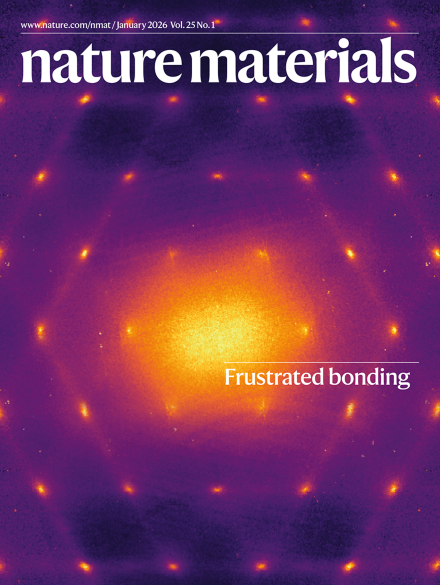
X-ray diffraction and pair distribution function analysis reveals frustrated bond order in LnCd3P3 (Ln = lanthanide). This frustrated bond network coexists with frustrated magnetism and may lead to the discovery of emergent quantum phenomena.
The ability to make porous extended structures in a predictable manner is now a mature and useful concept for materials scientists to solve real-world problems.
A technique combining laser fragmentation in liquids with the reduction of multiple metal salt precursors is developed to synthesize alloy nanoparticles, simultaneously achieving ultrasmall size and high compositional complexity for efficient and stable electrocatalysis.
The small-bandgap semiconductors LnCd3P3 (Ln = La, Ce, Pr and Nd) are promising materials to study emergent phenomena from geometric frustration across bond, spin and charge degrees of freedom.
Weaving-inspired topological design merges conventional polyurethane and epoxy polymers into a single, entangled network with enhanced mechanical performance and tunable properties that surpass traditional blending or supramolecular strategies.
Borrowing an idea from granular physics, researchers design and engineer soft composite materials with non-reciprocal static and dynamical mechanical behaviours, which could power the next generation of soft robots.
The electrostatic interactions in aqueous ionic media are screened by mobile charge carriers, limiting device design and operation speed. Here the built-in electric field is leveraged to dope ions into vanadium dioxide, triggering a surface insulator-to-metal transition, further enabling high-speed in-memory sensing in aqueous solutions.
A synthesis method mediated by laser-induced plasmon is developed to prepare subnanoscale high-entropy alloys, and a few such alloys display high stability for water splitting in proton exchange membrane electrolysers, operating at 2 A cm−2 for over 1,200 h.
Excitonic quantum oscillations are observed in correlated electron–hole bilayers and quantum phase transitions are identified between excitonic insulator and bilayer quantum Hall states under strong magnetic fields.
Quantum oscillations are reported in Coulomb-coupled electron–hole double layers that originate from recurring transitions between competing excitonic insulator and layer-decoupled quantum Hall states.
The electronic ground state of a correlated oxide interface is reversibly switched by light. Stemming from interfacial reconstructions, electrostatic confinement and photodoping, this effect opens a path towards engineering the optical response of oxides.
Time-resolved surface X-ray scattering is used to probe how light manipulates orbital order at the surface of a manganite. Femtosecond light is found to generate incoherent atomic disorder on an ultrafast timescale, consistent with the localization of polarons.
The coexistence of frustrated magnetism and bond order is demonstrated in a family of antiferromagnets. Layers of dual frustrated orders are interleaved in the same crystal lattice, which presents an exciting possibility for engineering new responses.
Advances have been made in thin-film piezoelectrics; however, the linearity of electric-field-induced strain with frequency and temperature still requires improvement. Here, by growing interlocked monoclinic and tetragonal polar nanoregions in (K,Na)NbO3 thin films, highly linear strains of up to 1.1% are reported at frequencies up to 105 Hz.
An FeIII/V redox mechanism in Li4FeSbO6 on delithiation without FeIV or oxygen formation with resistance to aging, high operating potential and low voltage hysteresis is demonstrated, with implications for Fe-based high-voltage applications.
Homojunction intermolecular charge separation is reported in photoexcited anion–cation pairs induced by external electric field bias, opening possibilities for light harvesting using molecular semiconductors.
Using crosslinked entanglement induced by weaving-inspired asymmetric nodes, flexible polyurethane and rigid epoxy polymers are efficiently integrated into a single multi-component polymeric network.
Using the shear jamming transition within soft composite solids, non-reciprocal mechanics are achieved for the asymmetric spatiotemporal control of soft materials.
Semiconductor polymers containing selenophene in their backbones and immunomodulatory groups in their side chains enable the fabrication of implantable bioelectronic devices with enhanced immune compatibility and low foreign-body response.
Peptide ionizable lipids containing specific amino acids and functional groups render lipid nanoparticles with the tissue-specific delivery of mRNA and prime editing systems, which can be useful for advanced mRNA-based therapeutics.
Tissue-specific mRNA or gene editing machinery delivery is achieved with lipid nanoparticles containing peptides with specific sequences, which tune the protein corona of the particles by mechanical optimization of peptide–protein binding affinities.