Thank you for visiting nature.com. You are using a browser version with limited support for CSS. To obtain
the best experience, we recommend you use a more up to date browser (or turn off compatibility mode in
Internet Explorer). In the meantime, to ensure continued support, we are displaying the site without styles
and JavaScript.
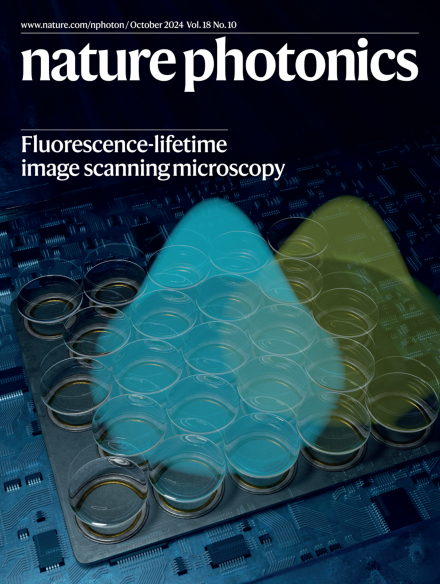
Integrating a single-photon avalanche detector (SPAD) array into a confocal laser scanning microscope yields a twofold increase in the localization accuracy for single-molecule localization microscopy. The cover shows an artistic impression of the SPAD array detector with microlenses, where the two disks/shaded Gaussians depict the emission of two different fluorescent molecules hitting the detector array.
Two independent demonstrations of room-temperature Bose–Einstein condensation of light in semiconductor optical microcavities with embedded quantum wells may pave the way for harnessing the effect for practical applications, such as high-power, single-mode emission from large-aperture devices.
Ultrashort laser light–matter interactions can create unique virtual quantum states. Researchers have now revealed this phenomenon in solution-grown semiconductor nanoplatelets using visible light.
Optical nanoantenna field enhancement is hampered by material- and size-dependent losses. Researchers have now made an atomic antenna using the controlled formation of an isolated germanium vacancy colour centre in diamond, which enables giant near-field optical enhancement and which can detect and control nearby charges and induce energy transfer.
Three-dimensional, label-free optical images of a complex volumetric sample can now be obtained at a 1-Hz volumetric frame rate, thanks to the use of ultrafast camera measurements and sparse representation of the sample optical response.
This Review provides an overview on high-performance photonic integrated circuit lasers at visible and short near-infrared wavelengths between 400 nm and 1,000 nm, focusing on low-noise, continuous-wave operation needed for many quantum technologies.
This Review provides an overview of the most recently developed quantum imaging systems, highlighting the nonclassical properties of sources, such as bright squeezed light, entangled photons and single-photon emitters that enable their functionality.
Using a gas–solid mixture approach, researchers used a transparent, scintillating nanoporous material for real-time detection of 85Kr and 3H, two pure beta emitters. They also simultaneously measure a mixture of them. The broadly applicable approach may be useful for nuclear industry and environmental safeguarding.
A direct lead-halide perovskite CT imager has been demonstrated. The detector arrays have 980 μm absorber thickness and exhibit detection quantum efficiency of 80% and noise-equivalent dose of 153 pGyair.
The integration of a single-photon detector array and imaging scanning microscopy in a confocal scanning microscope enables doubling the resolution of single-molecule localization microscopy.
An optical accelerator is designed to leverage a multiple-scattering cavity to passively induce optical nonlinear random mapping with a continuous-wave laser at a constant low power (~21 mW), providing a new avenue for optical computing.
Multiple scattering capable of synthesizing programmable linear and nonlinear transformations concurrently at low optical power in the order of milliwatts continuous-wave power for optical computing is demonstrated, paving the way for ultra-efficient, low-power all-optical neural networks.
Photon Bose–Einstein condensation is observed in a semiconductor laser, where thermalization and condensation of photons occur using an InGaAs quantum well and an open microcavity. The distinction between regimes of photon Bose–Einstein condensation and conventional lasing are clearly identified.
Bose–Einstein condensation of photons is demonstrated in a large-aperture electrically driven InGaAs vertical-cavity surface-emitting laser diode at room temperature. The observed photon Bose–Einstein condensate exhibits the fundamental transversal optical mode at a critical phase-space density.
Based on the acquisition of a multi-spectral reflection matrix at a high frame rate, a fully digital microscope overcomes aberrations and multiple scattering to provide a three-dimensional image of an ex vivo opaque cornea at a resolution of 0.29 μm and 0.5 μm in the transverse and axial directions, respectively.
Transfer printing of a quantum dot–ZnO film with a surface-functionalized viscoelastic stamp enables the realization of RGB QLED pixels with a resolution of 2,500 pixels per inch and a peak external quantum efficiency of 23.3% for green-emitting devices.
Researchers show that atom-like dipoles based on germanium vacancy centres in diamond may be useful as antennas, exhibiting million-fold near-field optical intensity enhancement. These antennas are used to detect and control the charge state of nearby carbon vacancies.