
Thank you for visiting nature.com. You are using a browser version with limited support for CSS. To obtain the best experience, we recommend you use a more up to date browser (or turn off compatibility mode in Internet Explorer). In the meantime, to ensure continued support, we are displaying the site without styles and JavaScript.

Volume 14 Issue 7, July 2017

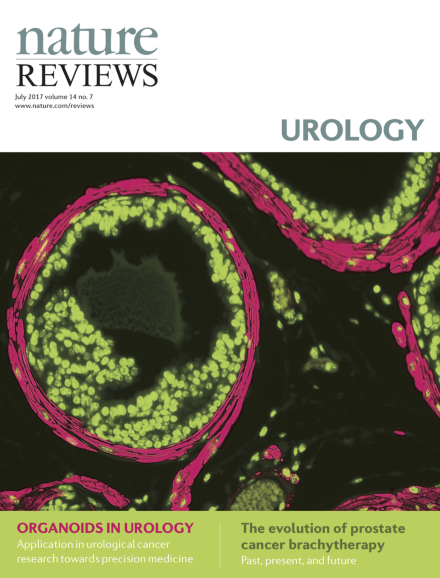
Cover image supplied by Sudeh Izadmehr, Department of Genetics and Genomic Sciences, Icahn School of Medicine at Mount Sinai, New York, NY 10029, USA. The image shows a high-power fluorescence microscopy view of a FVB/N mouse prostate. Immunofluorescence staining was performed using DAPI (4',6-diamidino-2-phenylindole) to stain nuclei and monoclonal antibody against α-smooth muscle actin to identify smooth muscle cells. Smooth muscle cells are elongated, tapering at each end with a centrally located nucleus. They encircle the basal epithelial, luminal epithelial, and neuroendocrine cells of each prostate gland. In prostate adenocarcinoma, breaks appear in the perimeter of circumferential smooth muscle cells; this discontinuity is a marker of invasion.
Research Highlight

Top of page ⤴

In Brief

Top of page ⤴

News & Views

  • The comparative efficacy of drugs for the management of overactive bladder syndrome (OAB) remains undefined. A new indirect treatment comparison demonstrates similar efficacy of mirabegron versus several antimuscarinic drugs and onabotulinum toxin A in a number of outcome measures. Head-to-head trials of these agents are still required to optimize the management of patients with OAB.

    • Arun Sahai
    • Sachin Malde
    News & Views
  • Sepsis is an infrequent but serious adverse risk of transrectal ultrasonography-guided prostate biopsy. A new study evaluated whether the use of single-dose ertapenem, a broad-spectrum antibiotic, resulted in increased carbapenem resistance following biopsy. However, physicians need to carefully consider the risks of antibiotic resistance when balancing the benefit of broad-spectrum antibiosis against a 1% risk of sepsis.

    • Deepak K. Pruthi
    • Michael A. Liss
    News & Views
  • Life expectancy after primary treatment for localized prostate cancer is long, so the importance of functional outcomes and quality-of-life measures cannot be underestimated. Careful assessment of the data, with an emphasis on patient selection, definition of clinical significance, and length of follow-up duration, is essential.

    • Thenappan Chandrasekar
    • Derya Tilki
    News & Views
  • Advances in understanding of prostate cancer biology and improved treatment options have changed management of metastatic prostate cancer. Escape of the malignancy from the prostatic capsule no longer means that treatment is focused on limiting systemic spread, and data suggest that local treatment of the prostate is beneficial, even in men whose tumour has spread.

    • Fred Saad
    News & Views
Top of page ⤴

Review Article

  • 3D organoids are valuable tools for increasing understanding of disease biology. In this Review, the authors describe how successful application of organoids into urological cancer research can further our understanding of these diseases and provide preclinical cancer models to aid precision medicine.

    • Shangqian Wang
    • Dong Gao
    • Yu Chen

    Collection:

    Review Article
  • Brachytherapy offers an excellent treatment option for definitive and salvage treatment of prostate cancer, with excellent oncological outcomes, limited toxic effects, and good quality of life for patients. However, use of prostate brachytherapy has been declining. In this comprehensive Review, Zaorsky and colleagues consider the evolution of brachytherapy from its inception to contemporary practice, from historical background to current indications and contraindications, underlying radiophysics and technical aspects, cost, and clinical outcomes.

    • Nicholas G. Zaorsky
    • Brian J. Davis
    • Eric M. Horwitz
    Review Article
  • The risk of urinary incontinence and other lower urinary tract (LUT) symptoms increases substantially with advancing age; however, such symptoms can emerge in otherwise healthy individuals. In this Review, the authors describe the changes in LUT physiology that take place during the ageing process, and whether or not these changes arise as a consequence of 'normal', healthy ageing, or unaddressed pathology.

    • William Gibson
    • Adrian Wagg
    Review Article
Top of page ⤴

Search

Quick links