
Fig. 1: Mettl1 is essential for maintaining fertility.
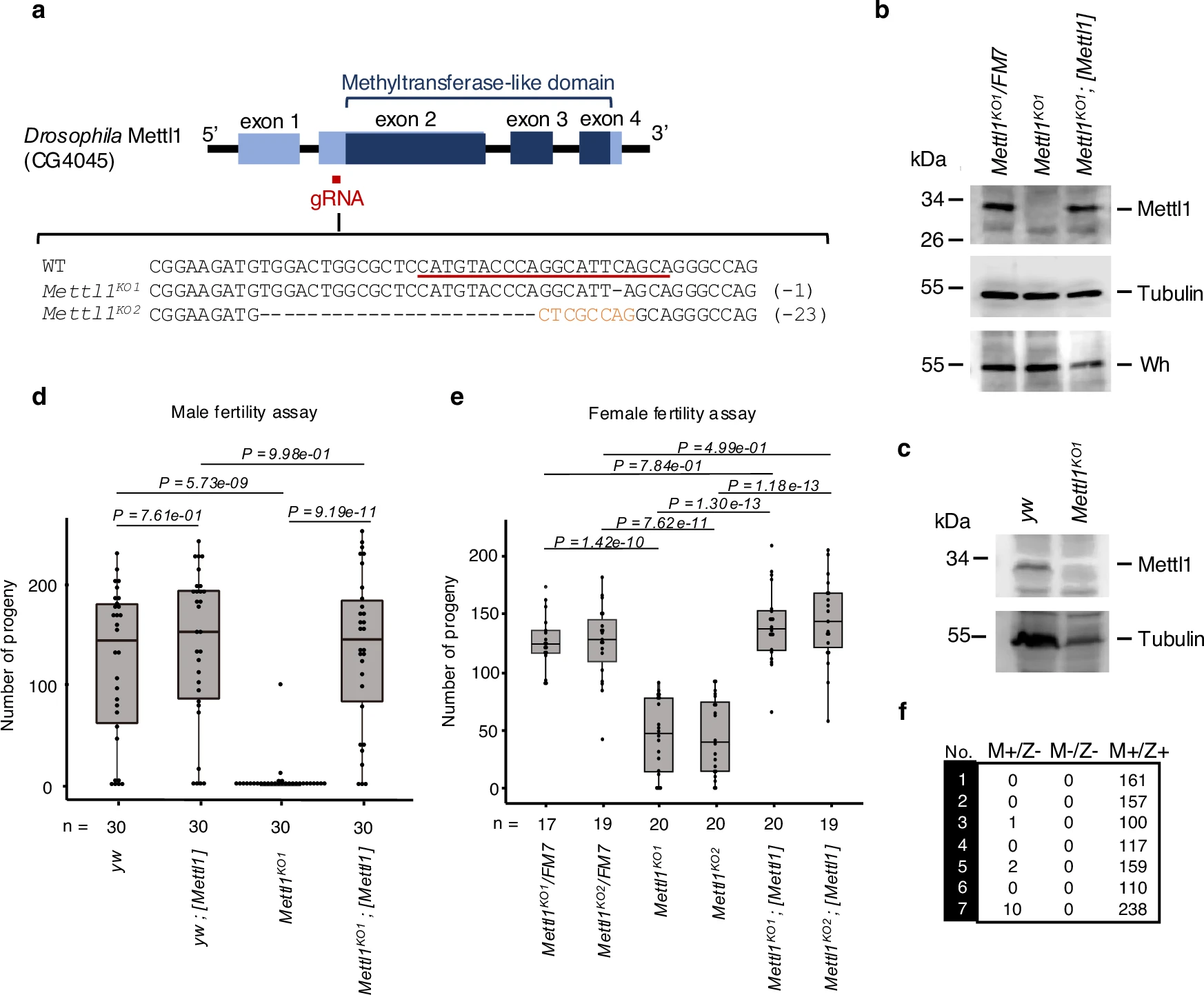
a Schematic diagram of the genomic structure of Mettl1 and a gRNA targeting Mettl1 exon 2 for CRISPR-mediated generation of Mettl1-KO lines. Mettl1 sequences of the WT (yw) and the Mettl1-KO mutants (Mettl1KO1 and Mettl1KO2). b Western blot showing Mettl1 and Wh in Drosophila ovaries. c Western blot showing Mettl1 in Drosophila testes. d Male fertility assay at 25 °C using WT (yw), WT with Mettl1 transgene (yw; [Mettl1]), Mettl1-KO (Mettl1KO1) and Mettl1-rescue (Mettl1KO1; [Mettl1]) males. e Female fertility assay at 25 °C using control (Mettl1KO1/FM7, Mettl1KO2/FM7), Mettl1-KO (Mettl1KO1, Mettl1KO2) and Mettl1-Rescue group (Mettl1KO1; [Mettl1], Mettl1KO2; [Mettl1]) females. FM7 is a balancer chromosome. f Male fertility assay at 25 °C using (yw; m + /z + ), and zygotic Mettl1-KO (Mettl1KO1; m + /z–), maternal and zygotic Mettl1-KO (Mettl1KO1; m–/z–) males. Each western blots were reproduced three times with similar results (b, c). In box plots of fertility assays, central bands, upper and lower edges of box plots represent median, first and third quartiles, respectively. Upper and lower whiskers represent maximum, and minimum values. The number (n = ) below the box plot indicates sample size. Upper and lower edges of boxes represent third and first quartiles, respectively (d, e). Two-sided P-values were calculated using Tukey’s HSD test (d, e). Source data of Fig. 1b–e are provided as a Source Data file.
