
Abstract
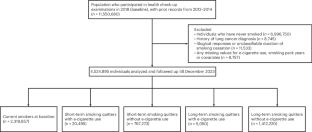
Electronic cigarettes (e-cigarettes) have gained popularity as a less harmful alternative to conventional cigarettes, yet their associations with lung cancer risk after smoking cessation remain uncertain. Here we evaluated 4,524,895 adults with a conventional smoking history who participated in the Korean National Health Screening Program in 2018 (baseline), with prior records from 2012–2014. Participants were classified as current smokers, short-term quitters or long-term quitters, and followed up to December 2023. Daily e-cigarette use at baseline was used to define post-cessation e-cigarette use. Lung cancer incidence and lung cancer-specific death (LCSD) were assessed using multivariable Cox models. Over 24,182,543 person-years, 35,887 lung cancers and 12,807 LCSD events occurred. Compared with complete quitters, e-cigarette use after smoking cessation was associated with higher risks of lung cancer incidence (adjusted hazard ratio (aHR) 1.56, 95% confidence interval (CI) 1.24–1.97) and LCSD (aHR 2.00, 95% CI 1.28–3.15). Associations were directionally consistent in short-term and long-term quitters and were prominent in the high-risk subgroup (incidence: aHR 1.91, 95% CI 1.44–2.53; LCSD: aHR 1.92, 95% CI 1.13–3.24). Although causality cannot be established, these findings suggest that e-cigarette use after smoking cessation may attenuate the benefits of complete cessation for lung cancer prevention.
This is a preview of subscription content, access via your institution
Access options
Access Nature and 54 other Nature Portfolio journals
Get Nature+, our best-value online-access subscription
$32.99 / 30 days
cancel any time
Subscribe to this journal
Receive 12 print issues and online access
$259.00 per year
only $21.58 per issue
Buy this article
- Purchase on SpringerLink
- Instant access to the full article PDF.
USD 39.95
Prices may be subject to local taxes which are calculated during checkout


Data availability
The data supporting the findings of this study are derived from the Korean NHIS health screening and claims databases. Individual-level data are not publicly available because they contain sensitive personal health information and are protected under NHIS data governance and privacy regulations. For research purposes, de-identified data are accessible upon application through the NHIS Big Data Platform (https://nhiss.nhis.or.kr/). Applicants are required to submit a research proposal (including study aims, cohort definition and a data specification), documentation of institutional review board approval, and other materials requested by NHIS. Applications undergo administrative and data-provision review, and access is granted only for approved variables and time periods. Approved users can analyze the data through NHIS-designated secure analysis environments. The review and approval timeline is determined by NHIS and may vary by the complexity of the requested dataset and operational demand. Decisions are typically issued after completion of the review process (often within several weeks, but potentially longer for customized datasets). Further information on eligibility, required documents, fees and access procedures is available at https://nhiss.nhis.or.kr/.
Code availability
The statistical analyses in this Article were conducted using SAS v.9.4 with the built-in SAS/STAT procedure proc phreg. Figures were generated using R (v.4.3.3) with the open-source packages ggplot2 (v.3.5.1) and patchwork (v.1.2.0). No customized or nonpublic packages were used. The analytic SAS and R code used in this study is available via GitHub at https://github.com/SNUBH-bigdata/ECig_SmokingQuitters. De-identified NHIS analytic datasets are accessible upon application through the NHIS Big Data Platform, subject to NHIS approval and data extraction procedures, and can be analyzed within NHIS-designated secure analysis environments.
References
Bray, F. et al. Global cancer statistics 2022: GLOBOCAN estimates of incidence and mortality worldwide for 36 cancers in 185 countries. CA Cancer J. Clin. 74, 229–263 (2024).
Malhotra, J., Malvezzi, M., Negri, E., La Vecchia, C. & Boffetta, P. Risk factors for lung cancer worldwide. Eur. Respir. J. 48, 889–902 (2016).
Zou, K. et al. Etiology of lung cancer: evidence from epidemiologic studies. J. Natl Cancer Cent. 2, 216–225 (2022).
IARC Working Group on the Evaluation of Carcinogenic Risks to Humans. Personal habits and indoor combustions. IARC Monogr. Eval. Carcinog. Risks Hum. 100, 1–538 (2012).
National Lung Screening Trial Research Team et al. Reduced lung-cancer mortality with low-dose computed tomographic screening. N. Engl. J. Med. 365, 395–409 (2011).
Pastorino, U. et al. Prolonged lung cancer screening reduced 10-year mortality in the MILD trial. Ann. Oncol. 30, 1162–1169 (2019).
de Koning, H. J. et al. Reduced lung-cancer mortality with volume CT screening in a randomized trial. N. Engl. J. Med. 382, 503–513 (2020).
US Preventive Services Task Force. et al. Screening for lung cancer: US Preventive Services Task Force Recommendation Statement. JAMA 325, 962–970 (2021).
Wolf, A. M. D. et al. Screening for lung cancer: 2023 guideline update from the American Cancer Society. CA Cancer J. Clin. 74, 50–81 (2024).
Stone, E. & Vachani, A. Tobacco control and tobacco cessation in lung cancer—too little, too late? Semin. Respir. Crit. Care Med. 37, 649–658 (2016).
Marques, P., Piqueras, L. & Sanz, M. J. An updated overview of e-cigarette impact on human health. Respir. Res. 22, 151 (2021).
Obisesan, O. H. et al. Trends in e-cigarette use in adults in the United States, 2016–2018. JAMA Intern. Med. 180, 1394–1398 (2020).
Lindson, N. et al. Pharmacological and electronic cigarette interventions for smoking cessation in adults: component network meta-analyses. Cochrane Database Syst. Rev. 9, CD015226 (2023).
Balfour, D. J. K. et al. Balancing consideration of the risks and benefits of e-cigarettes. Am. J. Public Health 111, 1661–1672 (2021).
Lang, A. E. et al. England is handing out e-cigarettes: is the ‘swap to stop’ tobacco control scheme harm reduction or harm production? Am. J. Respir. Crit. Care Med. 208, 1024–1025 (2023).
Wills, T. A., Soneji, S. S., Choi, K., Jaspers, I. & Tam, E. K. E-cigarette use and respiratory disorders: an integrative review of converging evidence from epidemiological and laboratory studies. Eur. Respir. J. 57, 1901815 (2021).
Gotts, J. E., Jordt, S. E., McConnell, R. & Tarran, R. What are the respiratory effects of e-cigarettes? Brit. Med. J. 366, l5275 (2019).
Pastorino, U. et al. Stopping smoking reduces mortality in low-dose computed tomography screening participants. J. Thorac. Oncol. 11, 693–699 (2016).
Golden, S. E. et al. “I already know that smoking ain’t good for me”: patient and clinician perspectives on lung cancer screening decision-making discussions as a teachable moment. Chest 158, 1250–1259 (2020).
Huerta, T. R., Walker, D. M., Mullen, D., Johnson, T. J. & Ford, E. W. Trends in e-cigarette awareness and perceived harmfulness in the U.S. Am. J. Prev. Med. 52, 339–346 (2017).
Lee, J. A., Kim, S. H. & Cho, H. J. Electronic cigarette use among Korean adults. Int. J. Public Health 61, 151–157 (2016).
Sanford, N. N., Sher, D. J., Xu, X., Aizer, A. A. & Mahal, B. A. Trends in smoking and e-cigarette use among US patients with cancer, 2014–2017. JAMA Oncol. 5, 426–428 (2019).
Heiden, B. T. et al. Prevalence of cigarette and e-cigarette use among U.S. adults eligible for lung cancer screening based on updated USPSTF guidelines. Cancer Epidemiol. 76, 102079 (2022).
Shin, D. W. et al. Lung cancer specialist physicians’ attitudes towards e-cigarettes: a nationwide survey. PLoS ONE 12, e0172568 (2017).
US Preventive Services Task Force. et al. Interventions for tobacco smoking cessation in adults, including pregnant persons: US Preventive Services Task Force Recommendation Statement. JAMA 325, 265–279 (2021).
Soule, E. et al. Electronic cigarette use intensity measurement challenges and regulatory implications. Tob. Control 32, 124–129 (2023).
Cobb, N. K., Brookover, J. & Cobb, C. O. Forensic analysis of online marketing for electronic nicotine delivery systems. Tob. Control 24, 128–131 (2015).
Lee, S., Kimm, H., Yun, J. E. & Jee, S. H. Public health challenges of electronic cigarettes in South Korea. J. Prev. Med. Public Health 44, 235–241 (2011).
Kim, S., Goniewicz, M. L., Yu, S., Kim, B. & Gupta, R. Variations in label information and nicotine levels in electronic cigarette refill liquids in South Korea: regulation challenges. Int. J. Environ. Res. Public Health 12, 4859–4868 (2015).
Tang, M. S. et al. Electronic-cigarette smoke induces lung adenocarcinoma and bladder urothelial hyperplasia in mice. Proc. Natl Acad. Sci. USA 116, 21727–21731 (2019).
Jensen, R. P., Luo, W., Pankow, J. F., Strongin, R. M. & Peyton, D. H. Hidden formaldehyde in e-cigarette aerosols. N. Engl. J. Med. 372, 392–394 (2015).
Fowles, J., Barreau, T. & Wu, N. Cancer and non-cancer risk concerns from metals in electronic cigarette liquids and aerosols. Int. J. Environ. Res. Public Health 17, 2146 (2020).
Lee, H. W. et al. E-cigarette smoke damages DNA and reduces repair activity in mouse lung, heart, and bladder as well as in human lung and bladder cells. Proc. Natl Acad. Sci. USA 115, E1560–E1569 (2018).
Herzog, C. et al. Cigarette smoking and e-cigarette use induce shared DNA methylation changes linked to carcinogenesis. Cancer Res. 84, 1898–1914 (2024).
Velasco, W. V. et al. Comparative effects of combustible cigarette versus electronic cigarette exposures on KRAS mutant lung cancer promotion. Neoplasia 67, 101185 (2025).
Bracken-Clarke, D. et al. Vaping and lung cancer – a review of current data and recommendations. Lung Cancer 153, 11–20 (2021).
Kalkhoran, S. & Glantz, S. A. Modeling the health effects of expanding e-cigarette sales in the United States and United Kingdom: a Monte Carlo analysis. JAMA Intern. Med. 175, 1671–1680 (2015).
Patnode, C. D. et al. Interventions for tobacco cessation in adults, including pregnant persons: updated evidence report and systematic review for the US Preventive Services Task Force. JAMA 325, 280–298 (2021).
Lung cancer risk factors. Centers for Disease Control and Prevention https://www.cdc.gov/lung-cancer/risk-factors/index.html (2025).
Tammemagi, M. C. et al. Selection criteria for lung-cancer screening. N. Engl. J. Med. 368, 728–736 (2013).
Cassidy, A. et al. The LLP risk model: an individual risk prediction model for lung cancer. Br. J. Cancer 98, 270–276 (2008).
Tindle, H. A. et al. Lifetime smoking history and risk of lung cancer: results from the Framingham Heart Study. J. Natl Cancer Inst. 110, 1201–1207 (2018).
Meza, R. et al. Evaluation of the benefits and harms of lung cancer screening with low-dose computed tomography: modeling study for the US Preventive Services Task Force. JAMA 325, 988–997 (2021).
Peto, R. et al. Smoking, smoking cessation, and lung cancer in the UK since 1950: combination of national statistics with two case-control studies. Brit. Med. J. 321, 323–329 (2000).
Rojewski, A. M. et al. Tobacco dependence predicts higher lung cancer and mortality rates and lower rates of smoking cessation in the National Lung Screening Trial. Chest 154, 110–118 (2018).
Tanner, N. T. et al. The association between smoking abstinence and mortality in the National Lung Screening Trial. Am. J. Respir. Crit. Care Med. 193, 534–541 (2016).
Choi, S., Lee, K. & Park, S. M. Combined associations of changes in noncombustible nicotine or tobacco product and combustible cigarette use habits with subsequent short-term cardiovascular disease risk among South Korean men: a nationwide cohort study. Circulation 144, 1528–1538 (2021).
Stephens, W. E. Comparing the cancer potencies of emissions from vapourised nicotine products including e-cigarettes with those of tobacco smoke. Tob. Control 27, 10–17 (2018).
Seong, S. C. et al. Data resource profile: the National Health Information Database of the National Health Insurance Service in South Korea. Int. J. Epidemiol. 46, 799–800 (2017).
Seong, S. C. et al. Cohort profile: the National Health Insurance Service-National Health Screening Cohort (NHIS-HEALS) in Korea. BMJ Open 7, e016640 (2017).
Shin, D. W., Cho, B. & Guallar, E. Korean National Health Insurance Database. JAMA Intern. Med. 176, 138 (2016).
Son, J. S. et al. Association of blood pressure classification in Korean young adults according to the 2017 American College of Cardiology/American Heart Association Guidelines with subsequent cardiovascular disease events. JAMA 320, 1783–1792 (2018).
Hwangbo, Y. et al. Incidence of diabetes after cancer development: a Korean national cohort study. JAMA Oncol. 4, 1099–1105 (2018).
Reitsma, M. et al. Reexamining rates of decline in lung cancer risk after smoking cessation. A meta-analysis. Ann. Am. Thorac. Soc. 17, 1126–1132 (2020).
Pescatello, L. S., Arena, R., Riebe, D. & Thompson, P. D. ACSM’s Guidelines for Exercise Testing and Prescription (Lippincott Williams & Wilkins, 2014).
Charlson, M. E., Pompei, P., Ales, K. L. & MacKenzie, C. R. A new method of classifying prognostic comorbidity in longitudinal studies: development and validation. J. Chronic Dis. 40, 373–383 (1987).
Fine, J. P. & Gray, R. J. A proportional hazards model for the subdistribution of a competing risk. J. Am. Stat. Assoc. 94, 496–509 (1999).
Acknowledgements
The nationwide population-based data used in this study were provided by the South Korean NHIS (NHIS-2025-06-1-05).
Funding
Y.W.K. discloses support for the research of this work from the National R&D Program for Cancer Control through the National Cancer Center (NCC) funded by the Ministry of Health and Welfare, Republic of Korea (grant number HA23C0252). The funders had no role in study design, data collection and analysis, decision to publish or preparation of the manuscript.
Author information
Authors and Affiliations
Contributions
Y.W.K. and E.J.P. had full access to all of the study data and take responsibility for the integrity of the data and the accuracy of the data analysis. Y.W.K., E.J.P., K.I.K. and T.H.Y. contributed to the concept and design of the study, data collection, data analysis, data interpretation, paper preparation, revision and final approval of the paper. H.-R.K., D.-H.J., Y.J.L., J.S.P., J.H.L. and C.-T.L. contributed to the data analysis, revision and final approval of the paper. Y.W.K. is the overall study guarantor. The corresponding author (Y.W.K.) attests that all listed authors meet authorship criteria and that no others meeting the criteria have been omitted.
Corresponding author
Ethics declarations
Competing interests
Y.W.K. has received honorarium from AstraZeneca, and research grants not related to this study from AstraZeneca. The other authors declare no competing interests.
Peer review
Peer review information
Nature Medicine thanks Esther Omaiye, Guillermo Paraje, Mahdi Sheikh and the other, anonymous, reviewer(s) for their contribution to the peer review of this work. Peer reviewer reports are available. Primary Handling Editor: Ming Yang, in collaboration with the Nature Medicine team.
Additional information
Publisher’s note Springer Nature remains neutral with regard to jurisdictional claims in published maps and institutional affiliations.
Extended data
Supplementary information
Rights and permissions
Springer Nature or its licensor (e.g. a society or other partner) holds exclusive rights to this article under a publishing agreement with the author(s) or other rightsholder(s); author self-archiving of the accepted manuscript version of this article is solely governed by the terms of such publishing agreement and applicable law.
About this article

Cite this article
Kim, Y.W., Park, E.J., Kwak, K.I. et al. Electronic cigarette use after smoking cessation and lung cancer risk. Nat Med (2026). https://doi.org/10.1038/s41591-026-04469-5
Received:
Accepted:
Published:
Version of record:
DOI: https://doi.org/10.1038/s41591-026-04469-5

