Thank you for visiting nature.com. You are using a browser version with limited support for CSS. To obtain
the best experience, we recommend you use a more up to date browser (or turn off compatibility mode in
Internet Explorer). In the meantime, to ensure continued support, we are displaying the site without styles
and JavaScript.
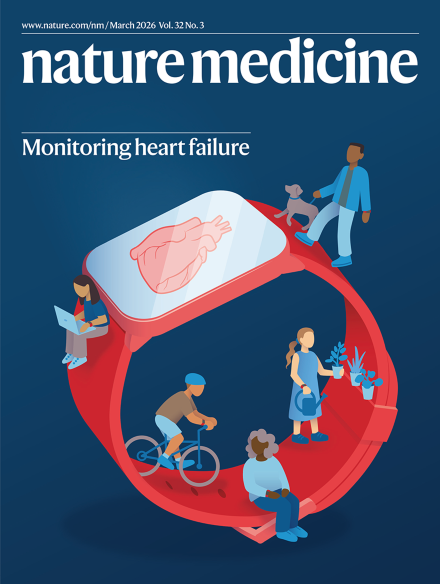
In this issue, Gao et al. show that a deep learning model trained on daily wearable-derived data from patients with heart failure predicts unplanned healthcare events. The cover depicts a smartwatch that enables unobtrusive remote monitoring of heart health in free-living patients.
The field of genetic therapies needs robust investments, transparency and reliable regulatory frameworks to overcome recent challenges and continue to translate new technologies into patients’ benefit.
Regulatory approval of blood-based biomarkers for Alzheimer’s disease could change diagnosis, trial design and therapeutic development. As these tests move into the clinic, physicians must assess how best to deploy them in real-world care.
Artificial intelligence models are evolving from chats to hypotheses. Now their ideas are being validated in organoids and animals — and even in early-stage clinical trials.
Women in medicine face persistent structural and cultural barriers that disproportionately impede career advancement. Here we describe how professional medical associations can advance academic, scholarly and leadership development through inclusive strategies and practical frameworks designed to address both systemic and individual challenges.
Stem-cell-derived islet cells could transform type 1 diabetes by removing the need for injected or infused insulin and improving quality of life. But evaluation of these therapies must center on the voices of people living with type 1 diabetes and examine meaningful outcomes.
We propose straightforward principles to foster an evaluation-forward operating system that can transform the adoption of clinical artificial intelligence from a leap of faith into a stepwise, trust-building process.
Designing interventions that fit seamlessly into real-world care settings is crucial to curtailing rising antimicrobial resistance in resource-limited settings; a large, pragmatic trial in China shows that this is feasible.
An ‘off-the-shelf’ neoantigen vaccine shows safety and immunogenicity in individuals with Lynch syndrome, further advancing hopes for preventive vaccines for hereditary cancer syndromes.
Data show that nutrient supplementation can modify epigenetic clock-based measurements of biological age, a major advance for the supplement field; however, whether such interventions can increase healthspan remains an open question.
A phase 1 study demonstrates proof-of-concept of liver-targeted PCSK9 base editing for familial hypercholesterolemia, but turning this into a transformative therapy will require stringent optimization of editing efficiency, safety, patient selection and trial design.
We assessed how germline Y haplogroups and somatic loss of the Y chromosome (LOY) associate with risk of disease in East Asian and European populations. LOY increases the risk of type 2 diabetes in East Asian men, particularly when polygenic risk scores are low. The identification of pancreatic β-cells with LOY supports its potential involvement in the pathogenesis of type 2 diabetes.
Extracorporeal liver cross-circulation using genetically modified pig livers was feasible in a human decedent model, providing effective temporary liver support with minimal immunosuppression. In this model, xenograft integrity was preserved, and metabolic and hemodynamic stability were maintained even after removal of the native human liver in the decedent.
The correct diagnosis and disease prognosis of Lewy body diseases remains challenging. Two new immunoassays enable the quantification of the biomarker DOPA decarboxylase in multiple fluid samples. In the cerebrospinal fluid, elevated concentrations of DOPA decarboxylase show great potential to support the diagnosis of Lewy body disorders.
The authors propose a framework for clinical AI evaluation within simulated digital hospital environments that capture the evolving constraints, and cascading effects, of clinical decisions.
This Review highlights insights from recent clinical trials and discusses critical factors for optimizing cancer vaccines, with a focus on proxies for vaccine efficacy, neoantigen selection, modular platforms and early intervention.
A pragmatic, cluster randomized trial in rural Guangdong, China, showed that 12-month implementation of a comprehensive antibiotic stewardship program involving physician training, point-of-care prompts, monthly peer review feedback and smartphone-based patient education substantially reduced antibiotic prescriptions for acute respiratory infections compared to control consultations.
In this phase 3 trial, human immunodeficiency virus-negative Vietnamese adults with tuberculous meningitis were stratified by LTA4H genotype to assess whether this influences corticosteroid response. However, outcomes were not significantly better according to genotype.
In a double-blind, cluster-randomized, placebo-controlled trial in Niger that examined azithromycin mass drug distribution in different age groups of children, there was evidence of selection of macrolide resistance determinants in the gut in children 1 to 59 months old, but resistance to other classes of antibiotics were not observed in the gut or nasopharynx.
Bimagrumab is a monoclonal antibody targeting type II activin receptors. In a randomized trial, bimagrumab combined with semaglutide led to up to 17.8 kg weight reduction, surpassing the effects of semaglutide alone (up to 14.2 kg). Notably, the combination preserved lean mass while reducing visceral fat, highlighting its potential for effective obesity management.
The authors developed an LXR inverse agonist, TLC-2716, and show it is effective in reducing triglycerides and cholesterol in dysmetabolic preclinical models. Additionally, a phase 1 trial in healthy participants shows that TLC-2716 is well tolerated and reduces plasma triglycerides and postprandial remnant cholesterol, highlighting its potential for managing cardiovascular risk.
A genetic study in over 300,000 males reveals that Y chromosome loss affects type 2 diabetes risk differently in East Asians and Europeans. Multi-omics data suggest that this may be due to impaired glucose metabolism in Y-deficient pancreatic β cells.
The authors developed a microfluidic device, FIND-Chip, designed to automate and enhance oocyte recovery from follicular fluid, a process traditionally done manually. When used in clinical settings, the device recovered additional oocytes missed during manual screening, substantially increasing the number of viable oocytes available for in vitro fertilization.
A cluster-randomized trial in rural Lesotho showed that uncontrolled hypertension diagnosis and management delivered by minimally trained lay persons in the community using a mobile decision support tool was superior to facility referral for improving clinical outcomes.
A deep learning model using smartwatch data was shown to predict peak oxygen uptake and unplanned healthcare events in the TRUE-HF prospective cohort of patients with heart failure, as well as unplanned healthcare utilization in patients with heart failure in the All of Us Research Program.
In a trial involving 2,069 patients and 111 clinicians across 24 disciplines, patients performing a preconsultation session with an LLM-powered chatbot had a significantly lower consultation time and both patients and clinicians reported improved communication and satisfaction.
MedHELM, an extensible evaluation framework including a new taxonomy for classifying medical tasks and a benchmark of many datasets across these categories, enables the evaluation of large language models on real-world clinical tasks.
Five-year survival data and biomarker analysis of the PRADO extension cohort of the phase 2 OpACIN-neo trial, in which patients with high-risk stage III melanoma received neoadjuvant ipilimumab and nivolumab and underwent pathologic response-directed surgery and adjuvant therapy, show 71% event-free survival and 88% overall survival, with tumor mutational burden, IFNγ signature and PD-L1 expression associated with favorable outcomes.
Genomic and transcriptomic analysis of samples from patients with multiple myeloma, followed by in vitro validation, indicate mechanisms of antigen escape in response to GPRC5D T cell-engager talquetamab, including biallelic deletions, small nucleotide variants, insertion-deletions and chromatin silencing.
Transcriptomic and clinical data analyses from multiple cohorts of patients with cancer receiving immunotherapy find that PD-1 blockade potentiates tumor-specific IgG1 plasma cell responses that complement cellular immunity and contribute to clinical benefit.
In this multicenter phase 1 trial of patients with advanced solid tumors resistant to anti-PD-1 therapy, treatment with the anti-latent TGFβ1 antibody linavonkibart with or without pembrolizumab was safe, and encouraging clinical response rates were associated with T cell infiltration and immune activation.
In a phase 1b/2 trial, an off-the-shelf vaccine using gorilla adenoviral and modified vaccinia Ankara vectors with over 200 mutated peptides known to be present in persons with mismatch-repair-deficient tumors is safe and elicits neoantigen-specific T cells in individuals with Lynch syndrome.
In a prespecified ancillary analysis of the COSMOS randomized trial, supplementation with daily multivitamins, but not with cocoa extract, over the course of 2 years decreased biological aging, as measured by epigenetic aging clocks.
In a randomized controlled trial that included 97 participants, 69% patients with Crohn’s disease (CD) allocated to a fasting-mimicking diet (FMD) achieved clinical response, and over 60% reached remission, outperforming the control group. The FMD also reduced markers of intestinal inflammation, suggesting this dietary intervention could serve as adjunctive treatment for CD.
In a study of four brain-dead human decedents, extracorporeal liver cross-circulation using genetically modified pig livers provides essential hepatic functions, supporting the feasibility of this approach for temporary liver support as a bridge to organ transplantation.
In a phase 1 trial enrolling six patients with heterozygous familial hypercholesterolemia, treatment with lipid nanoparticles designed for base editing and inactivation of PCSK9 in hepatocytes showed preliminary evidence of reduced low-density lipoprotein levels without the occurrence of serious adverse events or evidence of off-target editing.
In a randomized trial enrolling 354 patients with heterozygous familial hypercholesterolemia on maximally tolerated lipid-lowering therapy, treatment with the cholesteryl ester transfer protein inhibitor obicetrapib was well tolerated and significantly lowered low-density lipoprotein cholesterol by 36.3% as compared to placebo.
Multiomic single-cell analyses of 15 Down syndrome fetal cortical samples identify widespread disruption of neurodevelopmental transcriptional programs, driven by three dosage-sensitive chromosome 21 transcription factors.
Using two newly developed immunoassays tested in three clinical cohorts, this study highlights CSF DOPA decarboxylase as a promising biomarker for differentiating dementia with Lewy bodies and Parkinson’s disease from Alzheimer’s disease and controls.
The phase 2/3 DEVOTE trial demonstrated that high-dose nusinersen significantly improved motor function and was safe in patients with spinal muscular atrophy, compared with a matched sham control.
In a case series of eight pediatric patients with systemic lupus erythematosus, dermatomyositis or systemic sclerosis, autologous anti-CD19 CAR T cell therapy was feasible, safe and effective in reducing disease activity.
Analysis of a placebo-controlled trial of a BCMA-targeting CAR-T cell therapy in patients with myasthenia gravis shows that CAR-T cell infusion selectively remodels the systemic immune environment, with elimination of BCMA-high plasma cells and activated plasmacytoid dendritic cells and changes in the autoreactive B cell repertoire.
In a randomized, double-blind, placebo-controlled trial comparing autologous mRNA-engineered BCMA-targeting CAR T cell therapy versus placebo in patients with generalized myasthenia gravis, a significantly higher percentage of patients exhibited a reduction in disease activity in the treatment arm than in the placebo arm.
In the phase 1/2 CASTLE basket trial, autologous CD19 CAR-T cell therapy in patients with treatment-refractory systemic lupus erythematosus, systemic sclerosis or idiopathic inflammatory myopathy was safe, with improved disease activity and patient-reported global health in most patients.
A large language model (LLM)-powered systematic review of over 1,000 studies revealed that, despite the growth of medical research involving LLMs, a majority of studies do not involve real-world clinical data.