
Abstract
Institutions actively seek global talent to foster innovation in the contemporary landscape of scientific research, education, and technological progress. The COVID-19 pandemic underscored the importance of international collaboration as researchers and academicians faced limitations in accessing labs and conducting research experiments. This study uses a research collaboration system to examine the relationship between organizational intellectual capital (Human and structural Capital) and team scientific and technological performance. Further, this study underscores the moderating role of top management support. Using a time-lagged study design, data were collected from 363 participants in academic and research institutions. The results show a positive relationship between organizational intellectual capital (Human and structural Capital) and team scientific and technological performance using a research collaboration system. Moreover, top management support positively moderates the study’s hypothesized relationships. The study’s findings contribute significantly to existing knowledge in this field, with implications for academia, researchers, and government focused on technology transmission, talent management, research creative collaboration, supporting innovation, scientific research, technological progress, and preparing for future challenges.
Introduction
Global talent management and the talent hunt within research and educational institutions have become extensively discussed topics in international human resource management (HRM) (Al et al., 2022). Global talent management is intricately connected to the notion of finding, managing, and facilitating the fetch of research, skills, techniques, and knowledge among team members and progress in education and technology (Kwok, 2022; Sommer et al., 2017). This topic assumes a greater position when it is looked at through the lens of research, academicians, and educational institutions serving as a means of achieving scientific and technological advancement and performance (Kaliannan et al., 2023; Patnaik et al., 2022). Effective knowledge management and transfer occur between teams engaged in cross-border research collaborations (Davenport et al., 2002; Fasi, 2022). Effective team management, global talent recruitment, and the exchange of scientific knowledge across national boundaries face different challenges due to the swift growth of economic and political fanaticism. This is particularly evident in advanced economies that rely heavily on knowledge-based industries (Vaiman et al., 2018). Research and educational sectors are encountering significant challenges in effectively hunting and managing international talent, particularly in the aftermath of the COVID-19 pandemic, during which approximately half of the global workforce faced the possibility of job loss (Almeida et al., 2020; Radhamani et al., 2021). Due to the implementation of lockdown measures by governments, many research intuitions are facing significant issues, and the pandemic has changed the situation; work was stuck, and scientists around the globe are thinking to be prepared for this kind of situation, which is possible through the use scientific research collaboration platforms. These platforms serve as a means to exchange research and knowledge, which is crucial in the talent hunt and management (Haak-Saheem, 2020). In the situation above, wherein limitations exist regarding the exchange of research and knowledge within the institutions, it becomes imperative for the top management of institutions to incentivize employees to engage the team in knowledge sharing actively and achieve team-level scientific and technological advancement. It can be achieved by implementing a research collaboration system that facilitates knowledge exchange and contributes to effective talent hunt and management (Haider et al., 2022; Xu et al., 2024).
A research collaboration network is a tool for scientific and technological advancement and talent management encompassing various processes and practices to facilitate the sharing, integration, translation, and transformation of scientific knowledge (Biondi & Russo, 2022). During and after the COVID-19 era characterized by travel restrictions, research networking platforms serve as valuable tools for students and researchers located in variance regions to engage in the exchange of research knowledge and achieve team-level scientific and technological advancement (Yang et al., 2024). Enhancing intellectual capital (IC) within the organizations is imperative within this framework (Pellegrini et al., 2022; Vătămănescu et al., 2023). Intellectual capital (IC) is the intangible assets owned by an organization that has the potential to generate value (Stewart, 1991). An organization’s intellectual capital (IC) includes human and structural capital (Marinelli et al., 2022). According to Vătămănescu et al. (2023), the organization can effectively manage the skills and abilities of its team members across different countries by properly utilizing both human and structural capital and establishing a strong research collaboration system with the help of top management support. This capability remains intact even during and after the COVID-19 pandemic. This study emphasizes the importance of talent hunt and management within research and educational institutions in the post-COVID-19 pandemic because of every country’s following implementation of lockdown measures. Our study focuses on the implication of facilitating the exchange of research, knowledge, and techniques among team members during and after this period. The effective way to share research expertise and techniques in such a scenario is through a research collaboration network (O’Dwyer et al., 2023).
While previous research has extensively explored talent management in various industries (Al Ariss, Cascio, & Paauwe, 2014; Susanto, Sawitri, Ali, & Rony, 2023), a noticeable gap exists in the body of knowledge regarding the discussion of global talent acquisition and management within research and academic institutions, particularly within volatile environments and about scientific and technological advancements (Harsch & Festing, 2020). The objective of this research is to fill this research gap.1) To investigate the strategies of how research and educational institutions hunt and manage gobble talent. 2)To analyze the impact of human and structural capital and team scientific and technological performance using a research collaboration system. 3) To examine the moderating effect of top management support on the IC to use the research collation network among institution research teams and scientific and technological performance.
In addition, current research contributes significantly to the literature by elucidating the pivotal role of organizational intellectual capital in strengthening scientific and technological performance through research collaborative networks. This study advances our grip on how internal resources drive innovation and research outcomes by empirically demonstrating the positive association between human and structural capital and team-level scientific and technological performance. Furthermore, the current study highlights the moderating effect of top management support, suggesting that management commitment can amplify the benefits of intellectual capital (human and structural capital). These results show a subtle perspective on how organizations can influence their intellectual assets to foster higher levels of productivity and innovation. The study’s theoretical contributions lie in integrating resource-based views and organizational theory with performance metrics, while its practical implications provide actionable insights for institutions aiming to optimize their intellectual resources and management practices. This research also sets the stage for future inquiries into the dynamics of intellectual capital and management support in various collaborative contexts.
Research theories, literature review, and hypotheses development
Research theories
The focus of the current study pertains to the challenges surrounding talent management within institutions during and after the COVID-19 pandemic(Fernandes et al., 2023). Global talent management is intently linked to the objective of enhancing the intellectual capital of the organization (Zada et al., 2023). Considering the COVID-19 pandemic, which raised much more attention toward scientific and technological advancement, the academic sector has noticed an observable shift towards utilizing research collaboration platforms to share scientific knowledge effectively and achieve scientific and technological performance. Intellectual capital encompasses five distinct resource categories, as identified by Roos and Roos (1997), comprising three immaterial and two touchable resources. Intangible resources such as human capital, structural capital, and customer capital are complemented by tangible resources, encompassing monetary and physical assets. Global talent management encompasses human and structural capital management (Felin & Hesterly, 2007). The enhancement of talent management capabilities within the institution can be achieved by cultivating institution-specific competencies in both human and structural capital (Al Ariss et al., 2014). This concept lines up with the theoretical background of the resource-based view (RBV) theory presented by Barney (1991). According to this theory, organizations should prioritize examining their core resources to recognize valuable assets, competencies, and capabilities that can contribute to attaining a sustainable competitive advantage (Barney, 1991).
During and after the COVID-19 scenario, virtual platforms are utilized by institutions to engage students and staff abroad in research and knowledge exchange, which is part of global talent management. Staff possessing adequate knowledge repositories will likely participate in knowledge exchange activities. Therefore, organizations must improve their internal resources to enhance talent management, as per the fundamental principle of the RBV theory (Barney, 1991). Enhancing internal resources entails strengthening an organization’s human capital, which refers to its staff’s scientific research and technical skills and knowledge and structural capital. Strengthening these two resources can facilitate the institution in effectively sharing knowledge through a research collaboration platform, consequently enhancing their global talent management endeavors and contributing to the team’s scientific and technological performance.
In this research, we also utilize institutional theory (Oliver, 1997) and Scott (2008) as a framework to examine the utilization of research collaboration social platforms by faculty of institutions. Our focus is on exchanging research and technical knowledge within the climate of global talent management during and after the COVID-19 epidemic. According to Scott (2008), “Institutional theory is a widely recognized theoretical framework emphasizing rational myths, isomorphism, and legitimacy (p. 78)”. For electronic data interchange, the theory has been utilized in technology adoption research (Damsgaard, Lyytinen (2001)) and educational institutes (J. et al., 2007). In the pandemic situation, institutional theory provides researchers with a framework to analyze the motivations of employees within institutions to engage in teams to achieve team-level scientific and technological performance through a research collaboration system. According to institutional theory, organizations should utilize a research collaboration network to ensure that their staff do not need to compromise their established norms, values, and expectations. During the COVID-19 pandemic, numerous countries implemented limitations on international movement as a preventive measure. Consequently, there has been a growing identification of the potential importance of utilizing an institutional research collaboration platform for facilitating the online exchange of knowledge, skills, research techniques, and global talent management among employees of institutions operating across various countries. The active support of staff by the top management of an institution can play a key role in expediting the implementation of social networks for research collaboration within the institution (Zada et al., 2023).
Literature review
An institution’s scientific and technological advancement is contingent upon optimal resource utilization (Muñoz et al., 2022). Global talent hunt and management encompasses utilizing information and communication technologies (ICT) to provide a way for the exchange of research knowledge and techniques, thereby enabling the implementation of knowledge-based strategies (Muñoz et al., 2022). In a high research-level turbulent environment, it becomes imperative to effectively manage human capital (HUC) to facilitate the appropriate exchange of research knowledge and techniques (Salamzadeh, Tajpour, Hosseini, & Brahmi, 2023). Research shows that transferring research knowledge and techniques across national boundaries, exchanging best practices, and cultivating faculty skills are crucial factors in maintaining competitiveness (Farahian, Parhamnia, & Maleki, 2022; Shao & Ariss, 2020).
It is widely acknowledged in scholarly literature that there is a prevailing belief among individuals that talent possesses movability and that research knowledge and techniques can be readily transferred (Bakhsh et al., 2022; Council, 2012). However, it is essential to note that the matter is more complex than it may initially appear (Biondi & Russo, 2022). The proliferation of political and economic nationalism in developed knowledge-based economies poses a significant risk to exchanging research knowledge and techniques among faculty members in research and educational institutions worldwide (Arocena & Sutz, 2021). During and after COVID-19, knowledge transfer can be effectively facilitated by utilizing a research collaboration network platform (Duan & Li, 2023; Sulaiman et al., 2022). This circumstance is noticeable within the domain of international research and development, wherein academic professionals have the opportunity to utilize research collaboration platforms as a means of disseminating valuable research knowledge and techniques to their counterparts in various nations (Jain et al., 2022).
The scientific and technological advancement of institutions linked by intuition research and development level and research and development depend on the intuition’s quality of research, knowledge, and management (Anshari & Hamdan, 2022). However, there is a need to enhance the research team’s capacity to learn and transfer research knowledge and techniques effectively. Research suggests that institutional human capital (HUC) is critical in managing existing resources and hunting international talent, particularly after the COVID-19 pandemic (Sigala, Ren, Li, & Dioko, 2023). Human capital refers to the combined implicit and crystal clear knowledge of employees within an institution and their techniques and capabilities to effectively apply this knowledge to achieve scientific and technological advancements (Al-Tit et al., 2022). According to Baron and Armstrong (2007) Human capital refers to the abilities, knowledge, techniques, skills, and expertise of individuals, particularly research team members, that are relevant to the current task.
Furthermore, HUC encompasses the scope of individuals who can contribute to this reservoir of research knowledge, techniques, and expertise through individual learning. As the literature shows, the concept of IC encompasses the inclusion of structural capital (STC), which requires fortification through the implementation of a proper global talent acquisition and management system (Pak et al., 2023; Phan et al., 2020). STC encompasses various mechanisms to enhance an institution’s performance and productivity (Barpanda, 2021). STC is extensively acknowledged as an expedited framework for HUC, as discussed by Bontis (1998) and further explored by Gogan, Duran, and Draghici (2015). During and after the COVID-19 epidemic, a practical approach to global talent management involves leveraging research collaboration network platforms to facilitate knowledge exchange among research teams (Arslan et al., 2021). However, the crucial involvement of top management support is imperative to effectively manage talent by utilizing research collaboration network platforms for knowledge transfer (Zada et al., 2023). Nevertheless, the existing body of knowledge needs to adequately explore the topic of talent management about knowledge transfer on research collaboration platforms, particularly in the context of institution-active management support (Tan & Md. Noor, 2013).
Conceptual model and research hypothesis
By analyzing pertinent literature and theoretical frameworks, we have identified the factors influencing staff intention in research and academic institutions to utilize research collaboration networks after the COVID-19 pandemic and achieve scientific and technical performance. This study aims to explain the determinants. Additionally, this study has considered the potential influence of top management support as a moderator on the associations between education and research institution staff intention on IC to utilize research collaboration platforms in the post-COVID-19 era and predictors. Through this discourse, we shall generate several hypotheses to serve as the basis for constructing a conceptual model (see Fig. 1).
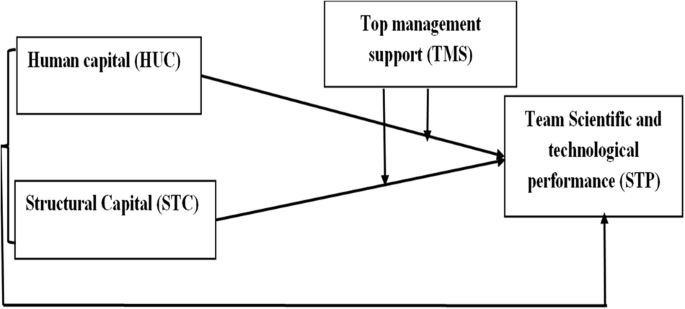
Relationships between study variables: human capital, structural capital, top management support, and team scientific and technological performance. Source: authors’ development.
Human capital and team scientific and technological performance
According to Dess and Picken (2000), HUC encompasses individuals’ capabilities, knowledge, skills, research techniques, and experience, including staff and supervisors, relevant to the specific task. Human capital also refers to the ability to pay to this reservoir of knowledge, techniques, and expertize through individual learning (Dess & Picken, 2000). HUC refers to the combinations of characteristics staff possess, including but not limited to research proficiency, technical aptitude, business acumen, process comprehension, and other similar competencies (Kallmuenzer et al., 2021). The HUC is considered an institutional repository of knowledge, as Bontis and Fitz‐enz (2002) indicated, with its employees serving as representatives. The concept of HUC refers to the combined abilities, research proficiency, and competencies that individuals possess to address and resolve operational challenges within an institutional setting (Barpanda, 2021; Yang & Xiangming, 2024). The human capital possessed by institutions includes crucial attributes that allow organizations to acquire significant internal resources that are valuable, difficult to replicate, scarce, and cannot be substituted. It aligns with the theoretical framework of the RBV theory, as suggested by Barney (1991). IC is extensively recognized as a main factor in revitalizing organizational strategy and promoting creativity and innovation. It is crucial to enable organizations to acquire and effectively disseminate knowledge among their employees, contribute to talent management endeavors, and achieve scientific and technological performance (Alrowwad et al., 2020; He et al., 2023). Human capital is linked to intrinsic aptitude, cognitive capabilities, creative problem-solving, exceptional talent, and the capacity for originality (Bontis & Fitz‐enz, 2002). In talent management, there is a focus on enhancing scientific and technological performance and development. According to Shao and Ariss (2020), HUC is expected to strengthen employee motivation to utilize research collaboration networks for scientific knowledge-sharing endeavors. Based on these arguments, we proposed that.
Hypothesis 1 Human capital (HUC) positively impacts team scientific and technological performance using a research collaboration system.
Structural capital and team scientific and technological Performance
According to Mehralian, Nazari, and Ghasemzadeh (2018) structural capital (STC) encompasses an organization’s formalized knowledge assets. It consists of the structures and mechanisms employed by the institution to enhance its talent management endeavors. The concept of STC is integrated within the framework of institutions’ programs, laboratory settings, and databases (Cavicchi & Vagnoni, 2017). The significance of an organization’s structural capital as an internal tangible asset that bolsters its human capital has been recognized by scholars such as Secundo, Massaro, Dumay, and Bagnoli (2018), and This concept also lines up with the RBV theory (J. Barney, 1991). The strategic assets of an organization encompass its capabilities, organizational culture, patents, and trademarks (Gogan et al., 2015).
Furthermore, Birasnav, Mittal, and Dalpati (2019) Suggested that these strategic assets promote high-level organizational performance, commonly called STC. Literature shows that STC encompasses an organization’s collective expertise and essential knowledge that remains intact even when employees depart (Alrowwad et al., 2020; Mehralian et al., 2018; Sarwar & Mustafa, 2023). The institution’s socialization, training, and development process facilitates the transfer of scientific research knowledge, skills, and expertise to its team (Arocena & Sutz, 2021; Marchiori et al., 2022). The STC is broadly recognized as having important potential and is a highly productive resource for generating great value. STC motivates its team member to share expertise with their counterparts at subordinate organizations by utilizing an institution’s research collaboration network and achieving team-level scientific and technological performance. This method remains effective even in challenging environments where traditional means of data collection, face-to-face meetings, and travel are not feasible (Secundo et al., 2016). In light of the above literature and theory, we propose the following hypothesis.
Hypothesis 2: Structural capital (STC) positively impacts team scientific and technological performance using a research collaboration system.
Top management support as a moderator
If the relationship between two constructs is not constant, the existence of a third construct can potentially affect this relationship by enhancing or diminishing its strength. In certain cases, the impact of a third construct can adjust the trajectory of the relationship between two variables. The variable in question is commonly called the “moderating variable.” According to Zada et al. (2023), top management support to leaders efficiently encourages team members within institutions to share research scientific knowledge with their counterparts in different countries through international research collaboration systems. Similarly, another study shows that the active endorsement of the top management significantly affects the development of direct associations, thereby influencing the team and organization’s overall performance (Biondi & Russo, 2022; Phuong et al., 2024). Different studies have confirmed that top management support is crucial in fostering a conducive knowledge-sharing environment by offering necessary resources (Ali et al., 2021; Lee et al., 2016; Zada et al., 2023). During and after the COVID-19 epidemic, numerous nations implemented nonessential travel restrictions and lockdown measures. In the given context, utilizing a research collaboration system would effectively facilitate the exchange of research, skills, and knowledge among staff belonging to various subsidiaries of an institution (Rådberg & Löfsten, 2024; Rasheed et al., 2024). However, it is common for researchers to exhibit resistance to adopting a novel research technique, often citing various justifications for their reluctance. To address the initial hesitance of employees at subsidiary institutes towards utilizing research collaborative networking within the institute, top management must employ strategies that foster motivation, encouragement, and incentives. These measures help create an atmosphere where team members feel empowered to engage with the new system freely. Institutional theory asserts that top management support is crucial for aligning talent management with institutional norms. Human and structural capital, pivotal within the institutional framework, contributes to an institution’s capacity to attract and retain talent, enhancing legitimacy. Adaptation to scientific and technological advancements is imperative for international institutional competitiveness, as institutional theory dictates (Oliver, 1997). Grounded on the above discussion, we have hypothesized.
Hypothesis 3a: Top management support moderates the relationship between human capital (HUC) and team scientific and technological performance. Specifically, this relationship will be stronger for those with higher top management support and weaker for those with lower top management support.
Hypothesis 3b: Top management support moderates the relationship between structural capital (STC) and team scientific and technological performance through the use of research collaboration network platforms. Specifically, this relationship will be stronger for those with higher top management support and weaker for those with lower top management support.
Methods data and sample
Sample and procedures
To test the proposed model, we collected data from respondents in China’s research and academic sector in three phases to mitigate standard method variance (Podsakoff, MacKenzie, Lee, & Podsakoff, 2003). In the first phase (T1-phase), respondents rated human capital, structural capital, and demographic information. After one month, respondents rated the team’s scientific and technological performance in the second phase (T2-phase). Following another one-month interval, respondents were asked to rate top management support in the third phase (T3-phase). In the first phase, after contacting 450 respondents, we received 417 usable questionnaires (92.66%). In the second phase, we received 403 usable questionnaires. In the third phase, we received 363 usable questionnaires (90.07%), constituting our final sample for interpreting the results. The sample comprises 63.4% male and 36.6% female respondents. The age distribution of the final sample was as follows: 25–30 years old (6.6%), 31–35 years old (57%), 36–40 years old (19.8%), and above 40 years old (16.5%). Regarding respondents’ experience, 45.7% had 1–5 years, 39.4% had 6–10 years, 11.3% had 11–15 years, and 3.6% had over 16 years. According to the respondents’ levels of education, 4.1% had completed bachelor’s degrees, 11.6% had earned master’s degrees, 78.8% were doctorate (PhD) scholars, and 5.5% were postdoctoral and above.
Measurement
To measure the variables, the current study adopted a questionnaire from previous literature, and age, gender, education, and experience were used as control variables. A five-point Likert scale was used (1 = strongly disagree to 5 = strongly agree). Human capital (HUC) was measured through an eight-item scale adopted by Kim, Atwater, Patel, and Smither (2016). The sample item is “The extent to which human capital of research and development department is competitive regarding team performance”. The self-reported scale developed by Nezam, Ataffar, Isfahani, and Shahin (2013) was adopted to measure structural capital. The scale consists of seven items. The sample scale item is “My organization emphasizes IT investment.” In order to measure top management support, a six-item scale was developed by Singh, Gupta, Busso, and Kamboj (2021), was adopted, and sample item includes “Sufficient incentives were provided by top management (TM) for achieving scientific and technological performance.” Finlay, the self-reported scale developed by Gonzalez-Mulé, Courtright, DeGeest, Seong, and Hong (2016) was adopted to gauge team scientific and technological performance and scales items are four. The sample item is “This team achieves its goals.”
Results
Assessment of measurement model
In the process of employing AMOS for analysis, the initial step encompasses an assessment of the model to determine the strength and validity of the study variables. The evaluation of variable reliability conventionally revolves around two key aspects, which are indicator scale reliability and internal reliability. More precisely, indicator reliability is deemed to be recognized when factor loadings exceed the threshold of 0.60. In parallel, internal consistency reliability is substantiated by the attainment of values exceeding 0.70 for both Cronbach’s alpha and composite reliability, aligning with well-established and recognized guidelines (Ringle et al., 2020).
To gauge the reliability of construct indicators, we utilized two key metrics which are composite reliability (CR) and average variance extracted (AVE). The CR values for all variables were notably high, exceeding 0.70 and falling within the range of 0.882 to 0.955. This signifies a robust level of reliability for the indicators within each construct. Furthermore, the AVE values, which indicate convergent validity, exceeded the minimum threshold of 0.50, with each construct value varying from 0.608 to 0.653, thus affirming the presence of adequate convergent validity.
In addition to assessing convergent validity, we also examined discriminant validity by scrutinizing the cross-loadings of indicators on the corresponding variables and the squared correlations between constructs and AVE values. Our findings indicated that all measures exhibited notably stronger loadings on their intended constructs, thereby underscoring the measurement model’s discriminant validity.
Discriminant validity was recognized by observing average variance extracted (AVE) values that exceeded the squared correlations between constructs, as indicated in Table 1. In conjunction with the Composite Reliability (CR) and AVE values, an additional discriminant validity assessment was conducted through a Heterotrait-Monotrait Ratio (HTMT) analysis. This analysis entailed a comparison of inter-construct correlations against a predefined upper threshold of 0.85. The results demonstrated that all HTMT values remained significantly below this threshold, affirming satisfactory discriminant validity for each variable (Henseler et al., 2015). Every HTMT value recorded was situated beneath the specified threshold, thereby supplying supplementary confirmation regarding the constructs’ discriminant validity. In summary, the results of the outer model assessment indicate that the variables showcased commendable levels of reliability and validity, with the discriminant validity being suitably and convincingly established.
Moreover, correlation Table 2 shows that human capital is significantly and positively correlated with structural capital (r = 0.594**), TMS (r = 0.456 **), and STP (r = 0.517**). Structural capital is also significantly and positively correlated with TMS (r = 0.893**) and STP (r = 0.853**). Furthermore, TMS is significantly and positively correlated with STP (0.859**).
Confirmatory factor analysis (CFA)
A comprehensive confirmatory factor analysis was estimated by employing the software AMOS version 24 to validate the distinctiveness of the variables. CFA shows the fitness of the hypothesized four factors model, including human capital, structural capital, top management support, and team scientific and technological performance, as delineated in Table 3; the results show that the hypothesized four-factor model shows fit and excellent alternative models. Consequently, The study variables demonstrate validity and reliability, which makes the dimension model appropriate for conducting a structural path analysis, as advocated by Hair, Page, and Brunsveld (2019).
Hypotheses testing
This study used the bootstrapping approach, which involves 5,000 bootstrap samples to test the proposed study model and assess the significance and strength of the structural correlations. Using this approach, bias-corrected confidence intervals and p-values were generated in accordance with Streukens and Leroi-Werelds (2016) guidelines. First, we did an analysis that entailed checking the path coefficients and their connected significance. The findings, as shown in Table 4, validate Hypothesis 1, revealing a positive correlation between HUC and STP (β = 0.476, p < 0.001). Additionally, the finding validates Hypothesis 2, highlighting a positive association between structural capital and STP (β = 0.877, p < 0.001). For the moderation analysis, we utilized confidence intervals that do not encompass zero, per the guidelines that Preacher and Hayes (2008) recommended.
In our analysis, we found support for Hypothesis 3a, which posited that top management support (TMS) moderates the relationship between human capital (HUC) and team scientific and technological performance (STP). The results in Table 4 showed that the moderating role, more precisely, the interaction between HUC and TMS, was substantial and positive (β = −0.131, p = 0.001). These results suggest that TMS enhances the positive association between HUC and STP, as shown in Fig. 2. Consequently, we draw the conclusion that our data substantiates hypothesis 3a. Furthermore, Hypothesis 3b posited that TMS moderates the relationship between STC and STP. The results indicate that TMS moderates the association between STC and STP (β = −0.141, p = 0.001, as presented in Table 4 and Fig. 3).
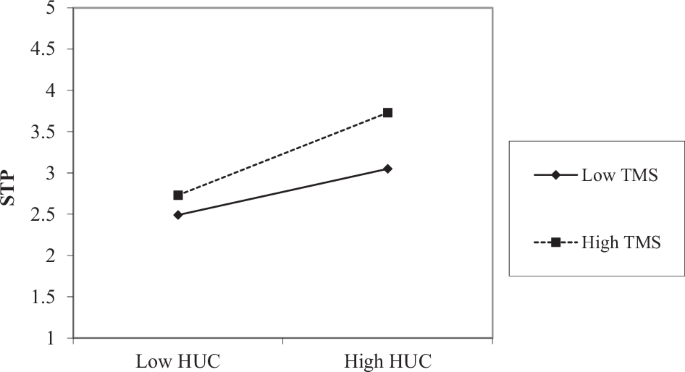
The moderating effect of top management support (TMS) on the relationship between human capital (HUC) and team scientific and technological performance (STP). Source: authors’ development.
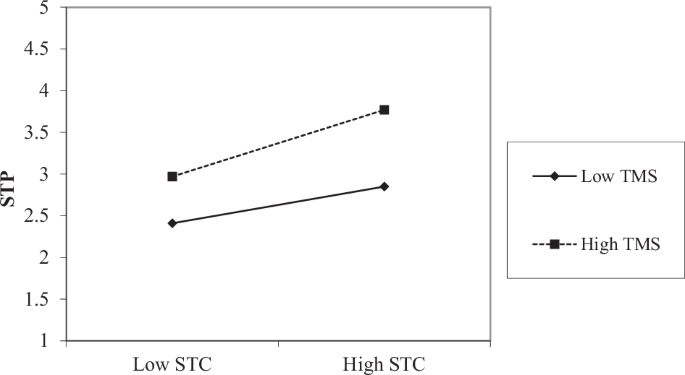
The moderating effect of top management support (TMS) on the relationship between structural capital (SUC) and team scientific and technological performance (STP). Source: authors’ development.
Discussion
The current study highlights the importance of research and academic institutions effectively enhancing their scientific and technological capabilities to manage their global talent within an international research collaboration framework and meet future challenges. Additionally, it underscores the need for these institutions to facilitate scientific knowledge exchange among their employees and counterparts in different countries. The enhancement of talent management through the exchange of scientific research knowledge can be most effectively accomplished by utilizing a collaborative research system between educational and research institutions (Shofiyyah et al., 2023), particularly in the context of the COVID-19 landscape. This study has confirmed that enhancing the higher education and research institutions’ human capital (HUC) and structural capital (STC) could attract and maintain global talent management and lead to more effective scientific and technological progress. The findings indicate that the utilization of human capital (HUC) has a significant and positive effect on scientific and technological term performance (STP) (Hypothesis 1), which is consistent with previous research (Habert & Huc, 2010). This study has additionally demonstrated that the implementation of structural capital (STC) has a significant and positive effect on team scientific and technological performance (STP), as indicated by hypothesis 2, which is also supported by the previous studies finding in different ways (Sobaih et al., 2022). This study has also shown that top management support moderates the association between human capital (HUC) and team scientific and technological performance hypothesis 3a and the association between structural capital (STC) and team scientific and technological performance hypothesis 3b. These hypotheses have garnered support from previous studies’ findings in different domains (Chatterjee et al., 2022). The study’s empirical findings also confirm the substantial moderating influence exerted by top management support on the relationships between HUC and STP described in hypothesis 3a and STC and STP described in hypothesis 3b, as evidenced by the results presented in Table 4. Additionally, graphical representations are conducted to investigate the impacts on hypotheses 3a and 3b resulting from the application of high-top management support (TMS) and weak TMS.
The effect of high-top management support (TMS) and weak TMS on Hypothesis 3a is depicted in Fig. 2. The solid line illustrates the effects of robust TMS on Hypothesis 3a, while the dashed line shows the effects of weak TMS on Hypothesis 3a. The graphic description validates that, as human capital (HUC) increases, team scientific and technological performance (STP) is more pronounced when influenced by robust TMS than weak TMS. This is evidenced by the steeper slope of the solid line in comparison to the dashed line. This finding suggests that employees within the research and academic sectors are more likely to utilize research collaboration networks when influenced by HUC and receive strong support from the organization’s top management.
The graph in Fig. 3 shows the impact of solid top management support (TMS) and weak TMS on Hypothesis 3b. The dotted lines continuous on the graph correspond to the effects of robust TMS and weak TMS, respectively. Figure 3 illustrates that, with increasing top management support (TMS), scientific and technological performance (STP) increase is more significant for robust TMS than weak TMS. This is evident from the steeper slope of the continuous line compared to the slope of the dotted line. This finding suggests that employees within universities and institutes are more likely to engage in research collaboration systems when they receive strong support from top management despite enhanced structural support.
Theoretical contribution
The current study makes significant contributions to the existing body of knowledge by exploring the intricate dynamics between organizational intellectual capital and team performance within scientific and technological research, especially during the unprecedented times brought about by the COVID-19 pandemic. Through its detailed examination of human and structural capital, alongside the moderating impact of top management support, the study provides a multi-faceted understanding of how these factors interact to enhance team outcomes.
This research enriches the literature on intellectual capital by providing empirical evidence on the positive association between HUC and STC and team performance. HUC, which includes employees’ skills, knowledge, and expertise, is a critical driver of innovation and productivity (Lenihan et al., 2019). The study highlights how a team’s collective intelligence and capabilities can lead to superior scientific and technological outputs. This finding aligns with and extends previous research that underscores the importance of skilled HR in achieving organizational success (Luo et al., 2023; Salamzadeh et al., 2023). Structural capital, encompassing organizational processes, databases, and intellectual property, contributes significantly to team performance(Ling, 2013). The study illustrates how well-established structures and systems facilitate knowledge sharing, streamline research processes, and ultimately boost the efficiency and effectiveness of research teams. This aspect of the findings adds depth to the existing literature by demonstrating the tangible benefits of investing in robust organizational infrastructure to support research activities.
Another essential contribution of this study is integrating a research collaboration network as a facilitating factor. This network, including digital platforms and tools that enable seamless communication and collaboration among researchers, has become increasingly vital in remote work and global collaboration (Mitchell, 2023). By examining how these systems leverage HUC and STC to enhance team performance, the study provides a practical understanding of the mechanisms through which technology can facilitate team scientific and technological performance.
One of the most novel contributions of this study is its emphasis on the moderating role of top management support. The findings suggest that when top management actively supports research initiatives, provides required resources, and fosters innovation, the positive effects of human and structural capital on team performance are amplified (Zada et al., 2023). This aspect of the study addresses a gap in the literature by highlighting the critical influence of top management on the success of intellectual capital investments. It underscores the importance of managerial involvement and strategic vision in driving research excellence and team scientific and technological performance.
Practical implications
The practical implications of the current study are weightage for organizations aiming to enhance their research and innovation capabilities and boost their scientific and technical progress. Organizations should prioritize recruiting, training, and retaining highly skilled and trained researchers and professionals globally. This can be achieved through targeted hiring practices, offering competitive compensation and retention, providing continuous professional development opportunities, and developing proper research collaboration networks. Organizations can leverage their expertize to drive innovative research and technological advancements by nurturing a global, talented workforce. Investing in robust organizational structures, processes, and systems is critical (Joseph & Gaba, 2020). This includes developing comprehensive databases, implementing efficient research processes, securing intellectual property, and strengthening collaborations. These factors support efficient knowledge sharing and streamline research activities, leading to higher productivity and quality research outcomes (Azeem et al., 2021). Organizations should ensure that their infrastructure is adaptable and can support remote and collaborative work environments.
The current study emphasizes the importance of digital platforms and tools facilitating research collaboration. Organizations should adopt advanced research collaboration networks that enable seamless communication, data sharing, and talent management. These systems are particularly crucial in a globalized research environment where team members may be geographically dispersed. Investing in such technology can significantly enhance research projects’ productivity in a sustainable way (Susanto et al., 2023). Top Management plays a vital role in the success of research initiatives and contributes to scientific and technological performance. Top management should actively support research teams by providing required resources, setting clear strategic directions, and fostering a culture of innovation. This includes allocating budgets for organizational research and development, encouraging cross-border collaboration, recognizing and rewarding research achievements, and enhancing overall performance. Effective Management ensures that the intellectual capital within the organization is fully utilized and aligned with organizational developmental goals (Paoloni et al., 2020). Organizations should create a working atmosphere that encourages research, creativity, and innovation. This can be done by establishing innovation labs, promoting interdisciplinary research, recruiting international talents, sharing research scholars, and encouraging the sharing of ideas across different departments globally. A research-oriented culture that supports innovation can inspire researchers to pursue groundbreaking work and contribute to the organization’s competitive edge.
Limitations and future research direction
The research presents numerous theoretical and practical implications; however, it has. The potential limitation of common method bias could impact the findings of this study. This concern arises because the data for the study variables were obtained from a single source and relied on self-report measures (Podsakoff, 2003). Therefore, it is recommended that future studies be conducted longitudinally to gain additional insights into organizations’ potential to enhance efficiency. Furthermore, it is essential to note that the sample size for this study was limited to 363 respondents who were deemed usable. These respondents were drawn from only ten research and academic institutions explicitly targeting the education and research sector.
Consequently, this restricted sample size may hinder the generalizability of the findings. Future researchers may employ a larger sample size and implement a more systematic approach to the organization to enhance the comprehensiveness and generalizability of findings in the context of global talent management and scientific and technological advancement. Furthermore, in future investigations, researchers may explore alternative boundary conditions to ascertain whether additional factors could enhance the model’s efficacy.
Conclusion
Numerous academic studies have emphasized the significance of examining talent management outcomes in global human resource management (HRM). The continuous international movement of highly qualified individuals is viewed as a driving force behind the development of new technologies, the dissemination of scientific findings, and the collaboration between institutions worldwide. Every organization strives to build a qualified and well-trained team, and the personnel department of the organization focuses on finding ways to transfer knowledge from experienced workers to new hires. This study uses a research collaboration system to examine the relationship between organizational intellectual capital (Human and structural Capital) and team scientific and technological performance. Further, this study underscores the moderating role of top management support. These findings offer a nuanced perspective on how organizations can leverage their intellectual assets to foster higher productivity and innovation, especially in emergencies.
Data availability
Due to respondents’ privacy concerns, data will not be publicly available. However, it can be made available by contacting the corresponding author at a reasonable request.
References
Al-Tit AA, Al-Ayed S, Alhammadi A, Hunitie M, Alsarayreh A, Albassam W (2022) The impact of employee development practices on human capital and social capital: the mediating contribution of knowledge management. J Open Innov 8(4):218
Al Ariss A, Cascio WF, Paauwe J (2014) Talent management: current theories and future research directions. J World Bus 49(2):173–179
Al Jawali H, Darwish TK, Scullion H, Haak-Saheem W (2022) Talent management in the public sector: empirical evidence from the Emerging Economy of Dubai. Int J Hum Resour Manag 33(11):2256–2284
Ali M, Li Z, Khan S, Shah SJ, Ullah R (2021) Linking humble leadership and project success: the moderating role of top management support with mediation of team-building. Int J Manag Proj Bus 14(3):545–562
Almeida F, Santos JD, Monteiro JA (2020) The challenges and opportunities in the digitalization of companies in a post-COVID-19 World. IEEE Eng Manag Rev 48(3):97–103
Alrowwad AA, Abualoush SH, Masa’deh RE (2020) Innovation and intellectual capital as intermediary variables among transformational leadership, transactional leadership, and organizational performance. J Manag Dev 39(2):196–222
Anshari M, Hamdan M (2022) Understanding knowledge management and upskilling in Fourth Industrial Revolution: transformational shift and SECI model. VINE J Inf Knowl Manag Syst 52(3):373–393
Arocena R, Sutz J (2021) Universities and social innovation for global sustainable development as seen from the south. Technol Forecast Soc change 162:120399
Arslan A, Golgeci I, Khan Z, Al-Tabbaa O, Hurmelinna-Laukkanen P (2021) Adaptive learning in cross-sector collaboration during global emergency: conceptual insights in the context of COVID-19 pandemic. Multinatl Bus Rev 29(1):21–42
Azeem M, Ahmed M, Haider S, Sajjad M (2021) Expanding competitive advantage through organizational culture, knowledge sharing and organizational innovation. Technol Soc 66:101635
Bakhsh K, Hafeez M, Shahzad S, Naureen B, Faisal Farid M (2022) Effectiveness of digital game based learning strategy in higher educational perspectives. J Educ e-Learn Res 9(4):258–268
Barney J (1991) Firm resources and sustained competitive advantage. J Manag 17(1):99–120
Barney JB, Clark DN (2007) Resource-based theory: Creating and sustaining competitive advantage. Oup Oxford
Baron A, Armstrong M (2007) Human capital management: achieving added value through people. Kogan Page Publishers
Barpanda S (2021) Role of human and structural capital on performance through human resource practices in Indian microfinance institutions: a mediated moderation approach. Knowl Process Manag 28(2):165–180
Biondi L, Russo S (2022) Integrating strategic planning and performance management in universities: a multiple case-study analysis. J Manag Gov 26(2):417–448
Birasnav M, Mittal R, Dalpati A (2019) Integrating theories of strategic leadership, social exchange, and structural capital in the context of buyer–supplier relationship: an empirical study. Glob J Flex Syst Manag 20:219–236
Bontis N (1998) Intellectual capital: an exploratory study that develops measures and models. Manag Decis 36(2):63–76
Bontis N, Fitz‐enz J (2002) Intellectual capital ROI: a causal map of human capital antecedents and consequents. J Intellect Cap 3(3):223–247
Cavicchi C, Vagnoni E (2017) Does intellectual capital promote the shift of healthcare organizations towards sustainable development? Evidence from Italy. J Clean Prod 153:275–286
Chatterjee S, Chaudhuri R, Vrontis D (2022) Does remote work flexibility enhance organization performance? Moderating role of organization policy and top management support. J Bus Res 139:1501–1512
Council NR (2012) Education for life and work: developing transferable knowledge and skills in the 21st century. National Academies Press
Davenport S, Carr A, Bibby D (2002) Leveraging talent: spin–off strategy at industrial research. RD Manag 32(3):241–254
Dess GG, Picken JC (2000) Changing roles: Leadership in the 21st century. Organ Dyn 28(3):18–34
Duan W, Li C (2023) Be alert to dangers: collapse and avoidance strategies of platform ecosystems. J Bus Res 162:113869
Farahian M, Parhamnia F, Maleki N (2022) The mediating effect of knowledge sharing in the relationship between factors affecting knowledge sharing and reflective thinking: the case of English literature students during the COVID-19 crisis. Res Pract Technol Enhanc Learn 17(1):1–25
Fasi MA (2022) An overview on patenting trends and technology commercialization practices in the university Technology Transfer Offices in USA and China. World Pat Inf 68:102097
Felin T, Hesterly WS (2007) The knowledge-based view, nested heterogeneity, and new value creation: philosophical considerations on the locus of knowledge. Acad Manag Rev 32(1):195–218
Fernandes C, Veiga PM, Lobo CA, Raposo M (2023) Global talent management during the COVID‐19 pandemic? The Gods must be crazy! Thunderbird Int Bus Rev 65(1):9–19
Gogan LM, Duran DC, Draghici A (2015) Structural capital—a proposed measurement model. Procedia Econ Financ 23:1139–1146
Gonzalez-Mulé E, Courtright SH, DeGeest D, Seong J-Y, Hong D-S (2016) Channeled autonomy: the joint effects of autonomy and feedback on team performance through organizational goal clarity. J Manag 42(7):2018–2033
Haak-Saheem W (2020) Talent management in Covid-19 crisis: how Dubai manages and sustains its global talent pool. Asian Bus Manag 19:298–301
Habert B, Huc C (2010) Building together digital archives for research in social sciences and humanities. Soc Sci Inf 49(3):415–443
Haider SA, Akbar A, Tehseen S, Poulova P, Jaleel F (2022) The impact of responsible leadership on knowledge sharing behavior through the mediating role of person–organization fit and moderating role of higher educational institute culture. J Innov Knowl 7(4):100265
Hair JF, Page M, Brunsveld N (2019) Essentials of business research methods. Routledge
Harsch K, Festing M (2020) Dynamic talent management capabilities and organizational agility—a qualitative exploration. Hum Resour Manag 59(1):43–61
He S, Chen W, Wang K, Luo H, Wang F, Jiang W, Ding H (2023) Region generation and assessment network for occluded person re-identification. IEEE Trans Inf Forensic Secur 19:120–132
Henseler J, Ringle CM, Sarstedt M (2015) A new criterion for assessing discriminant validity in variance-based structural equation modeling. J Acad Mark Sci 43:115–135
Jain N, Thomas A, Gupta V, Ossorio M, Porcheddu D (2022) Stimulating CSR learning collaboration by the mentor universities with digital tools and technologies—an empirical study during the COVID-19 pandemic. Manag Decis 60(10):2824–2848
Joseph J, Gaba V (2020) Organizational structure, information processing, and decision-making: a retrospective and road map for research. Acad Manag Ann 14(1):267–302
Kaliannan M, Darmalinggam D, Dorasamy M, Abraham M (2023) Inclusive talent development as a key talent management approach: a systematic literature review. Hum Resour Manag Rev 33(1):100926
Kallmuenzer A, Baptista R, Kraus S, Ribeiro AS, Cheng C-F, Westhead P (2021) Entrepreneurs’ human capital resources and tourism firm sales growth: a fuzzy-set qualitative comparative analysis. Tour Manag Perspect 38:100801
Kim KY, Atwater L, Patel PC, Smither JW (2016) Multisource feedback, human capital, and the financial performance of organizations. J Appl Psychol 101(11):1569
Kwok L (2022) Labor shortage: a critical reflection and a call for industry-academia collaboration. Int J Contemp Hosp Manag 34(11):3929–3943
Lee J-C, Shiue Y-C, Chen C-Y (2016) Examining the impacts of organizational culture and top management support of knowledge sharing on the success of software process improvement. Comput Hum Behav 54:462–474
Lenihan H, McGuirk H, Murphy KR (2019) Driving innovation: public policy and human capital. Res policy 48(9):103791
Ling Y-H (2013) The influence of intellectual capital on organizational performance—knowledge management as moderator. Asia Pac J Manag 30(3):937–964
Luo J, Zhuo W, Xu B (2023) The bigger, the better? Optimal NGO size of human resources and governance quality of entrepreneurship in circular economy. Manag Decis (ahead-of-print) https://doi.org/10.1108/MD-03-2023-0325
Damsgaard J, Lyytinen K (2001) The role of intermediating institutions in the diffusion of electronic data interchange (EDI): how industry associations intervened in Denmark, Finland, and Hong Kong. Inf Soc 17(3):195–210
Marchiori DM, Rodrigues RG, Popadiuk S, Mainardes EW (2022) The relationship between human capital, information technology capability, innovativeness and organizational performance: an integrated approach. Technol Forecast Soc Change 177:121526
Marinelli L, Bartoloni S, Pascucci F, Gregori GL, Briamonte MF (2022) Genesis of an innovation-based entrepreneurial ecosystem: exploring the role of intellectual capital. J Intellect Cap 24(1):10–34
Mehralian G, Nazari JA, Ghasemzadeh P (2018) The effects of knowledge creation process on organizational performance using the BSC approach: the mediating role of intellectual capital. J Knowl Manag 22(4):802–823
Mitchell A (2023) Collaboration technology affordances from virtual collaboration in the time of COVID-19 and post-pandemic strategies. Inf Technol People 36(5):1982–2008
Muñoz JLR, Ojeda FM, Jurado DLA, Peña PFP, Carranza CPM, Berríos HQ, Vasquez-Pauca MJ (2022) Systematic review of adaptive learning technology for learning in higher education. Eurasia J Educ Res 98(98):221–233
Nezam MHK, Ataffar A, Isfahani AN, Shahin A (2013) The impact of structural capital on new product development performance effectiveness—-the mediating role of new product vision and competitive advantage. Int J Hum Resour Stud 3(4):281
O’Dwyer M, Filieri R, O’Malley L (2023) Establishing successful university–industry collaborations: barriers and enablers deconstructed. J Technol Transf 48(3):900–931
Oliver C (1997) Sustainable competitive advantage: combining institutional and resource‐based views. Strateg Manag J 18(9):697–713
Pak J, Heidarian Ghaleh H, Mehralian G (2023) How does human resource management balance exploration and exploitation? The differential effects of intellectual capital‐enhancing HR practices on ambidexterity and firm innovation. Human Resource Manag https://doi.org/10.1002/hrm.22180
Paoloni M, Coluccia D, Fontana S, Solimene S (2020) Knowledge management, intellectual capital and entrepreneurship: a structured literature review. J Knowl Manag 24(8):1797–1818
Patnaik S, Munjal S, Varma A, Sinha S (2022) Extending the resource-based view through the lens of the institution-based view: a longitudinal case study of an Indian higher educational institution. J Bus Res 147:124–141
Pellegrini L, Aloini D, Latronico L (2022) Open innovation and intellectual capital during emergency: evidence from a case study in telemedicine. Knowl Manag Res Pract 21(4), 765–776
Phan LT, Nguyen TV, Luong QC, Nguyen TV, Nguyen HT, Le HQ, Pham QD (2020) Importation and human-to-human transmission of a novel coronavirus in Vietnam. N Engl J Med 382(9):872–874
Phuong QN, Le Ngoc M, Dong HT, Thao TLT, Tran T, Cac T (2024) Enhancing employment opportunities for people with disabilities in Vietnam: the role of vocational training and job placement centers. J Chin Hum Resour Manag 15(3):64–75
Podsakoff N (2003) Common method biases in behavioral research: a critical review of the literature and recommended remedies. J Appl Psychol 885(879):10.1037
Podsakoff PM, MacKenzie SB, Lee J-Y, Podsakoff NP (2003) Common method biases in behavioral research: a critical review of the literature and recommended remedies. J Appl Psychol 88(5):879
Preacher KJ, Hayes AF (2008) Asymptotic and resampling strategies for assessing and comparing indirect effects inmultiple mediator models. Behav Res Methods 40(3):879–891
Rådberg KK, Löfsten H (2024) The entrepreneurial university and development of large-scale research infrastructure: Exploring the emerging university function of collaboration and leadership. J Technol Transf 49(1):334–366
Radhamani R, Kumar D, Nizar N, Achuthan K, Nair B, Diwakar S (2021) What virtual laboratory usage tells us about laboratory skill education pre-and post-COVID-19: Focus on usage, behavior, intention and adoption. Educ Inf Technol 26(6):7477–7495
Rasheed MH, Khalid J, Ali A, Rasheed MS, Ali K (2024) Human resource analytics in the era of artificial intelligence: Leveraging knowledge towards organizational success in Pakistan. J Chin Hum Resour Manag 15:3–20
Ringle CM, Sarstedt M, Mitchell R, Gudergan SP (2020) Partial least squares structural equation modeling in HRM research. Int J Hum Resour Manag 31(12):1617–1643
Roos G, Roos J (1997) Measuring your company’s intellectual performance. Long Range Plan 30(3):413–426
Salamzadeh A, Tajpour M, Hosseini E, Brahmi MS (2023) Human capital and the performance of Iranian Digital Startups: the moderating role of knowledge sharing behaviour. Int J Public Sect Perform Manag 12(1-2):171–186
Sarwar A, Mustafa A (2023) Analysing the impact of green intellectual capital on environmental performance: the mediating role of green training and development. Technol Anal Strateg Manag 1–14. https://doi.org/10.1080/09537325.2023.2209205
Scott WR (2008) Institutions and organizations: ideas and interests. Sage
Secundo G, Dumay J, Schiuma G, Passiante G (2016) Managing intellectual capital through a collective intelligence approach: an integrated framework for universities. J Intellect Cap 17(2):298–319
Secundo G, Massaro M, Dumay J, Bagnoli C (2018) Intellectual capital management in the fourth stage of IC research: a critical case study in university settings. J Intellect Cap 19(1):157–177
Shao JJ, Ariss AA (2020) Knowledge transfer between self-initiated expatriates and their organizations: research propositions for managing SIEs. Int Bus Rev 29(1):101634
Shofiyyah NA, Komarudin TS, Hasan MSR (2023) Innovations in Islamic Education Management within the University Context: addressing challenges and exploring future prospects. Nidhomul Haq 8(2):193–209
Sigala M, Ren L, Li Z, Dioko LA (2023) Talent management in hospitality during the COVID-19 pandemic in Macao: a contingency approach. Int J Contemp Hosp Manag 35(8):2773–2792
Singh SK, Gupta S, Busso D, Kamboj S (2021) Top management knowledge value, knowledge sharing practices, open innovation and organizational performance. J Bus Res 128:788–798
Sobaih AEE, Hasanein A, Elshaer IA (2022) Higher education in and after COVID-19: the impact of using social network applications for e-learning on students’ academic performance. Sustainability 14(9):5195
Sommer LP, Heidenreich S, Handrich M (2017) War for talents—how perceived organizational innovativeness affects employer attractiveness. RD Manag 47(2):299–310
Stewart T (1991) Brainpower: how intellectual capital is becoming America’s most valuable. Fortune
Streukens S, Leroi-Werelds S (2016) Bootstrapping and PLS-SEM: A step-by-step guide to get more out of your bootstrap results. Eur Manage J 34(6):618–632
Sulaiman F, Uden L, Eldy EF (2022) Online Learning in Higher Education Institution During COVID-19: A Review and the Way Forward. Paper presented at the International Workshop on Learning Technology for Education Challenges
Susanto P, Sawitri NN, Ali H, Rony ZT (2023) Employee performance and talent management impact increasing construction company productivity. Int J Psychol Health Sci 1(4):144–152
Tan CN-L, Md. Noor S (2013) Knowledge management enablers, knowledge sharing and research collaboration: a study of knowledge management at research universities in Malaysia. Asian J Technol Innov 21(2):251–276
Vaiman V, Sparrow P, Schuler R, Collings DG (2018) Macro talent management: a global perspective on managing talent in developed markets. Routledge
Vătămănescu E-M, Cegarra-Navarro J-G, Martínez-Martínez A, Dincă V-M, Dabija D-C (2023) Revisiting online academic networks within the COVID-19 pandemic–From the intellectual capital of knowledge networks towards institutional knowledge capitalization. J Intellect Cap 24(4):948–973
Wang Y, Lee L-H, Braud T, Hui P (2022) Re-shaping Post-COVID-19 teaching and learning: A blueprint of virtual-physical blended classrooms in the metaverse era. Paper presented at the 2022 IEEE 42nd International Conference on Distributed Computing Systems Workshops (ICDCSW)
Wang Z, Wang N, Liang H (2014) Knowledge sharing, intellectual capital and firm performance. Manag Decis 52(2):230–258
Xu A, Li Y, Donta PK (2024) Marketing decision model and consumer behavior prediction with deep learning. J Organ End Use Comput (JOEUC) 36(1):1–25
Yang G, Xiangming L (2024) Graduate socialization and anxiety: insights via hierarchical regression analysis and beyond. Stud High Educ 1–17. https://doi.org/10.1080/03075079.2024.2375563
Zada M, Khan J, Saeed I, Zada S, Jun ZY (2023) Linking public leadership with project management effectiveness: mediating role of goal clarity and moderating role of top management support. Heliyon 9(5)
Author information
Authors and Affiliations
Contributions
Conceptualization: Muhammad Zada and Imran Saeed. Methodology: Jawad Khan. Software: Shagufta Zada. Data collection: Muhammad Zada, Shagufta Zada and Jawad Khan. Formal analysis: Imran Saeed and Jawad Khan. Resources: Muhammad Zada. Writing original draft preparation: Muhammad Zada and Imran Saeed. Writing review and editing: Jawad Khan, Shagufta Zada. All authors have read and agreed to the published version of the paper.
Corresponding author
Ethics declarations
Competing interests
The authors declare no competing interests.
Ethical approval
The author sought and received ethical approval from the Research Ethical Committee School of Economics and Management at Hanjiang Normal University, China, with approval number 2023REC001, and the study complied with ethical standards.
Informed consent statement
Informed consent was obtained from all subjects involved in the study. All the participants were accessed with the support of the HR Department employed in China’s research and academia sector. Response Participants were provided with comprehensive information regarding the study’s purpose and procedures. Confidentiality and privacy were strictly implemented throughout the research process. Using the time lag data collection approach, we collected from 393 employees employed in China’s research and academic sector.
Additional information
Publisher’s note Springer Nature remains neutral with regard to jurisdictional claims in published maps and institutional affiliations.
Rights and permissions
Open Access This article is licensed under a Creative Commons Attribution-NonCommercial-NoDerivatives 4.0 International License, which permits any non-commercial use, sharing, distribution and reproduction in any medium or format, as long as you give appropriate credit to the original author(s) and the source, provide a link to the Creative Commons licence, and indicate if you modified the licensed material. You do not have permission under this licence to share adapted material derived from this article or parts of it. The images or other third party material in this article are included in the article’s Creative Commons licence, unless indicated otherwise in a credit line to the material. If material is not included in the article’s Creative Commons licence and your intended use is not permitted by statutory regulation or exceeds the permitted use, you will need to obtain permission directly from the copyright holder. To view a copy of this licence, visit http://creativecommons.org/licenses/by-nc-nd/4.0/.
About this article

Cite this article
Zada, M., Saeed, I., Khan, J. et al. Navigating post-pandemic challenges through institutional research networks and talent management. Humanit Soc Sci Commun 11, 1164 (2024). https://doi.org/10.1057/s41599-024-03697-9
Received:
Accepted:
Published:
Version of record:
DOI: https://doi.org/10.1057/s41599-024-03697-9
