
Abstract
This study explores the role of international strategic alliances in the development of dynamic internationalization capabilities and how these capabilities influence the competitive advantage of small and medium-sized enterprises. A quantitative research approach is employed, utilizing a survey methodology to collect data from 211 SMEs in Taiwan. The data is analyzed using SPSS 28.0 and Smart-PLS 4.0 to test the proposed hypotheses. Findings reveal that international strategic alliances significantly contribute to the development of dynamic internationalization capabilities, which in turn enhance the competitive advantage of SMEs. Specifically, both explorative and exploitative alliances play a crucial role in fostering dynamic internationalization capabilities, which subsequently lead to differentiation, cost, and institutional advantages. This study contributes to the existing literature by providing empirical evidence on the relationship between international strategic alliances, dynamic internationalization capabilities, and competitive advantage in the context of SMEs. It extends the understanding of how SMEs can leverage international strategic alliances to develop dynamic internationalization capabilities and gain a competitive edge. From a practical perspective, findings suggest that managers of SMEs should prioritize the maintenance and strengthening of international strategic alliances and adopt foreign network knowledge to enhance the development of dynamic internationalization capabilities. This strategy can help SMEs to improve their competitive position in the international market.
Introduction
In Taiwan, small and medium-sized enterprises (SMEs) constitute 97.65% of all enterprises, according to 2022 statistics (Ministry of Economic Affairs, 2022), and they are distributed across various industries. SMEs, defined as firms with fewer than 200 employees (Tsai and Ren, 2019), play a crucial role in Taiwan’s economy, contributing significantly to innovation and job creation (Tsai and Ren, 2019; Al-Hakimi et al., 2023). Given Taiwan’s relatively small domestic market and limited natural resources, SMEs are compelled to internationalize to access larger markets and sustain growth (Tsai and Ren, 2019). This trend is especially prominent in the manufacturing sector, where many SMEs target international markets from the early stages of their business. Despite their contributions, Taiwanese SMEs face several challenges in internationalization, including a lack of economies of scale, limited resources, and risk aversion (Al-Hakimi et al., 2023; Al-Hattami, 2022; Al-Hattami and Kabra, 2022). To overcome these barriers, SMEs frequently leverage network relationships and international strategic alliances (ISAs) to acquire the necessary resources and knowledge to compete globally.
Scholars have widely discussed the concept of competitive advantage (CA), particularly regarding strategies and organizational management (Peng, 2022; Peng and Li, 2021). Numerous insights have been offered on how firms create CA (Delery and Roumpi, 2017; Harrigan and Diguardo, 2017; Rui et al., 2017). However, there is a notable gap in the literature on how SMEs maintain CA in the international market by utilizing dynamic capabilities (DCs) (Lee and Yoo, 2019; Saranga et al., 2018). For Taiwanese SMEs, this question is critical due to their reliance on internationalization for growth and survival. It is crucial for these firms to navigate competition from local and global players, as well as manage the risks associated with diverse international market conditions, making international CA a key factor (Kwak et al., 2018). Thus, this study aims to explore how Taiwanese internationalized SMEs cultivate dynamic capabilities to maintain CA in the international context.
The internationalization process of multinational enterprises (MNEs) often assumes that entering foreign markets necessitates significant adaptation and problem-solving due to the inherent complexities and uncertainties (Johanson and Vahlne, 2017; Knight and Liesch, 2016; Vahlne and Jonsson, 2017). While many studies have linked dynamic capabilities (DC) to improved performance, resilience, and adaptability (Peng and Lin, 2021a; Zhou et al., 2020), these findings primarily focus on larger firms, such as MNEs. Lin and Wu (2014) emphasize the critical role of DC within the resource-based view, illustrating how these capabilities directly impact firm performance. However, for SMEs, which often lack the resources and international experience of MNEs, the development of DCs is even more crucial as they internationalize. In an international context, SMEs face rapidly changing environments, necessitating continual learning and adaptation of their DCs through external knowledge acquisition, often gained via strategic alliances (Helfat and Peteraf, 2003; Subramanian and Youndt, 2005; Zhou et al., 2020). Despite previous research on capabilities and CA (Peng et al., 2019a, 2019b), few studies have comprehensively examined how SMEs develop their DCs through organizational learning, particularly through the lens of ISAs. Faroque et al. (2021) explore the microfoundations of network exploration and exploitation capabilities, underscoring the importance of these capabilities in recognizing international opportunities. This study fills this gap by proposing a theoretical model that explores the development of DCs in SMEs, highlighting the role of ISAs in facilitating resource-capacity-CA transformation.
The design and development of DCs should vary according to the situation (Cavusgil and Knight, 2015), which means that DCs should be incorporated with the internationalized or globalized connotations and elements (Teece, 2007). Pinho and Prange (2016) agreed with Winter (2003), putting forward that the value of DC lies in the context-dependence itself, which makes the DC essentially change due to different contexts, such as dynamic internationalization capabilities (DICs). However, based on the classification by Prange and Verdier (2011) and Pinho and Prange (2016), DICs can be divided into three levels. First, DICs consist of international exploitation and international exploration, in which international exploitation covers consolidation capability and threshold capability, while international exploration comprises disruption capability and value-adding capability. The impact of the four DICs on international performance has been verified by Pinho and Prange (2016), but they failed to explore the concept of duality (i.e., ambidexterity) that is significant in the context of SMEs (Broersma et al., 2016; Heavey et al., 2015; Luca et al., 2019; Peng and Lin, 2021a; Vahlne and Jonsson, 2017). Ambidexterity can be considered as a positive context for employees of an organization. It plays a critical role in confirming the old system, adjusting the learning process (exploitation and exploration), and facilitating the acquisition of new methods / ideas and quality upgrade in a dynamic manner (Peng and Lin, 2021a; Peng et al., 2019a, 2019b; Zhou et al., 2020). Hence, in addition to verifying the impact of the DICs of SMEs in Asia on CA, this study discusses ambidexterity.
The development process of DICs would not be efficient, or even possible, without the contribution of knowledge resources such as the social network, which is presumed to exert significant effects on organizational performance and competitiveness in both national and international realms (Liuet al., 2018; Knight and Liesch, 2016; Mitrega and Pfajfar, 2015; Pinho and Prange, 2016). However, few research findings have explored how to drive antecedents to develop diversified capabilities and to have further effects on performance (Hsu and Wang, 2012; Liu et al., 2018; Peng and Lin, 2021a, 2021b; Zhou et al., 2020). Nielsen and Gudergan (2012) put forward the concept of ISAs. They believed that ISAs would bring in knowledge of different attributes based on the differences in strategic purpose and collaborative intention of the alliances, and these alliances are classified into international explorative and international exploitative alliances. Knight and Liesch (2016) summarized the knowledge resources collected from ISAs that affect DCs, in which the acquisition of knowledge and information is of vital importance to the development of DCs (Li et al., 2013; Mitrega and Pfajfar, 2015). Unfortunately, previous research on ISAs failed to understand the DICs that can lead to their success, indicating the low level of understanding of what DICs are required for a SME to secure CA through international explorative/exploitative alliances and how a company can accomplish the final outcomes with these capabilities. To address this research gap, this study uses the ISA as an external source of acquisition of knowledge and information to improve the qualities of capability and performance based on the international context (Knight and Liesch, 2016; Mitrega and Pfajfar, 2015). Based on the above arguments, ISAs play an important role in the acquisition of international market information. Thus, this study regards the ISA as an antecedent of DICs and CA to analyze the correlation among them.
To address the identified gaps in the literature, this study seeks to answer the following research questions: (1) How do ISAs contribute to the development of DICs in SMEs? (2) How do international exploration and exploitation influence the CA of SMEs? (3) What is the role of ambidexterity in enhancing SMEs’ CA in international markets? (4) How do different types of ISAs affect the development of DICs and CA? These questions will be explored through a quantitative survey of Taiwanese SMEs, providing insights into how they can strategically position themselves in the global market.
Based on the above contentions, this study expects to make the following contributions: the paper (1) explores SMEs’ DICs from the process perspective of organizational learning; (2) discusses the effect that different types of ISAs bring to DICs; (3) discusses the verification of relationships among the ISA, DICs, and the CA of internationalized SMEs, and (4) provides managerial implications for Taiwan international SMEs.
The remainder of this paper is structured as follows. Section “Theoretical background and hypotheses” reviews the theoretical background and develops the hypotheses, focusing on the role of ISAs and DICs in driving SMEs’ CA. Section “Methodology” outlines the research methodology, including the data collection process and the statistical methods used to test the hypotheses. In Section “Results”, the results of the empirical analysis are presented and discussed. Finally, Section “Discussion and conclusions” concludes the paper by integrating the discussion of the findings with their theoretical and practical implications, summarizing the main contributions, and addressing the limitations of the study along with suggestions for future research.
Theoretical background and hypotheses
Internationalization and competition advantage
As a continuous concept, internationalization refers to the degree to which internationalization is deepened along with the progress of product life cycle. The four primary methods of gaining a CA are cost leadership, differentiation, defensive strategies, and strategic alliance (Li and Zhou, 2010). Sandberg (2013) regarded internationalization as an incremental process which is driven by the mutual effect between the acquisition of international business operations and commitment to international markets, demonstrated by gathering specific knowledge related to markets or customers of certain foreign markets. To manage and control international markets, SMEs learn from these markets; thus, they can make quick analysis, segmentation, and interpretation of customers’ actual demands to offer the needed commodities to the customers (Buccieri et al., 2020; Cadogan et al., 2009; Nakos et al., 2019). SMEs can conduct quick integration, spread, analysis, interpretation, and identification of extensive information, and can also absorb improvement suggestions to enhance existing products and marketing approaches for customers and competitors in international markets (Buccieri et al., 2020; Peng and Lin, 2021b). In the context of Taiwan, SMEs play a crucial role in the economy, accounting for 97.65% of enterprises (Ministry of Economic Affairs, 2022). Due to Taiwan’s limited domestic market and resource constraints, SMEs are particularly motivated to internationalize in order to access larger markets and maintain competitiveness (Tsai and Ren, 2019). Taiwanese SMEs, especially those in the manufacturing sector, often rely on ISAs to acquire the knowledge and resources necessary for international expansion, helping them to overcome the inherent challenges of limited scale and resource availability (Liu et al., 2018). There is a growing body of literature on the CA of firms based on the perspective of internationalization, which has gained empirical support, whether from the view of the internationalization of SMEs, the network type of firms, or how the knowledge flow affects CAs (Li and Zhou, 2010; Rui et al., 2017).
Nevertheless, there is little discussion about the sustainability of CAs (Harrigan and Diguardo, 2017), and how CAs are acquired by SMEs during their internationalization (Kwak et al., 2018). CA, management attitude, and foreign knowledge and experience do not substantially connect with internationalization (Weerawardena et al., 2017). Falahat et al. (2020) forecast four necessary export competencies as CA drivers for exporting SMEs: market knowledge, product innovation, price, and marketing communication. According to the findings, a CA only acts as a link between pricing capabilities and SMEs’ international performance. SMEs’ financial and strategic performance may be utilized to evaluate their global performance (Falahat et al., 2018; Popa et al., 2018; Silva et al., 2018). CAs may be used to forecast how well SMEs will do on a global scale (Rua et al., 2018).
Internationalization is quite different in high-tech industries compared to other industries. Most high-tech industries enhance their innovation capability and the ability of product release through international cooperation or M&A, or by offering new products and services which are superior to those in new markets (Anning-Dorson, 2018). This perspective aligns with Aldibiki and El Ebrashi (2023), who emphasize that leveraging networks and capabilities is crucial for SMEs’ internationalization success. Kamepalli et al. (2020) investigated the impact of merger policy on pre-merger innovation, discovering that a liberal merger policy might dampen entrant innovation. To gain an in-depth comprehension of the effectiveness and capability growth of the internationalization of SMEs, it is necessary to incorporate the CAs under internationalization with the institutionalized ones based on past differentiation and cost leadership (Li and Zhou, 2010). Thus, exploring the development of SMEs’ DICs and the relationship between DICs and CA is becoming increasingly crucial in the theory of internationalization, particularly considering the role of network exploration and exploitation capabilities in identifying international opportunities (Faroque et al., 2021).
International strategic alliance
Strategic alliance is essentially a pact of collaboration struck amongst industry contemporaries, targeting the accomplishment of shared objectives. Alliance affiliates adhere to a uniform standard, culminating in a mutual agreement on certain parameters (Christoffersen, 2013; Nielsen and Nielsen, 2009; Robson and Katsikeas, 2005). According to Gulati (1998), SMEs have a tremendous opportunity to develop by combining with other big corporations and building strategic alliances. These are defined as voluntary alliances between businesses based on contractual ties that allow for growth and transformation through collaboration in the production and development of a final product, as well as the transfer of technology, skills, and services. A strategic alliance, in finer detail, encompasses partnerships of interfirm collaboration engineered to influence the enduring product market stance of at least a single participant (Robson and Katsikeas, 2005). Faroque et al. (2021) emphasize the importance of microfoundations in network exploration and exploitation capabilities, which are essential for recognizing international opportunities, thereby enhancing the effectiveness of strategic alliances. Historic examinations of strategic alliances have endeavored to fill myriad research voids from the standpoint of organizational comprehension and knowledge conveyance. This includes aspects such as (1) methodologies for managing knowledge within strategic alliances, (2) tactics for knowledge dissemination among partners, (3) strategies for knowledge acquisition from parent entities by the joint venture, and (4) the evolution and impact of knowledge pertaining to collaboration itself over time (Christoffersen, 2013; Ho and Wang, 2015; Nielsen and Nielsen, 2009; Simonin, 1999). Furthermore, Aldibiki and El Ebrashi (2023) highlight that the role of networks in the internationalization of SMEs is crucial, as these networks can facilitate access to necessary resources and knowledge, enhancing the potential success of strategic alliances. These investigations have unveiled that knowledge cultivation and transfer within an alliance bear immense strategic value in bolstering a firm’s competitive edge (Christoffersen, 2013; Nielsen and Nielsen, 2009).
A growing body of scholarly work has broadened the realm of local strategic alliances to incorporate ISAs, intertwining theories such as resource-oriented views, DC, organizational learning, and corporate internationalization. This convergence has birthed a multidisciplinary research field. Within the framework of technological evolution and globalization, ISAs emphasize more on the stability, expansion, and enduring progression of international business organizations compared to their local counterparts (Robson and Katsikeas, 2005). ISAs can be viewed as a mode of collaboration amongst firms in an international and interconnected environment, harmonizing the firms’ objectives and missions to optimize resource utilization and autonomous management within organizations (Ho and Wang, 2015; Li et al., 2013; Nielsen and Gudergan, 2012).
Robson and Katsikeas (2005) further elucidated that ISAs are foreign investment ventures encapsulating a ceaseless process of commercial activity, underlining the formation issues of intrapartner traits and interpartner compatibility. As such, alliance classifications also diverge based on differing partner characteristics and compatibility modes. Nielsen and Gudergan (2012), borrowing from Lavie and Rosenkopf’s (2006) viewpoint, segmented ISAs into international exploration alliances and international exploitation alliances. They characterized international exploration alliances as ISAs primarily engrossed in upstream value-chain activities aimed at knowledge sharing and development; conversely, international exploitation alliances concentrate on downstream activities such as marketing and distribution. This dichotomy mirrors the classification of Dual Innovation Capabilities (DICs) by ambidexterity, disregarding the requisites of varied alliance characteristics on knowledge attributes, strategic maneuvers, and innovation.
International firms will choose to join one of the ISAs depending on their distinct organizational structures, capabilities, strategies, processes, cultures, and objectives. International exploitation alliances furnish internationalized firms with more exploitation knowledge, thereby enhancing capital and asset productivity and efficiency through standardization, systematic cost reductions, and advancements to existing technologies, skills, and capabilities (Nielsen and Gudergan, 2012). Similarly, international exploration alliances equip internationalized firms with more exploration knowledge, thus aiding in the unearthing of new wealth-creation opportunities and superior returns through innovation, new capabilities, and investments in absorptive capacity (Nielsen and Gudergan, 2012).
Firms participating in international exploration alliances foster a reciprocal learning culture through engagement and interaction with firms from other nations, grounded in a stable and robust cooperative relationship (Ho and Wang, 2015; Christoffersen, 2013; Nielsen and Nielsen, 2009). Such informal agreements allow international firms to access innovative knowledge resources from the alliance network. Concurrently, international firms within the alliance can leverage joint problem-solving, joint new product development, and joint research and development investment projects (Robson and Katsikeas, 2005) to amass internal innovation capabilities (Li et al., 2013). Scholars propose that the superior efficiency of international firms in fostering close strategic relationships (Christoffersen, 2013; Nielsen and Nielsen, 2009) will aid international firms in creating collaborative opportunities with other firms, obtaining the requisite knowledge and information to strengthen their value innovation capability, thereby further enhancing international exploration (Robson and Katsikeas, 2005).
Moreover, strategic relationships within international exploration alliances’ member base will allow international firms to comprehend the operating model of benchmarking firms and knowledge processing, equipping firm members with the skills to identify external knowledge and further correct internal routines, processes, and production efficiency (Li et al., 2013; Nielsen and Gudergan, 2012). The process of external learning that promotes internal learning enables international firms to bolster their fundamental capabilities and viability as a foundation for business growth (Ho and Wang, 2015; Nielsen and Gudergan, 2012). Nielsen and Nielsen (2009) asserted that international interfirm relationships with innovative learning can enhance the understanding of both firms’ tacit knowledge, improve their inadequacies in knowledge application, strengthen the link between relationships and knowledge, and further improve the ability to apply innovation. Thus, the study forms the following hypotheses:
H1: International explorative alliance has a positive impact on international exploration.
H2: International explorative alliance has a positive impact on international exploitation.
The knowledge-based perspective views firms as storehouses of knowledge and competencies, while the learning-based perspective emphasizes the acquisition of knowledge that stimulates the development of firm-specific capabilities. Both the knowledge-based theory and the organizational learning theory acknowledge that the nature of knowledge can influence the ease or difficulty of learning and knowledge transfer. Inkpen (2002) identifies five antecedents in alliance learning: (1) learning partner characteristics, (2) teaching partner characteristics, (3) knowledge characteristics, (4) relationship factors, and (5) alliance establishment. He suggests work that incorporates these diverse categories and establishes causal links across variables (Ho and Wang, 2015).
International firms participating in international exploitation alliances are committed to learning and absorbing explicit knowledge that can immediately enhance their internal operational processes. Compared to their counterparts in international exploration alliances, firms in exploitation alliances pay greater attention to diversified relationship connections, such as structural holes and weak ties, as proposed by scholars. During the process of knowledge transfer or learning, international firms also learn how to create value through knowledge while amassing knowledge assets (Christoffersen, 2013; Nielsen and Gudergan, 2012; Nielsen and Nielsen, 2009). For one, international firms learn about the needs of customers in the international market and competitor information from external knowledge sources to provide more efficient products and services. Furthermore, international firms absorb more diverse sources of knowledge from alliances, which aids them in enhancing related innovation activities and capabilities, ultimately improving the development of new products or processes. Based on this understanding, this study formulates the following hypotheses:
H3: International exploitative alliance has a positive impact on international exploration.
H4: International exploitative alliance has a positive impact on international exploitation.
Dynamic internationalization capabilities (DICs)
According to the DC viewpoint, firms must continually produce, integrate, and reconfigure their skills and capabilities to adapt to their environment and sustain CA (Eisenhardt and Martin, 2000). The essential traits in DC are exploration and exploitation, and innovation (Atuahene-Gima, 2005). Exploitation focuses on improving present capabilities, whereas exploration focuses on testing existing notions (e.g., March, 1991).
Teece et al. (1997) extended the resource-based view to a dynamic environment through enabling firms to create higher value by developing new knowledge and resources (Peng et al., 2019a, 2019b), suggesting that firms should be constantly updating and reconfiguring their resources and capabilities to address environmental changes. In their study of the impact of DC on the internationalization of SMEs, Mudalige et al. (2019) discovered that owner-specific DCs have a positive influence on both firm DC and internationalization, and firm DCs have a positive influence on internationalization. The development of DCs facilitates firms to consolidate, understand, and reconfigure their internal and external resources in response to dynamic environmental changes in their domestic markets (Peng et al., 2019a, 2019b; Zhou et al., 2020). While enterprises have entered the internationalization process through large-scale expansion, the complexity of the international environment is far higher than that of domestic ones. In order to adapt to the changes in international environments, enterprises need to adopt different operational strategies according to their respective needs so as to increase their ability to learn and reconfigure (Day, 2011; Zhou et al., 2020). Therefore, we can enable these strategies to create greater efficiency. At the same time, a firm can use internal resources to centralize these resources and capabilities, thereby enhancing its performance. Both adaptation to environment and learning are prerequisites for the long-term survival of organizations, so organizations need to improve their current knowledge and strive to acquire new knowledge to expand new markets (Limaj and Bernroider, 2019; Aldibiki and El Ebrashi, 2023). Scholars also argued that DICs can enhance capabilities and broaden resources, thus affecting the performance of firms (Helfat and Raubitschek, 2018).
Limaj and Bernroider (2019) contended that firms increase their exploration and exploitation in different manners. Scholars conducted a dual study of exploration and exploitation earlier, driving firms to develop capabilities while performing varied, competitive behaviors based on their capabilities (Peng and Lin, 2021b; Zhou et al., 2020). The likelihood of success in new markets can be increased through updating and integrating existing capabilities and developing new capabilities. In order to gain success, organizations not only need to value the contents of knowledge and the way of learning, but also make clear that the time it takes to increase the CA and improve performance of organizations by utilizing new or exploratory information and resources (Limaj and Bernroider, 2019). Current knowledge primarily considers international exploitation as the driver for internationalization, and it is believed that the international exploitation can be enhanced by adjusting resource allocation and learning locally available information (Limaj and Bernroider, 2019; Vrontis et al., 2017); international exploration, on the other hand, involves innovation, flexibility, and discovery (Limaj and Bernroider, 2019). Firms create new capabilities for new markets, constantly explore new technologies and new product development based on new customer needs, acquire totally new management capabilities, and recombine internal and external resources, thus allowing enterprises to expand prior knowledge and enhance new value. With the expansion of new markets in the process of internationalization, new knowledge and resources are tapped and acquired through its relationships with local partners in order to create new capabilities, achieve potential advantages a better long-term performance (Vrontis et al., 2017; Faroque et al., 2021), and enhance the adaptability to market changes.
Replacing internal resources and learning management knowledge can greatly improve the performance of firms (Peng et al., 2019a; Vrontis et al., 2017; Zhou et al., 2020). While some scholars believe that DICs have a positive correlation with performance (Stadler et al., 2013), other studies have found negative or no significant correlations (Schilke, 2014). Empirical evidence is still not very clear. Firms’ DICs also vary with internationalization strategies, and the factors required to develop those competencies to facilitate the achievements in the context of internationalization are yet not discovered (Gassmann and Keupp, 2007).
Teece et al. (1997) indicated that the development of exploitation enables firms to acquire new capabilities and resources, adjust internal resources for improvement in business efficiency, and find and capitalize on opportunities. International exploitation is the driving force for firms’ value creation. Acquiring external knowledge and transforming it into internally recognized knowledge is the primary mission of international exploration (Limaj and Bernroider, 2019; Pinho and Prange, 2016). The quality and value of knowledge are items that must be subject to verification in the model of input-process-output. Therefore, internationalized SMEs with better international exploitation will be able to integrate knowledge and technology to facilitate new product development that addresses foreign customers’ needs. When firms introduce this knowledge during knowledge creation and integration of internal knowledge, they are able to create new knowledge with more values than competitors (Prange and Verdier, 2011), thereby enhancing their own market growth and profitability (Peng and Lin, 2021b). Morgan et al. (2009) also argued that enhancing their existing capabilities through exploitation can support firms to satisfy consumer wants and needs and create CAs in new markets while developing their ability to integrate resources and create market values required to achieve outstanding performance (Bicen et al., 2021). Based on the above, this study makes a hypothesis as follows:
H5: International exploitation has a positive impact on competitive advantage.
Organizational learning needs new capabilities and new values to assist in integration after entering new international markets. Moreover, firms’ internationalization process is a type of organizational learning. In the international market, the information and knowledge need to be integrated with the international exploration, so that internationalized SMEs can have a clear strategic position and confirm the needs of global customers, thus expanding market shares and profitability (Peng and Lin, 2021b). International exploration of this advantage empowers firms to develop new capabilities, increase business resilience, exploit new technologies, obtain new managerial capabilities, and discover internal and external resources (Mikalef and Pateli, 2017) so that organizations can maintain a long-term CA in response to market conditions by extending their prior knowledge and building new values (Limaj and Bernroider, 2019). This implies that internationalized SMEs with a high degree of international exploitation are competent to replace internal knowledge based on variations in the external environment and gain strategic dominance with specific strategic behaviors. In addition, scholars have indicated that international exploitation can promote firms’ innovative behaviors and accelerate their knowledge creation (Peng and Lin, 2021a, 2021b), thereby gaining a competitive edge (Limaj and Bernroider, 2019). Furthermore, international exploration results in disruptive innovations (Vrontis et al., 2017), enabling firms to have greater flexibility and innovative energy infusions to maintain a long-term performance excellence (Li, Ye, Sheu, and Yang, 2018). Gerschewski et al. (2018) and Khan and Lew (2018) also studied the internationalization behavior of international new ventures (INVs) and proposed that INVs should gain knowledge in the international market through constant learning to overcome the liabilities of newness and foreignness in their internationalization progression and post-entry survival (Spyropoulou et al., 2018). In the internationalized SME context, international exploration is seen as critical for CA relative to large enterprises in explaining foreign customer value, and positively correlates with performance (Limaj and Bernroider, 2019; Peng and Lin, 2021a, 2021b). Thus, this study makes a hypothesis as follows:
H6: International exploration has a positive impact on competitive advantage.
International exploration and exploitation are critical driving factors for enhancing knowledge integration and creation. International exploitation can increase the reliability and productivity of knowledge, whereas international exploration can strengthen organizational capabilities to integrate new/external knowledge into the internal knowledge base, thereby enabling internationalized SMEs to respond to competitors’ behaviors (Koryak et al., 2018). Competency exploration is described as “experimentation with innovative possibilities with uncertain, distant, and usually negative returns” (March, 1991), and it comprises risk-taking and exploring. However, there is still a lack of understanding on the joint effect of international exploration and exploitation. This study therefore discusses the concept of ambidexterity.
The notion of ambidexterity, proffered by intellectuals, has been espoused in vast measures by diverse institutions and managerial investigations to delve into the ramifications of bifurcated competencies or undertakings on corporate efficacy (Gibson and Birkinshaw, 2004; Koryak et al., 2018; Peng and Lin, 2021b; Peng et al., 2019a, 2019b; Zhou et al., 2021). Instances of these dualities incorporate transformative vs. incremental ingenuity, transmutative leadership juxtaposed against the transformational variant, and exploration-oriented versus exploitation-centric capabilities among others (Peng et al., 2019a, 2019b; Peng and Lin, 2019). Nevertheless, institutions employing an ambidextrous strategy execute examinations and accompanying processes with alacrity and adaptability, aiming to introduce novel commodities or provisions into the international marketplace (Peng and Lin, 2019; Vahlne and Jonsson, 2017).
The ambidexterity arising from international exploration and exploitation contributes to making internationalized SMEs focus concurrently on the advancement of knowledge acquisition and knowledge creation, as well as reducing the allocation risk of overemphasizing international exploration and exploitation (Broersma et al., 2016; Heavey et al., 2015; Luca et al., 2019; Vahlne and Jonsson, 2017). In addition, some scholars (Peng and Lin, 2021a; Peng et al., 2019a, 2019b) have claimed that ambidexterity is a structural mode, which promotes the establishment of various organizational structures by firms to participate in activities with contradictions and opposites via differentiation strategy. In the context of internationalization, Peng and Lin (2021b) argued that when there is a strong complementary effect between international exploration and international exploitation, it is beneficial for international enterprises to cultivate adaptability between different capabilities, which will be reflected in the subsequent international performance. For instance, in a highly variable environment, resources invested in international exploitation can be transferred to international exploration in pursuit of performance maximization: in other words, CA is improved. By simultaneously adopting international exploration and exploitation, and thus utilizing the existing knowledge and resources, internationalized SMEs can more easily explore related knowledge or resources and learn about the situation in a more thorough way (Rafailidis et al., 2017). Thus, more effective reconfiguration of current knowledge/resources is achieved while promoting international exploration and exploitation to leverage existing strengths and deal with risk to inspire market opportunities in the future (Spyropoulou et al., 2018). Therefore, this study proposes the following hypothesis:
H7: Ambidexterity of international exploitation and exploration has a positive impact on competitive advantage.
To elucidate the relationship between International Exploration and Competitive Advantage, it is imperative to acknowledge that exploration activities serve as a foundational element for firms aspiring to navigate and thrive in dynamic international markets (Zhang and Chen, 2013). Through international exploration, firms gain critical insights into emerging market trends, consumer preferences, and competitive dynamics, all essential for adapting strategies to meet evolving demands (Buccieri et al., 2020). However, the act of exploration does not inherently secure CA; the capability to leverage the insights garnered is equally paramount (Cadogan et al., 2009).
In this context, International Exploitation assumes a pivotal role. Exploitation encompasses applying newly acquired knowledge and resources to enhance existing capabilities and operational efficiencies (Helfat and Peteraf, 2003). For SMEs, particularly within the Taiwanese landscape, the transition from exploration to exploitation is crucial for converting innovative concepts into viable products and services (Al-Hakimi et al., 2023). Operating within a resource-constrained environment, Taiwanese SMEs must strategically manage this transition, ensuring that the knowledge acquired through exploration is adapted to local market conditions and effectively utilized to refine offerings while responding to competitive pressures (Nielsen and Gudergan, 2012; Li et al., 2013).
Consequently, while international exploration establishes the groundwork for potential CA, it is international exploitation that ultimately mediates this relationship (Zhang and Chen, 2013). Effective exploitation enables firms to harness exploratory insights, transforming knowledge into actionable strategies that drive performance and foster competitive differentiation (Broersma et al., 2016). Thus, comprehending the mediating role of international exploitation is essential, as it underscores the necessity of gathering information through exploration and systematically mobilizing it to achieve sustained CAs in the global marketplace (Peng and Lin, 2021b). In conclusion, the interplay between exploration and exploitation emphasizes a dynamic capability framework vital for the success of SMEs in international contexts (Al-Hattami and Kabra, 2022; Heavey et al., 2015).
H8: Hypothesis: international exploitation mediates the relationship between international exploration and competitive advantage in Taiwanese SMEs.
Based on the above hypotheses, this study presents a research framework as shown in Fig. 1.
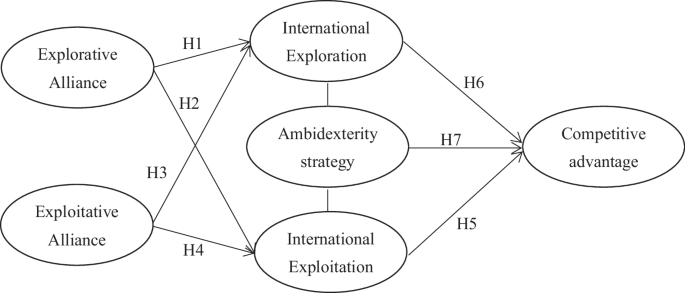
Research Framework.
Methodology
Research approach
This study adopted a questionnaire survey approach. The questionnaire survey is a popular and extensively used research technique for quick collection from the target population (Rasool et al., 2020). The authors built the source of the required sample size using a business directory, and the Investment Commission of the Ministry of Economic Affairs approved the mail questionnaire.
Sampling
The purposive sampling was adopted in this study. Taiwanese SMEs were surveyed to test the hypotheses, and their informants’ (top managers) knowledge about their companies and their relationships with stakeholders were also investigated. These top managers were selected as the main information providers in this study because they are supposed to be familiar with the actual situation of their firms’ operations, internationalization, and capability development. A few studies have discussed the factors that SMEs utilize to sustain their internationalization level at the primary stage of their creation. Taiwanese SMEs were adopted in this study to better understand the verification for similar models under different cultural backgrounds (Asian areas). According to the Ministry of Economic Affairs, enterprises with the number of employees less than 200 can be classified as SMEs in Taiwan. Before distributing the questionnaire, we first handed out 40 copies for a pretest, and the follow-up test was conducted after checking the reliability of items in the scale. This study targeted the managers of foreign-owned SMEs in Taiwan as research subjects, with the aim of gathering insights on their relevant capabilities, experience, and the internal scale of production activities. We sent out 1,082 copies of the questionnaire in total between June and September 2020, and in August 2020, reminded managers again to return the questionnaire. 218 copies of questionnaire were collected. A total of 211 valid questionnaires were left after processing data cleaning and deleting 7 invalid questionnaires, representing an effective response rate of 19.5%. Table 1 summarizes the respondents’ demographic characteristics.
The study considers potential recall bias among the respondents and thus divides the questionnaires into early and late response groups, following the approach proposed by Armstrong and Overton (1977). A comparison was performed to determine if significant differences existed between the two groups in terms of the sample data and study dimensions. The results indicated no substantial differences in primary dimensions and basic information, suggesting that the issue of non-response bias is negligible.
In addition, the study’s methodology involved collecting data from the same respondents using a single questionnaire, potentially leading to common method bias (CMB). To mitigate this, the study applied Harman’s single-factor test, subjecting all measured items to an unrotated factor analysis. The results revealed nine factors with eigenvalues greater than 1, and the variance explained by the first factor was 38.43%, which did not account for the majority of the variance. These findings suggest that the study did not exhibit common method bias.
Measures
In this study, the concept of international strategic alliance was defined as a sustained collaboration between firms aimed at evaluating foreign markets. The measures of this concept were adopted from previous studies conducted by Nielson and Gudergan (2012), Lavie and Rosenkopf (2006), and Rothaermel (2001), which consist of six items for explorative alliance and four items for exploitative alliance.
The concept of ambidexterity was also adopted, as defined by Gibson and Birkinshaw (2004), aligning with the theoretical framework put forward by Tushman and O’Reilly (1996). The ambidexterity score was calculated to reflect the balance between international exploration and exploitation, with a higher score indicating a greater level of ambidexterity.
CAs include the direct outcomes resulting from competition with rivals in foreign markets. Based on the study of Li and Zhou (2010), some multidimensional methods, including differentiation advantage (four items), institutional advantage (four items), and cost advantage (four items), were adopted in this study to measure CAs. All of the scales provided above are measured by a 5-point Likert scale ranging from 1 (strongly disagree) to 5 (strongly agree), as Appendix 1 shows.
In this study, marketing and R&D proportions are included as control variables to account for their potential influence on the relationship between ISAs, DICs, and CA. Marketing expenditure is crucial for SMEs’ ability to enter new markets and enhance brand visibility, particularly in international settings (Cadogan et al., 2009). Higher marketing investments can allow firms to capture greater market share and better meet customer needs in foreign markets, potentially influencing CA (Peng and Lin, 2021b). Similarly, R&D expenditure is often associated with innovation and the development of new products or processes, which are essential for firms aiming to differentiate themselves in global markets (Tsai and Ren, 2019). Therefore, the inclusion of both marketing and R&D proportions as control variables helps to isolate the specific effects of ISAs and DC on CA, ensuring that any observed effects are not merely due to variations in marketing or R&D investments across firms.
Data analysis strategy
In order to analyze the data collected from our survey, this study employed a two-step approach using SPSS 28.0 and Smart-PLS 4.0. First, SPSS 28.0 was applied to conduct descriptive statistics and reliability analysis. This allowed us to understand the basic features of our data and to assess the consistency of our measures. This study used Smart-PLS 4.0, a software tool for Partial Least Squares Structural Equation Modeling (PLS-SEM). PLS-SEM is a variance-based structural equation modeling method that is particularly suitable for exploratory research and for modeling complex relationships. In our study, it was used to test our hypotheses and to examine the relationships among ISAs, dynamic internationalization capability, and CA. The use of SPSS and Smart-PLS allowed us to rigorously analyze our data and to draw robust conclusions from our findings. These tools are widely used in the field of management research, and their use in our study ensures that our results are reliable and valid.
Results
Assessing the measurement model
In this study, the reliability of the measurement scales was established through the computation of Cronbach’s alpha values, which ranged from 0.768 to 0.865, as reported in Table 2. To verify the validity of the scales, a Confirmatory Factor Analysis (CFA) was performed utilizing SmartPLS. The results of the CFA indicated that the scales demonstrated both convergent and discriminant validity. The Average Variance Extracted (AVE) for all dimensions was higher than the minimum requirement of 0.5 and the Composite Reliability (CR) values for all dimensions were above 0.7, demonstrating convergent validity. The discriminant validity was established as the square root of the AVE for each dimension was greater than its correlation with other dimensions. The final model consisted of five constructs: exploitative alliance, explorative alliance, international exploitation, international exploration, and CA. The goodness-of-fit indices for the model, fit indexes were shown as follows: SRMR = 0.043, NFI = 0.968.
Examining structural model
In this study, hypotheses were tested using structural equation modeling (SEM) through SmartPLS, a statistical program that accommodates complex data structures. Before hypothesis testing, the variance inflation factor (VIF) was assessed to determine the presence of multicollinearity among the predictor latent variables. The results indicated that the VIF values were within acceptable limits, with no issues of multicollinearity.
The structural path diagram is shown in Fig. 2. Hypotheses H1 and H2 propose that internationalized SMEs are positively impacted by the number of international explorative alliance partners, positively impacting the growth of international exploration and exploitation. The results showed that international explorative alliance was positively associated with international exploration (β = 0.579, p < 0.001), supporting H1, but had no significant effect on international exploitation (β = −0.511, p > 0.1), not supporting H2. Hypotheses H3 and H4 propose that internationalized SMEs are positively impacted by the number of international exploitative alliance partners, positively impacting the growth of international exploration and exploitation. The results showed that international exploitative alliance was significant in predicting international exploitation (β = 0.788, p < 0.001), supporting H3, but had no significant effect on international exploration (β = −0.145, p > 0.1), not supporting H4. The Stone-Geisser Q2 values obtained through the blindfolding procedures for international exploration, international exploitation, and CA were larger than zero, indicating that the model has predictive relevance.

Hypotheses Testing.
Hypotheses H5 and H6 propose that international exploration and international exploitation have a positive correlation with CA. The results indicate that international exploitation (β = 0.782, p < 0.001) had a more positive impact on international CA than international exploration (β = −0.048, p > 0.1), supporting H6 but not H5. Hypothesis H7 posits that ambidexterity strategy has a positive effect on international CA. Figure 2 and Table 3 shows that ambidexterity strategy had a positive relationship with international CA (β = 0.229, p < 0.001), supporting H7.
The results of the structural model indicate that H8, which posits that international exploitation mediates the relationship between international exploration and CA in Taiwanese SMEs, is supported. Although international exploration does not directly influence CA, the analysis reveals a statistically significant and positive effect of international exploration on international exploitation (β = 0.299, p < 0.001). This finding underscores the mediating role of international exploitation, confirming that the effectiveness of exploitation processes is essential for translating the benefits of exploration into CA.
Discussion and conclusions
The results provide some important insights into the role of alliance selection and various underlying outcomes of ISAs. Although knowledge transfer and learning through ISAs have become a common approach for internationalized SMEs to assess knowledge while developing DICs, the intrinsic competition between alliance partners often leads to dilemmas in the knowledge transfer and learning processes. To address these complexities, this study establishes a verifiable research framework that integrates dynamic capability and organizational learning perspectives. The hypotheses developed from prior literature, which explore the relationships among ISAs, DICs, and CA, are strongly supported by the data in terms of both statistical and practical significance. Indeed, the findings suggest that international exploitation plays a crucial role in bridging the connections among ISAs, international exploration, and CA. This result supports organizational learning theorists’ views that the choice of alliance modes significantly affects the acquisition of different types of knowledge, and thereby influences the development of DICs.
Contributions to both strategic alliance and DC literature by this study depend on the extension of recent studies (i.e., Pinho and Prange, 2016) via exploring the relationships among ISAs, DICs, and international CA. More specifically, we present the following contributions made by this study. The results indicate that international exploitation are positively related to CA (H1). These results are consistent with previous research (e.g., Molina-Castillo et al., 2011; Pinho and Prange, 2016; Prange and Verdier, 2011), demonstrating that DIC becomes necessary when SMEs expand into international markets and develop new products. Compared with Pinho and Prange (2016) and Prange and Verdier (2011), this study focused on Taiwanese SMEs in an Asian context; the confirmation of this effect in the current study is a supplement to the previous viewpoint and supports enhancement for international marketing and DC perspectives. However, the results show that international exploration has insignificant effect on CA. Internationalized SMEs need to collect a large amount of information on consumers and competitors in local markets to develop and maintain international markets. Besides, they also need to invest considerable funds and resources to respond to competitions from international competitors. The innovation capability developed from international exploration is impossible to transform into CAs in short term. In this case, sales of existing products and modified product features are required to meet the market demands and generate excess profits to support competitive campaigns.
Meanwhile, other than the study from Pinho and Prange (2016), in spite of the interaction between exploration and exploitation, this study assumes that ambidexterity has a positive impact on CA. The research results show that ambidexterity has a positive and significant effect on CA. These results are consistent with those of claims (H3) from Peng and Lin (2021a), Peng et al. (2019a, 2019b), Junni et al. (2013), and Vahlne and Jonsson (2017), who emphasized and verified the importance of ambidexterity in different research contexts. Such a result may arise from the focus on ambidexterity in international surroundings as a critical factor for firms in conducting successful competition against foreign competitors (Broersma et al., 2016; Heavey et al., 2015; Luca et al., 2019).
Furthermore, international explorative alliance has a positive impact on international exploration (H4), and international exploitative alliance has a positive impact on international exploitation (H7), which validates earlier studies in the international marketing literature (e.g., Ho and Wang, 2015; Li et al., 2013; Nielsen and Gudergan, 2012; Pinho and Prange, 2016). Nevertheless, studies do not usually distinguish among different types of DICs or associate them with international surroundings (Mort and Weerawardena, 2006; Pinho and Prange, 2016). ISAs are a prerequisite for foreign knowledge acquisition and connection establishment, which gives firms exploration and exploitation advantages in terms of value creating, customer relationship establishing, and innovation maintaining (Christoffersen, 2013; Ho and Wang, 2015; Nielsen and Gudergan, 2012). This leads to superior international CAs, such as cost, differentiation, and institutional advantages. However, there is no statistical significance among international explorative alliance, international exploration & international exploitative alliance, and international exploitation. The possible reason may be the similarity and heterogeneity of knowledge. In the process of organizational learning, organizations will absorb, assimilate, and integrate external knowledge and information based on existing knowledge property and basis for further integration with organizational capabilities. With the combination of knowledge of the same property, wastes and burdens may be generated in the process of knowledge acquisition and selection. Therefore, obtaining highly heterogeneous knowledge from different alliances of knowledge property will help to develop and maintain capabilities.
The analysis of the roles of ISAs provides some counterintuitive results. The findings indicate that international explorative and exploitative alliances have nonsignificant or only very tentative impacts on international exploitation and exploration, respectively, in the context of Taiwanese SMEs. This contrasts sharply with existing studies, which were mostly tested in Western research settings and suggest that international explorative and exploitative alliances are vital elements for improving DICs and performance (Nielsen and Gudergan, 2012). This counterintuitive result offers rich potential for further research, as it challenges the assumption that exploration activities automatically result in competitive success.
The findings substantiate H8, demonstrating that international exploitation functions as a mediator in the relationship between international exploration and CA. While international exploration equips SMEs with critical insights into new markets, these insights must be channeled through exploitation processes to yield competitive benefits. In Taiwan’s resource-constrained environment, effectively managing the transition from exploration to exploitation is imperative for adapting exploratory knowledge to local market conditions and responding to international competitive pressures (Nielsen and Gudergan, 2012; Pinho and Prange, 2016). Contrary to previous research that posits a direct relationship between exploration and CA (Zhou et al., 2020), this study reveals that exploration alone is insufficient to secure competitive success without the complementary role of exploitation. This diverges from the linear models of internationalization often suggested in earlier literature (Peng and Lin, 2021b). The theoretical contribution of this study lies in emphasizing the necessity of integrating both exploration and exploitation to sustain CA. This extends the DC framework by underlining the importance of balancing these two capabilities, particularly in resource-constrained contexts such as Taiwan, to fully realize the benefits of internationalization. By emphasizing the strategic importance of exploitation, this study offers a nuanced understanding of how Taiwanese SMEs can leverage ISAs to strengthen both their exploratory and exploitative capabilities to sustain international CAs (Christoffersen, 2013; Peng and Lin, 2021b; Al-Hakimi et al., 2023). Such capabilities are particularly crucial in dynamic environments like Taiwan’s, where SMEs must carefully balance exploration and exploitation to remain competitive on a global scale (Broersma et al., 2016; Heavey et al., 2015).
Managerial implications
This discussion brings about the managerial implications of this study, which are extensively connected to how ISAs facilitate and develop DICs. If firms can establish communication and contact channels—for instance, if they establish ISAs—then they can acquire ideas and thoughts on products and product functions or augment customer-preferred products. Therefore, based on our results, managers should dedicate themselves to ISA maintenance and reinforcement, and adopt foreign network knowledge to facilitate the advancement of diversified capabilities covering threshold, value-adding, consolidation, disruption capabilities, among others.
Despite ISAs enhancing the advancement of DICs specifically, some constraints arise from the expansion into international markets (Carr et al., 2010). Sufficient knowledge for interpretation is necessary for internationalized SMEs so that they can collect foreign intelligence from the ISAs and share the intelligence in a more effective way throughout the organization. As the concept of export market orientation was proposed by Cadogan et al. (2009), the internal related capabilities are still required to enhance the understanding of the international market through the collection and application of international information. The process of interpretation relies on the existing international exploration and exploitation. Additionally, the managerial implication of the research findings lies in the fact that managers should achieve the required DIC development by encouraging formal (e.g., systems of integrated information and electronic communication, business intelligence, and internet) and informal (a social network of information sharing, banquets, and interdepartmental personal relationships) knowledge-processing mechanisms.
This study gives prominence to the key points for managers in DIC deployment, customer value creation, and delivery, and encourages attainment of more CAs and superior performances compared to foreign competitors in international surroundings. When it comes to the practice of CAs, scholars in the study of DC (Peng et al., 2019a, 2019b; Subramanian and Youndt, 2005; Zhou et al., 2020) have proposed strong statements. First, successful DICs provide internationalized SMEs with help in product popularization and spreading component design costs across many contexts, thus offering attractive products to consumers around the world. International exploration and exploitation achieve success in multiple surroundings, which is demonstrated by this study. Thus, managers should monitor those capabilities which are developing over time and contribute to cost, differentiation, and institutional advantage, just as they do threshold and value-adding capabilities. Current DICs typology may help managers to better understand where to focus their attention and how to accelerate certain processes of capability development for resource liberation (Pinho and Prange, 2016; Prange and Verdier, 2011).
Another interesting finding of the study lies in the positive effect of ambidexterity on international CA. In the ambidextrous environment, firms can adjust their capability development and resource allocation by perceiving differences in capabilities, thus mitigating the negative effects arising from insufficient resources. Top managements should establish an ambidextrous context in which a culture or a structure appreciated by all employees is shaped. When it comes to ambidextrous context-building, it is suggested that managers may take the organizational structure into consideration and make a full assessment of the management efficiency so as to avoid artificially expanding the range of management and further extending the distance of information transmission. They should devote their efforts to reducing procedures in operational coordination and enhance their ability to make quick responses and spread information within international markets. The establishment of the “structural mechanism” is conducive to transnational enterprises/MNEs while shaping the dual-structural organization. This shaping effort can empower the organization to address problems of international knowledge integration and management arising from internal complexity and diversity. The MNEs are then encouraged to identify valuable knowledge and consider relevant information in an integrated manner.
Research limitations and suggestions for future studies
While existing research offers abundant insight into the antecedents of DC, the specific catalysts pertinent to internationalized SMEs in the global milieu remains an under-explored domain. This study strives to shed light on the genesis of dynamic international capabilities through the prism of ISAs. However, the study acknowledges certain limitations. Principally, this research proposes two distinct categories of ISAs from an international relationship perspective. Despite both types offering valuable contributions to the cultivation of international exploration and exploitation capabilities, the study does not investigate which form of ISAs more significantly bolsters the development of dynamic international capabilities. Moreover, the engagement with diverse ISAs necessitates certain investments or costs, which could impose a substantial financial strain on SMEs. Consequently, it would be worthwhile for future research to assess the differential impacts of various ISAs on dynamic international capabilities. This could help identify the optimal investment and engagement strategies for SMEs.
One of the limitations of this study is that it adopts a cross-sectional design, which captures a snapshot of the phenomena at a particular point in time. While this design is useful for identifying relationships among variables, it does not allow for the examination of how these relationships evolve over time. This is particularly relevant for our study, as the process of building ambidexterity in internationalized SMEs is likely to be a dynamic one, involving changes and adaptations over time. Therefore, while our study provides valuable insights into the relationships among ISAs, dynamic internationalization capability, and CA, it does not fully address the ‘how’, ‘why’, ‘when’, and ‘where’ of building ambidexterity in internationalized SMEs. Future research could address this limitation by adopting a longitudinal design, which would allow for the examination of the dynamic processes involved in building ambidexterity.
Secondly, it’s important to acknowledge that ISAs are not the only factors that influence the formation of DICs. Other variables, guided by various theories like the knowledge transfer perspective, organizational learning theory, and innovation theory, could lead to different results when added into the research framework. Hence, future studies could consider integrating additional significant variables drawn from these varied theoretical frameworks to deepen our understanding of internationalization theory. Thirdly, while the research sample in this study focuses on SMEs, it should be noted that many SMEs may expand their organizational scale due to market expansion or operational growth during the process of internationalization. Several studies have highlighted that enterprises of different scales may exhibit different strategic behaviors. Thus, the findings of this study may not be universally applicable to all firms, and further research could explore the dynamics of firms of varying scales to provide a more comprehensive understanding of internationalization processes.
Moreover, this study has a low response rate because only 211 research samples were obtained, indicating a limited degree of generalization. Since SME’s internationalization is an important and valuable topic, more samples are required in order to enrich the contributions of research findings, although this study has conducted a lot of effective tests. Therefore, this study suggests that in addition to taking large enterprises as research samples, future researchers can compare the differences between enterprises in different countries, and add cross-cultural differences to make the study more valuable for reference. In addition, this study suggests that future researchers conduct longitudinal studies and verifications on internationalized SMEs, so as to provide more diversified data records of enterprises’ changes in ability and scale, and of the formulation of relevant internationalization strategies in cultivating DICs and expanding new markets.
Data availability
The datasets generated during and/or analyzed during the current study are available from the corresponding author on reasonable request.
References
Al-Hakimi MA, Goaill MM, Al-Hattami HM, Murshid MA, Saleh MH, Moghalles SAM (2023) Improving operational performance of manufacturing SMEs: the interactive effect of technical and human lean practices. Int J Qual Reliab Manag 40(4):1092–1110
Al-Hattami HM (2022) Impact of AIS success on decision-making effectiveness among SMEs in less developed countries. Inform Technol Dev 30(3):472–492
Al-Hattami HM, Kabra JD (2022) The influence of accounting information system on management control effectiveness: the perspective of SMEs in Yemen. Inform Dev 40(1):75–93
Aldibiki A, El Ebrashi R (2023) The role of networks and capabilities in the internationalization of SMEs in North Africa: the case of Egyptian SMEs. Thunderbird Int Bus Rev 65(6):581–597
Anning-Dorson T (2018) Innovation and competitive advantage creation: The role of organisational leadership in service firms from emerging markets. Int Mark Rev 35(4):580–600
Armstrong JS, Overton TS (1977) Estimating nonresponse bias in mail surveys. J Mark Res 14(3):396–402
Atuahene-Gima K (2005) Resolving the capability–rigidity paradox in new product innovation. J Mark 69(4):61–83
Bicen P, Hunt SD, Madhavaram S (2021) Coopetitive innovation alliance performance: Alliance competence, alliance’s market orientation, and relational governance. J Bus Res 123:23–31
Broersma R, Van Gils A, De Grip A (2016) Ambidexterity in SMEs: role of absorptive capacity and CEO’s strategic engagement. Academy of management proceedings. Academy of Management
Buccieri D, Javalgi RG, Cavusgil E (2020) International new venture performance: role of international entrepreneurial culture, ambidextrous innovation, and dynamic marketing capabilities. Int Bus Rev 29(2):101639
Cadogan JW, Kuivalainen O, Sundqvist S (2009) Export market-oriented behavior and export performance: quadratic and moderating effects under differing degrees of market dynamism and internationalization. J Int Mark 17(4):71–89
Carr JC, Haggard KS, Hmieleski KM, Zahra SA (2010) A study of the moderating effects of firm age at internationalization on firm survival and short-term growth. Strateg Entrep J 4(2):183–192
Cavusgil ST, Knight G (2015) The born global firm: an entrepreneurial and capabilities perspective on early and rapid internationalization. J Int Bus Stud 46(1):3–16
Christoffersen J (2013) A review of antecedents of international strategic alliance performance: synthesized evidence and new directions for core constructs. Int J Manag Rev 15(1):66–85
Day GS (2011) Closing the marketing capabilities gap. J Mark 75(4):183–195
Delery JE, Roumpi D (2017) Strategic human resource management, human capital and competitive advantage: is the field going in circles? Hum Resour Manag J 27(1):1–21
Eisenhardt KM, Martin JA (2000) Dynamic capabilities: what are they? Strateg Manag J 21(10-11):1105–1121
Falahat M, Lee YY, Ramayah T, Soto-Acosta P (2020) Modelling the effects of institutional support and international knowledge on competitive capabilities and international performance: Evidence from an emerging economy. J Int Manag 26(4):100779
Falahat M, Tehseen S, Van Horne C (2018) Entrepreneurial innovativeness and its impact on SMES’ performances. Int J Entrep 22(3):1–9
Faroque AR, Morrish SC, Kuivalainen O, Sundqvist S, Torkkeli L (2021) Microfoundations of network exploration and exploitation capabilities in international opportunity recognition. Int Bus Rev 30(1):101767
Gassmann O, Keupp MM (2007) The competitive advantage of early and rapidly internationalising SMEs in the biotechnology industry: A knowledge-based view. J World Bus 42(3):350–366
Gerschewski S, Lew YK, Khan Z, Park BI (2018) Post-entry performance of international new ventures: the mediating role of learning orientation. Int Small Bus J 36(7):807–828
Gibson CB, Birkinshaw J (2004) The antecedents, consequences, and mediating role of organizational ambidexterity. Acad Manag J 47(2):209–226
Gulati R (1998) Alliances and networks. Strateg Manag J 19(4):293–317
Harrigan KR, Diguardo MC (2017) Sustainability of patent-based competitive advantage in the US communications services industry. J Technol Transf 42(6):1–28
Heavey C, Simsek Z, Fox BC (2015) Managerial social networks and ambidexterity of SMEs: the moderating role of a proactive commitment to innovation. Hum Resour Manag 54(S1):201–221
Helfat CE, Raubitschek RS (2018) Dynamic and integrative capabilities for profiting from innovation in digital platform-based ecosystems. Res Policy 47(8):1391–1399
Helfat C, Peteraf M (2003) The dynamic resource-based view: capability lifecycles. Strateg Manag J 24(10):997–1010
Ho HW, Wang F (2015) Unpacking knowledge transfer and learning paradoxes in international strategic alliances: contextual differences matter. Int Bus Rev 24(2):287–297
Hsu LC, Wang CH (2012) Clarifying the effect of intellectual capital on performance: the mediating role of dynamic capability. Br J Manag 23(2):179–205
Inkpen AC (2002) Learning, knowledge management, and strategic alliances: so many studies, so many unanswered questions. Coop Strateg Allian 267:289
Johanson J, Vahlne JE (2017) The internationalization process of the firm—a model of knowledge development and increasing foreign market commitments. In: Buckley PJ, Enderwick P, Cross AR (eds) International business. Blackwell, Oxford
Junni P, Sarala RM, Taras VAS, Tarba SY (2013) Organizational ambidexterity and performance: A meta-analysis. Acad Manag Perspect 27(4):299–312
Kamepalli SK, Rajan RG, Zingales L (2020) Kill Zone, University of Chicago, Becker Friedman Institute for Economics Working Paper (2020-19)
Khan Z, Lew YK (2018) Post-entry survival of developing economy international new ventures: a dynamic capability perspective. Int Bus Rev 27(1):149–160
Knight GA, Liesch PW (2016) Internationalization: from incremental to born global. J World Bus 51(1):93–102
Koryak O, Lockett A, Hayton J, Nicolaou N, Mole K (2018) Disentangling the antecedents of ambidexterity: exploration and exploitation. Res Policy 47(2):413–427
Kwak DW, Seo YJ, Mason R, Brown S, Hill A (2018) Investigating the relationship between supply chain innovation, risk management capabilities and competitive advantage in global supply chains. Int J Oper Prod Manag 38(1):2–21
Lavie D, Rosenkopf L (2006) Balancing exploration and exploitation in alliance formation. Acad Manag J 49(4):797–818
Lee K, Yoo J (2019) How does open innovation lead competitive advantage? A dynamic capability view perspective. PloS ONE 14(11):e0223405
Li L, Qian G, Qian Z (2013) Do partners in international strategic alliances share resources, costs, and risks? J Bus Res 66(4):489–498
Li Y, Ye F, Sheu C, Yang Q (2018) Linking green market orientation and performance: antecedents and processes. J Clean Prod 192:924–931
Li JJ, Zhou KZ (2010) How foreign firms achieve competitive advantage in the Chinese emerging economy: managerial ties and market orientation. J Bus Res 63(8):856–862
Limaj E, Bernroider EW (2019) The roles of absorptive capacity and cultural balance for exploratory and exploitative innovation in SMEs. J Bus Res 94:137–153
Lin Y, Wu LY (2014) Exploring the role of dynamic capabilities in firm performance under the resource-based view framework. J Bus Res 67(3):407–413
Liu CH, Horng JS, Chou SF, Huang YC, Chang AY (2018) How to create competitive advantage: the moderate role of organizational learning as a link between shared value, dynamic capability, differential strategy, and social capital. Asia Pac J Tour Res 23(8):1–18
Luca D, Ferraris A, Papa A, Vrontis D (2019) The role of external embeddedness and knowledge management as antecedents of ambidexterity and performances in Italian SMEs. IEEE Trans Eng Manag 68(2):360–369
Mikalef P, Pateli A (2017) Information technology-enabled dynamic capabilities and their indirect effect on competitive performance: Findings from PLS-SEM and fsQCA. J Bus Res 70:1–16
Ministry of Economic Affairs (2022) 2022 White paper on small and medium enterprises. Ministry of Economic Affairs, Taiwan. Retrieved from https://www.moeasmea.gov.tw
Mitrega M, Pfajfar G (2015) Business relationship process management as company dynamic capability improving relationship portfolio. Ind Mark Manag 46:193–203
Molina-Castillo FJ, Jimenez-Jimenez D, Munuera-Aleman JL (2011) Product competence exploitation and exploration strategies: the impact on new product performance through quality and innovativeness. Ind Mark Manag 40(7):1172–1182
Mort G, Weerawardena J (2006) Networking capability and international entrepreneurship: how networks function in Australian born global firms. Int Mark Rev 23(5):549–572
Morgan NA, Vorhies DW, Mason CH (2009) Market orientation, marketing capabilities, and firm performance. Strateg Manag J 30(8):909–920
Mudalige D, Ismail NA, Malek MA (2019) Exploring the role of individual level and firm level dynamic capabilities in SMEs’ internationalization. J Int Entrep 17:41–74
Nakos G, Dimitratos P, Elbanna S (2019) The mediating role of alliances in the international market orientation-performance relationship of smes. Int Bus Rev 28(3):603–612
Nielsen BB, Gudergan S (2012) Exploration and exploitation fit and performance in international strategic alliances. Int Bus Rev 21(4):558–574
Nielsen BB, Nielsen S (2009) Learning and innovation in international strategic alliances: an empirical test of the role of trust and tacitness. J Manag Stud 46(6):1031–1056
Peng MYP, Lin KH (2019) Impact of ambidexterity and environmental dynamism on dynamic capability development tradeoffs. Sustainability 11(8):2334
Peng MYP (2022) The roles of dual networks and ties on absorptive capacity in SMEs: the complementary perspective. Total Qual Manag Bus Excell 33(5-6):566–589
Peng MYP, Li R (2021) The influence of subject heterogeneity and absorptive capacity of acquirer on innovation performance in technology-driven M&As. J Manag Organ 27(4):650–673
Peng MYP, Lin KH (2021a) Disentangling the antecedents of the relationship between organisational performance and tensions: exploration and exploitation. Total Qual Manag Bus Excell 32(5-6):574–590
Peng MYP, Lin KH (2021b) International networking in dynamic internationalization capability: the moderating role of absorptive capacity. Total Qual Manag Bus Excell 32(9-10):1065–1084
Peng MYP, Lin KH, Peng DL, Chen P (2019a) Linking organizational ambidexterity and performance: the drivers of sustainability in high-tech firms. Sustainability 11(14):3931
Peng MYP, Zhang Z, Yen HY, Yang SM (2019b) Dynamic capabilities and firm performance in the high-tech industry: quadratic and moderating effects under differing ambidexterity levels. Sustainability 11(18):5004
Pinho JC, Prange C (2016) The effect of social networks and dynamic internationalization capabilities on international performance. J World Bus 51:391–403
Popa S, Soto-Acosta P, Perez-Gonzalez D (2018) An investigation of the effect of electronic business on financial performance of Spanish manufacturing SMEs. Technol Forecast Soc Change 136:355–362
Prange C, Verdier S (2011) Dynamic capabilities, internationalization processes and performance. J World Bus 46(1):126–133
Rafailidis A, Trivellas P, Polychroniou P (2017) The mediating role of quality on the relationship between cultural ambidexterity and innovation performance. Total Qual Manag Bus 28(9-10):1134–1148
Robson MJ, Katsikeas CS (2005) International strategic alliance relationships within the foreign investment decision process. Int Mark Rev 22(4):399–419
Rothaermel FT (2001) Incumbent’s advantage through exploiting complementary assets via interfirm cooperation. Strateg Manag J 22(6-7):687–699
Rasool SF, Wang M, Zhang Y, Samma M (2020) Sustainable work performance: the roles of workplace violence and occupational stress. Int J Environ Res Public Health 17(3):912
Rui H, Zhang M, Shipman A (2017) Chinese expatriate management in emerging markets: a competitive advantage perspective. J Int Manag 23(2):124–138
Rua O, França A, Fernández Ortiz R (2018) Key drivers of SMEs export performance: the mediating effect of competitive advantage. J Knowl Manag 22(2):257–279
Sandberg S (2013) Emerging market entry node pattern and experiential knowledge of small and medium-sized enterprises. Int Mark Rev 30(2):106–129
Saranga H, George R, Beine J, Arnold U (2018) Resource configurations, product development capability, and competitive advantage: an empirical analysis of their evolution. J Bus Res 85:32–50
Schilke O (2014) On the contingent value of dynamic capabilities for competitive advantage: The nonlinear moderating effect of environmental dynamism. Strateg Manag J 35(2):179–203
Spyropoulou S, Katsikeas CS, Skarmeas D, Morgan NA (2018) Strategic goal accomplishment in export ventures: the role of capabilities, knowledge, and environment. J Acad Mark Sci 46(1):109–129
Simonin BL (1999) Ambiguity and the process of knowledge transfer in strategic alliances. Strateg Manag J 20(7):595–623
Silva BN, Khan M, Han K (2018) Towards sustainable smart cities: A review of trends, architectures, components, and open challenges in smart cities. Sustain Cities Soc 38:697–713
Stadler C, Helfat CE, Verona G (2013) The impact of dynamic capabilities on resource access and development. Organ Sci 24(6):1782–1804
Subramanian M, Youndt MA (2005) The influence of intellectual capital on the types of innovative capabilities. Acad Manag J 48(3):450–463
Teece DJ, Pisano G, Shuen A (1997) Dynamic capabilities and strategic management. Strateg Manag J 18(7):509–533
Teece DJ (2007) Explicating dynamic capabilities: the nature and microfoundations of (sustainable) enterprise performance. Strateg Manag J 28(13):1319–1350
Tsai HT, Ren S (2019) Antecedents of strategic ambidexterity in the context of internationalisation: a panel study of Taiwan Small and median-sized enterprises. Technol Anal Strateg Manag 31(8):986–1001
Tushman ML, O’Reilly III CA (1996) Ambidextrous organizations: Managing evolutionary and revolutionary change. Calif Manage Rev 38(4):8–29
Vahlne JE, Jonsson A (2017) Ambidexterity as a dynamic capability in the globalization of the multinational business enterprise (MBE): Case studies of AB Volvo and IKEA. Int Bus Rev 26(1):57–70
Vrontis D, Thrassou A, Santoro G, Papa A (2017) Ambidexterity, external knowledge and performance in knowledge-intensive firms. J Technol Transf 42(2):374–388
Weerawardena J, Mort GS, Liesch PW (2017) Capabilities development and deployment activities in born global B-to-B firms for early entry into international markets. Ind Mark Manag 78(2):122–136
Winter S (2003) Understanding dynamic capabilities. Strateg Manag J 24(10):991–995
Zhang W, Chen RR (2013) Dynamic capability and IJV performance: the effect of exploitation and exploration capabilities. Asia Pac J Manag 30(2):601–632
Zhou L, Peng MYP, Shao L, Yen HY, Lin KH, Anser MK (2020) Ambidexterity in social capital, dynamic capability, and SMEs’ performance: quadratic effect of dynamic capability and moderating role of market orientation. Front Psychol 11:584969
Zhou L, Peng M. Y. P, Shao L, Yen, HY, Lin KH, Anser MK (2021) Ambidexterity in social capital, dynamic capability, and SMEs’ performance: quadratic effect of dynamic capability and moderating role of market orientation. Frontiers in Psychology, 11,584969
Author information
Authors and Affiliations
Contributions
Michael Yao-Ping Peng composed the conception and design and drafted the article. Michael Yao-Ping Peng interpreted data and revised it critically for important intellectual content. Michael Yao-Ping Peng collaborated with the writing of the study. Michael Yao-Ping Peng provided data methodology and analysis help. Michael Yao-Ping Peng made critical comments and amendments.
Corresponding author
Ethics declarations
Competing interests
The author declares no competing interests.
Ethical approval
This study initially received ethical approval from the Ethics Review Committee of Foshan University, Mainland China (Approval Code: FU-HREC028/2020, Approval Date: May 18, 2020). To ensure compliance with the updated 2024 Declaration of Helsinki and to reflect the location of data collection, the study was subsequently reviewed and approved by the Research Ethics Committee of National Taiwan Normal University, Taiwan (REC Number: 202412ES040, Approval Date: April 5, 2025). The research involved minimal risk, and the Taiwan-based committee granted an expedited review and a waiver of written informed consent. All procedures were carried out in accordance with institutional and international ethical standards.
Informed consent
Written informed consent was obtained from all participants prior to their involvement in the study, conducted between June and September 2020. Participants, who were top managers of Taiwanese SMEs, were purposively sampled based on their expertise in internationalization strategies. They were provided with a detailed consent form explaining the purpose of the research, their rights as participants, and the use of their data for academic research and publication purposes. The consent process assured anonymity, confidentiality, and voluntary participation, with the option to withdraw from the study at any time without penalty. The study did not involve vulnerable groups, such as minors, persons with disabilities, or other populations requiring special ethical considerations. Participants were competent professionals capable of providing informed consent autonomously. No financial or material incentives were offered, and the study posed minimal risk to participants. The anonymized responses were used solely for academic purposes, ensuring full adherence to ethical guidelines.
Additional information
Publisher’s note Springer Nature remains neutral with regard to jurisdictional claims in published maps and institutional affiliations.
Supplementary information
Appendix 1 Measurement of scale
Appendix 1 Measurement of scale
Construct | Variables | Items |
|---|---|---|
International strategic alliance | Explorative alliance | Our company attaches great importance to acquiring the technology and knowledge from international alliances. |
Our company attaches great importance to leaning the experience of technological application from international alliances. | ||
Our company attaches great importance to the probability of developing new technologies and knowledge. | ||
The purpose for our company to establish international alliances lies in acquiring new technologies. | ||
The purpose for our company to establish international alliances lies in acquiring knowledge related to production. | ||
The purpose for our company to establish international alliances lies in acquiring exclusive knowledge of products. | ||
Exploitative alliance | Our company attaches great importance to acquiring effective marketing or distribution systems. | |
Our company attaches great importance to acquiring international experience from alliances. | ||
The purpose for our company to establish international alliances lies in the fast acquisition of distribution. | ||
The purpose for our company to establish international alliances lies in the fast acquisition of local market knowledge and information. | ||
Dynamic internationalization capability | Threshold capability | Our company acquires export market-related information about new markets. |
Our company assesses the potential of new markets. | ||
Our company assesses the potential of new competitors. | ||
Our company builds relationships with new international suppliers. | ||
Our company builds relationships with new local suppliers. | ||
Consolidation capability | Our company collects more important market information from current markets. | |
Our company reinforces its contacts in current export markets. | ||
Our company reinforces the monitoring of competitive products in current export markets. | ||
Our company enhances understanding of existing overseas customer requirements. | ||
Value-adding capability | Our company raises the quality of its products, services and processes. | |
Our company invests in enhancing its skills in exploiting mature technologies that improve productivity. | ||
Our company upgrades its skills in product-development processes. | ||
Our company enhances its competencies in searching for solutions to customer problems that are near to existing solutions. | ||
Our company implements new manufacturing processes. | ||
Our company acquires new technological knowledge. | ||
Disruption capability | Our company implements radical processes, products, and services. | |
Our company acquires radically new technologies. | ||
Our company learns new technologies with which it has no prior experience. | ||
Our company acquires competences in processes and products that are radically new. | ||
Competitive advantage | Differentiation advantage | Compared to competing products, our products offer superior benefits to customers. |
Our products are unique and nobody but our company can offer them. | ||
We take great efforts in building a strong brand name—nobody can easily copy that. | ||
We successfully differentiate ourselves from others through effective advertising and promotion campaigns | ||
Cost advantage | Our manufacturing costs are lower than our competitors. | |
Our efficient internal operation system has decreased the cost of our products. | ||
Our economy of scale enables us to achieve a cost advantage. | ||
We have achieved a cost leadership position in the industry. | ||
Institutional advantage | Securing local resources such as land, electricity, and human resources. | |
Obtaining external funding and financing. | ||
Gaining government support and approval. | ||
Expediting project approval from relevant authorities. |
Rights and permissions
Open Access This article is licensed under a Creative Commons Attribution-NonCommercial-NoDerivatives 4.0 International License, which permits any non-commercial use, sharing, distribution and reproduction in any medium or format, as long as you give appropriate credit to the original author(s) and the source, provide a link to the Creative Commons licence, and indicate if you modified the licensed material. You do not have permission under this licence to share adapted material derived from this article or parts of it. The images or other third party material in this article are included in the article’s Creative Commons licence, unless indicated otherwise in a credit line to the material. If material is not included in the article’s Creative Commons licence and your intended use is not permitted by statutory regulation or exceeds the permitted use, you will need to obtain permission directly from the copyright holder. To view a copy of this licence, visit http://creativecommons.org/licenses/by-nc-nd/4.0/.
About this article

Cite this article
Peng, M.YP. The role of international strategic alliance and dynamic internationalization capability in building competitive advantage for SMEs: evidence from Taiwan. Humanit Soc Sci Commun 12, 1148 (2025). https://doi.org/10.1057/s41599-025-05076-4
Received:
Accepted:
Published:
Version of record:
DOI: https://doi.org/10.1057/s41599-025-05076-4
