
Abstract
Amid rapid population aging and the swift progress of artificial intelligence technology, the use of artificial intelligence products (AIPs) can improve older adults’ well-being by helping them integrate into digital society. However, limited research has explored the influence mechanism of this social integration. This study builds a theoretical model to explore the influence mechanism of different sources of intergenerational digital feedback on older adults’ digital social integration (DSI) from personal initiative perspective. An explanatory sequential mixed-method design is used, including a quantitative study (questionnaire survey with 549 respondents) and qualitative study (semi-structured interviews with 11 participants). A structural equation model is used for quantitative data analysis, and the quantitative results are explained by the qualitative results. Our results show that societal feedback has the greatest impact on older adults’ motivation and capability to use AIPs, and that motivation to use has a greater impact on personal initiative than capability to use. In addition, the results confirm that the key to DSI of older adults is their own initiative to use AIPs. Accordingly, this study proposes that the whole society should actively help older adults use AIPs, better integrating them into digital society.
Introduction
Promoting the integration of older adults into digital society, to bridge the digital divide and enhance their digital well-being, requires joint efforts across society (Fang et al. 2024). However, as global digitalization accelerates, increasing digital social exclusion has brought a series of negative impacts to older adults. In terms of physical health, digital social exclusion reduces access to health information and medical services, and increases the risk of cognitive impairment in older adults (Wang et al. 2024b). On the psychological level, the technology anxiety caused by the digital divide has a significant correlation with declining mental health and increased rates of depression (Cheng et al. 2023). Additionally, older adults are increasingly marginalized due to their underuse of digital services such as those related to social interaction, shopping, and transportation (Ball et al. 2019). These impacts demonstrate that the benefits of digital technology development do not reach older populations, leading to identity confusion caused by a diminished sense of self-worth and belonging in the digital society (Zhang, 2023), as well as cultural isolation resulting from the collision between technology-based culture and traditional culture (Özgül et al. 2025).
In recent years, artificial intelligence products (AIPs) have brought hope for the digital social integration (DSI) of older adults (Condie and Dayton, 2020). That is to say, older adults can easily access digital society and enjoy convenience in areas such as social interaction and daily lives by using AIPs. For example, social robots played a key role in reducing isolation and facilitating social connections among older adults during the COVID-19 pandemic (Ma et al. 2021). And smart home technologies help maintain the autonomy and independence of older adults, thereby improving their well-being (Tian et al. 2024). Overall, the use of related technologies not only improves the quality of life, but also provides an effective way for older adults to understand digital culture and cultivate a social identity.
Despite the positive impact of AIPs on the well-being and DSI of older adults, challenges remain in their widespread acceptance and use. A common phenomenon is older adults exhibiting negative behavioral tendencies such as resistance and avoidance when confronted with technologies. For example, the acceptance rate of social assistive robots among older Chinese people is 51.0%, with short durations of continued use (He et al. 2023). This result is similar with older populations in countries such as the United Kingdom (Choudrie et al. 2020). Most people gradually lose interest in new products as they age (Bae et al. 2021). Although some older adults have an inherent desire to explore technology, factors such as cognitive ability, education level, and digital literacy make it difficult for older adults to integrate into digital society. In general, a lack of the personal initiative needed to overcome such barriers leads to difficulties in promoting AIPs among older adults and hinders their integration into digital society.
Therefore, enhancing the personal initiative of older adults to use AIPs is crucial for their widespread adoption and improving the level of DSI among older adults. The generation of personal initiative requires high-level information processing abilities and critical thinking skills, as well as intrinsic motivation based on awareness and needs (Luo et al. 2024). However, these characteristics are often precisely what these older digital immigrants lack. They require external support when they have a lower level of capability and a lack of intrinsic motivation (Ma et al. 2022). With the development of AI and the emphasis on the independence of older adults, the traditional social support model no longer meets their needs. Society should construct and/or strengthen an intergenerational support system centered on using intelligent technology, and stimulate the intrinsic motivation of older adults to use the technology and improve their digital literacy, ensuring that they can enjoy the same technological benefits as young people. This support model is known as intergenerational digital feedback.
Intergenerational digital feedback is a universal and extensive form of intergenerational interaction in the digital age. It is defined as the process in which the younger generation guide the older generation in using digital technologies and support them as they integrate into digital society (Reis et al. 2021). The younger generation are considered digital natives who inherently possess higher levels of digital literacy and quick adaptability to AIPs (Okello Candiya Bongomin et al. 2024). And most AIPs are developed and deployed based on the younger generation’s thinking patterns and usage habits, which puts older adults at a disadvantage when using these products. Furthermore, the process of using AIPs is usually slower and more complex for older adults, influenced by their cognitive ability, knowledge structure, and habits (Choudrie et al. 2018). Therefore, obtaining assistance from younger generations is important when older adults seek to use AIPs and integrate into digital society.
Existing studies on the relationship between intergenerational digital feedback and DSI focus mainly on the family level. Family support, including instrumental support, informational support, and emotional support, has a positive impact on older adults’ social integration and life satisfaction (Xiong and Zuo, 2019). Although the family occupies a core position in the social network of older adults, and support from family is indispensable, promoting the DSI of older adults requires participation from all actors. In particular, support from the community is crucial to awaken a self-awareness (or initiative) among older adults to use AIPs, and support from society plays an important role in creating a friendly environment to use AIPs (Yao et al. 2021). In a word, different types of intergenerational digital feedback (from family, community, and society) exhibit significant differences in terms of the categories of help they provide and the impacts on older adults. A lack of distinction among these types of feedback has caused result bias in some past research (Viscogliosi et al. 2020; Yang et al. 2024). Furthermore, few studies focus on the influence of family, community, and society on the DSI of older adults from an integrated perspective. Therefore, we will explore how different types of intergenerational digital feedback affect older adults’ motivation, capability, and behavior, to fully understand DSI among older adults.
Given the current status of research and the practical problems, we introduce the Capability, Opportunity, Motivation, Behavior (COM-B) model for analysis. The COM-B model can capture the factors that affect a change in behavior: capability, opportunity, motivation, and their relationships (Laato et al. 2020). According to the model, capability refers to a self-cognition of the degree to which an individual possesses the physical and psychological abilities to achieve their desired goals. In our research, capability refers to digital capability, which includes knowledge, competence, and experience related to the use of AIPs. Opportunity refers to the non-individual factors that allow or help an individual perform a certain behavior, including material opportunities and social opportunities. Opportunities are manifested here as intergenerational digital feedback. Motivation is defined as all the brain processes that energize and direct behavior, including reflective motivational processes (evaluations and plans) and automatic motivational processes (emotions and impulses), that is, the factors that promote active use of AIPs by older adults (such as enjoyment/fun, usefulness, ease of use, etc.). Behavior in our paper refers to personal initiative, which is the systematic result of the interaction of capability, motivation, and opportunity. Based on the COM-B model, we posed three research questions to fill the current research gap:
RQ1: What are the differences between the influence mechanisms of intergenerational digital feedback on the capability and motivation of older adults to use AIPs?
RQ2: What roles do capability and motivation play in older adults’ initiative to use AIPs?
RQ3: What are the differences between the influence mechanisms of personal initiative on the acculturation and identity of older adults?
To address these questions, we used an explanatory sequential mixed-method design including quantitative study (questionnaire survey with 549 respondents) and qualitative study (semi-structured interviews with 11 participants) to explore the influence mechanism of different sources of intergenerational digital feedback on older adults’ DSI from personal initiative perspective. The next section is the literature review and presentation of hypotheses. The third section describes the research methodology. The fourth and fifth sections report the results of the quantitative study and qualitative study, respectively. The sixth section includes discussion, implications, and limitations. The last section is the conclusions.
Literature review and hypothesis development
Digital social integration
Social integration refers to a process by which the social identity of an individual is constructed; in this process, individuals connect with others, adapt, reshape themselves, assimilate, and finally integrate (Berkman et al. 2000). With the rapid development of digital technology, connections between individuals have become closer. For instance, the emergence of social media platforms like Facebook and WeChat allows individuals from different classes, ethnicities, educational backgrounds, and regions to communicate within the same cyberspace. However, technological development has also created issues such as the digital divide, as well as information cocoons resulting from personalized recommendation algorithms, which deepen divisions between groups with different user profiles. DSI has thus become an important issue in contemporary times. Particularly for older adults, for whom DSI relates to their health status, social interaction, and well-being, DSI is important for building an inclusive society.
The COVID-19 pandemic accelerated the upgrade of information technology, and the subsequent explosive development of AI has brought new changes to the relationship between older adults and digital society. For example, home isolation encouraged older adults to engage more actively with online communities, enhancing their resilience in digital society and improving their level of DSI (Kamalpour et al. 2020). A survey of older adults in Canada and Spain showed that intelligent assistants made significant contributions to helping older adults select interests, develop habits, and construct social networks (Rosales et al. 2024). However, a debate remains about whether older adults should integrate into digital society through using technology as soon as possible. For example, many people question the neutrality and authenticity of AI, which relies on external data (Muñoz et al. 2025). As AI advances, the possibility of technology controlling older adults may exist, increasing their dependency on technology or reducing their freedom in decision-making (Pirhonen et al. 2020). In addition, some older adults believe that accepting these technologies means admitting failure or being weak (Felber et al. 2023). In summary, integration into digital society through AIPs can bring numerous benefits, but issues such as ageism and privacy invasion, persist widely and continuously.
On the subject of DSI, older adults should be allowed to autonomously choose to integrate, to voluntarily participate, and to integrate in an understandable way. The process of integration should focus on psychological and cognitive aspects, rather than on technical usage. Based on the contemporary welfare system and the social relationships possessed by older groups, true isolation rarely occurs at the traditional social level. However, cognitive gaps in digital culture and digital identity are emerging between older groups and younger groups in the digital space (Hülür and Macdonald, 2020). Therefore, we should explore the DSI of older adults from the perspectives of acculturation and identity.
We considered the particular characteristics of older adults in the process of defining acculturation and identity accordingly, to ensure the accuracy of the concepts. Acculturation refers to the process of continuous and direct cultural contact between digital immigrants (represented by the older group) and digital natives, so that the older adults can acquire the values, literacy, and skills related to digital culture and change their behaviors, adapting to the norms of digital culture (Greenhalgh et al. 2013). Identity refers to the psychological process of integrating oneself with the emotional experience and behavior patterns of those in digital society (Spears, 2021).
Intergenerational digital feedback
Intergenerational feedback, the process by which the younger generation mentor the older generation by offering support and knowledge, is an important and common topic of research on aging and social media (Makita et al. 2021). The older generation have made outstanding contributions to the development of society and deserve the help of the younger generation, and of the whole society, to live contentedly and improve their quality of life. In regards to digital society, older adults lack digital expertise and experience, as well as access to digital products, which results in a digital divide and a series of inequality issues in this space (Sourbati and Loos, 2019). Contemporary young people, with their social resources, communication abilities, and digital knowledge, should take responsibility for older adults, allocating digital resources, bridging the digital divide, and helping them integrate into digital society, namely, providing intergenerational digital feedback.
Intergenerational digital feedback has multiple forms and sources due to the diverse support needed by older adults. Therefore, the objectives, scenarios, and providers of intergenerational digital feedback differ significantly from one study to the next. Table 1 lists some of these studies.
As shown in Table 1, intergenerational digital feedback can occur in the context of family, community, or society.
Intergenerational digital feedback at the family level primarily refers to digital assistance provided by the offspring of older individuals, specifically including financial support, instrumental support, and emotional support related to AIP usage (Czaja, 2016). This support provides practical assistance for older adults via face-to-face opportunities to learn about AIPs and recognize their needs related to digital life.
Intergenerational digital feedback from the community is primarily provided by community volunteers, young mentors, and health service providers who help older adults become experts in using AIPs. Community-based support is more professional compared to family support and promotes the systematization of digital knowledge among older adults (Yao et al. 2021).
Societal feedback is provided by the government, enterprises, website designers, and social organizations. These entities mainly focus on policy formulation, product provision, and professional education, ensuring that older adults have equal access to technological benefits and are immersed in an inclusive environment (Wang et al. 2024a).
Family, community, and society constitute a multi-level intergenerational digital feedback system that is mutually connected and functionally complementary, jointly promoting the DSI of older adults. However, current studies largely focus on single or dual sources of intergenerational digital feedback, neglecting either the driving force of families in older adults’ use of AIPs; or the impact of community in developing digital literacy among them; or the significance of a digitally inclusive social environment. Therefore, considering the comprehensive impact of intergenerational digital feedback from family, community, and society on older adults is necessary.
Motivation and intergenerational digital feedback
The origin of individual motivation is often closely related to social support. Many older adults have difficulty feeling motivated to use digital products due to their individual cognition, education, and values (Yang and Lin, 2019). Therefore, motivation arises only when members of the younger generation provide them with knowledge and support. That is, the motivation of older adults to use AIPs is closely related to intergenerational digital feedback.
Intergenerational digital feedback from different sources will affect this motivation. For example, the informational and emotional support provided by offspring might stimulate an older person’s desire to explore social technology and use it to maintain family communication. Seguí et al. show that an intergenerational project of learning information and communication technology based on the community can provide informational and emotional support for older adults through the establishment of a partnership between the older adults and junior high school students; this partnership can not only uncover the older adults’ needs for digital products, but also drive them to use smartphones and tablets actively (Seguí et al. 2019). Yoon et al. believe the government can provide economic incentives to social organizations that provide computer and technical resources (for example, refurbished computers, mobile phones, and personalized training) to older adults, giving them the opportunity to understand the characteristics and functions of smart devices and thus increasing their motivation to use them (Yoon et al. 2020). Rasi et al. believe that public libraries can play the role of technical resource and training centers, providing older adults with access to computers and the Internet as well as training opportunities, so that older adults can experience the ease of use and usefulness of intelligent devices, leading to a desire to use them (Rasi et al. 2021). In conclusion, we believe that different sources of intergenerational digital feedback can enhance the motivation of older adults to use AIPs actively. Thus, we propose the following hypotheses:
H1: Intergenerational digital feedback from family can significantly affect older adults’ motivation to use AIPs.
H2: Intergenerational digital feedback from community can significantly affect older adults’ motivation to use AIPs.
H3: Intergenerational digital feedback from society can significantly affect older adults’ motivation to use AIPs.
Capability and intergenerational digital feedback
Perceived social support is an important predictor of individual capability. Existing research shows that older adults require digital literacy, economic ability, social capital, and other capabilities in order to use mobile devices (Tirado-Morueta et al. 2018). Considering the lack of cognition toward digital society and the partial loss of ability caused by aging, older adults tend to acquire their ability to use AIPs from social support (information, tools, or emotional support) provided by younger adults. That is, the capability of older adults to use AIPs is often closely related to the intergenerational digital feedback they acquire from different sources. For example, informal support from their children and grandchildren is a key element in improving their digital capabilities (Rosales and Blanche-T, 2022). The social isolation caused by the COVID-19 pandemic highlighted the importance of intergenerational relationships among family members to developing the digital communication capabilities of older adults (Flynn, 2022). Rios et al. demonstrate that the participation of older adults in Internet training programs organized by the community enhances the heterogeneity of these adults’ social networks and improves their social capital and digital capability (Rios et al. 2019). In addition, all kinds of social organizations improve the digital skills of older adults effectively through intergenerational teaching methods, in which younger mentors (Lee and Kim, 2019) or children who attend courses with older adults can tutor them. An interview with educators of older adults shows that social education provided by public libraries, nursing homes, universities for older adults, and non-governmental organizations improves the digital capabilities of older adults (Tomczyk et al. 2022). In conclusion, we believe that different sources of intergenerational digital feedback will enhance the capability of older adults to use AIPs actively. Therefore, we propose the following hypotheses:
H4: Intergenerational digital feedback from family can significantly affect older adults’ capability to use AIPs.
H5: Intergenerational digital feedback from community can significantly affect older adults’ capability to use AIPs.
H6: Intergenerational digital feedback from society can significantly affect older adults’ capability to use AIPs.
Personal initiative, motivation, and capability
Personal initiative is affected by the combined influence of motivation and capability. For older adults, the active use of AIPs requires two factors. On the one hand, higher individual motivation is an important factor for an individual to have personal initiative. For example, an exploratory study in Germany found that the motivation to continuously monitor health is an important reason why older adults actively use smart devices (Germini et al. 2022). Social motivation and emotional motivation are also important drivers for the active use of intelligent technology by older adults (Kim et al. 2019). In terms of social technology and online social networks, Chopik demonstrated that enjoyment is the key factor to encourage older adults to use social technology actively, and this motivation also affects mobile device use (Chopik, 2016).
On the other hand, a higher level of self-perceived capability will improve the initiative of older adults to use AIPs. For example, the results of an interview with older adults with hearing impairment show that they often lack confidence in their knowledge, skills, and ability to use digital technology (Funk et al. 2018), so that they are reluctant to use new devices actively. Furthermore, Schroeder et al. argue that perceived digital capability is a determinant of older adults actively using online services (Schroeder et al. 2023). Jokisch et al. studied the influence of different structures of Internet self-efficacy (general Internet self-efficacy and communication Internet self-efficacy) on the active use of the Internet by different types of older users (Jokisch et al. 2020). Therefore, we propose the following hypotheses:
H7: Motivation to use AIPs can significantly affect the personal initiative of older adults to use AIPs.
H8: Capability to use AIPs can significantly affect the personal initiative of older adults to use AIPs.
DSI and personal initiative
DSI can help older adults maintain their independence and alleviate feelings of loneliness. Studies have shown that actively using AIPs promotes the DSI of disadvantaged groups. Drydakis showed immigrants immersing themselves in local culture and integrating into society by using m-Integration applications, which include m-Health and m-Mental health applications (Drydakis, 2021). Similarly, Chan found that sexual and gender minority individuals hope to reduce public stigma, seek social support, and build greater levels of community connection through actively using social media (Chan, 2022). For older adults, research has proven that the active use of AIPs effectively bridges the digital divide and promotes DSI, including acculturation and identity. For example, Campos et al. studied how older adults maintain their independence, communicate with younger generation, and alleviate their social isolation through the active use of environmentally intelligent technologies, such as robotics, wireless sensor networks, mobile applications, and interactive video games (Campos et al. 2016). An interview with older adults suggested that the active adoption of healthcare information technology helped them to form and maintain multi-level social activities, thereby enhancing their feelings of social integration (Zhao et al. 2022). Thus, we propose the following hypotheses:
H9: The personal initiative of older adults can significantly affect their acculturation in digital society.
H10: The personal initiative of older adults can significantly affect their identity in digital society.
This paper explores the influence mechanism of different sources of intergenerational digital feedback on the integration of older adults into digital society from the perspective of personal initiative, based on the COM-B model. As shown in Fig. 1, intergenerational digital feedback at the family, community, and society levels has an impact on personal initiative through the motivation to use and capability to use AIPs, which in turn affect two dimensions of DSI, namely, acculturation and identity.
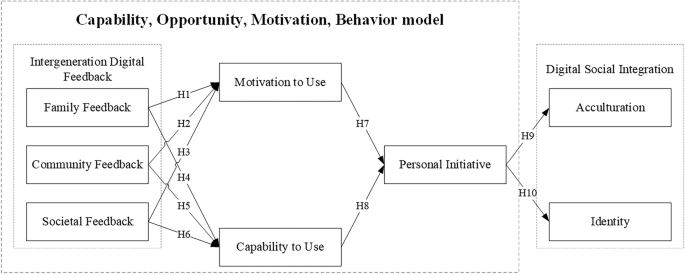
Research model.
Research methodology
Study design
The study was conducted as an explanatory sequential mixed-method study consisting of a survey followed by in-depth interviews. This design helps researchers avoid the inconsistencies caused by focusing on only qualitative or quantitative analyses and helps them build a better understanding of the quantitative results (Creswell and Clark, 2017). Since values related to AI are complex, contradictory, and dynamic in an aging society, using only quantitative studies limits the depth of the findings (Birgili and Demir, 2022). However, the intrinsic logic and reasons behind quantitative results can be captured by incorporating a qualitative method (Knott et al. 2022), which can enhance the subjective interpretation of the influence mechanism between intergenerational digital feedback and DSI and also reduce the result bias caused by differences in the respondents’ social class, gender, and race (Esmaeilzadeh and Maddah, 2024; Park et al. 2023).
Therefore, the research is divided into two stages. In stage 1, we distributed the designed questionnaire among older adults to assess the research model. In stage 2, we conducted semi-structured interviews with 11 participants from the quantitative phase to gain insights into the quantitative results. Figure 2 provides a diagram of the procedures in the two-stage design.

A diagram of the procedures in the two-stage design.
Measurements
In the first stage, all the scales were based on previous studies and modified to fit the current research context. All items adopted a seven-point Likert scale where 1 represents negative (strongly disagree) and 7 represents positive (strongly agree), with the exception of the control variables. The measures of intergenerational digital feedback from society, community, and family were adapted from the social support scale (Gottlieb and Bergen, 2010; Shakespeare-Finch and Obst, 2011; Thanakwang, 2015); the measures of motivation to use were adapted from the perceived usefulness scale (Alalwan et al. 2016); the measures of capability to use were adapted from the self-efficacy scale (Zeng et al. 2022); the scale of personal initiative was used to measure the initiative level of older adults toward using AIPs (Frese et al. 1997); the measures of acculturation were adapted from the sociocultural adaptation scale (Ward and Kennedy, 1999); and the scale of identity was adapted from the social identification scale (Postmes et al. 2013). The complete variables and indicators are shown in Supplementary Materials (Table S1).
In the second stage, we conducted semi-structured interviews to explore the relationship between intergenerational digital feedback and DSI in the process of AIPs use. As a part of the explanatory sequential mixed-method study, the main role of the interview is to explain the quantitative results. The interview guide includes six topic areas. In setting the questions, we integrated current core issues related to DSI, intergenerational digital feedback, and the constructs in the COM-B model, as shown in Supplementary Materials (Table S2).
Data collection
This study collected firsthand data by means of a questionnaire survey to verify the conceptual model. Given that some scales were not available in Chinese, these English scales were first translated into Chinese by one author who is proficient in both languages. We then had these scales tested by two experts in AI and behavioral sciences and seven PhDs in related areas. To ensure the quality of the questionnaire, 50 copies of a pre-survey questionnaire were distributed offline. All 50 were collected. We interviewed some of the respondents and revised the questionnaire according to their suggestions.
We collected the formal questionnaire from December 2022 to March 2023, with the assistance of Hefei Civil Affairs Bureau. Hefei is one of the pilot cities of China’s AI Elderly Care Social Experiment, and the government in Hefei has selected some communities as pilot units. Therefore, we distributed questionnaires in pilot communities based on a user list provided by relevant departments and enterprises after obtaining authorization. Table 2 details the inclusion and exclusion criteria.
Before we issued the questionnaires, we selected eight volunteers from the communities to help us and conducted relevant training for them. We also identified the specific AIPs the respondents had access to according to the “Smart Health Care Products and Services Promotion Directory (2022 edition) Classification”. All the respondents signed a written informed consent, ensuring they were fully aware of the study’s purpose, their voluntary participation, and their right to withdraw at any time.
Each questionnaire took about 30 min to complete; those respondents who had difficulty reading and writing finished the questionnaires using an oral question-and-answer format with the assistance of the volunteers. In addition, we collected demographic information such as the respondent’s age, gender, and educational level. We collected a total of 759 questionnaires; we retained 549 valid questionnaires after eliminating the invalid ones, with an effective rate of 72.33%. Table 3 shows the statistical characteristics of the sample.
We selected the participants for the qualitative research from respondents in the questionnaire survey. We conducted a face-to-face semi-structured interview with each of these participants, which lasted approximately 40 min. Each participant was interviewed in person and alone, with no companion attending. Participant information is shown in Supplementary Materials (Table S3).
Data analysis and interpretation
Quantitative analysis
In the quantitative analysis, PLS-SEM was used to investigate complex connections among constructs and indicators in the exploratory study. In addition, PLS imposes minimal restrictions on sample size and residual distribution. Therefore, this paper used SmartPLS 3.2.8 (Boenningstedt, Germany) for quantitative analysis.
Qualitative analysis
The qualitative analysis started from transcription. As Oliver, Serovich, and Mason noted, the transcription is a critical element in qualitative analysis (Oliver et al. 2005). The researchers were both the interviewers (listed in Supplementary Materials (Table S3)) and the transcribers. The participants were interviewed in their familiar and comfortable environment. We used voice transcription software (iFlyrec) to record and convert the recordings into text. The original transcript was proofread and handled by the researcher responsible for that participant and checked by the other two researchers. The researchers during each interview supplemented the transcript with notes and observations. This transcription process guaranteed that every researcher became intimately familiar with the data through reading it actively and repeatedly. Once checked, we sent copies to the participants to further confirm the reliability and authenticity, resulting in a final transcript for our analysis.
Then, we manually coded interesting features of the data in a systematic fashion across the entire dataset, collating data relevant to each code. Next, we sorted the different codes into potential themes, and collated all the relevant coded data extracts within the themes. To reduce the deviation caused by subjective bias, we also used the automatic coding function of the NVivo15 software for coding and theme identification, comparing with the above manual results, thereby obtaining a collection of candidate themes and sub-themes, and extracts of data that had been coded in relation to them. Subsequently, we used Patton’s dual criteria judging categories (internal homogeneity and external heterogeneity) to review the themes (Braun and Clarke, 2006). The iterative process of the codes and themes continued until the themes were coherent and additional refinements yielded no substantial changes. Finally, an analytic narrative embedded with extracts was elaborated based on the research questions and quantitative results.
Additionally, to enhance the authenticity, validity, and reliability of analysis, the transcription, coding, and initial themes generation were all conducted in Chinese. After the qualitative data reached theoretical saturation, the researchers and a bilingual expert translated the coded data extracts within the identified themes to English, meeting the requirements of cross-language qualitative research (Abfalter et al. 2021).
Quantitative results
Measurement model testing
Common method bias
Harman’s one-factor test was used to identify any potential common method bias (Podsakoff and Organ, 1986). All the items used in this study were input into a principal component analysis (PCA) solution with end-rotation factors. If a single factor accounts for more than 50% of the variance, the questionnaire data may have common method bias (Mattila and Enz, 2002). Eight dimensions were extracted from 36 items. The percentage of the first (largest) factor in the total variance is 49.42%. No factor is higher than 50%, and all factors account for 74.09% of the total variance. Therefore, the possibility of common method bias in this study is small.
Reliability and validity
To validate the measurement model, we assessed the reliability of the construct and two types of validity. Table 4 shows the factor loading, combined reliability (CR), Cronbach’s alpha, and average variance extracted (AVE) coefficient of the model. In this study, the factor loading of the model ranges from 0.784 to 0.947, values that are greater than the recommended value of 0.7 (Hair et al. 2012). The CR is an important measure of the internal reliability of each dimension of the model; in this study, the range of the CR is 0.913–0.960, which is greater than the recommended value of 0.7. Cronbach’s alpha is an important measure of the internal validity of the model, and most of the literature suggests that the value needs to be greater than 0.7 (Hair et al. 2012). The range of values in this study is 0.862–0.949, which is greater than the recommended value of 0.7, indicating good internal consistency of the questionnaire. The AVE took values ranging from 0.724 to 0.857, all of which are greater than 0.5, indicating that the observed items explain much more variance than the error term and that the validity of the model aggregation is relatively high (Hair et al. 2012).
The results in Table 5 show that the square root of the AVE for each construct is greater than the correlation involving that construct, which confirms the discriminant validity (Hair et al. 2012). Wang et al. argued that HTMT is an alternative method for determining discriminant validity. The HTMT values of less than 0.85, shown in Table 6, confirm the discriminant validity (Wang et al. 2022).
Structural model
In this study, the theoretical model was analyzed using SmartPLS 3.2.8 for structural equation analysis. The bootstrapping procedure was run with 5000 subsamples. The specific results are shown in Fig. 3 and Table 7.

Model results.
Finally, we conducted a control variable test. The t-test results show that age, gender, education, marriage status, and monthly income have no significant impact on the results.
Qualitative results
Building upon the quantitative findings, we undertook a qualitative analysis to gain deeper insights into the results. The interview data yielded five themes that explained the quantitative results, and that were further subdivided into seven sub-themes.
Theme 1. Intergenerational digital feedback facilitates motivation to use
Theme 1 has two sub-themes, namely family feedback and societal feedback. The study examined the participants’ experiences and perceptions of intergenerational digital feedback at these different levels, and how the feedback from these sources affected their intrinsic motivation to use AIPs.
Family feedback
In the sub-theme of family feedback, we observed that offspring guided older adults to use AIPs and also helped them reconstruct their identities and meanings in digital society. Feedback at the family level alleviates the technical anxiety of older adults when using AIPs, strengthens their motivation to use AIPs, and leads to a change in their attitude toward AIPs, from resistance to acceptance. For example, “At first, I didn’t want to use any functions of my phone other than video or voice calls at all. My daughter set the elder mode in Alipay for me, and she also helped me tie a medical insurance card remotely. I find my phone very good and I am no longer afraid of online shopping and illness” (Ge Zhonghua; male; 68; user of smart phone). Positive intergenerational interaction improves the perceived usefulness of AIPs by older adults, enhancing their motivation to use AIPs: “I thought the AIP issued by the government was useless until my grandson told me that it [an intelligent glucose meter] could remind me to measure my blood glucose level on time and record the data, which gave me the idea to try it” (Zhu Siyu; male; 67; user of intelligent glucose meter and smart phone).
Societal feedback
This sub-theme showed that with the maturation of intelligent technologies, the government and AIP-related enterprises devoted great effort to stimulating the motivation of older adults to use AIPs. The experiment promoting smart technology for elderly care and the associated publicity conducted by the government arouse the commitment and interest of older adults in AIPs: “My smart glucose meter is distributed for free by the government. The community staff tells me that I am the participant of the national-level experiment and I should use the device carefully, give regular feedback, so that I can help more older adults like me in the future” (Zhu Siyu; male; 67; user of intelligent glucose meter and smart phone). “I often see new technologies on the CCTV News, like robots, and I always dream of using them. If they are as smart as is advertised, it will be better than having a nanny” (Zhang Bo; female; 79; user of intelligent air purifier). From the perspective of AIP-related enterprises, face-to-face guidance and instruction by customer service staff can further enhance the perceived usefulness of AIPs among older adults. As one participant stated, “Salespeople often come to my house and teach me to use the intelligent glucose meter, so that they can transfer my data to the platform and monitor my health state” (Fan Wenliang; female; 66; user of intelligent glucose meter).
Theme 2. Intergenerational digital feedback facilitates capability to use
Theme 2 has three sub-themes, namely family feedback, community feedback, and societal feedback. The qualitative results of the three sub-themes explained the significant influence of intergenerational digital feedback on the capability to use AIPs among older adults.
Family feedback
At the household level, offspring not only teach older adults about digital knowledge but also train them in digital skills. The continuous guidance, resolving of doubt, and sharing of experience have become important sources of a capability to use AIPs in older adults. Three participants’ comments reflected different ways of teaching and training that affect capability: “My daughter taught me to use the smart watch to make my usage smooth” (Sun Wenzhao; male; 65; user of smart watch and smart phone). “When I have questions, I can consult with my granddaughter at any time. Although my memory is not good, she can remind me in time” (Zhang Bo; female; 79; user of intelligent air purifier). “When I chat with my children, they often tell me some knowledge of AIPs to help me use them better” (Ge Zhonghua; male; 68; user of smart phone).
Community feedback
A community center can provide older adults with opportunities to learn about and practice using AIPs, systematically improving their digital literacy. For example, systematic training and skill transmission in community centers promote the capability to use AIPs. “The AI training class in the community is very good, although I sometimes cannot keep up with the progress, but I also learned a lot of tips” (Zhang Guihua; male; 66; user of intelligent walking aid device). In addition, community centers offer older adults opportunities to communicate with other people, use AIPs more bravely, and improve their digital literacy. “I like to practice using my smartphone in the community center because there are many people to communicate with and I am not afraid to make mistakes, which makes my proficiency improve very quickly” (Liu Qian; female; 61; user of intelligent TV and smart phone).
Societal feedback
At the society level, personalized customer service by AIP-related enterprises, as well as the popularization of digital skills by the government, are the main sources of self-efficacy to use AIPs. The enterprises have specific personnel responsible for solving problems that older adults may encounter in the process of using AIPs, who improve the perceived ease of use among older adults and improve their capability indirectly. For instance, “If I have any problem with my smart wheelchair, I can always call my product manager and he will be very patient and answer my questions” (Zheng Yuanyuan; male; 63; user of intelligent wheelchair). The government also popularizes relevant knowledge and skills among older adults via various channels. For example, “I knew a lot about AIPs from TV. I believe that I can use them easily” (Wu Dongxu; male; 82; user of iPad).
Theme 3. Motivation to use facilitates personal initiative
AIPs can make up for physiological and cognitive deficiencies, as well as meet the psychological needs of older adults, thereby promoting their initiative to use AIPs. The instant messaging function of smartphones can effectively alleviate the loneliness of older adults, and thus improve their initiative: “I am eager to keep in touch with my children; since everyone uses smartphones to communicate, I will take the initiative to use it” (Ge Zhonghua; male; 68; user of smart phone). The life assistance characteristics of AIPs that enable older adults to maintain their lifestyles motivate them to use the AIPs actively. “The doctor said my eyes may soon be blind. I am very afraid of not being able to read once blind. However, Siri can read a lot of masterworks, which makes me feel a little bit better” (Zhu Siyu; male; 67; user of intelligent glucose meter and smart phone). In addition, participants reflected that speech control is an attractive function, motivating them to use AIPs actively, through which they can take control of their surroundings: “Speech control is one of my favorite functions of AIPs. I have a bad memory and can’t operate these products well. Speech control can help me solve this problem and makes me not need to remember cumbersome operations” (Liu Qian; female; 61; user of intelligent TV and smart phone).
Theme 4. Capability to use facilitates personal initiative
The active behaviors of older adults toward AIPs are diverse (i.e., using them in depth, using them in breadth, and continuous use), and are closely related to each person’s capability. For instance, one participant said the following: “I have a lot of knowledge about AIPs and I want to put it into practice. So I enjoy not only using my smartphone, but also trying out new devices” (Sun Wenzhao; male; 65; user of smart watch and smart phone). Another participant stated that, “Compared with the people around me, I’m good at using the smart phone and smart watch. I have used them for nearly 2 years and now I can’t live completely without them” (Wang Yanli; female; 69; user of smart watch and smart phone). When the digital literacy of older adults is insufficient to support their use of AIPs, they will have a negative attitude toward the AIPs and might revert back to using familiar electronic products. When we visited his home, Guo Xiulian took out his phone from a drawer and said, “Although I have been using a smartphone for a long time, I’m not very good at it. I still prefer watching the news on television rather than browsing news on my smartphone” (Guo Xiulian; male; 72; user of intelligent mattress and smart phone).
Theme 5. Personal initiative facilitates DSI
The fifth theme is that personal initiative facilitates DSI. This theme encompasses psychological expressions related to cognition, emotion, and behavior while integrating into digital society. Within this theme, subthemes of acculturation and identity are identified.
Acculturation
For older adults, their acceptance of cultural diversity and the change of lifestyles in digital society are facilitated by using AIPs actively. Older adults strengthen their acceptance and tolerance of diverse cultures when they have more contact with younger generations through AIPs: “I often feel left behind in the digital era, but I work hard to keep up and don’t want to fall too far behind. Using AIPs makes me communicate with young people, and helps me keep up with the ideas of the times” (Wu Dongxu; male; 82; user of iPad). In addition, the change of participants’ lifestyles as they join the digital society is facilitated through engagement with the digital consumer culture found on AIPs: “We use our smartphones to take pictures and make our own short videos. We have our own ‘network circle,’ where there are many old people like me with similar hobbies” (Sun Wenzhao; male; 65; user of smart watch and smart phone).
Identity
We observed that social identities and personal identity were enhanced by augmenting older adults’ personal initiative to use AIPs. Social identities involve the descriptions of personal initiative in local fusion to integrate emotional experience and behavior patterns of older adults: “In the process of using AIPs, I have built friendships with surrounding older adults who are interested in AIPs. They said that I am still young and very fashionable” (Zhang Guihua; male; 66; user of intelligent walking aid device). Personal identity entails a feeling of oneness with the younger generation as an older person continues to use the AIPs. For example, they evaluate their relationship with statements like, “I like my life now; I feel I belong to this era. When I communicate with younger people, I can feel that there is no obvious generation gap” (Zhang Bo; female; 79; user of intelligent air purifier).
Discussion, implications and limitations
Discussion of the findings
The purpose of this study is to reveal the relationship between intergenerational digital feedback and the DSI of older adults, and to adopt an explanatory sequential mixed-method design to deepen our understanding of DSI.
The impacts of the three types of intergenerational digital feedback on motivation and capability to use AIPs are significantly different (RQ1). Intergenerational feedback at the family and society levels has a positive effect on motivation and capability. This finding aligns with prior research highlighting the potential of support from family and society to enhance the intrinsic motivation and digital literacy of older adults (Rosales and Blanche-T, 2022; Yoon et al. 2020). However, compared with family feedback, societal feedback has a greater impact on older adults’ capability and motivation to use AIPs. Regarding capability, offspring usually take on the responsibility of elder care (Stuifbergen and Van Delden, 2011), and they may not systematically teach older adults how to use AIPs. However, the staff from AIP-related enterprises are required to provide continuous customer service, which helps older adults improve their digital literacy. Regarding motivation, societal feedback is seen in official programs encouraging older adults to use AIPs; in China, influenced by past habits, the majority of older adults have an extremely high level of trust in the government (Entradas, 2022). Regarding the lack of influence from community feedback on the motivation of older adults to use AIPs, we believe this may be because community members often focus on the security and daily care of older adults (Kennedy et al. 2021), and their interactions lack in-depth communication at the psychological and social levels, which make them less likely to motivate older adults to use AIPs. In our interviews, most older adults did not mention motivation and encouragement derived from their community.
The study confirms the positive role capability and motivation play in older adults’ initiative to use AIPs (RQ2). Furthermore, the results reveal that motivation to use has a greater impact on personal initiative than capability to use. In the COM-B model, both motivation and capability can promote an individual’s behavior. However, as previous research has revealed, higher motivation often indicates a greater likelihood of behavioral implementation, and this phenomenon tends to be more obvious among older adults (Lin and Roberts, 2020). A well-established fact is that older adults, compared with younger individuals, are more inclined to maintain their existing lifestyles. In the absence of pressing needs, they often lack the motivation to embrace change (Kahana et al. 2003). This means that if older adults are unwilling to change their existing lifestyles, their initiative to use AIPs is often poor, even if they have sufficient digital literacy or convenient access to acquire digital capabilities. Furthermore, we clarify that while motivations can be diverse, when they are reflected in behaviors, the behaviors may be consistent (Tyler et al. 2020). In other words, different motivations can lead to the same active use behavior of AIPs. Similarly, the qualitative data support the link between motivation and personal initiative.
The association between personal initiative and DSI (RQ3) reinforces the significance of fostering initiative in personal use behavior. This finding aligns with literature that highlights the positive outcomes associated with personal initiative (Drydakis, 2021). Furthermore, our research highlights that personal initiative influences the identity of older adults more strongly than their acculturation. This result may occur because older adults are more focused on how to integrate into digital society and enhance their sense of identity, thereby reducing feelings of loneliness and social isolation (Burholt et al. 2020). When an individual’s behavior and lifestyle differ from that of the group, both the individual and others may experience a sense of alienation, diminishing the individual’s sense of social identity and belonging. The use of AIPs is a representative lifestyle in the digital age. When older adults use them, both they themselves and those around them consider them members of digital society. However, older adults have their own understanding of culture in digital society. In particular, people born in the 1950s are unlikely to share the same cultural preferences as those born in the 1990s. Although the older adults can understand the thoughts of younger generations as they delve deeper into using AIPs, they have also formed cultural expressions that differ from those of younger people (Ng and Indran, 2022). Therefore, the impact of personal initiative on identity is greater than that on acculturation.
Theoretical implications
This study contributes to the theory and literature in three key aspects.
First, the study introduces the COM-B model to the field of information technology and systems usage in regards to older adults and presents ideal effects. It not only expands the theoretical boundaries and application scenarios of the model in this field (Li and Kang, 2022) but also further explores the applicable objects of the COM-B model. The COM-B model and social support theory have shown their respective advantages in explaining individual behaviors (Viner et al. 2022; Willmott et al. 2021). However, recent calls for research include Chen et al. who urged further investigation into COM-B from the perspective of social support (Chen et al. 2023). In response, our research provides robust empirical evidence that the initiative behavior of older adults depends on their motivation and capability to utilize social support. Although this fusion may not apply in other fields, it shows the extensibility of the COM-B model.
Second, the study explores the influence mechanism of different dimensions of intergenerational digital feedback on the DSI of older adults, providing more insights for the development of social support theory in regards to social inclusion. Although studies on the relationship between older adults and technology based on the social support theory are increasing (Chen et al. 2024; Zhang et al. 2025), the integrated influence and mechanism of multi-dimensional intergenerational feedback remain underexplored. Compared with family feedback and community feedback, societal feedback has the most significant effect on the motivation and capability of older adults. This is an important finding, indicating that in the path towards DSI, more efforts at the society level are needed, not just traditional social integration methods based on family or social networks (Newman and Zainal, 2020).
A third contribution of the study is that it provides a deeper insight into how AIPs can enhance the well-being of older adults, echoing the advocacy for engaging older adults in the digital world (He et al. 2022) and contributing to the theory of social integration. Our results confirm the significant impact of older adults actively using AIPs on their social identity and acculturation. Just as recent studies emphasize that the dimensions of DSI need to be redefined in the face of technological revolution (Gunnes et al. 2024), our results also provide new insights into the dimensions. In addition, our study explores the relationship between older adults and digital society from personal initiative perspective, suggesting that academic researchers should reinvestigate the methods of social participation of older users and providing new evidence for social gerontology.
Practical implications
This study makes three practical contributions.
First, the influence of intergenerational digital feedback at the society level on motivation and capability is the most significant, showing the important role played by the government and AIP-related enterprises. As we revealed in the interview results, the government and enterprises play different roles. At the government level, multisector collaboration is needed to address complex social problems throughout a person’s lifetime, as suggested by the World Health Organization. Therefore, government departments should strengthen multi-enterprise, multi-industry, and multi-department cooperation in digital areas of older adults’ daily lives, such as online consumption, ride-hailing, and telemedicine, through improving incentive policies and funding schemes (Liang et al. 2023; Peng et al. 2023). At the same time, age-friendly policies should shift their focus from simple inclusion toward empowering older adults to exercise their agency and maintain their functional ability. Related enterprises could strive to develop age-appropriate interactive models through user-oriented design approaches. That is, when undertaking participatory design, enterprises should consider the preferences and demands of older adults, prompting them to use AIPs. These initiatives may encounter obstacles such as constrained financial support and a prolonged investment return cycle for the enterprises. We recommend establishing various types of partnership and expanding diversified financing sources.
Second, the role of family and community in encouraging and supporting the use of AIPs by older adults cannot be ignored. Instrumental and informational support from offspring is an important way to overcome the technological self-efficacy barriers of older adults (Xiong and Zuo, 2019). More importantly, the emotional interaction with family, such as receiving respect, attention, and patience, is crucial in inspiring an enthusiasm to learn among older adults and supporting their adaptation of technology and thus DSI. However, considering the potential ageism of offspring and the time spent on the daily care of older adults, we note that family members should adjust their methods of communication and care in an appropriate manner. The community should play a guiding role in helping older adults use AIPs. For example, systematic digital assistance programs, specialized courses, or mentoring programs in the community can support older adults in learning new technologies (Suchowerska and McCosker, 2022). In addition, community centers should be developed into places where older adults, younger people, community workers and volunteers exchange experiences on the use of technology and solve problems for each other. These initiatives may encounter obstacles such as the insufficient attention of the community to technological education, a lack of suitable location, or a lack of personnel. Community managers should increase their attention to and investment in the problem of the digital divide among older adults according to the actual situation in each region and culture.
Finally, the results of the qualitative and quantitative analysis both show that personal initiative is the key to DSI, and the influence of motivation and capability on personal initiative is significant. Hence, older adults should develop multiple approaches to improve personal initiative, such as making full use of intergenerational digital feedback and cultivating a growth mindset. As digital immigrants, older adults will first seek help from their families when they encounter problems in using information technology (Xiong and Zuo, 2019). However, support from family alone is not sufficient to help them reach full digital literacy of the older adults. Older adults should make full use of the support available from all dimensions: older adults can also leverage the power of their community and of society to improve their digital literacy and initiative (Yoon et al. 2020). For instance, they can actively participate in online and offline classes to improve their digital capabilities. Furthermore, older adults may encounter obstacles due to aging, such as weak perceptibility, declined cognition, and difficulties in obtaining information; overcoming these obstacles requires older adults to cultivate a growth mindset and use their rich experience and wisdom to adapt to the evolving digital society.
Limitations
This study has the following limitations.
First, due to the constraints of the territory used and the time period of data collection, the generalizability of our findings may be limited. Therefore, in the future, research will consider the issue of social integration across regions, cultures, and multiple ethnic backgrounds to enhance the universality of the research results. Furthermore, data in both the questionnaire and interview process were self-reported, which might result in social desirability bias in the results. Thus, future research will combine multi-dimensional objective data and subjective data.
Second, we conducted a cross-sectional survey in this study, which means that the results might not reflect the long-term effects of intergenerational digital feedback on the social integration of older adults. Therefore, longitudinal and experimental studies are needed to fully explore the causal relationship between variables over time, and to accurately reflect the attitudes of older adults using AIPs.
Finally, because of the multi-dimensional nature of intergenerational digital feedback, the division based on the source cannot fully reflect the overall picture of intergenerational interaction. Therefore, future studies will further consider the impact of intergenerational feedback from different perspectives on the DSI of older adults, for example, the perception and utilization of social support, as well as the two-way nature of social support and other issues.
Conclusions
The integration of older adults into digital society has gradually become a worldwide issue, driven by the aging population and by the digitization of society. With the development of AI, how to improve the initiative of older adults to use AIPs has become a key issue. This study explores the influence mechanism of different sources of intergenerational digital feedback on the DSI of older adults from the perspective of personal initiative. The results show the following: (1) Significant differences exist in the impact of intergenerational digital feedback from various sources on the motivation and capability of older adults to use AIPs. (2) The motivation to use has a greater impact on personal initiative than the capability to use does. (3) Personal initiative has a stronger influence on the identity (as compared with the acculturation) of older adults.
Our findings provide new empirical evidence for understanding the complex systematic relationship between opportunity, capability, motivation, and behavior in the context of the interaction between older adults and AIPs. This study expands the theories of social integration, COM-B, and social identification. The results also emphasize that the government, enterprises, and organizations should shoulder the social responsibility of helping older adults use AIPs and provide effective support for improving the quality of older adults’ lives, building a new social consensus in the era of AI.
However, the dark side of technological development cannot be veiled by the brilliant prospects of AI technology development. Issues such as privacy, ageism, and illusions are gradually becoming social dilemmas that older adults may encounter in the process of integrating into the digital society. This reflects that technology cannot be the panacea for the ostensible ageing demographic pressure. Therefore, we suggest caution in estimating the real effects of technological revolution on the future of aging, and extensive discussion on the mutual relationship between aging and technology to gain comprehensive understanding and profound insights into social-gerontechnology. In addition, we should co-construct a more symmetrical, equal and circular social normative frameworks in the digital era through deepening the understanding of later life course experience.
Data availability
The datasets generated during and/or analysed during the current study are available from the corresponding author on reasonable request.
References
Abfalter D, Julia M-S, Raich M (2021) Translation decisions in qualitative research: a systematic framework. Int J Soc Res Methodol 24(4):469–486. https://doi.org/10.1080/13645579.2020.1805549
Alalwan AA, Dwivedi YK, Rana NPP, Williams MD (2016) Consumer adoption of mobile banking in Jordan. J Enterp Inf Manag 29(1):118–139. https://doi.org/10.1108/JEIM-04-2015-0035
Bae H, Jo SH, Lee E (2021) Why do older consumers avoid innovative products and services? J Serv Mark 35(1):41–53. https://doi.org/10.1108/JSM-10-2019-0408
Ball C, Francis J, Huang K-T, Kadylak T, Cotten SR, Rikard R (2019) The physical–digital divide: Exploring the social gap between digital natives and physical natives. J Appl Gerontol 38(8):1167–1184. https://doi.org/10.1177/0733464817732518
Bashirian S, Khoshravesh S, Ayubi E, Karimi-Shahanjarini A, Shirahmadi S, Solaymani PF (2023) The impact of health education interventions on oral health promotion among older people: a systematic review. BMC Geriatr 23(1):548. https://doi.org/10.1186/s12877-023-04351-w
Berkman LF, Glass T, Brissette I, Seeman TE (2000) From social integration to health: Durkheim in the new millennium. Soc Sci Med 51(6):843–857. https://doi.org/10.1016/S0277-9536(00)00065-4
Birgili B, Demir Ö (2022) An explanatory sequential mixed-method research on the full-scale implementation of flipped learning in the first years of the world’s first fully flipped university: Departmental differences. Comput Educ 176:104352. https://doi.org/10.1016/j.compedu.2021.104352
Braun V, Clarke V (2006) Using thematic analysis in psychology. Qual Res Psychol 3(2):77–101. https://doi.org/10.1191/1478088706qp063oa
Burholt V, Winter B, Aartsen M et al. (2020) A critical review and development of a conceptual model of exclusion from social relations for older people. Eur J Ageing 17(1):3–19. https://doi.org/10.1007/s10433-019-00506-0
Campos W, Martinez A, Sanchez W, Estrada H, Castro-Sánchez NA, Mujica D (2016) A systematic review of proposals for the social integration of elderly people using ambient intelligence and social networking sites. Cogn Comput 8:529–542. https://doi.org/10.1007/s12559-016-9382-z
Chan RC (2022) Benefits and risks of LGBT social media use for sexual and gender minority individuals: An investigation of psychosocial mechanisms of LGBT social media use and well-being. Comput Hum Behav 139:107531. https://doi.org/10.1016/j.chb.2022.107531
Chen D, Zhang H, Shao J et al. (2023) Determinants of adherence to diet and exercise behaviours among individuals with metabolic syndrome based on the Capability, Opportunity, Motivation, and Behaviour model: a cross-sectional study. Eur J Cardiovasc Nurs 22(2):193–200. https://doi.org/10.1093/eurjcn/zvac034
Chen X, Wu M, Wang D, Zhang J, Qu B, Zhu Y (2024) Association of smart elderly care and quality of life among older adults: the mediating role of social support. BMC Geriatr 24(1):471. https://doi.org/10.1186/s12877-024-05073-3
Cheng X, Huang X, Yang B, Xiao Y (2023) Unveiling the paradox of technostress: Impacts of technology-driven stressors on the elderly’s avoidance behaviors. Inf Manag 60(8):103875. https://doi.org/10.1016/j.im.2023.103875
Chopik WJ (2016) The benefits of social technology use among older adults are mediated by reduced loneliness. Cyberpsychology Behav Soc Netw 19(9):551–556. https://doi.org/10.1089/cyber.2016.0151
Choudrie J, Junior C-O, McKenna B, Richter S (2018) Understanding and conceptualising the adoption, use and diffusion of mobile banking in older adults: A research agenda and conceptual framework. J Bus Res 88:449–465. https://doi.org/10.1016/j.jbusres.2017.11.029
Choudrie J, Pheeraphuttranghkoon S, Davari S (2020) The digital divide and older adult population adoption, use and diffusion of mobile phones: A quantitative study. Inf Syst Front 22:673–695. https://doi.org/10.1007/s10796-018-9875-2
Condie B, Dayton L (2020) Four AI technologies that could transform the way we live and work. Nature 588(7837):S126–S126. https://doi.org/10.1038/d41586-020-03413-y
Creswell JW, Clark VLP (2017) Designing and conducting mixed methods research. Sage, California
Czaja SJ (2016) Long-term care services and support systems for older adults: The role of technology. Am Psychol 71(4):294. https://doi.org/10.1037/a0040258
Drydakis N (2021) Mobile applications aiming to facilitate immigrants’ societal integration and overall level of integration, health and mental health. Does Artif Intell Enhanc outcomes? Comput Hum Behav 117:106661. https://doi.org/10.1016/J.CHB.2020.106661
Entradas M (2022) In science we trust: the effects of information sources on COVID-19 risk perceptions. Health Commun 37(14):1715–1723. https://doi.org/10.1080/10410236.2021.1914915
Esmaeilzadeh P, Maddah M (2024) Robotic companions and healthy aging: A mixed-methods exploration of older adults’ perspectives and insights. Technol Soc 78:102689. https://doi.org/10.1016/j.techsoc.2024.102689
Fang Z, Liu Y, Peng B (2024) Empowering older adults: bridging the digital divide in online health information seeking. Hum Soc Sci Commun 11(1):1748. https://doi.org/10.1057/s41599-024-04312-7
Felber NA, Tian YJ, Pageau F, Elger BS, Wangmo T (2023) Mapping ethical issues in the use of smart home health technologies to care for older persons: a systematic review. BMC Med Ethics 24(1):24. https://doi.org/10.1186/s12910-023-00898-w
Flynn S (2022) Bridging the Age-based Digital Divide: An Intergenerational Exchange during the First COVID-19 Pandemic Lockdown Period in Ireland. J Intergener Relatsh 20(2):135–149. https://doi.org/10.1080/15350770.2022.2050334
Frese M, Fay D, Hilburger T, Leng K, Tag A (1997) The concept of personal initiative: Operationalization, reliability and validity in two German samples. J Occup Organ Psychol 70(2):139–161. https://doi.org/10.1111/j.2044-8325.1997.tb00639.x
Funk A, Garcia CMullen T (2018) CE: original research: understanding the hospital experience of older adults with hearing impairment. Am J Nurs 118(6):28–34. https://doi.org/10.1097/01.NAJ.0000534821.03997.7b
Germini F, Noronha N, Borg Debono V et al. (2022) Accuracy and acceptability of wrist-wearable activity-tracking devices: systematic review of the literature. J Med Internet Res 24(1):e30791. https://doi.org/10.2196/30791
Gottlieb BH, Bergen AE (2010) Social support concepts and measures. J Psychosom Res 69(5):511–520. https://doi.org/10.1016/j.jpsychores.2009.10.001
Greenhalgh T, Wherton J, Sugarhood P, Hinder S, Procter R, Stones R (2013) What matters to older people with assisted living needs? A phenomenological analysis of the use and non-use of telehealth and telecare. Soc Sci Med 93:86–94. https://doi.org/10.1016/j.socscimed.2013.05.036
Gunnes M, Løe I-C, Kalseth J (2024) Exploring the impact of information and communication technologies on loneliness and social isolation in community-dwelling older adults: a scoping review of reviews. BMC Geriatr 24(1):215. https://doi.org/10.1186/s12877-024-04837-1
Hair JF, Sarstedt M, Ringle CM, Mena JA (2012) An assessment of the use of partial least squares structural equation modeling in marketing research. J Acad Mark Sci 40(3):414–433. https://doi.org/10.1007/s11747-011-0261-6
He Q, He Y, Liu Q, Ma C (2023) Acceptance of social assistant robots for the older adults living in the community in China. Geriatr Nurs 52:191–198. https://doi.org/10.1016/j.gerinurse.2023.06.006
He Y, Li K, Wang Y (2022) Crossing the digital divide: The impact of the digital economy on elderly individuals’ consumption upgrade in China. Technol Soc 71:102141. https://doi.org/10.1016/j.techsoc.2022.102141
Hülür G, Macdonald B (2020) Rethinking social relationships in old age: Digitalization and the social lives of older adults. Am Psychol 75(4):554. https://doi.org/10.1037/amp0000604
Jokisch MR, Schmidt LI, Doh M, Marquard M, Wahl H-W (2020) The role of internet self-efficacy, innovativeness and technology avoidance in breadth of internet use: Comparing older technology experts and non-experts. Comput Hum Behav 111:106408. https://doi.org/10.1016/j.chb.2020.106408
Kahana E, Kahana B, Kercher K (2003) Emerging lifestyles and proactive options for successful ageing. Ageing Int 28:155–180. https://doi.org/10.1007/s12126-003-1022-8
Kamalpour M, Watson J, Buys L (2020) How can online communities support resilience factors among older adults. Int J Hum –Computer Interact 36(14):1342–1353. https://doi.org/10.1080/10447318.2020.1749817
Kennedy MA, Hatchell KE, DiMilia PR et al. (2021) Community health worker interventions for older adults with complex health needs: A systematic review. J Am Geriatr Soc 69(6):1670–1682. https://doi.org/10.1111/jgs.17078
Kim MJ, Lee C-K, Contractor NS (2019) Seniors’ usage of mobile social network sites: Applying theories of innovation diffusion and uses and gratifications. Comput Hum Behav 90:60–73. https://doi.org/10.1016/j.chb.2018.08.046
Knott E, Rao AH, Summers K, Teeger C (2022) Interviews in the social sciences. Nat. Rev. Method Prim. 2(1):73. https://doi.org/10.1038/s43586-022-00150-6
Laato S, Islam AN, Farooq A, Dhir A (2020) Unusual purchasing behavior during the early stages of the COVID-19 pandemic: The stimulus-organism-response approach. J Retail Consum Serv 57:102224. https://doi.org/10.1016/j.jretconser.2020.102224
Lee OE-K, Kim D-H (2019) Bridging the digital divide for older adults via intergenerational mentor-up. Res Soc Work Pr 29(7):786–795. https://doi.org/10.1177/1049731518810798
Li L, Kang K (2022) Understanding the real-time interaction between middle-aged consumers and online experts based on the COM-B model. J Mark Anal 11(23):1–13. https://doi.org/10.1057/s41270-022-00196-1
Liang C, Wang X, Gu D, Li P, Chen H, Xu Z (2023) Smart management information systems (Smis): concept, evolution, research hotspots and applications. Data Intell 5(4):857–884. https://doi.org/10.1162/dint_a_00231
Lin N, Roberts KR (2020) Using the theory of planned behavior to predict food safety behavioral intention: A systematic review and meta-analysis. Int J Hosp Manag 90:102612. https://doi.org/10.1016/j.ijhm.2020.102612
Luo C, Yang C, Yuan R, Liu Q, Li P, He Y (2024) Barriers and facilitators to technology acceptance of socially assistive robots in older adults - A qualitative study based on the capability, opportunity, and motivation behavior model (COM-B) and stakeholder perspectives. Geriatr Nurs 58:162–170. https://doi.org/10.1016/j.gerinurse.2024.05.025
Ma X, Zhang X, Guo X, Lai K-h, Vogel D (2021) Examining the role of ICT usage in loneliness perception and mental health of the elderly in China. Technol Soc 67:101718. https://doi.org/10.1016/j.techsoc.2021.101718
Ma Y, Gu Y, Hong W, Ping ZS, Liang C, Gu D (2022) How COVID-19 Affects the Willingness of the Elderly to Continue to Use the Online Health Community: A Longitudinal Survey. J Organ End Use Comput 34(6):1–17. https://doi.org/10.4018/JOEUC.308820
Makita M, Mas-Bleda A, Stuart E, Thelwall M (2021) Ageing, old age and older adults: A social media analysis of dominant topics and discourses. Ageing Soc 41(2):247–272. https://doi.org/10.1017/S0144686X19001016
Mattila AS, Enz CA (2002) The role of emotions in service encounters. J Serv Res 4(4):268–277. https://doi.org/10.1177/1094670502004004004
Muñoz JM, Bernacer J, Noë A, Thompson E (2025) Why AI will never be able to acquire human-level intelligence. Nature 637(8047):794–794. https://doi.org/10.1038/d41586-025-00170-8
Newman MG, Zainal NH (2020) The value of maintaining social connections for mental health in older people. Lancet Public Health 5(1):e12–e13. https://doi.org/10.1016/S2468-2667(19)30253-1
Ng R, Indran N (2022) Not too old for TikTok: How older adults are reframing aging. Gerontologist 62(8):1207–1216. https://doi.org/10.1093/geront/gnac055
Okello Candiya Bongomin G, Akol Malinga C, Manzi Amani A, Balinda R (2024) Recalibrating the scope of financial inclusion through financial technologies in the digital age: the role of digital literacy as a moderator in rural Uganda. Inf Technol People 38(3):1178–1207. https://doi.org/10.1108/ITP-09-2022-0732
Oliver DG, Serovich JM, Mason TL (2005) Constraints and opportunities with interview transcription: Towards reflection in qualitative research. Soc Forces 84(2):1273–1289. https://doi.org/10.1353/sof.2006.0023
Özgül E, Döner NH, Çürük GN (2025) Investigating older Adults’ technology attitudes: Psychometric evaluation and cross-cultural adaptation of the TechPH scale. Int J Med Inform :106001. https://doi.org/10.1016/j.ijmedinf.2025.106001
Pani-Harreman KE, Bours GJ, Zander I, Kempen GI, van Duren JM (2021) Definitions, key themes and aspects of ‘ageing in place’: a scoping review. Ageing Soc 41(9):2026–2059. https://doi.org/10.1017/S0144686X20000094
Park HK, Chung J, Ha J (2023) Acceptance of technology related to healthcare among older Korean adults in rural areas: A mixed-method study. Technol Soc 72:102182. https://doi.org/10.1016/j.techsoc.2022.102182
Peng L, Man SS, Chan AH, Ng JY (2023) Personal, social and regulatory factors associated with telecare acceptance by Hong Kong older adults: an indication of governmental role in facilitating telecare adoption. Int J Hum –Computer Interact 39(5):1059–1071. https://doi.org/10.1080/10447318.2022.2050539
Pirhonen J, Melkas H, Laitinen A, Pekkarinen S (2020) Could robots strengthen the sense of autonomy of older people residing in assisted living facilities?—A future-oriented study. Ethics Inf Technol 22(2):151–162. https://doi.org/10.1007/s10676-019-09524-z
Podsakoff PM, Organ DW (1986) Self-reports in organizational research: Problems and prospects. J Manag 12(4):531–544. https://doi.org/10.1177/014920638601200408
Postmes T, Haslam SA, Jans L (2013) A single‐item measure of social identification: Reliability, validity, and utility. Br J Soc Psychol 52(4):597–617. https://doi.org/10.1111/bjso.12006
Rasi P, Vuojärvi H, Rivinen S (2021) Promoting media literacy among older people: A systematic review. Adult Educ Q 71(1):37–54. https://doi.org/10.1177/0741713620923755
Reis L, Mercer K, Boger J (2021) Technologies for fostering intergenerational connectivity and relationships: Scoping review and emergent concepts. Technol Soc 64:101494. https://doi.org/10.1016/j.techsoc.2020.101494
Rios JS, Wohn DY, Lee Y-H (2019) Effect of Internet literacy in understanding older adults’ social capital and expected Internet support. Commun Res Rep 36(2):93–102. https://doi.org/10.1080/08824096.2019.1586664
Rosales A, Blanche-T D (2022) Explicit and Implicit Intergenerational Digital Literacy Dynamics: How Families Contribute to Overcome the Digital Divide of Grandmothers. J Intergener Relatsh 20(3):328–346. https://doi.org/10.1080/15350770.2021.1921651
Rosales A, Fernández-Ardèvol M, Gómez-León M, Jacobetty P (2024) Old age is also a time for change: trends in news intermediary preferences among internet users in Canada and Spain. Hum Soc Sci Commun 11(1):455. https://doi.org/10.1057/s41599-024-02940-7
Schroeder T, Dodds L, Georgiou A, Gewald H, Siette J (2023) Older adults and new technology: Mapping review of the factors associated with older adults’ intention to adopt digital technologies. JMIR Aging 6(1):e44564. https://doi.org/10.2196/44564
Seguí FL, de San Pedro M, Verges EA, Algado SS, Cuyàs FG (2019) An intergenerational information and communications technology learning project to improve digital skills: user satisfaction evaluation. JMIR Aging 2(2):e13939. https://doi.org/10.2196/13939
Shakespeare-Finch J, Obst PL (2011) The development of the 2-way social support scale: A measure of giving and receiving emotional and instrumental support. J Pers Assess 93(5):483–490. https://doi.org/10.1080/00223891.2011.594124
Sourbati M, Loos EF (2019) Interfacing age: Diversity and (in) visibility in digital public service. J Digit Media Policy 10(3):275–293. https://doi.org/10.1386/jdmp_00003_1
Spears R (2021) Social influence and group identity. Annu Rev Psychol 72:367–390. https://doi.org/10.1146/ANNUREV-PSYCH-070620-111818
Stuifbergen MC, Van Delden JJ (2011) Filial obligations to elderly parents: a duty to care? Med Health Care Philos 14:63–71. https://doi.org/10.1007/s11019-010-9290-z
Suchowerska R, McCosker A (2022) Governance networks that strengthen older adults’ digital inclusion: The challenges of metagovernance. Gov Inf Q 39(1):101649. https://doi.org/10.1016/j.giq.2021.101649
Suh T, Moradi M (2023) Transferring in-store experience to online: An omnichannel strategy for DIY customers’ enhanced brand resonance and co-creative actions. J Bus Res 168:114237. https://doi.org/10.1016/j.jbusres.2023.114237
Suntai Z, Beltran SJ (2023) The intersectional impact of race/ethnicity and sex on access to technology among older adults. Gerontologist 63(7):1162–1171. https://doi.org/10.1093/geront/gnac178
Thanakwang K (2015) Family support, anticipated support, negative interaction, and psychological well‐being of older parents in Thailand. Psychogeriatrics 15(3):171–178. https://doi.org/10.1111/psyg.12107
Tian YJ, Felber NA, Pageau F, Schwab DR, Wangmo T (2024) Benefits and barriers associated with the use of smart home health technologies in the care of older persons: a systematic review. BMC Geriatr 24(152). https://doi.org/10.1186/s12877-024-04702-1
Tirado-Morueta R, Aguaded-Gómez JI, Hernando-Gómez Á (2018) The socio-demographic divide in Internet usage moderated by digital literacy support. Technol Soc 55:47–55. https://doi.org/10.1016/j.techsoc.2018.06.001
Tirado-Morueta R, Rodríguez-Martín A, Álvarez-Arregui E, Ortíz-Sobrino MÁ, Aguaded-Gómez JI (2021) The digital inclusion of older people in Spain: technological support services for seniors as predictor. Ageing Soc 43(6):1409–1435. https://doi.org/10.1017/S0144686X21001173
Tomczyk Ł, Mróz A, Potyrała K, Wnęk-Gozdek J (2022) Digital inclusion from the perspective of teachers of older adults-expectations, experiences, challenges and supporting measures. Gerontol. geriatrics Educ 43(1):132–147. https://doi.org/10.1080/02701960.2020.1824913
Tyler M, De George-Walker L, Simic V (2020) Motivation matters: Older adults and information communication technologies. Stud Educ Adults-NIACE 52(2):175–194. https://doi.org/10.1080/02660830.2020.1731058
Viner R, Russell S, Saulle R et al. (2022) School closures during social lockdown and mental health, health behaviors, and well-being among children and adolescents during the first COVID-19 wave: a systematic review. JAMA Pediatr 176(4):400–409. https://doi.org/10.1001/jamapediatrics.2021.5840
Viscogliosi C, Asselin H, Basile S et al. (2020) Importance of Indigenous elders’ contributions to individual and community wellness: results from a scoping review on social participation and intergenerational solidarity. Can J Public Health 111:667–681. https://doi.org/10.17269/s41997-019-00292-3
Wang L, Wang R, Wu J (2022) Impact of green human resource management practices on employee engagement from the perspective of banking employees. Int J Inf Syst Change Manag 13(2):148–165. https://doi.org/10.1504/IJISCM.2022.129261
Wang N, Zhou S, Liu Z, Han Y (2024a) Perceptions and satisfaction with the use of digital medical services in urban older adults of China: mixed methods study. J Med Internet Res 26:e48654. https://doi.org/10.2196/48654
Wang Y, Wu Z, Duan L et al. (2024b) Digital exclusion and cognitive impairment in older people: findings from five longitudinal studies. BMC Geriatr 24(1):406. https://doi.org/10.1186/s12877-024-05121-y
Ward C, Kennedy A (1999) The measurement of sociocultural adaptation. Int J. Intercult. Relat. 23(4):659–677. https://doi.org/10.1016/S0147-1767(99)00014-0
Willmott TJ, Pang B, Rundle-Thiele S (2021) Capability, opportunity, and motivation: an across contexts empirical examination of the COM-B model. BMC Public Health 21(1):1014. https://doi.org/10.1186/s12889-021-11019-w
Xiong J, Zuo M (2019) How does family support work when older adults obtain information from mobile internet? Inf. Technol. People 32(6):1496–1516. https://doi.org/10.1108/ITP-02-2018-0060
Yang H-L, Lin S-L (2019) The reasons why elderly mobile users adopt ubiquitous mobile social service. Comput Hum Behav 93:62–75. https://doi.org/10.1016/j.chb.2018.12.005
Yang X, Xi N, Gu D et al. (2024) Medical practice in gamified online communities: Longitudinal effects of gamification on doctor engagement. Inf Manag 61(7):103906. https://doi.org/10.1016/j.im.2023.103906
Yao Y, Zhang H, Liu X, Liu X, Chu T, Zeng Y (2021) Bridging the digital divide between old and young people in China: challenges and opportunities. Lancet Healthy Longev 2(3):e125–e126. https://doi.org/10.1016/S2666-7568(21)00032-5
Yoelin AB (2022) Intergenerational service learning within an aging course and its impact on undergraduate students’ attitudes about aging. J Intergener Relatsh 20(3):277–292. https://doi.org/10.1080/15350770.2021.1881019
Yoon H, Jang Y, Vaughan PW, Garcia M (2020) Older adults’ internet use for health information: digital divide by race/ethnicity and socioeconomic status. J Appl Gerontol 39(1):105–110. https://doi.org/10.1177/0733464818770772
Zeng G, Fung S-f LiJ, Hussain N, Yu P (2022) Evaluating the psychometric properties and factor structure of the general self-efficacy scale in China. Curr Psychol 41:3970–3980. https://doi.org/10.1007/s12144-020-00924-9
Zhang M (2023) Older people’s attitudes towards emerging technologies: A systematic literature review. Public Underst Sci 32(8):948–968. https://doi.org/10.1177/09636625231171677
Zhang Y, Xi N, Liang C et al. (2025) Gamification for elderly well-being: Effects on experience and engagement. Technol Forecast Soc Chang 217:124155. https://doi.org/10.1016/j.techfore.2025.124155
Zhao Y, Zhang T, Dasgupta RK, Xia R (2022) Narrowing the age‐based digital divide: Developing digital capability through social activities. Inf Syst J 33(2):268–298. https://doi.org/10.1111/isj.12400
Acknowledgements
This study was supported by the National Social Science Fund of China, grant number 21AZD116.
Author information
Authors and Affiliations
Contributions
Wenjia Hong, Yiming Ma and Changyong Liang contributed to the study design. Data collection and analysis were performed by Wenjia Hong, Yiming Ma and Junhong Zhu. The first draft of the manuscript was written by Wenjia Hong and Yiming Ma. The final draft of the manuscript was read and approved by all authors.
Corresponding authors
Ethics declarations
Competing interests
The authors declare no competing interests.
Ethical approval
The procedures used in this study adhered to the ethical standards set out in the Declaration of Helsinki. As the study was not medical research nor regarded human experimentation, and the questions in the questionnaire did not have any adverse effect on the rights and health status of the respondents and participants, ethical approval was not required for this questionnaire-based study according to the biomedical ethics committee of the Hefei University of Technology in 14th November 2022. Furthermore, all respondents and participants were at least 18 years old and consented to participate in the research study by completing the questionnaire. The information collected is anonymous and used for research purposes only.
Informed consent
Written informed consent was obtained from all the respondents prior data collection in December 2022 to March 2023. The consent was obtained directly by the research team from older adult respondents, and it covered participation in the study, use of data for research purposes, and permission for publication of anonymized data. All respondents were fully informed about the purpose of the research, the voluntary nature of their participation, and the measures to ensure anonymity and confidentiality.
Additional information
Publisher’s note Springer Nature remains neutral with regard to jurisdictional claims in published maps and institutional affiliations.
Supplementary information
Rights and permissions
Open Access This article is licensed under a Creative Commons Attribution-NonCommercial-NoDerivatives 4.0 International License, which permits any non-commercial use, sharing, distribution and reproduction in any medium or format, as long as you give appropriate credit to the original author(s) and the source, provide a link to the Creative Commons licence, and indicate if you modified the licensed material. You do not have permission under this licence to share adapted material derived from this article or parts of it. The images or other third party material in this article are included in the article’s Creative Commons licence, unless indicated otherwise in a credit line to the material. If material is not included in the article’s Creative Commons licence and your intended use is not permitted by statutory regulation or exceeds the permitted use, you will need to obtain permission directly from the copyright holder. To view a copy of this licence, visit http://creativecommons.org/licenses/by-nc-nd/4.0/.
About this article

Cite this article
Hong, W., Liang, C., Ma, Y. et al. Intergenerational digital feedback and digital social integration of older adults: an empirical study from personal initiative perspective. Humanit Soc Sci Commun 12, 1144 (2025). https://doi.org/10.1057/s41599-025-05518-z
Received:
Accepted:
Published:
Version of record:
DOI: https://doi.org/10.1057/s41599-025-05518-z
