
Abstract
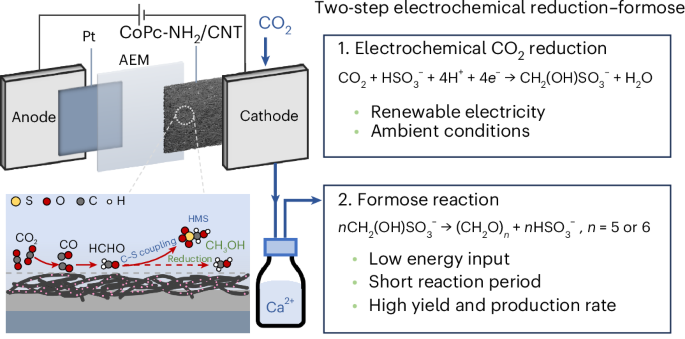
Sustainable synthesis of C5+ carbohydrates from CO2 remains challenging due to the complexity of controlled CO2 reduction and carbon–carbon coupling. Biochemical approaches can convert primary CO2 reduction products into C5+ carbohydrates, but are often constrained by lengthy reaction periods, low production rates and system complexity. Here we present a two-step electrochemical reduction–formose reaction method that uses hydroxymethanesulfonate (HMS) as a more stable surrogate for formaldehyde to facilitate the direct synthesis of C5+ carbohydrates from electrochemically fixed CO2. Using cobalt tetraaminophthalocyanine molecules supported on multiwalled carbon nanotubes as an electrocatalyst, we achieve an HMS Faradaic efficiency of ~12% at a total current density of 150 mA cm−2. Employing direct CO reduction increases the Faradaic efficiency to ~25% with over 63% carbon efficiency. The produced HMS enables an efficient formose reaction under mild conditions reaching a yield of 20.4% for C5+ carbohydrates. The CO2-derived HMS also demonstrates its versatility as a formaldehyde surrogate in other reactions for synthesizing various valuable chemical products, promising a new approach for feeding advanced chemical synthesis with electrochemically fixed CO2 via the intercepted formaldehyde intermediate.
This is a preview of subscription content, access via your institution
Access options
Subscribe to this journal
Receive 12 digital issues and online access to articles
$119.00 per year
only $9.92 per issue
Buy this article
- Purchase on SpringerLink
- Instant access to the full article PDF.
USD 39.95
Prices may be subject to local taxes which are calculated during checkout


Data availability
All experimental data supporting the findings of this study are available in the Supplementary Information. Source data are provided with this paper.
References
Crandall, B. S. et al. Transforming CO2 into advanced 3D printed carbon nanocomposites. Nat. Commun. 15, 10568 (2024).
Belsa, B. et al. Materials challenges on the path to gigatonne CO2 electrolysis. Nat. Rev. Mater. 9, 535–549 (2024).
Sullivan, I. et al. Coupling electrochemical CO2 conversion with CO2 capture. Nat. Catal. 4, 952–958 (2022).
Chen, Y. et al. Efficient multicarbon formation in acidic CO2 reduction via tandem electrocatalysis. Nat. Nanotechnol. 19, 311–318 (2024).
Barecka, M. H., Ds Dameni, P., Zakir Muhamad, M., Ager, J. W. & Lapkin, A. A. energy-efficient ethanol concentration method for scalable CO2 electrolysis. ACS Energy Lett. 8, 3214–3220 (2023).
Wu, Y., Liang, Y. & Wang, H. Heterogeneous molecular catalysts of metal phthalocyanines for electrochemical CO2 reduction reactions. Acc. Chem. Res. 54, 3149–3159 (2021).
Ulmer, U. et al. Fundamentals and applications of photocatalytic CO2 methanation. Nat. Commun. 10, 3169 (2019).
Ma, H. et al. Direct electroreduction of carbonate to formate. J. Am. Chem. Soc. 145, 24707–24716 (2023).
Zhang, X. et al. Molecular engineering of dispersed nickel phthalocyanines on carbon nanotubes for selective CO2 reduction. Nat. Energy 5, 684–692 (2020).
Zhan, C. et al. Key intermediates and Cu active sites for CO2 electroreduction to ethylene and ethanol. Nat. Energy 9, 1485–1496 (2024).
Soland, N. E., Roh, I., Huynh, W.-S. & Yang, P. Synthesis of carbohydrates from methanol using electrochemical partial oxidation over palladium with the integrated formose reaction. ACS Sustain. Chem. Eng. 11, 12478–12483 (2023).
Ruiz-Mirazo, K., Briones, C. & de la Escosura, A. Prebiotic systems chemistry: new perspectives for the origins of life. Chem. Rev. 114, 285–366 (2014).
Hann, E. C. et al. A hybrid inorganic–biological artificial photosynthesis system for energy-efficient food production. Nat. Food 3, 461–471 (2022).
Liu, Z., Wang, K., Chen, Y., Tan, T. & Nielsen, J. Third-generation biorefineries as the means to produce fuels and chemicals from CO2. Nat. Catal. 3, 274–288 (2020).
Cestellos-Blanco, S. et al. Toward abiotic sugar synthesis from CO2 electrolysis. Joule 6, 2304–2323 (2022).
O’Brien, C. P., Watson, M. J. & Dowling, A. W. Challenges and opportunities in converting CO2 to carbohydrates. ACS Energy Lett. 7, 3509–3523 (2022).
Liu, G. et al. Solar-driven sugar production directly from CO2 via a customizable electrocatalytic–biocatalytic flow system. Nat. Commun. 15, 2636 (2024).
Zheng, T. et al. Upcycling CO2 into energy-rich long-chain compounds via electrochemical and metabolic engineering. Nat. Catal. 5, 388–396 (2022).
Cai, T. et al. Cell-free chemoenzymatic starch synthesis from carbon dioxide. Science 373, 1523–1527 (2021).
Robinson, W. E., Daines, E., van Duppen, P., de Jong, T. & Huck, W. T. S. Environmental conditions drive self-organization of reaction pathways in a prebiotic reaction network. Nat. Chem. 14, 623–631 (2022).
Bris, A. et al. Direct Analysis of complex reaction mixtures: formose reaction. Angew. Chem. Int. Ed. Engl. 63, e202316621 (2024).
Haynes, W. M. et al. (eds) CRC Handbook of Chemistry and Physics 95th edn (CRC, 2014).
Li, J. et al. Mechanism-guided realization of selective carbon monoxide electroreduction to methanol. Nat. Synth. 2, 1194–1201 (2023).
Wu, Y., Jiang, Z., Lu, X., Liang, Y. & Wang, H. Domino electroreduction of CO2 to methanol on a molecular catalyst. Nature 575, 639–642 (2019).
Wu, Y., Jiang, Z., Lin, Z., Liang, Y. & Wang, H. Direct electrosynthesis of methylamine from carbon dioxide and nitrate. Nat. Sustain. 4, 725–730 (2021).
Singh, A. et al. Molecular electrochemical catalysis of CO-to-formaldehyde conversion with a cobalt complex. J. Am. Chem. Soc. 146, 22129–22133 (2024).
Chan, T. et al. Role of mass transport in electrochemical CO2 reduction to methanol using immobilized cobalt phthalocyanine. ACS Appl. Energy Mater. 7, 3091–3098 (2024).
Zhu, Q. S. et al. The solvation environment of molecularly dispersed cobalt phthalocyanine determines methanol selectivity during electrocatalytic CO reduction. Nat. Catal. 7, 987–999 (2024).
Cheon, S., Li, J. & Wang, H. In situ generated CO enables high-current CO2 reduction to methanol in a molecular catalyst layer. J. Am. Chem. Soc. 146, 16348–16354 (2024).
Li, J., Al-Mahayni, H., Chartrand, D., Seifitokaldani, A. & Kornienko, N. Electrochemical formation of C–S bonds from CO2 and small-molecule sulfur species. Nat. Synth. 2, 757–765 (2023).
Zhang, X. et al. Highly selective and active CO2 reduction electrocatalysts based on cobalt phthalocyanine/carbon nanotube hybrid structures. Nat. Commun. 8, 14675 (2017).
Kim, H. J. et al. Synthesis of carbohydrates in mineral-guided prebiotic cycles. J. Am. Chem. Soc. 133, 9457–9468 (2011).
Delidovich, I. V., Simonov, A. N., Taran, O. P. & Parmon, V. N. Catalytic formation of monosaccharides: from the formose reaction towards selective synthesis. ChemSusChem 7, 1833–1846 (2014).
Iqbal, Z. & Novalin, S. The formose reaction: a tool to produce synthetic carbohydrates within a regenerative life support system. Curr. Org. Chem. 16, 769–788 (2012).
Omran, A., Menor-Salvan, C., Springsteen, G. & Pasek, M. The messy alkaline formose reaction and its link to metabolism. Life 10, 125 (2020).
Nielsen, S. S. in Food Analysis Laboratory Manual, Food Science Texts Series (ed. Nielsen, S. S.) 47–53 (Springer US, 2010).
Iqbal, M. Z. & Novalin, S. Analysis of formose sugar and formaldehyde by high-performance liquid chromatography. J. Chromatogr. A 1216, 5116–5121 (2009).
Angyal, S. J. The Lobry de Bruyn-Alberda van Ekenstein transformation and related reactions. Top. Curr. Chem. 215, 1–14 (2001).
Waki, M., Shirai, S. & Hase, Y. Saccharide formation by sustainable formose reaction using heterogeneous zeolite catalysts. Dalton Trans. 53, 2678–2686 (2024).
Yue, H. R., Zhao, Y. J., Ma, X. B. & Gong, J. L. Ethylene glycol: properties, synthesis, and applications. Chem. Soc. Rev. 41, 4218–4244 (2012).
Weinberg, N. L. & Mazur, D. J. Electrochemical hydrodimerization of formaldehyde to ethylene-glycol. J. Appl. Electrochem. 21, 895–901 (1991).
Xia, R. et al. Electrosynthesis of ethylene glycol from C1 feedstocks in a flow electrolyzer. Nat. Commun. 14, 4570 (2023).
Li, R., Yang, D. J., Lou, H. M., Zhou, M. S. & Qiu, X. Q. Influence of sulfonated acetone-formaldehyde condensation used as dispersant on low rank coal-water slurry. Energy Convers. Manage. 64, 139–144 (2012).
Li, Y. J. et al. The molecular structure and spectroscopic properties of formaldoxime (CH2NOH). Phys. Scr. 99, 055403 (2024).
Acknowledgements
This work was supported by the National Brown Investigator Award (H.W.) and US National Science Foundation (grant number CHE-2154724, H.W.). The flow cell work was supported by the Yale Center for Natural Carbon Capture (H.W.).
Author information
Authors and Affiliations
Contributions
J.L. and H.W. conceived this project and designed the experiments. J.L. and K.C. synthesized the catalyst materials, performed the TEA and LCA and conducted the electrochemical and chemical reactions. Y.S. assisted in some of these experiments. J.Y. carried out the post-reaction separation of carbohydrates. J.L., K.C. and H.W. wrote the manuscript with input from N.E.S. and P.Y. The manuscript was edited by Y.G. and S.C., who also contributed to data analysis. H.W. supervised the project.
Corresponding authors
Ethics declarations
Competing interests
The authors declare no competing interests.
Peer review
Peer review information
Nature Synthesis thanks Rong Xia and the other, anonymous, reviewer(s) for their contribution to the peer review of this work. Primary Handling Editor: Alexandra Groves, in collaboration with the Nature Synthesis team.
Additional information
Publisher’s note Springer Nature remains neutral with regard to jurisdictional claims in published maps and institutional affiliations.
Supplementary information
Supplementary Information (download PDF )
Supplementary Figs. 1–16, Notes 1 and 2 and Tables 1–4.
Source data
Source Data Fig. 2 (download XLSX )
Electrochemical testing data.
Source Data Fig. 3 (download XLSX )
Formose reaction and TEA data.
Rights and permissions
Springer Nature or its licensor (e.g. a society or other partner) holds exclusive rights to this article under a publishing agreement with the author(s) or other rightsholder(s); author self-archiving of the accepted manuscript version of this article is solely governed by the terms of such publishing agreement and applicable law.
About this article

Cite this article
Li, J., Chen, K., Soland, N.E. et al. Artificial synthesis of carbohydrates from electrochemically fixed carbon dioxide. Nat. Synth 5, 588–595 (2026). https://doi.org/10.1038/s44160-025-00961-x
Received:
Accepted:
Published:
Version of record:
Issue date:
DOI: https://doi.org/10.1038/s44160-025-00961-x

