Thank you for visiting nature.com. You are using a browser version with limited support for CSS. To obtain
the best experience, we recommend you use a more up to date browser (or turn off compatibility mode in
Internet Explorer). In the meantime, to ensure continued support, we are displaying the site without styles
and JavaScript.
Mountain regions are increasingly exposed to hazards driven by rapid climate change. Extreme rainfall and heatwaves, combined with shrinking glaciers, reduced snow cover, and thawing permafrost, can destabilise slopes and disrupt hydrological systems. These processes increase the likelihood of floods, landslides, debris flows, ice-rock avalanches, and cascading multi-hazard events, posing threats to ecosystems, infrastructure, and communities. Understanding these complex interactions is essential for predicting risks and developing effective adaptation strategies.
This cross-journal collection from Communications Earth & Environment, Communications Sustainability,Nature Communications, and Scientific Reports brings together research that explores the physical mechanisms and societal impacts of mountain hazards under changing climatic and cryospheric conditions. Contributions addressing risk governance, adaptation approaches, and socio-economic implications are also encouraged.
Climate change is increasing the risk of ice-rock avalanches in the Himalaya while preparedness and recognition remain limited, according to a reassessment of the 2021 Chamoli disaster, lessons from the Blatten near-miss, and analysis of institutional gaps that motivate an anticipatory hazard governance framework.
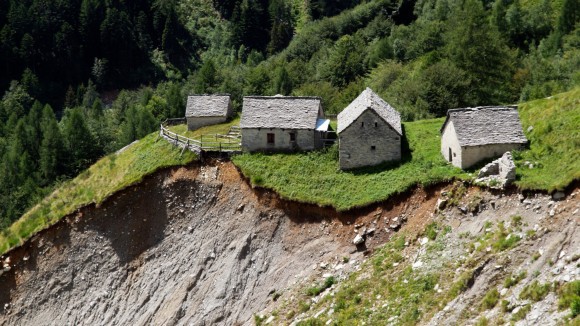
On 28 May 2025, twenty million cubic metres of rock and ice buried the medieval village of Blatten and nearby settlements in the Swiss Lötschen valley. In the wake of the warmest decade since at least 742 CE, the disaster underlines the impact of climate warming on people and heritage.
Small lakes in mountain regions hold significant potential to wreak havoc as a result of sudden drainage. This Comment argues that the risks can be managed within existing disaster reduction frameworks, but must be acknowledged and monitored.
Massively increased ice speeds in combination with a stable terminus position led to a giant ice detachment (~40 million cubic meters) from a Tibetan glacier in November 2022, which ranks among the largest recorded ice avalanches, according to a study based on satellite imagery and seismic data.
The study presents an updated global inventory of glacial lake outburst floods, revealing a sharp rise in event frequency since the 1980s and a strong delayed link to climate warming, highlighting growing risks to downstream communities.
Regional variations in critical rainfall patterns are more significant than differences between processes in a warming climate, with increased probability of occurrence and affected area, according to analysis of the critical rainfall conditions for debris-flow initiation in Austria between 2003 and 2022.
Combining field and laboratory experiments with autonomous monitoring can provide a comprehensive framework for more effective landslide hazard prediction, as revealed by a monitoring system that continuously records relevant soil and environmental parameters.
Debris-flow surges can form from the spontaneous growth of small surface instabilities into large waves that amplify flow destructiveness, according to high-resolution in situ measurements combined with a friction inversion and numerical simulations.
By quantifying changes in lake area before glacier lake outburst floods (GLOFs) worldwide from 1990 to 2023, this study shows that despite the overall growth in total lake area and hazard potential, pre-GLOF lake areas barely changed or even decreased regionally and are dependent on a decreasing number of ice-dammed lakes.
Warmer temperatures enhance formation of glacial lakes that can suddenly and catastrophically release as a glacial lake outburst flood (GLOF), threatening downstream lives and infrastructure. This Review outlines observed and projected changes in glacial lakes and GLOFs, reporting that both will increase with ongoing deglaciation.
Climate warming has driven increased rockfall from an unstable mountain slope in the Swiss Alps, according to a record of rockfall activity spanning the past century based on tree damage.