
Abstract
Seasonal allergic rhinitis (SAR) places a significant socioeconomic burden, particularly on individuals with poorly managed recurrent and severe symptoms despite standard-of-care treatment. Stapokibart, a humanized monoclonal antibody that targets the interleukin (IL)-4 receptor subunit alpha, inhibits its interaction with both IL-4 and IL-13 in type 2 inflammation. Here we aim to assess the efficacy and safety of stapokibart as an add-on therapy in adults with moderate-to-severe SAR. The study was a phase 3 multicenter, randomized, double-blind, placebo-controlled clinical trial with 108 patients diagnosed with moderate-to-severe SAR and having baseline blood eosinophil counts ≥300 cells μl−1. Participants were randomized (1:1) to receive 600 mg (loading dose) to 300 mg stapokibart subcutaneously or a placebo every 2 weeks for 4 weeks. The primary endpoint was mean change from baseline in daily reflective total nasal symptom score (rTNSS) over the first 2 weeks. Multiplicity-tested secondary endpoints included changes in rTNSS over 4 weeks, reflective total ocular symptom score and Rhinoconjunctivitis Quality of Life Questionnaire score over 2 weeks and 4 weeks. Compared with the placebo, stapokibart led to a significant improvement in the mean change from baseline in daily rTNSS during the 2-week (least-squares mean difference, −1.3; 95% confidence interval, −2.0 to −0.6; P = 0.0008) and 4-week (least-squares mean difference, −1.7; 95% confidence interval, −2.5 to −0.8; P = 0.0002) treatments. Stapokibart significantly improved the multiplicity-tested secondary endpoints. Treatment-emergent adverse events were comparable between the groups. Pharmacodynamics and exploratory analyses indicated that the observed improvements in outcomes during pollen season may be attributed to the reduction of type 2 inflammation in response to stapokibart treatment. The results of this trial show that pollen seasonal administration of stapokibart improved both nasal and ocular symptoms and quality of life in patients with moderate-to-severe SAR. ClinicalTrials.gov registration: NCT05908032.
Main
Allergic rhinitis (AR) is a persistent inflammatory condition of the nasal mucosa, mediated by immunoglobulin E (IgE) and triggered by aeroallergens. AR predominantly exhibits type 2 inflammatory signatures and can be categorized into seasonal (SAR) and perennial (PAR)1,2. Notably, SAR exhibits more severe and intense symptoms3,4, prominent nasal inflammation5 and decreased quality of life (QOL)2, and is more challenging to control compared with PAR6. Furthermore, the expected consequences of future climate change encompass an increase in pollen levels and prolonged blooming seasons, leading to the projection that SAR is likely to become more widespread as a global health issue7,8.
Despite receiving standard-of-care (SoC) treatment, including H1 antihistamines or intranasal corticosteroids, over 60% of patients with SAR are dissatisfied with their treatment owing to poor symptom control6,9, highlighting a huge unmet need for effective therapeutic interventions. However, the encouraging efficacy of biologics in other type 2 inflammatory diseases of the respiratory tract suggests their potential use for SAR treatment. Previous RCT trials as well as meta-analysis studies have shown the significant efficacy of pre- and co-seasonal administration of omalizumab (an anti-IgE monoclonal antibody) in improving nasal and ocular symptoms, and QOL in patients with SAR during the pollen season10,11,12. Although some economic analyses conducted within asthma and chronic urticaria cohorts have concluded that omalizumab is a cost-effective treatment option when administered to specific patient groups13,14, the cost ranging from US$10,000 to US$70,000 per year for the minimum to maximum dose significantly restricts its broader utilization across type 2 inflammations15. Administration with omalizumab as a preventive escalated therapy for the overall SAR population may potentially lead to overtreatment and is not deemed cost-effective. Furthermore, two studies investigated the effects of combination treatment with biological agents targeting interleukin (IL)-4 or IL-4 receptor subunit alpha (IL-4Rα) (specifically dupilumab and VAK694) and grass pollen subcutaneous immunotherapy (SCIT) on SAR16,17. In these two trials, in which nasal allergen challenges or allergen-induced skin late-phase response models were used as primary efficacy endpoints outside the pollen season, no significant differences were observed in the suppression of allergic responses between the combined anti-IL4 and SCIT treatment and SCIT monotherapy. Nevertheless, there has been an absence of clinical trials evaluating the efficacy of incorporating biologics as a seasonal add-on therapy to SoC treatment during the pollen season for patients with moderate-to-severe SAR.
Stapokibart (CM310) is a humanized antibody targeting IL-4Rα and effectively blocking its interaction with both IL-4 and IL-13 of type 2 inflammation. Our findings from a double-blind, randomized, placebo-controlled, phase 2 trial (the MERAK trial; ClinicalTrials.gov identifier: NCT05470647)18 indicated that stapokibart was well tolerated and safe in the overall moderate-to-severe SAR population. Notably, it significantly reduced the daily reflective total nasal symptom score (rTNSS) in a subgroup of patients with blood eosinophil counts of at least 300 cells μl−1, when exposed to pollen. Thus, we designed the PHECDA trial to confirm the efficacy and safety of stapokibart as seasonal add-on therapy to SoC treatment in adults with moderate-to-severe SAR and with a blood eosinophil count of at least 300 cells μl−1.
Results
Patients
A total of 279 patients were assessed for eligibility between 10 August 2023 and 10 September 2023, of whom 108 were randomized to receive either stapokibart (n = 50) or placebo (n = 58). Exclusion of the 40 patients was based on ‘investigators’ discretion’, permitting the investigator to consider patients ineligible for our study if they showed uncooperative behavior or had conditions potentially leading to protocol noncompliance or affecting evaluation outcomes. Of these, 29 had incomplete assessments by the end of enrollment, and 9 were excluded owing to poor compliance, 1 owing to SoC intolerance and 1 owing to anemia and abnormal renal function. One participant in the placebo group discontinued treatment early because of treatment-emergent adverse events (TEAEs) (Fig. 1). Two participants reported the use of medications that are prohibited by the protocol for managing preexisting conditions (allergic conjunctivitis and asthma exacerbation), as major deviations from the protocol affecting efficacy evaluation, and subsequent continuous data were handled using the last observation carried forward (LOCF) method, while subsequent binary data were classified as nonresponse according to the composite variable strategy, as outlined in the Statistical Analysis Plan (SAP; see ‘Statistical Analysis Plan’ in Supplementary Information). Other minor deviations from the protocol are detailed in Supplementary Information ‘Supplementary Table 1’. Data from all 108 participants were included in the efficacy analysis set.

The flow chart depicts the process of patient screening, randomization and final analysis in the study. aThree patients had multiple reasons for not meeting the eligibility criteria, which resulted in nonadditive data. bPatients were excluded based on the following objective circumstances: had insufficient assessments until enrollment completion (n = 29), poor compliance (n = 9), unable to tolerate background treatment during screening (n = 1) and had anemia and abnormal renal function leading to safety concerns (n = 1).
The mean age of patients (n = 108) was 37.0 years, with 52.8% being female. The mean duration of SAR was 9.3 years, and the mean baseline blood eosinophil count was 540 cells μl−1. The baseline mean rTNSS, reflective total ocular symptom score (rTOSS) and mean total Rhinoconjunctivitis Quality of Life Questionnaire (RQLQ) score were similar between the two groups (Table 1).
Efficacy
Stapokibart significantly improved the mean change from baseline in daily rTNSS over a 2-week treatment (the primary efficacy endpoint), compared with placebo (least-squares (LS) mean difference, −1.3; confidence interval (CI), −2.0 to −0.6; P = 0.0008) (Table 2). Sensitivity analysis showed no significant interaction between centers and treatment groups (P = 0.222). Subgroup analyses favored stapokibart over placebo regarding the primary endpoint for all subgroups (Extended Data Fig. 1).
Secondary outcomes and results from the per-protocol analysis are detailed in Table 2, Fig. 2, Extended Data Tables 1–4 and Extended Data Figs. 2 and 3. Similarly, the mean percentage change concerning daily rTNSS over 2 weeks’ treatment was greater with stapokibart versus placebo (LS mean difference, −13.5%; 95% CI, −21.9% to −5.1%; P = 0.002) (Extended Data Table 1). Furthermore, the efficacy of stapokibart was significantly evident over the 4-week treatment (LS mean difference in mean change from baseline in daily rTNSS over 4 weeks of treatment, −1.7; 95% CI, −2.5 to −0.8; P = 0.0002; and in mean percentage change, −17.4%; 95% CI, −26.8% to −8.0%; P = 0.0004) (Table 2 and Extended Data Table 1). Indeed, stapokibart led to greater improvements than placebo in multiple efficacy endpoints for nasal symptoms, including morning (a.m.) instantaneous total nasal symptom score (iTNSS), a.m. rTNSS and evening (p.m.) rTNSS as well as daily, a.m. and p.m. assessments of most individual nasal symptoms over the 2-week and 4-week treatment periods (Extended Data Table 1). Based on the time course of daily rTNSS, the onset of action was observed on day 4 (LS mean difference, −1.0; 95% CI, −1.8 to −0.2; P = 0.017), and the maximum effect was observed on day 14 (LS mean difference, −2.1; 95% CI, −3.1 to −1.1; P = 0.0001) over the 2-week treatment and day 18 (LS mean difference, −2.2; 95% CI, −3.3 to −1.1; P < 0.0001) over the 4-week treatment (Fig. 2 and Supplementary Information ‘Supplementary Table 2’). The area under the curves (AUCs) of changes from baseline in daily rTNSS had improved in the stapokibart versus placebo group over the 2-week (LS mean difference, −19.1; 95% CI, −29.6 to −8.6; P = 0.0005) and 4-week treatment (LS mean difference, −47.4; 95% CI, −71.2 to −23.6; P = 0.0002) (Extended Data Table 2).
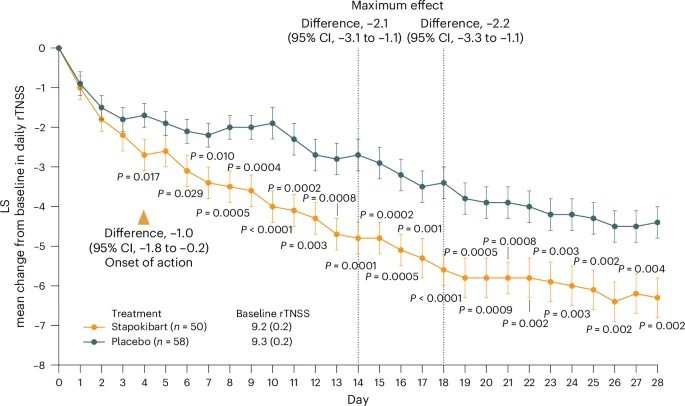
Onset of action for stapokibart was observed on day 4 (orange triangle), and the maximum effect was observed on day 14 and day 18 (gray vertical dotted lines) over the 2- and 4-week treatment periods, respectively. The changes from baseline in daily rTNSS up to week 4 were analyzed through a mixed-effect model for repeated measures, with the baseline daily rTNSS as the covariate and the treatment group, study site, visit and treatment-by-visit interaction as fixed effects. LS mean changes are shown for 50 patients in the stapokibart group and 58 in the placebo group. The error bars indicate standard errors. Differences in LS means and the corresponding 95% CIs were calculated. P values were two sided and nominal, without adjustments for multiple comparisons. The rTNSS is used to assess the overall severity of nasal symptoms over the past 12 h on a scale from 0 to 12. Lower scores indicate less severe nasal symptoms.
Stapokibart also resulted in greater improvements than placebo in daily ocular symptoms as indicated by significantly greater mean changes from baseline in the daily rTOSS over both the 2-week treatment (LS mean difference, −0.7; 95% CI, −1.3 to 0.0; P = 0.039) and 4-week treatment (LS mean difference, −0.8; 95% CI, −1.4 to −0.2; P = 0.016) (Table 2). The mean percentage change from baseline in daily rTOSS showed a similar trend (Extended Data Table 3). Consistently, the effect of stapokibart was greater than that of the placebo for other daily ocular symptom-associated endpoints, including a.m. rTOSS, p.m. rTOSS, a.m. instantaneous total ocular symptom score (iTOSS) and individual ocular symptom scores (Extended Data Table 3).
The stapokibart group also achieved longer mild symptoms or was free of nasal and ocular symptoms compared with the placebo group over the 4-week treatment (median difference, 4.0 days; 95% CI, 1.0–7.0; P = 0.0005) (Extended Data Fig. 2a). The proportion of participants achieving mild or no nasal symptoms was 26.0%, 42.0%, 52.0% and 64.0% at day 7, 14, 21 and 28 in the stapokibart group, respectively, while the proportion was 10.3%, 15.5%, 27.6% and 39.7%, respectively, in the placebo group (Extended Data Fig. 2b).
Stapokibart also showed significantly greater changes from baseline in the total RQLQ score than placebo at both week 2 (LS mean difference, −0.9; 95% CI, −1.4 to −0.4; P = 0.0003) and week 4 (LS mean difference, −1.0; 95% CI, −1.5 to −0.5; P < 0.0001) (Table 2). The differences versus placebo exceeded the minimal clinically important difference (MCID) of 0.5 point19, and 88.0% and 100.0% of stapokibart-treated patients versus 67.2% and 79.3% of placebo-treated patients achieved a ≥0.5 reduction from baseline in RQLQ score at week 2 (P = 0.012) and 4 (P = 0.0004), respectively (Extended Data Table 4). Moreover, the LS mean changes from baseline in all domains of the RQLQ score were greater in the stapokibart group than in the placebo group (all P < 0.05; Extended Data Fig. 3a,b).
Safety
TEAEs were reported in 26 (52.0%) patients in the stapokibart group and 27 (46.6%) in the placebo group (Table 3), all mild to moderate. Treatment-related TEAEs occurred in 7 (14.0%) patients in the stapokibart group and 5 (8.6%) in the placebo group. One patient in the placebo group discontinued treatment owing to two TEAEs (moderate night sweats and asthenia), which resolved spontaneously without treatment. No serious AEs or deaths occurred in either group. The most common TEAEs (≥5%) were upper respiratory tract infection, urinary tract infection, hyperuricemia, hyperlipidemia and cough.
Pharmacokinetics, pharmacodynamics and immunogenicity
The concentration–time trait of stapokibart was measured (Extended Data Fig. 4). The stapokibart group showed greater reductions in the concentrations of pharmacodynamic (PD) markers, including serum thymus and activation-regulated chemokine (TARC) (Extended Data Fig. 5a,b), serum total IgE (Extended Data Fig. 5c,d) and plasma eotaxin-3 (Extended Data Fig. 5e,f). The changes in counts (Extended Data Fig. 5g,h) and percentages (Extended Data Fig. 5i,j) of blood eosinophils were generally similar between groups. Treatment-emergent anti-drug antibodies were detected in 3 (6.0%) participants in the stapokibart group at week 12, whereas neutralizing antibodies were not detected.
Exploratory outcomes
The effects of stapokibart on both systemic and local levels of immunoglobulins (Ig), as well as on prespecified inflammatory biomarkers, implicated in the pathogenesis of SAR or associated with treatment response, were evaluated (Supplementary Tables 3 and 4). The stapokibart group showed significant reductions in median change and percentage change from the baseline of serum specific IgE (sIgE) levels against four pollen allergens over the 4-week period (Extended Data Fig. 6a,c), accompanied by observable trends toward reductions in sIgE levels in nasal secretions (Extended Data Fig. 6b,d), compared with the placebo group. Significant reductions in the levels of the Charcot–Leyden crystal protein (CLC) and cystatin SN (CST1), both biomarkers of type 2 inflammation, were observed in nasal secretions from the stapokibart treatment group compared with the placebo group (Extended Data Fig. 6e,f).
Nasal brushing performed at baseline and weeks 2 and 4 was evaluable for RNA sequencing (RNA-seq) analysis in 100 eligible patients who completed sample collections and provided samples of sufficient quality for analysis (Supplementary Table 1). Gene expression profiling at the point of disease progression posttreatment, relative to baseline levels, revealed that a set of genes showed significant downregulation in response to stapokibart compared with placebo (Fig. 3a). These genes are predominantly canonical type 2 inflammation biomarkers, including intelectin 1 (ITLN1), CST1, chloride channel accessory 1 (CLCA1), periostin (POSTN) CLC and others. Stapokibart-mediated inhibition of IL-4 and IL-13 could modulate genes pertinent to SAR, which were significantly enriched in pathways linked to immune regulation and inflammatory responses, showing attenuation at weeks 2 and 4 of treatment, as determined by functional enrichment analysis (Fig. 3b).

a, Heatmap illustrating the overlapping differentially expressed genes (absolute value log2(fold change) > 2 and q-value < 0.05) comparing post-stapokibart time points to baseline, as well as intergroup comparisons at each posttreatment time point. b, Normalized enrichment scores (NES) for the top 20 pathways that showed significant downregulation in posttreatment comparisons (weeks 2 and 4) between stapokibart and placebo. c, NES for the top 20 pathways that showed significant downregulation in a post-stapokibart comparison (at weeks 2 and 4) relative to baseline.
Discussion
Our study has indicated that, compared with treatment with placebo, treatment with stapokibart resulted in a significant reduction in daily nasal and ocular symptom scores during the pollen phase in patients with moderate-to-severe SAR and with high symptom loads despite receiving SoC. Furthermore, stapokibart treatment also resulted in significantly greater improvements in QOL and an increased percentage of SAR with no or only mild symptoms.
The preliminary data from our phase 2 MERAK trial have indicated the efficacy of stapokibart in moderate-to-severe SAR in patients with a blood eosinophil count of at least 300 cells μl−1 (ref. 18). Coincidentally, the trials of dupilumab, another biological agent targeting IL-4R, have consistently shown significant benefits for patients with other airway diseases characterized by elevated blood eosinophil counts10,20,21,22. In this regard, the PHECDA study has also investigated the efficacy of stapokibart in patients with moderate-to-severe SAR with high blood eosinophil counts and indicated that stapokibart resulted in early, substantial and clinically significant improvements toward multiple aspects of SAR, involving a persistent reduction in major nasal and ocular symptoms and RQLQ scores. Indeed, the between-group differences in rTNSS, the primary endpoint in our study, significantly exceed the recommended threshold for an MCID in studies on AR23, and a higher percentage of stapokibart-treated patients (42.0% and 64.0%) achieved mild or no nasal symptoms (all individual symptom scores of ≤1 point) at weeks 2 and 4, respectively, compared with placebo-treated patients (15.5% and 39.7%, respectively). These findings for the greater efficacy of stapokibart are also supported by the observation that patients administered with this drug experienced a greater number of days with no or only mild nasal and ocular symptoms over the entire course of exposure to pollen. Indeed, a significantly greater treatment effect of stapokibart in the reduction of rTNSS was noted from day 4 to day 28, with the maximum effect observed on day 14 for the loading dose (600 mg) and on day 18 for the second dose (300 mg) of stapokibart. The effect of stapokibart throughout the 4-week treatment period suggests that it may be necessary to continuously suppress type 2 inflammation to maintain symptom control during pollen exposure. Distinct from the previous two trials investigating anti-IL-4 on SAR16,17, our study evaluated therapeutic efficacy in patients showing pronounced symptoms during natural pollen exposure, which were closed to real-world clinical conditions, thereby providing a more authentic assessment of treatment outcomes. Furthermore, our PHECDA trial, along with other studies involving biologics, indicates that a therapeutic strategy combining SoC is effective in the management of allergic disorders.
The baseline scores on the RQLQ in our study reflect the burden of QOL, which is exacerbated with increasing severity of AR1,24,25. RQLQ items include activity limitation and mental and physical functions in addition to the nasal and ocular symptoms. Both RQLQ total and domain scores showed significant and clinically meaningful improvements, consistent with the improvement in rTNSS observed in patients administered with stapokibart. The proportion of patients treated with stapokibart and achieving an improvement in the total RQLQ score above the MCID (0.5 points)19 at weeks 2 and 4 of treatment was 88.0% and 100.0%, respectively, compared with 67.2% and 79.3%, respectively, for placebo. This finding contrasts with those of most RCTs investigating the effect of allergen-specific immunotherapy for SAR, which have reported a between-group difference in RQLQ of less than 0.5 (ref. 19), and suggests that stapokibart may provide the greatest clinical benefit to patients with moderate-to-severe SAR.
The observed improvements in outcomes during pollen season may be attributed to both systemic and local effects resulting from the reduction of type 2 inflammation in response to stapokibart treatment. Stapokibart significantly reduced serum TARC, plasma eotaxin-3, CLC and CST1 levels in nasal secretions during the 4-week treatment period. These biomarkers, which are upregulated by IL-4 and IL-13, serve as indicators of type 2 inflammation26. RNA-seq analysis of nasal brushing samples revealed a significant downregulation of a set of genes, predominantly associated with type 2 inflammation, following treatment with stapokibart compared with placebo. These genes may contribute to the efficacy of stapokibart in SAR patients who are inadequately controlled with SoC treatment. Transcriptomic evaluations from nasal brushing, incorporating stapokibart from the current study and dupilumab, indicate that IL-4Rα-targeted biologics augment SoC treatment by modulating transcriptional inflammatory pathways27,28,29. Stapokibart treatment resulted in a significant reduction in serum total IgE and sIgE levels over a 4-week period compared with placebo. Similar trends were observed in nasal secretions albeit without achieving statistical significance. In this respect, the observed significant difference between the groups suggests a potential additional antagonistic effect of stapokibart on the sustained peak seasonal allergen-induced IgE production. These findings are consistent with both the preclinical study of stapokibart30 and clinical studies of dupilumab in allergic asthma and SAR31,32. However, these findings should be interpreted with caution, and further research is required to comprehensively characterize systemic and local humoral immune responses to stapokibart treatment.
The strength of the PHECDA trial lies in its well-designed timing for participant recruitment and evaluation of medical endpoints, aligning with pollen exposure in each center of Chinese pollen networks. The intervention and assessment were conducted with adequate exposure to pollen throughout the trial. Also, the 1-week run-in period for SoC treatment was implemented to ensure that all eligible patients had moderate-to-severe SAR and a baseline blood eosinophil count of at least 300 cells μl−1 was required, which ensured a targeted study focused on the specific population that would derive maximum benefit from stapokibart. Our study thus indicates that administration of stapokibart during the pollen season, along with the ability to selectively identify suitable patients, would facilitate the precise application of biologics in clinical practice and enhance the efficient utilization of medical resources.
The PHECDA study also has some limitations. First, it enrolled a relatively homogeneous Chinese population; therefore, the findings of our study need to be substantiated in individuals from different ethnic backgrounds and cultures, as well as different geographical locations with different types of pollen and climate, any of which may influence the outcome. Second, the study observed relatively high placebo responses, most likely due to increased adherence to standard background medications, as reported in other biologic asthma trials33,34,35.
These findings show that stapokibart significantly improves both nasal and ocular symptoms and QOL in patients with moderate-to-severe SAR, while maintaining a favorable safety profile. Stapokibart presents an efficacious treatment choice for SAR patients who have not achieved satisfactory improvement with SoC treatment.
Methods
Study design
The PHECDA study was a phase 3 multicenter, randomized, double-blind, placebo-controlled, parallel-group clinical trial conducted at 18 centers across China. This trial was registered with ClinicalTrials.gov, NCT05908032, before the commencement of patient recruitment (registration date: 18 June 2023). The trial design and reporting adhered strictly to the protocol and SAP, both of which are provided in full in the ‘Clinical Study Protocol’ and ‘Statistical Analysis Plan’ sections of Supplementary Information (ref. 36). The study was conducted during the pollen season, which was defined as the period from the third day of three consecutive days when the daily pollen count was at least 20 per 1,000 mm2 to the third day of three consecutive days when daily pollen count was less than 20 per 1,000 mm2 (Supplementary Fig. 1). The study consisted of a 1-week screening and run-in period, a 4-week treatment period and an 8-week follow-up period.
This study was conducted in accordance with the Declaration of Helsinki and Good Clinical Practice guidelines. The study protocol and amendments (Supplementary Information, ‘Study Protocol Amendment Description’) were developed collaboratively by the sponsors and principal investigators, and subsequently approved by the independent ethics committees of Beijing Tongren Hospital of Capital Medical University and the ethics committee of each participating center (see ‘List of Investigators’ in Supplementary Information). Written informed consent was signed by all participants before enrollment. The participants received compensation for commuting and blood collection.
Data collection was executed via an electronic data capture system, with subsequent analysis performed by independent statisticians from an external contract research organization, adhering rigorously to a predetermined SAP. This trial was designed as a short-term study, and previous clinical investigations of stapokibart showed a favorable safety profile18,37,38. The investigators meticulously oversaw the well-being and safety of the trial participants, documenting AEs, administering medical interventions and conducting follow-ups on AEs, in alignment with good clinical practice guidelines and the investigator’s brochure. The China Center for Drug Evaluation provided continuous and thorough supervision throughout the entire trial. The established safety of stapokibart and robust procedures implemented to ensure the integrity, reliability and validity of the study data eliminated the necessity for a Data Safety Monitoring Board. All authors collectively resolved to submit the paper for publication and accept accountability for the precision and comprehensiveness of the analysis.
Population
A total of 108 eligible participants were enrolled, consisting of adults aged 18–65 years, female or male (self-reported) and with a clinical history of SAR with or without allergic conjunctivitis in the previous two pollen seasons39. The inclusion criteria included a positive serum weed-pollen-specific IgE test at the screening period, an adequate degree of exposure to pollen, history of being inadequately controlled by intranasal corticosteroids or more medications for SAR, at least 6 points for the baseline a.m. iTNSS and the average of the last 6 rTNSS assessments before randomization, at least 2 points for the nasal congestion score and score for any individual nasal symptom, and a baseline peripheral blood eosinophil count of at least 300 cells μl−1. The application of all these inclusion criteria characterized the study population as being composed of individuals with moderate-to-severe SAR despite receiving SoC12. The key exclusion criteria included the recent use of any biologic and active nasal disease other than SAR that could potentially affect the efficacy assessment, such as acute or chronic sinusitis, non-AR, and upper respiratory tract or sinus infection. The details of the inclusion and exclusion criteria are available in Supplementary Methods.
Randomization and masking
Participants were randomized in a 1:1 ratio to receive either stapokibart or the matching placebo. Randomization was stratified by study site via an interactive web response system. A randomization statistician generated a randomization list of participants using the stratified block randomization method with a block size of 4, using the SAS, version 9.4. All participants were enrolled by investigators and specified personnel at each center, and assigned to the treatment group via the interactive web response system.
Stapokibart and a matching placebo were provided by the manufacturer in visually indistinguishable vials, and labels with the medication code were applied to the vials by statisticians and specified personnel blinded to the medication and not involved with the study. Similarly, investigators, site staff and all participants were also blinded to treatment assignment in a double-blind manner. The randomization statistician did not participate in any other work related to this study and was not allowed to disclose any information regarding randomization lists to any investigators or personnel involved with the study. Emergency unblinding or pharmacovigilance unblinding were not performed during the study.
Procedures
All patients received 100 μg of mometasone furoate nasal spray in each nostril and 10 mg of oral loratadine once daily during the run-in period (1 week) and throughout the treatment period (4 weeks). On day 1, participants received a loading dose (600 mg) of stapokibart or a matching placebo. In the subsequent 4 weeks, 300 mg of stapokibart or placebo was administered every 2 weeks. The study treatments were administered by subcutaneous injection by designated nurses at the outpatient clinic at each center throughout the 4-week treatment period. Patient visits were scheduled weekly from randomization until week 4, followed by follow-up visits at weeks 8 and 12.
Patients recorded self-assessed AR symptom scores daily in a paper diary during the entire 4-week treatment period. The total nasal symptom score (TNSS; range 0–12 points) was calculated as the sum of scores for nasal congestion, runny nose, nasal itching and sneezing, and the total ocular symptom score (TOSS; range 0–9 points) was the sum of scores for itching and burning eyes, tearing and watering eyes, and eye redness. Each symptom was scored from 0 (no symptom) to 3 points (severe). The rTNSS and rTOSS were used as assessments concerning symptom severity within the preceding 12-h period with the a.m. assessment administered before background treatment and the p.m. assessment conducted at a fixed time approximately 12 h posttreatment. The daily rTNSS and rTOSS were calculated as the average of the p.m. score obtained during the day and the a.m. score obtained on the following day. The a.m. iTNSS and iTOSS were self-assessed by each patient once daily in the morning before treatment. The severity scales used for rTNSS, iTNSS, rTOSS and iTOSS are shown in Supplementary Information (‘Clinical Study Protocol’). The nasal and ocular related total and individual symptom scores of the baseline were determined as the average of the last six non-missing scores (p.m.: day −3 to day −1; a.m.: day −2, day −1 and day 1) before randomization. RQLQ was used to investigate patients’ QOL at weeks 0, 2 and 4.
Outcomes
The primary efficacy endpoint was the mean change from baseline in daily rTNSS over a 2-week treatment period.
Secondary endpoints included mean change from baseline in rTNSS over 4 weeks of treatment; mean changes from baseline in rTNSS (a.m. and p.m. assessments), a.m. iTNSS, rTOSS (daily, a.m. and p.m. assessments), a.m. iTOSS and individual nasal (nasal congestion, runny nose, nasal itching and sneezing) and ocular (itching and burning eyes, tearing and watering eyes, and eye redness) symptom scores (daily, a.m. and p.m. assessments) over the 2-week and 4-week treatment; mean percentage changes from baseline in daily rTNSS, a.m. iTNSS, daily rTOSS and a.m. iTOSS over the 2-week and 4-week treatment; change from baseline in the RQLQ score and the proportion of participants achieving ≥0.5 reduction from baseline in the RQLQ score, defined as the MCID19 at weeks 2 and 4; time to onset of action; time to maximum effect over the 2- and 4-week treatment periods; AUCs of change from baseline in daily rTNSS over the 2- and 4-week treatment; and number of days during which participants had no or mild (score of ≤1 point) nasal and ocular symptoms over the 2- and 4-week treatment periods. The assessment details of efficacy endpoints are provided in Supplementary Methods.
Safety assessments involved AEs, vital signs, physical examination, 12-lead electrocardiogram and laboratory tests. AEs were coded according to the Medical Dictionary for Regulatory Activities.
Pharmacokinetics assessment was based on serum stapokibart concentrations. PD assessments included analysis of median change and percentage change from baseline in concentrations of serum human TARC, plasma eotaxin-3 and serum total IgE, and in blood eosinophil counts and percentages. The assessments of immunogenicity included assessment of anti-drug and neutralizing antibodies that may have developed during treatment. Blood samples for the assessment of pharmacokinetics, TARC, eotaxin-3 and total IgE were collected at weeks 0, 1, 2, 4 and 12; those for the analysis of blood eosinophil counts were collected at weeks 0, 2, 4, 8 and 12; and those for the analysis of immunogenicity were collected at weeks 0, 4 and 12.
Post hoc efficacy outcomes included the proportion of participants with no or mild nasal symptoms (all individual symptom scores ≤1 point) at each day during treatment.
Detection of serum stapokibart concentration and PD markers
Stapokibart serum concentration was quantified using an enzyme-linked immunosorbent assay (ELISA) with IL-4Rα as the capture reagent and a mouse anti-human IgG4 Fc-HRP antibody (catalog number 9200-05, Southern Biotech) for detection. Total serum IgE levels were measured via electrochemiluminescence immunoassay on a Cobas e601 analyzer (Roche), using the IgE II commercial kit (reference: 04827031 190, Roche). Serum TARC concentrations were determined using the Quantikine ELISA Human CCL17/TARC Immunoassay kit (catalog number SDN00, R&D Systems). Plasma eotaxin-3 levels were analyzed with the Ella automated immunoassay system (catalog number SPCKC-PS-000486, Protein Simple).
Exploratory biomarker detection in serum and nasal secretions
Serum samples separated from peripheral whole blood and nasal secretions were collected at baseline and weeks 2, 4 and 12. The quantification of serum and nasal secretion protein biomarkers was conducted centrally. Samples were transported via a cold chain using dry ice and stored at temperatures below −60 °C. Nasal secretions were collected bilaterally from each patient. A scissored postoperative Merocel sinus sponge (2 × 0.7 × 0.5 cm; reference: 400402, Medtronic Xomed) was inserted into the superior fornix of each nostril parallel to the sagittal plane and maintained for 5–10 min. The sponge was carefully retrieved using Bayonet forceps and transferred into a 15-ml centrifuge tube containing 1 ml of 0.9% saline solution for secretion extraction. The sponges were then stored at 4 °C for 2 h before being transferred to a 5-ml syringe and centrifuged at 1,500 g for 15 min at 4 °C. Finally, the supernatants were collected and stored in aliquots at −80 °C until further analysis.
The sIgE levels for Ambrosia (catalog number R03412), Artemisia (catalog number R01512) and Chenopodium (catalog number R03506) (all from Haike Biotech) in both serum and nasal secretions were quantified using the ALLEOS 2000 system (HYCOR Biomedical). The sIgE levels for Humulus (catalog number E4WGY, Pharmacia Biotech) were assessed using the UniCAP system (Pharmacia Diagnostics). Other immunoglobulins, including total and Artemisia-specific IgA (catalog number 88-50600-88), IgG (catalog number 88-50550-88) and IgG4 (catalog number 88-50590-22), as well as total IgG2 (catalog number 88-50570-22), were quantified in both serum and nasal secretions using commercially available ELISA kits (all from Thermo Fisher Scientific). The assay plates were prepared with a coating of 5 μg ml−1 Artemisia antigen.
Serum and nasal secretion concentrations of CLC (catalog number SEC387Hu, Cloud-Clone) and histamine (catalog number CEA927Ge, Cloud-Clone), as well as CST1 (catalog number ARG81620, Arigobio) and apolipoprotein A-IV (catalog number ab214567, Abcam) in nasal secretions, were quantified using commercially available ELISA kits. The biomarkers detected in nasal secretions were normalized relative to the total protein concentration.
Nasal brushing RNA-seq processing and analysis
Bilateral nasal brushing was collected by swabbing the inferior turbinate of each nostril with a cytology brush. The brush samples were then placed into a 15-ml centrifuge tube containing 1 ml of RNAiso Plus (catalog number 9109, Takara Bio) and subsequently frozen at −80 °C. Total RNA was isolated using an RNeasy Mini Kit (catalog number 74106, Qiagen). RNA-seq libraries were constructed using the SMARTer Stranded Total RNA-Seq Kit v2 (catalog number 63441, Takara Bio). The purified libraries were quantified using a Qubit 2.0 Fluorometer (Life Technologies) and validated for insert size and molar concentration using an Agilent 2100 Bioanalyzer (Agilent Technologies). Cluster generation was performed on a cBot instrument with the library diluted to a final concentration of 10 pM, followed by sequencing on the Illumina NovaSeq 6000 platform (Illumina). Raw sequencing reads were preprocessed to remove rRNA reads, adapter sequences, short fragments and other low-quality reads. The cleaned reads were aligned to the human GRCh38 reference genome using HISAT2 software (version 2.0.4)40, allowing up to two mismatches. Following genome alignment, StringTie (version 1.3.3b)41 was used to estimate transcript counts with a reference annotation.
Differential gene expression analysis of nasal brushing RNA-seq count data was conducted using the limma/voom pipeline (version 3.54.2)42. The advantage of limma lies in its capability to incorporate a subject as a random effect, thereby accounting for baseline differences among individuals, which is crucial in this clinical context. The differential expression of genes induced by the treatment was evaluated by comparing the posttreatment time point to the baseline, as well as conducting intergroup comparisons at each time point. Genes showing an absolute value log2(fold change) > 2 and a Benjamini–Hochberg false discovery rate (FDR)-adjusted q-value < 0.05 were identified as differentially expressed. Min–max normalization was used to calculate Z-scores, thereby enhancing the visualization in heatmaps produced using the pheatmap package (version 4.9.0.2). Gene set enrichment analysis (GSEA) was conducted to evaluate the enrichment of differentially expressed genes in pathways from the MSigDB Hallmark and other pathway lists43 using the clusterProfiler package (version 4.9.0.2). All statistical and computational analyses were performed in R (version 4.2.0). Scripts for RNA-seq downstream analysis can be found at https://doi.org/10.5281/zenodo.14958556 (ref. 44). No custom code was developed for this study.
Statistical analysis
Based on the results from the MERAK trial (NCT05470647)18, the mean difference between the stapokibart and placebo groups in the primary endpoint (mean change from baseline in daily rTNSS over the 2-week treatment) was estimated at −1.50, with a common standard deviation (s.d.) of 2.43. With the two-sided α = 0.05, a dropout rate of about 10% and a power of 85%, a total of 108 participants were planned to be included in this trial (allocation ratio 1:1).
Efficacy analyses were performed in the efficacy analysis set, defined as all randomized participants who have received at least one dose of the study drug and recorded at least one efficacy data. The primary endpoint was analyzed using the analysis of covariance (ANCOVA) model, with the mean change from baseline in daily rTNSS over the 2-week treatment as the dependent variable and baseline rTNSS, study site and treatment group as covariates. The difference in LS means and the corresponding 95% CI were calculated together with the P value. All the data of the a.m. and p.m. rTNSS and rTOSS in the 4 weeks of treatment were collected, and thus, there was no missing data-handling issue for rTNSS and rTOSS. Missing data for RQLQ (one patient in the placebo group at week 2) was imputed by the LOCF method. To evaluate the center effect, sensitivity analysis was performed using ANCOVA with baseline rTNSS, study site, treatment group and interaction between study site and treatment group as covariates. In addition, subgroup analyses were performed by sex, weight, BMI, baseline daily rTNSS and baseline specific IgE classification. The other continuous efficacy endpoints over 2 or 4 weeks of treatment were analyzed with the same model.
The fixed-sequence step-down multiplicity procedure was applied to control the overall type I error for testing primary and selected secondary endpoints at a two-side 0.05 significance level. The widths of the confidence intervals for the between-group differences in other secondary endpoints were not adjusted for multiplicity. More details about statistical methods are described in Supplementary Methods.
The change and percentage change from baseline in continuous PD and exploratory biomarkers in serum and nasal secretions were descriptively summarized by group and group comparison was conducted by Wilcoxon rank-sum test.
Reporting summary
Further information on research design is available in the Nature Portfolio Reporting Summary linked to this article.
Data availability
The data supporting the findings of this trial are available in the article and Supplementary Information. The individual participant data are not accessible to the public owing to constraints related to patient confidentiality. All requests for additional data sharing should be directed to and reviewed by the lead clinical center, Beijing Tongren Hospital, as well as the trial sponsor, Keymed Biosciences (Chengdu) Co., Ltd. These entities will evaluate whether the requests are subject to any intellectual property or confidentiality restrictions. Requests may be submitted to Pub_data_request@keymedbio.com. A signed data access agreement with the sponsor is required before accessing shared data. Requests will be responded to in 3 months.
Raw sequencing data have been uploaded to the Genome Sequence Archive in the National Genomics Data Center, China National Center for Bioinformation/Beijing Institute of Genomics, Chinese Academy of Sciences, under accession HRA009883, and the processed sequencing data have been uploaded to the OMIX, China National Center for Bioinformation/Beijing Institute of Genomics, Chinese Academy of Sciences, under accession OMIX008443. Approval for discretionary access control is required owing to policy constraints. Researchers may submit applications via the website, and typically, the review process by the database administrator and discretionary access control spans several weeks. The GRCh38 human reference genome datasets were procured from the GENCODE repository (http://www.gencodegenes.org). Gene sets were retrieved from the Molecular Signatures Database (https://www.gsea-msigdb.org/gsea/msigdb/human/collections.jsp#H). Source data are provided with this paper.
References
Wise, S. K. et al. International consensus statement on allergy and rhinology: allergic rhinitis—2023. Int. Forum Allergy Rhinol. 13, 293–859 (2023).
Bousquet, J. et al. Allergic Rhinitis and its Impact on Asthma (ARIA) 2008 update (in collaboration with the World Health Organization, GA(2)LEN and AllerGen). Allergy 63, 8–160 (2008).
Ciprandi, G. et al. Seasonal and perennial allergic rhinitis: is this classification adherent to real life? Allergy 60, 882–887 (2005).
Wu, L. et al. Rhinitis symptom in patients with self-reported allergic rhinitis is influenced by sensitization pattern: a cross-sectional study of China. Int. Forum Allergy Rhinol. 13, 1007–1016 (2023).
König, K. et al. Cytokine profiles in nasal fluid of patients with seasonal or persistent allergic rhinitis. Allergy Asthma Clin. Immunol. 11, 26 (2015).
White, P., Smith, H., Baker, N., Davis, W. & Frew, A. Symptom control in patients with hay fever in UK general practice: how well are we doing and is there a need for allergen immunotherapy? Clin. Exp. Allergy 28, 266–270 (1998).
Adams-Groom, B. et al. Pollen season trends as markers of climate change impact: Betula, Quercus and Poaceae. Sci. Total Environ. 831, 154882 (2022).
Ziska, L. H. et al. Temperature-related changes in airborne allergenic pollen abundance and seasonality across the northern hemisphere: a retrospective data analysis. Lancet Planet. Health 3, e124–e131 (2019).
Zheng, M. et al. Clinical characteristics of allergic rhinitis patients in 13 metropolitan cities of China. Allergy 76, 577–581 (2021).
Casale, T. B. et al. Effect of omalizumab on symptoms of seasonal allergic rhinitis: a randomized controlled trial. JAMA 286, 2956–2967 (2001).
Tsabouri, S., Tseretopoulou, X., Priftis, K. & Ntzani, E. E. Omalizumab for the treatment of inadequately controlled allergic rhinitis: a systematic review and meta-analysis of randomized clinical trials. J. Allergy Clin. Immunol. Pract. 2, 332–340.e331 (2014).
Okubo, K. et al. Add-on omalizumab for inadequately controlled severe pollinosis despite standard-of-care: a randomized study. J. Allergy Clin. Immunol. Pract. 8, 3130–3140.e3132 (2020).
McQueen, R. B., Sheehan, D. N., Whittington, M. D., van Boven, J. F. M. & Campbell, J. D. Cost-effectiveness of biological asthma treatments: a systematic review and recommendations for future economic evaluations. Pharmacoeconomics 36, 957–971 (2018).
Kanters, T. A., Thio, H. B. & Hakkaart, L. Cost-effectiveness of omalizumab for the treatment of chronic spontaneous urticaria. Br. J. Dermatol. 179, 702–708 (2018).
Cardet, J. C. & Casale, T. B. New insights into the utility of omalizumab. J. Allergy Clin. Immunol. 143, 923–926.e921 (2019).
Chaker, A. M. et al. Short-term subcutaneous grass pollen immunotherapy under the umbrella of anti-IL-4: a randomized controlled trial. J. Allergy Clin. Immunol. 137, 452–461.e459 (2016).
Corren, J. et al. Short-term subcutaneous allergy immunotherapy and dupilumab are well tolerated in allergic rhinitis: a randomized trial. J. Asthma Allergy 14, 1045–1063 (2021).
Zhang, Y. et al. Efficacy and safety of stapokibart (CM310) in uncontrolled seasonal allergic rhinitis (MERAK): an investigator-initiated, placebo-controlled, randomised, double-blind, phase 2 trial. EClinicalMedicine 69, 102467 (2024).
Blaiss, M. S., Gronskyte Juhl, R., Siew, L. Q. C., Hammerby, E. & Devillier, P. Determining the minimal important differences in the RQLQ score with grass and tree allergy immunotherapy versus placebo in adults with moderate-to-severe allergy. Allergy 77, 1843–1851 (2022).
Bachert, C. et al. Efficacy and safety of dupilumab in patients with severe chronic rhinosinusitis with nasal polyps (LIBERTY NP SINUS-24 and LIBERTY NP SINUS-52): results from two multicentre, randomised, double-blind, placebo-controlled, parallel-group phase 3 trials. Lancet 394, 1638–1650 (2019).
Bhatt, S. P. et al. Dupilumab for COPD with type 2 inflammation indicated by eosinophil counts. N. Engl. J. Med. 389, 205–214 (2023).
Wenzel, S. et al. Dupilumab in persistent asthma with elevated eosinophil levels. N. Engl. J. Med. 368, 2455–2466 (2013).
Meltzer, E. O., Wallace, D., Dykewicz, M. & Shneyer, L. Minimal clinically important difference (MCID) in allergic rhinitis: Agency for Healthcare Research and Quality or anchor-based thresholds? J. Allergy Clin. Immunol. Pract. 4, 682–688.e686 (2016).
Bousquet, J. et al. Severity and impairment of allergic rhinitis in patients consulting in primary care. J. Allergy Clin. Immunol. 117, 158–162 (2006).
Petersen, K. D. et al. Quality of life in rhinoconjunctivitis assessed with generic and disease-specific questionnaires. Allergy 63, 284–291 (2008).
Ogulur, I. et al. Advances and highlights in biomarkers of allergic diseases. Allergy 76, 3659–3686 (2021).
Wipperman, M. F. et al. Differential modulation of allergic rhinitis nasal transcriptome by dupilumab and allergy immunotherapy. Allergy 79, 894–907 (2024).
Gayvert, K. et al. Nasal brushing molecular endotyping distinguishes patients with chronic rhinosinusitis with nasal polyps with better response to dupilumab. J. Allergy Clin. Immunol. 154, 619–630 (2024).
Guttman-Yassky, E. et al. Dupilumab progressively improves systemic and cutaneous abnormalities in patients with atopic dermatitis. J. Allergy Clin. Immunol. 143, 155–172 (2019).
Liu, W. et al. Stapokibart (CM310) targets IL-4Rα for the treatment of type 2 inflammation. iScience 27, 110721 (2024).
Corren, J. et al. Dupilumab efficacy in patients with uncontrolled, moderate-to-severe allergic asthma. J. Allergy Clin. Immunol. Pract. 8, 516–526 (2020).
Campion, N. J. et al. Dupilumab reduces symptom burden in allergic rhinitis and suppresses allergen-specific IgE production. Allergy 78, 1687–1691 (2023).
Castro, M. et al. Dupilumab efficacy and safety in moderate-to-severe uncontrolled asthma. N. Engl. J. Med. 378, 2486–2496 (2018).
Humbert, M. et al. Benefits of omalizumab as add-on therapy in patients with severe persistent asthma who are inadequately controlled despite best available therapy (GINA 2002 step 4 treatment): INNOVATE. Allergy 60, 309–316 (2005).
Ortega, H. G. et al. Mepolizumab treatment in patients with severe eosinophilic asthma. N. Engl. J. Med. 371, 1198–1207 (2014).
Wang, M., Zhang, Y., Li, J., Wang, C. & Zhang, L. Stapokibart (CM310) in patients with uncontrolled seasonal allergic rhinitis (PHECDA): rationale and design of a multicentre, randomized, double-blind, placebo-controlled study. Asia Pac. Allergy 15, 15–20 (2025).
Zhao, Y., Zhang, L., Zhang, J. & CM310AD005 Study Investigators. Efficacy and safety of stapokibart (CM310) in adults with moderate-to-severe atopic dermatitis: a multicenter, randomized, double-blind, placebo-controlled phase 3 trial. J. Am. Acad. Dermatol. 91, 984–986 (2024).
Zhao, Y. et al. Long-term efficacy and safety of stapokibart for moderate-to-severe atopic dermatitis: 52-week results from a phase 3 trial. Allergy https://doi.org/10.1111/all.16368 (2024).
Subspecialty Group of Rhinology, Editorial Board of Chinese Journal of Otorhinolaryngology Head and Neck Surgery & Subspecialty Group of Rhinology, Society of Otorhinolaryngology Head and Neck Surgery, Chinese Medical Association. Chinese guidelines for diagnosis and treatment of allergic rhinitis (2022, revised edition) [in Chinese]. Zhonghua Er Bi Yan Hou Tou Jing Wai Ke Za Zhi 57, 106–129 (2022).
Kim, D., Paggi, J. M., Park, C., Bennett, C. & Salzberg, S. L. Graph-based genome alignment and genotyping with HISAT2 and HISAT-genotype. Nat. Biotechnol. 37, 907–915 (2019).
Pertea, M. et al. StringTie enables improved reconstruction of a transcriptome from RNA-seq reads. Nat. Biotechnol. 33, 290–295 (2015).
Ritchie, M. E. et al. limma powers differential expression analyses for RNA-sequencing and microarray studies. Nucleic Acids Res. 43, e47 (2015).
Liberzon, A. et al. The Molecular Signatures Database (MSigDB) hallmark gene set collection. Cell Syst. 1, 417–425 (2015).
Li, J. Code for: Stapokibart for moderate-to-severe seasonal allergic rhinitis: a randomized phase 3 trial. Zenodo https://doi.org/10.5281/zenodo.14958556 (2025).
Acknowledgements
This study was sponsored by Keymed Biosciences (Chengdu) Co., Ltd. The acquisition of study samples and exploratory biomarker analyses were supported by the National Key R&D Program of China (project number 2022YFC2504100 to L.Z.), the Beijing Hospitals Authority Clinical Medicine Development Special Funding (project number ZLRK202303 to L.Z.) and the National Natural Science Foundation of China (project number 82025010 to C.W.). We thank the participants for their involvement in the study, as well as the investigators and site personnel for their valuable contributions to the trial. We also thank L. Shao of Keymed for assistance in medical writing.
Author information
Authors and Affiliations
Contributions
L.Z. and C.W. had full access to all of the data in the study and take responsibility for the integrity of the data and the accuracy of the data analysis. Y.Z., J. Li, M.W., Xian Li, B.Y., J. Liu, L.S., Z.C., Y.F., Weiwei Liu, Z. Xu, R.M., X.G., Wen Liu, J.X., X.R., Xuezhong Li, X.S., Y.Y., Y.W., Z. Xing, F.Q., J.P., Y.S., F.S., X.C., H.Y., G.Z., B.C., C.W. and L.Z. contributed to the study design, concept development, and acquisition, analysis and interpretation of data. Y.Z., J. Li, M.W., Xian Li, B.Y., H.Y., G.Z., B.C., C.W. and L.Z. drafted the paper. G.Z. performed statistical analyses. All authors performed critical revision of the paper for important intellectual content.
Corresponding authors
Ethics declarations
Competing interests
B.C. is a shareholder of Keymed Biosciences (Chengdu) Co., Ltd. G.Z. is an employee and shareholder of Keymed Biosciences (Chengdu) Co., Ltd. H.Y. is an employee of Keymed Biosciences (Chengdu) Co., Ltd. The other authors declare no competing interests.
Peer review
Peer review information
Nature Medicine thanks Stephen Durham and the other, anonymous, reviewer(s) for their contribution to the peer review of this work. Primary Handling Editors: Saheli Sadanand and Sonia Muliyil, in collaboration with the Nature Medicine team.
Additional information
Publisher’s note Springer Nature remains neutral with regard to jurisdictional claims in published maps and institutional affiliations.
Extended data
Extended Data Fig. 1 Subgroup analysis of mean change from baseline in daily rTNSS over 2-week treatment.
Mean change from baseline in daily rTNSS over 2-week treatment in each subgroup was analyzed using the Analysis of Covariance (ANCOVA) model, with the baseline daily rTNSS, study site, and treatment group as covariates. Difference in LS means and the corresponding 95% CI were calculated. Baseline specific IgE: grade <4 refers to a concentration <17.5 kUA l−1; grade ≥4 refers to a concentration ≥17.5 kUA l−1. The ADA-positive subgroup includes all subjects with post-treatment present ADA or post-treatment enhanced ADA, and the ADA-negative subgroup included all subjects with either negative ADA or pre-existing ADA. The Nab-positive subgroup included all subjects with post-treatment Nab positivity, and the Nab-negative subgroup included all subjects with post-treatment Nab negativity. ADA, anti-drug antibody; CI, confidence interval; IgE, immunoglobulin E; LS, least- squares; Nab, neutralizing antibody; rTNSS, reflective total nasal symptom score.
Extended Data Fig. 2 Evaluation of mild or no symptoms.
a, Median duration of mild or no nasal, ocular symptoms, and nasal and ocular symptoms over 2-week and 4-week treatment. The number of days with mild or no symptoms over 2 or 4 weeks of treatment was summarized for 50 patients in the stapokibart group and 58 in the placebo group, and the difference between groups was analyzed by Hodges-Lehmann method, together with its 95% CI. b, Proportion of patients with mild or no nasal symptoms at days 1, 7, 14, 21, and 28 (post-hoc analysis). Mild or no nasal symptoms were defined as all individual symptom scores of ≤ 1 point. The P values were two-sided and nominal, without adjustments for multiple comparisons.
Extended Data Fig. 3 Change from baseline in total RQLQ score and individual domains scores at 2-week (a) and 4-week treatment (b).
Least-squares mean changes are shown for 50 patients in the stapokibart group and 58 in the placebo group; error bars indicate standard errors. Data are shown as differences in median value (95% confidence interval). Scatter points indicate change from baseline value for individual patient. The total RQLQ is used to assess the quality of life status in adult patients with rhinoconjunctivitis; total scores range from 0 to 6, with lower scores indicating a higher quality of life. The individual domain ranges from 0 (no trouble) to 6 points (extreme trouble). Data was analyzed using the Analysis of Covariance (ANCOVA) model, with the baseline RQLQ score, study site, and treatment group as covariates. Missing data for RQLQ was imputed by last observation carried forward method. Changes from baseline in total RQLQ score at week 2 and week 4 were multiplicity-tested efficacy outcomes with type I error controlled by step-down test procedures. P values for individual domains scores were two-sided and nominal, without adjustments for multiple comparisons. RQLQ, Rhinoconjunctivitis Quality of Life Questionnaire.
Extended Data Fig. 4 Mean serum concentration of stapokibart over the course of the study period.
Error bars denote standard errors.
Extended Data Fig. 5 Median change and percentage change from baseline over time in pharmacodynamic markers.
a, b, Serum thymus and activation-regulated chemokine (TARC). c, d, Serum total immunoglobulin E (IgE). e, f, Plasma eotaxin-3. g, h, Blood eosinophil count. i, j, Blood eosinophil percentage. Comparisons between groups were analyzed using two-sided Wilcoxon rank-sum test, and P values were nominal without adjustments for multiple comparisons. Error bars denote interquartile ranges.
Extended Data Fig. 6 Median change and percentage change from baseline over time in exploratory biomarkers in serum and nasal secretion.
Changes of four grass pollen-specific immunoglobulin E (sIgE) in serum (a, c) and nasal secretion (b, d) were analyzed in patients with positive baseline sIgE ( ≥ 0.1 kU [kUA] l−1). e, f, Charcot-Leyden Crystal Protein (CLC) in serum and nasal secretion; cystatin SN (CST-1) in nasal secretion. Comparisons between groups were analyzed using two-sided Wilcoxon rank-sum test, and P values were nominal without adjustments for multiple comparisons. Error bars denote interquartile ranges.
Supplementary information
Supplementary Information (download PDF )
List of investigators, Supplementary Methods, Tables 1–4, Fig. 1, clinical study protocol, study protocol amendment description and SAP.
Supplementary Table (download XLSX )
S1: differential genes from nasal brushing RNA-seq; S2: GSEA results from nasal brushing RNA-seq.
Supplementary Data (download XLSX )
Statistical source data for accumulative pollen counts during the study period.
Source data
Source Data Fig. 1 (download XLSX )
Table showing the number of patients screened, randomization and final analysis of the study.
Source Data Fig. 2 (download XLSX )
Statistical source data for change from baseline over time in daily rTNSS during the 4-week treatment.
Source Data Fig. 3 (download XLSX )
Statistical source data for RNA-seq analysis of nasal brushing in study participants receiving stapokibart versus placebo at baseline and weeks 2 and 4.
Source Data Extended Data Fig. 1 (download XLSX )
Statistical source data for mean change from baseline in daily rTNSS over the 2-week treatment in each subgroup.
Source Data Extended Data Fig. 2 (download XLSX )
Statistical source data for evaluation of mild or no symptoms.
Source Data Extended Data Fig. 3 (download XLSX )
Statistical source data for change from baseline in total RQLQ score and individual domain scores at the 2-week and 4-week treatment.
Source Data Extended Data Fig. 4 (download XLSX )
Statistical source data for serum concentration of stapokibart over the course of the study period.
Source Data Extended Data Fig. 5 (download XLSX )
Statistical source data for median change and percentage change from baseline over time in pharmacodynamic markers.
Source Data Extended Data Fig. 6 (download XLSX )
Statistical source data for median change and percentage change from baseline over time in exploratory biomarkers in serum and nasal secretion.
Source Data Extended Data Table 1 (download XLSX )
Statistical source data for effect of stapokibart and placebo on nasal symptoms over the 2-week and 4-week treatment.
Source Data Extended Data Table 2 (download XLSX )
Statistical source data for area under the curve of change from baseline to weeks 2 and 4 in daily rTNSS.
Source Data Extended Data Table 3 (download XLSX )
Statistical source data for effect of stapokibart and placebo on ocular symptoms over the 2-week and 4-week treatment.
Source Data Extended Data Table 4 (download XLSX )
Statistical source data for proportion of participants achieving a ≥0.5 reduction from baseline in RQLQ score at weeks 2 and 4.
Rights and permissions
Open Access This article is licensed under a Creative Commons Attribution-NonCommercial-NoDerivatives 4.0 International License, which permits any non-commercial use, sharing, distribution and reproduction in any medium or format, as long as you give appropriate credit to the original author(s) and the source, provide a link to the Creative Commons licence, and indicate if you modified the licensed material. You do not have permission under this licence to share adapted material derived from this article or parts of it. The images or other third party material in this article are included in the article’s Creative Commons licence, unless indicated otherwise in a credit line to the material. If material is not included in the article’s Creative Commons licence and your intended use is not permitted by statutory regulation or exceeds the permitted use, you will need to obtain permission directly from the copyright holder. To view a copy of this licence, visit http://creativecommons.org/licenses/by-nc-nd/4.0/.
About this article

Cite this article
Zhang, Y., Li, J., Wang, M. et al. Stapokibart for moderate-to-severe seasonal allergic rhinitis: a randomized phase 3 trial. Nat Med 31, 2213–2221 (2025). https://doi.org/10.1038/s41591-025-03651-5
Received:
Accepted:
Published:
Version of record:
Issue date:
DOI: https://doi.org/10.1038/s41591-025-03651-5

