
Abstract
Globally, poverty and illness are linked, attracting widespread attention. In China, illness contributes to about 40% of rural poverty. This study sought to investigate how healthcare-seeking behavior differs between impoverished and non-impoverished populations within the same Chinese healthcare delivery system. It also sought to understand how differences should be considered when assessing spatial accessibility to provide more accurate recommendations for healthcare resource optimization and promote village revitalization and health equity in China. Methodologically, a survey conducted in May 2019 in Enshi Prefecture (a national impoverished region in Hubei Province, China) collected data on healthcare resource utilization regarding the inpatient and outpatient needs of both impoverished and non-impoverished populations. A Chi-square test compared their respective healthcare-seeking behaviors in three respects (e.g., preference for healthcare institution type, transportation mode, and travel time). Baidu Map data with healthcare institution locations and real-life travel times were then incorporated to assess spatial access to different types of healthcare institutions. Results showed that in Enshi, the most widespread village clinics (low-level) were generally the most utilized healthcare institutions for outpatient visits, with patients usually walking for about 30 min. The middle-level Township Health Centers (THCs) and high-level public hospitals were the most used for inpatient visits, with patients willing to drive up to 30 min to THCs and 60 min to hospitals. Comparatively, the impoverished have more frequent service demands but tend to choose lower-level healthcare institutions, with longer travel times and limited transportation modes. Although 75% of Enshi’s area was covered within 30 min by village clinics and 51% of the villages were within 60 min’ drive to hospitals, considerable areas remain under-served compared with the shortest travel time targets in China. In conclusion, spatial access to healthcare resources in Enshi must be further improved, especially by strengthening the service capacity of primary healthcare institutions to address the healthcare needs of Enshi’s impoverished population. The disparity in healthcare-seeking behavior between different population groups should be fully considered to effectively allocate limited healthcare resources to promote health equity for vulnerable populations as proposed in international and domestic policies.
Introduction
Poverty reduction is a global concern and illness has proven to be an important cause of poverty. In 2015, the United Nations announced the sustainable development goals (SDGs), with 17 goals and 169 targets meant to shift the world toward a more sustainable and resilient path (United Nations, 2015). Poverty reduction was listed as the first goal, specifically to “End poverty in all its forms everywhere” by 2030 (UNDESA, 2015; Wang et al., 2020). Populations living in poverty are more vulnerable to illness (Zhang and Zhao, 2021), with higher chronic disease burdens than populations from higher socioeconomic status (Beaglehole and Bonita, 2016; Clark, 2013). People living in poverty are more limited in their ability to practice behaviors that otherwise promote good health, are more predisposed to chronic diseases, and/or receive later (therefore, more advanced) diagnoses (Wagstaff, 2002). Yet, the reverse pathway is also common, as illnesses can lead to or exacerbate poverty through direct and indirect expenditures as well as loss of productivity (Nugent et al., 2018; Jan et al., 2018).
As the largest developing economy and home to one-fifth of the world’s population, China has made significant contributions to global poverty alleviation efforts in recent decades (World Bank, 2017). However, in 2016 there was still a poverty rate (defined by the World Bank as average income <$1.90 USD per day) of 0.5%, accounting for 7.2 million people (Chen and Pan, 2019). Studies have estimated that for 7.5% to 44% of people living in poverty in China, illness is the root cause (Chen and Pan, 2019; Kumar et al., 2015; Li et al., 2014). To break the cycle between poverty and illness, the Central Government of the People’s Republic of China developed the Health Poverty Alleviation Project as an integral component of its “Targeted Poverty Alleviation Program” (TPAP). Launched in 2015, TPAP aimed to eradicate extreme poverty by 2020 (P.R. China: State Council, 2015), by strengthening the financial risk protection safety net against health shocks and illness for impoverished people in rural China (NHC, 2016). It included three main strategies: (1) Preventive care, such as offering free physical examinations to the poor; (2) capacity building of local healthcare institutions to provide high-quality treatment and care, enhanced by investing in county hospitals and Township Healthcare Centers (THCs); and (3) strengthening the social security system beyond the New Rural Cooperative Medical Scheme (NCMS), which had already covered 98.8% of China’s rural population so that the impoverished would have additional medical assistance (Chen and Pan, 2019).
As health insurance projects developed along with greater financial support to impoverished populations, geographical impedance surpassed the financial burden as the primary barrier to receiving timely healthcare services in China (Chen and Pan, 2019, 2020). The geographical impedance that consumers must overcome to receive healthcare services can be expressed as “spatial access” (Guagliardo, 2004). As an effective indicator, spatial access has been widely used in previous studies to measure healthcare access and estimate healthcare equity (Gu et al., 2019; Wang et al., 2018, 2021; Wang & Pan, 2016). Over time, the measurement of spatial access evolved from the simplest Euclidean distance (straight line distance between the origin and destination) to travel distance (which considers road infrastructure), and later to travel time, which further incorporates transportation mode and time of the day (Balsa-Barreiro et al., 2019, 2023; Wang et al., 2021). Spatial access has been assessed for various population groups, including the general population, pregnant women, ethnic minority populations (Tao & Cheng, 2019; Wang & Pan, 2016), as well as for various healthcare services, including hospital healthcare, primary healthcare, cancer treatment, and emergency care (Ahmed et al., 2019; Kuupiel et al., 2019; Lin et al., 2018; Pan et al., 2016), in numerous countries (Ahmed et al., 2019; Kuupiel et al., 2019; McGrail and Humphreys, 2014; Tao et al., 2020). However, studies of spatial access to healthcare resources for impoverished populations and in comparison to non-impoverished populations are uncommon.
Thus, this study sought to better understand the healthcare-seeking behaviors of impoverished populations, their potential disparity in accessing inpatient and outpatient services within the same healthcare delivery system, and provide empirical evidence for healthcare resource investment during village revitalization efforts. This is especially timely in light of the “Healthy China 2030” initiative, focusing on health equity in China in the context of chronic Non-Communicable Diseases driven by urbanization, rising incomes, and aging which has posed major challenges for China’s healthcare system (Li et al., 2017; Yang et al., 2013). Consequently, we conducted a case study in Enshi Prefecture, which is a poverty-stricken region in Central China’s Hubei Province, with a specific focus on impoverished populations with chronic non-communicable diseases.
Materials and methods
Study area
Located in mountainous western Hubei Province, Enshi Tujia and Miao Autonomous Prefecture (恩施土家族苗族自治州) encompasses 24,060 km2 with an average altitude of 1000 m. As of 2018, Enshi administered eight county-level jurisdictions, 88 towns, and 2312 villages. All eight county-level jurisdictions were listed as nationally impoverished counties (NRRB, 2020). Factors shown to contribute to Enshi’s severe poverty are low financial resiliency to catastrophic disease expenditure and under-developed transportation infrastructure (Tan, 2012). Thus, Enshi is an ideal location to study the healthcare-seeking behaviors of the impoverished population and provide empirical evidence on village revitalization targeted healthcare resource allocation. In 2018, the population of Enshi was 3.37 million (resident population), with over half being ethnic minorities, including the Tujia (土家族), Miao (苗族), and Dong (侗族) peoples (Fig. 1).

Location of Enshi Prefecture in China and the administrative boundaries of its eight county-level jurisdictions.
Data sources and pretreatment
To understand the potentially disparate healthcare-seeking behaviors of impoverished and non-impoverished populations in rural China, self-reported inpatient and outpatient experiences were extracted from a self-conducted survey in May 2019. The survey was part of a rural primary healthcare project funded by the Bill and Melinda Gates Foundation which sought to improve primary healthcare and support poverty alleviation in rural China.
The survey was divided into three sampling stages. The first stage selected three provinces from among Mainland China’s 32 provincial-level jurisdictions, which were Hubei Province, Shanxi Province, and Henan Province. Second, two representative counties were selected from each selected province. Third, within each county, three representative towns were selected as starting points, from which we contacted the local doctors in these towns and collected data from hypertension and diabetes patients, until reaching >200 patients per ailment from each county (>400/ailment total). To address our specific research questions, we focused only on the Hubei portion of the survey (with two representative county-level jurisdictions from Enshi Prefecture, namely Badong County and Xuanen County).
As part of the survey, we collected basic demographic information including age, ethnicity, sex, and whether each patient was registered as part of the officially recognized “impoverished” population. The identification of “impoverished” was carried out by the Poverty Alleviation and Development Department as part of the national poverty reduction project that dynamically records populations living below the poverty line into a Poverty Registry System with the identification process public to every local resident (Chen and Pan, 2019). Information about healthcare-seeking behaviors for outpatient and inpatient visits was collected separately. For outpatient visits, the type of first-contact healthcare institution, transportation mode, travel time, and type of second-contact healthcare institution (if the first-contact healthcare institution cannot adequately treat the condition) were collected for a one-month period. For inpatient visits, the type of inpatient healthcare institution, transportation mode, and travel time were collected for a one-year period. We also asked an open-ended question: “When experiencing a minor sickness, where would you go for treatment?” Transportation modes were categorized into four types based on the logistical reality in China: walking/by foot, bicycling/by bicycle (including manual, electric, and motor bicycles), driving/by car (including personal vehicles and taxis), and other (including all other transportation modes such as public transportation). Travel time was split into 0–15, 15–30, 30–60, and over 60 min (Liu et al., 2018; Wang et al., 2018).
For outpatient care, healthcare institutions were categorized into eight types based on the classification of healthcare institutions in rural China (Fig. 2), namely: village clinics, private clinics, THCs, public hospitals within the residential county, private hospitals within the residential county, county hospitals outside the residential county, provincial/city hospitals outside the residential county, and other healthcare institutions (such as specialized public health institutions). The number of institutions decreases as the level increases, with village clinics being the most widely distributed primary healthcare institution designated to provide basic healthcare services. However, in China’s healthcare delivery system, even the most high-level hospitals can also provide the most basic outpatient services, posing a great challenge in China’s healthcare reform. For inpatient visits, the healthcare institutions were categorized into six types, the same as for outpatient visits but excluding village clinics and private clinics, which can only provide outpatient services in China (Fig. 2).
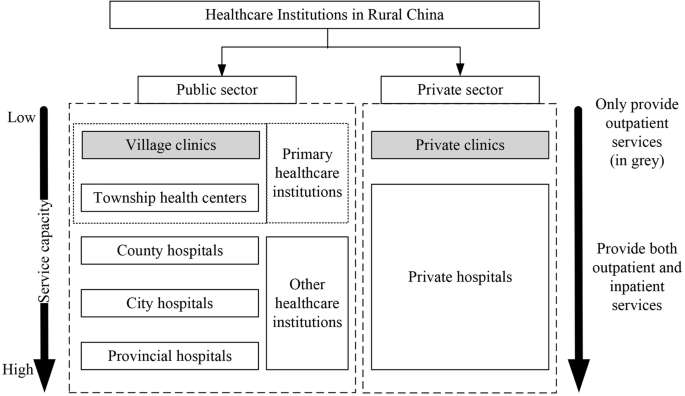
Note: Village clinics and Township Health Centers (THCs) are categorized as primary healthcare institutions that undertake both basic medical care and public health services; village clinics and private clinics (in gray) do not provide inpatient service while the others provide both outpatient and inpatient service; other healthcare institutions in the public sector include different types of specialized public health institutions such as emergency centers.
To assess spatial access to healthcare resources based on healthcare-seeking behavior in Enshi, the locations of all healthcare institutions were extracted from one of the most comprehensive open geospatial datasets in China, Baidu Map Points of Interest (POI) (Li et al., 2019a, b). The POI dataset includes drugstores, clinics, THCs, and hospitals, and we extracted the locations of all hospitals and THCs. However, in the POI dataset, a considerable percentage of village clinics was missing (only 251 village clinics were recorded in the POI dataset while the statistical yearbook recorded that in 2018 there were 2,327 village clinics in Enshi). Thus, we imputed these data with the locations of village administrative centers since village clinics are almost always located adjacent to village committees in rural China.
Analysis procedures
First, healthcare-seeking behaviors for outpatient and inpatient services were identified through self-reported healthcare utilization experiences. To assess differing needs for healthcare resources, the utilization frequencies of healthcare institutions for both outpatient and inpatient visits were analyzed separately for the impoverished and non-impoverished populations. The choice of healthcare institutions for outpatient and/or inpatient needs was then analyzed and incorporated with the answers to our open-ended question to reveal their healthcare institution preferences. The transportation modes and travel times were summarized to reveal the geographical impendence that patients would need to overcome for each type of healthcare institution. Calculations were executed using R 4.2.0 software.
Second, disparities between impoverished and non-impoverished populations were analyzed. For both outpatient and inpatient healthcare needs, the visiting frequency disparity between impoverished and non-impoverished populations was compared. Then a Chi-square test was utilized to compare the health-seeking behaviors between impoverished and non-impoverished populations in three respects, namely healthcare institution type, transportation mode, and average travel time. Calculations were executed using R 4.2.0 software.
Finally, spatial access to inpatient and outpatient services was assessed using Baidu Map data. In accordance with the “service circle” concept (The People’s Government of Hubei Province, 2021), the nearest-neighbor method (i.e., the shortest travel time to providers) was utilized to measure spatial access to healthcare resources in this study. In the first step, theoretical service areas were generated for all healthcare institutions, which were shown as circles centering on different types of healthcare institutions calculated using ArcGIS 10.5 software and the service area function. Area (e.g., possible resident locations) located within the service circle of each type of healthcare institution indicated the capability to receive timely healthcare services provided by that type of healthcare institution. Taking different types of healthcare institutions as centers, the corresponding radius was a fixed length straight line (Euclidean distance) set based on transportation mode and average travel time revealed from the previous analysis of healthcare-seeking behaviors, with travel speed set at 4 km/h for walking, 10 km/h for bicycling, and 30 km/h for driving. The results may not be entirely accurate (i.e., travel from origin to destination by straight line) but are still representative because Euclidean distance has been shown to highly correlate with actual travel distances along the road network including walking, bicycling, and driving distances (Li et al., 2019). In the second step, more accurate real-life travel times to two types of healthcare institutions (THCs and hospitals) were generated for every resident point (e.g., village administrative centers, such that in this study there was only one travel time for every village) using Baidu API (e.g., Application Programming Interface; https://lbsyun.baidu.com/), which is the most widely utilized navigation APP in China with the most up-to-date road network. However, from the supply side, the real-life travel time to village clinics could not be calculated because for every village the village administrative center overlapped with the village clinic location (see section “Data sources and pretreatment”). Further, from the demand side, only countable village administrative centers were included instead of all possible resident locations in the first step. Due to data availability (e.g., the spatial distribution of village clinics was unavailable) and calculation capacity (calculation of real-life travel time from origins to destinations using Baidu API has frequency limits), results from the two steps were incorporated to analyze spatial access to inpatient and outpatient services in Enshi.
Results
Healthcare-seeking behavior of outpatient visits
In total, 801 hypertension and/or diabetes patients were included in our survey, and about 33% were officially classified as being part of the impoverished population. The impoverished and non-impoverished population included in this study showed no significant disparity in demographic characteristics (e.g., gender, ethnicity, and age) nor lifestyle characteristics such as smoking and drinking habits (Hu et al., 2021), as shown in Table S1.
In general, most participants (~70%) had no outpatient visits in the month prior to our survey. Of the remaining participants who had 1–10 outpatient visit(s) each (453 outpatient visits total), a disproportionate amount (43.5%) was contributed by the impoverished population (only 33.1% of the population). The percentage of participants decreased as outpatient visit frequency increased (Table 1 & Supplemental Table S2), consistent for both the impoverished and non-impoverished populations. Yet, the outpatient visit frequency for the impoverished population was higher than for the non-impoverished population (P = 0.03), and the disparity between the two population groups increased along with outpatient visit frequency (Table 1).
Among the 453 outpatient visits, most (76.6%) occurred in village clinics, followed by THCs (7.7%) and in-county public hospitals (6.2%). These results were consistent with our respondent answers to the open-ended question “when experiencing a minor sickness, where would you go for treatment,” in which 341 participants (42.6%) chose to “see a doctor”, with about 86% of these choosing village clinic doctors (Table 1 & Supplemental Tables S3 and S4). Categorized into 4 types (Table 1), the choice of healthcare institution for outpatient visits showed no significant difference between the impoverished and non-impoverished population with P = 0.20. For the impoverished population, the proportion visiting village clinics was 77.7% compared with 75.8% for the non-impoverished population. Meanwhile, private clinics and hospitals outside of the residential counties (categorized in other healthcare institutions in Table 1 and listed separately in Supplemental Table S3) received no outpatient visits from the impoverished population, but 4.7% of outpatient visits from the non-impoverished population. Categorizing healthcare institutions into eight types (Table S3), the difference was significant with P < 0.001 (due to missing data the Fisher test was utilized). These results were largely consistent with survey respondent-expressed preferences for which healthcare institution they would choose for minor sickness outpatient visits, with 86.2% of respondents preferring to visit village clinics for minor sickness outpatient services.
Taking all healthcare institutions into consideration, the most utilized transportation mode for outpatient visits was walking (69.3%), followed by driving (10.6%) and bicycling (4.9%), with a large portion choosing “other” modes (15.2%; Table 1). In general, patients tended to drive or use “other” transportation mode to access higher-level healthcare institutions (e.g., all types of hospitals) but overwhelmingly chose to walk to lower-level healthcare institutions including village clinics (83.9%) and THCs (45.7%; Supplemental Table S5). The transportation modes utilized by the impoverished and non-impoverished outpatient populations differed significantly (P = 0.04), with the impoverished tending to walk or utilize “other” transportation modes more for outpatient visits, while the non-impoverished tended to drive or bicycle more (Table 1).
The average travel time to reach village clinics, THCs, and public hospitals within the residential counties for both impoverished and non-impoverished populations is shown in Table 1. Travel times for all healthcare institutions are included except for “other” healthcare institutions, due to their limited number of outpatient visitors. The general average travel time to all healthcare institutions for outpatient services showed no significant difference for the impoverished and non-impoverished populations (P = 0.32), but this result would be misleading if not assessed by institution type. For example, the average travel time that the impoverished population spent to reach THCs (30.83 min) was significantly longer than the non-impoverished (17.22 min) with a P-value of 0.04. The overall longer average travel time for outpatient visits reported by the non-impoverished was mostly due to their more frequently choosing to travel farther to in-county hospitals.
Healthcare-seeking behavior of inpatient visits
Among the survey participants, 41.1% had at least one inpatient visit in the preceding year (from May 2018 to April 2019), with about 11% reporting two or more inpatient visits. Although the inpatient visit frequency for the impoverished population showed no significant difference with the non-impoverished, the percentage of the impoverished population with three or more inpatient visits in the previous year (5.6%) was more than twice that of the non-impoverished population (2.8%; Table 2 & Supplemental Table S6).
A total of 461 inpatient visits were reported in the previous year, with 37.1% contributed by the impoverished population. Among the specific types of healthcare institutions where inpatient visits occurred, public hospitals within residential counties received the most (43.6%), followed by THCs (34.7%), and provincial/city hospitals outside residential counties (18.4%). In general, the non-impoverished population tended to choose higher-level healthcare institutions for inpatient care (P < 0.001). For example, the plurality of impoverished inpatient visits went to THCs (45.6%), followed by public hospitals within residential counties (39.8%) and provincial/city hospitals outside the residential county (11.7%). In contrast, for the non-impoverished, the largest portion of inpatient visits occurred in public hospitals within residential counties (45.9%), with just 28.3% occurring at THCs. The percentage of non-impoverished inpatients choosing provincial/city hospitals outside their residential counties (22.4%) was almost twice that of impoverished inpatients (Table 2 and Supplemental Table S7).
Regarding transportation modes utilized to reach healthcare institutions for inpatient visits, driving was the most utilized (49.2%), followed by “other” (32.5%). In general, higher-level healthcare institutions received a higher portion of inpatient visits facilitated by driving (Supplemental Table S8). The percentage of impoverished respondents who drove (49.7%), walked (17.0%), or bicycled (4.7%) to obtain inpatient care showed no significant difference with those in the non-impoverished population (49.0%, 14.5%, and 1.7%, respectively, P = 0.20), but comparatively, they were less likely to utilize “other” transportation modes to obtain inpatient care (28.6% versus 34.8%; Table 2).
Across all types of healthcare institutions, the average travel time spent to access inpatient services was found to be approximately an hour, and no significant difference was found between the impoverished (61.45 min) and non-impoverished (62.77 min, P = 0.82). However, being the most possibly utilized inpatient healthcare institution for the impoverished, the average travel time to access THCs was significantly longer for the impoverished population (34.59 vs. 25.04 min, P = 0.02). Although no significant difference was found between the impoverished and non-impoverished for accessing public hospitals within residential counties (64.51 vs. 47.70 min, P = 0.34), and provincial/city hospitals outside residential counties (172.22 vs. 132.06 min, P = 0.51), they showed the same trend. The longer average travel time overall for the non-impoverished population was due to their higher preference to travel to higher-level healthcare institutions located farther away (Table 2 & Supplemental Table S8).
Spatial access to healthcare resources
Based on Baidu POI, we identified 39 hospitals and 113 THCs, which was consistent with the number of healthcare institutions listed in the statistical yearbook of Enshi for 2018 (Enshi Prefecture Statistics Bureau, 2019). The number of village clinics listed in the yearbook was 2327, but only 251 village clinics were recorded in the Baidu POI dataset. Comparatively, the 2567 village centers identified using Baidu POI were more representative of the spatial distribution of village clinics. Thus, village administrative centers were identified as the central points of residents in each village, as well as the location of village clinics in this study. The healthcare institution and resident point distributions are shown in Fig. 3.

Healthcare providers included hospitals, township health centers, and village clinics, village administrative centers represented both the location of village clinics and population centers, and healthcare seeking occured along the road network (2019).
Based on the healthcare-seeking behavior analysis, participants were generally willing to spend about 30 min to seek outpatient services in village clinics, THCs, and hospitals, and drive for up to 30 min to THCs and 60 min to hospitals for inpatient services. The willingness of participants bicycling to seek outpatient/inpatient services was low. Considering that walking was the slowest transportation mode and driving was the fastest, the travel time to access healthcare services under the transportation mode of bicycling and others should be between the range of walking and driving. Nevertheless, only spatial accessibility under the transportation modes of walking and driving was displayed in this study.
The service areas of the three most utilized types of healthcare institutions are shown in Fig. 4A, D using Euclidean distances calculated with the average travel speed of the above-mentioned transportation modes and travel times to reveal all possible under-served areas. More accurate real-life travel times needed for residents to access THCs and hospitals from village centers were calculated using Baidu API, and the results are shown in Fig. 4B, C, E, F and Table 3. As village clinics are typically quite close to village centers, travel times from village centers to village clinics were not calculated.

A Spatial coverage of village clinics, township health centers (THCs), and hospitals for outpatient visits based on Euclidean distance calculated with an average travel speed of walking at 4 km/h and travel time of 30 min which was the most common scenario for outpatient visits in this study. Real-life shortest travel times along the road network by walking from every village administrative center (also usually the population center) to THCs (B) and hospitals (C) were further calculated using Baidu API. D Spatial coverage of THCs and hospitals for inpatient visits based on Euclidean distance calculated with average travel speed of driving at 30 km/h and travel time of 30 min for THCs/ 60 min for hospitals which was the most common scenario for inpatient visits in this study. Real-life shortest travel times along road network by driving to THCs (E) and hospitals (F) were further calculated using Baidu API. The scenarios of bicycling or using other transportation modes were not displayed but are assumed to be between the best scenario of driving and the worst scenario of walking.
In terms of timely access to outpatient services, village clinics made the greatest contribution while areas covered by THCs and hospitals within 30 min’ walk generally overlapped with the village clinics’ coverage areas (Fig. 4A). In general, 75.2% of Enshi’s area fell within 30 min’ walk from village clinics, with the highest coverage found in Enshi City, as well as Jianshi and Badong counties, and lowest coverage in Lichuan City and Hefeng County. Based on real-life travel time, only 47 villages were located within a 15-min walk to THCs, and an additional 50 villages were located within a 30-min walk to THCs. Meanwhile, only nine villages were found to be located within a 15-min walk to hospitals, with 16 additional villages located within a 30-min walk to hospitals. Most village residents must spend more than 2 h walking to THCs and hospitals.
In terms of timely access to inpatient services, THCs made the greatest contribution. Most of Enshi Prefecture’s area (93.8%) was within a 30-min drive from THCs, while 79.2% of the area was within a 60-min drive to hospitals, except for the boundary areas between Lichuan City and Xianfeng County, as well as Jianshi and Badong counties (Fig. 4D). Based on real-life travel time, almost 62% (1584) of the villages were able to access THCs within a 30-min drive, while only 141 villages required spending more than an hour driving to a THC. Nevertheless, only 418 villages were able to access hospitals within a 30-min drive, with another 900 villages able to obtain hospital services within 1 h. Furthermore, there were 274 villages outside a 2-h driving range to reach a hospital (Table 3).
Discussion
Being part of a rural primary healthcare project seeking to improve primary healthcare and support poverty alleviation in rural China, results from this study show that more targeted plans of healthcare resource investment are necessary to improve both general accessibility and equity between different population groups obtaining healthcare services.
Healthcare resource allocation needs improvement
Taking Enshi Prefecture as a pilot study area, the results show that most of the population preferred to obtain outpatient services via the most widespread but lowest-level village clinics and inpatient services through THCs and public hospitals within their residential counties. Walking was the most common transportation mode for obtaining outpatient services while driving and “other” were the most common modes for inpatient visits. On average, the travel time for outpatient visits was about 30 min to reach village clinics, while for inpatient visits 30 min were required to reach THCs and 60 min to reach the hospitals within residential counties.
Based on our analysis, the wide distribution of village clinics made the most significant contribution to facilitating outpatient visits, but there remains room for improvement. More than 75% of outpatients went to village clinics for treatment (Table 1), but more than 85% of participants reported that village clinics would be their first choice for treating minor sickness. In 2018, there were 2,327 village clinics distributed across 2312 villages, which surpassed the goal of having one village clinic per village. Yet, only about 75% of Enshi Prefecture’s area falls within the range of a 30-min walk to a village clinic (Fig. 4). In the context of the “service circle” concept being repeatedly highlighted by the Central Government of People’s Republic of China in recent years, pilot activities in individual administrative regions with comparatively good development conditions have been implemented and provide empirical experience for the remaining administrative regions. For example, Shanghai proposed the “15-min community service circle” policy, intending all types of public services to be reachable within a 15 min walk (The People’s Government of Shanghai, 2021), and it is being promoted widely in urban areas across China. The Hainan government proposed “30-min to primary care in rural areas and 15-min to primary care in urban areas” policy (The People’s Government of Hainan Province, 2018, 2015), which has been highly praised by the NHC. With the concept of a “15-min community healthcare service circle” policy having already been accepted and proposed by The People’s Government of Hubei Province (2021), the benchmarking of 30-min to primary healthcare in rural areas may also be realized. By contrast, the travel time spent to reach village clinics in Enshi Prefecture remains too long. It is worth noting that village centers were identified as village clinics due to data availability, so the results from this study might differ from the real-life situation. Nevertheless, this study still has great reference value because of the “one village clinic per village” policy, the small administrative area of each village, and the clustering trend to the most developed area for both village administrative centers and village clinics.
As the core infrastructure for the rural healthcare delivery system in China (Wang et al., 2018), THCs have played a pivotal role in ensuring the provision of inpatient services at the primary healthcare level, but their distribution must be further optimized to meet patient needs. While 93.8% of Enshi’s area fell within a 30-min service circle (Euclidean distance) from THCs, the real-life travel model along the road network indicated that only about 62% of the villages were located within a 30-min drive from THCs, with 95% being within a 60-min drive. Since hospitals usually cluster around county seats, it was not surprising that the real-life travel model found that only half of the villages (51.4%) were located within a 60-min drive of hospitals, with another 38.0% of the villages located within a 1- or 2-h drive of hospitals. In contrast, in 2018, only 10% of the population on Hainan Island lived further than 1 h from the nearest hospital and 19% lived further than 30 min from the nearest THCs (Wang et al., 2021). Despite longer travel times to obtain inpatient services, patients still preferred visiting hospitals over THCs, but this preference seemed to increase along with economic status. Consequently, the service capacities of THCs must be improved to meet patient demands for inpatient services across different regions, and hospital infrastructure must also be further enhanced in less-developed areas.
Access to healthcare services for impoverished populations needs additional attention
Regarding the general inefficiency of healthcare resource allocation in Enshi, disparities exist between the impoverished and non-impoverished in terms of their selection of healthcare institutions and transportation modes, as well as travel time. Even within the same healthcare environment, impoverished population groups may not be able to access timely and qualified healthcare services equally. Our findings indicate that the disease burden on the impoverished population was heavier than that on the non-impoverished population. In general, impoverished residents accounted for approximately 33% of the sample population, but they contributed 43% of the outpatient visits and 37% of the inpatient visits. The frequencies of obtaining outpatient and inpatient services were also higher for the impoverished population.
Compared with the non-impoverished population, the impoverished population tended to choose a narrower range of healthcare institution types for obtaining medical services, which were also lower-level. For example, the majority of the non-impoverished population preferred to seek inpatient healthcare services from hospitals, while most of the impoverished preferred THCs. This is likely due to two primary reasons: (i) medical expenditure and (ii) travel burdens associated with accessing healthcare institutions. According to a series of price-regulation policies in China (Chen and Pan, 2019), both medical prices and medical reimbursement benchmarks are set up at different rates based on each level of healthcare institution. As a result, impoverished residents often have comparatively limited options for which type of healthcare institution they can afford to obtain healthcare services. Moreover, since the impoverished populations tend to be clustered in rural areas farther away from the county seats where most higher-level healthcare institutions are located, they tend to experience an increased travel burden to access these healthcare institutions than the non-impoverished populations, both in terms of increased travel time and expenses incurred during transit.
The transportation modes adopted by Enshi’s impoverished population also tended to be less convenient with longer travel times. In terms of obtaining outpatient services, the reason that the non-impoverished population had a greater likelihood of driving and an overall longer average travel time (across all transportation modes) was that they tended to select higher levels of healthcare institutions located farther away. A considerable percentage of the impoverished population chose to drive to obtain inpatient services, which can be explained by the poorly constructed transportation systems in rural areas, which force impoverished residents to use cars instead of public transportation, especially when experiencing severe symptoms. The average travel times spent to access different types of healthcare institutions appeared to contribute to the type of healthcare institution Enshi’s impoverished residents chose to utilize, in that the greater travel times and distances to the higher-level healthcare institutions decreased their likelihood of traveling there.
Recommendations for local resource investment
To promote timely access to healthcare services and narrow the gap between impoverished and non-impoverished populations in Enshi, four recommendations are here proposed, based on the results from this study as well as information collected during the survey from residents, local officers, and consultant researchers. (1) Work to fully utilize new healthcare service provision techniques such as information technologies to improve healthcare service capacity, delivery efficiency, and spatial coverage of existing village clinics, especially in sparsely populated remote areas. (2) More accurately clarify the responsibility of THCs in China’s rural healthcare delivery system and promote the improvement of service capacity accordingly. (3) Accelerate the construction of regional healthcare sub-centers, including the construction of branch hospitals and upgrading of existing THCs, to shorten the travel time for obtaining hospital services. (4) Optimize other public services or policies that potentially affect residents’ accessibility to healthcare services, such as providing flexible village bus schedules (improving public transportation) to meet the demand of impoverished populations in rural areas for traveling to distant higher-level healthcare institutions.
Implications for health equity promotion
Although a global consensus has emerged that equal access to healthcare resources is fundamental for health equity (Li et al., 2017), disparities in healthcare-seeking behaviors between different population groups have not been fully considered. Consequently, evaluation of results may not be accurate to optimize healthcare service provision. We, therefore, recommend that comparative studies based on different population groups with more detailed data spanning larger areas be carried out to better reveal the deeper mechanisms of vulnerability and accessibility to healthcare resources and the resulting health status, as well as to provide more empirical evidence for the progress of SDGs. For example, this study focused on populations with chronic Non-Communicable Diseases because such diseases pose major challenges for China’s healthcare system as well as the impoverished populations, thus requiring focused research and targeted recommendations on resource optimization. However, the average healthcare needs of the population segment with chronic Non-Communicable Diseases (0.57 outpatient visits/month; 0.58 inpatient visits/year) was higher than both the local average in Enshi (0.39 outpatient visits/month; 0.18 inpatient visits/year) (Enshi Prefecture Statistics Bureau, 2019) and the national average (Wang et al., 2021). Thus, more generalized empirical evidence is needed to reveal the extent of vulnerability of the impoverished population in accessing healthcare services.
Further, modifications are necessary for specified research topics because results from this study may not be fully applicable in other regions. Considering the diverse ethnic cultures and social patterns that have been formed over a long period of time, the impoverished populations living in different regions of China may encounter dissimilar challenges in assessing healthcare services, and further discrepancies might exist at different spatial scales of analysis (Balsa-Barreiro et al., 2022). However, the methodology adopted in this study, which assesses the reasonability of healthcare resource allocation based on healthcare-seeking behavior, should be adopted elsewhere to support more targeted and precise recommendations for healthcare resource allocation and policy-making appropriate for unique local circumstances. The development of new spatial accessibility measurement models incorporating population group composition and respective healthcare-seeking behaviors is also recommended to assess the reasonability of healthcare resource allocation more accurately. Additionally, corresponding government interventions should be evaluated to generate successful experiences to accelerate the progress of SDGs.
Limitations
One limitation inherent in this study is that both individual and contextual level factors, such as medical insurance status, religious affiliations, and educational level, could potentially affect healthcare-seeking behaviors, but these factors were excluded for analysis due to their complex correlation with impoverished status and data availability. We, therefore, recommend the implementation of Andersen’s behavior model (Hu et al., 2021) based on integrated research to help address this concern in the future. Another limitation was that the composition of impoverished and non-impoverished residents in different regions was not available, so we were unable to parse out respective spatial access to various types of healthcare institutions for the impoverished and non-impoverished residents and further analyze how to optimize healthcare resources to narrow the gap between them. Moreover, with this project’s focus on village revitalization, the impoverished population in cities, who may have different healthcare-seeking preferences and obstacles in accessing healthcare, were not considered in this study.
Conclusion
In this study, we analyzed the general healthcare-seeking behaviors of both Enshi Prefecture’s impoverished and non-impoverished populations based on self-reported data, with spatial access to outpatient and inpatient healthcare resources across Enshi Prefecture obtained from an open dataset (Baidu Map). The reasonability of healthcare resource allocation was evaluated in contrast with the goals set by governmental policies while providing recommendations for future investments. The healthcare-seeking behaviors identified by this study can be used to set spatial accessibility parameters to more accurately evaluate the allocation of different types of healthcare resources across China, with implications for policy-making and to inform future healthcare resource allocations at various scales and levels of government. In attempting to address issues embedded in the process of poverty alleviation within the particular context of China’s healthcare system, the huge hindrance imposed on impoverished residents in the process of seeking both inpatient and outpatient medical services was highlighted. Based on our findings, it is highly recommended that the healthcare-seeking behavior patterns of impoverished residents identified in this study be incorporated into future policy-making procedures aimed at poverty alleviation in the context of China’s healthcare system. It is also recommended to carry out similar studies focusing on vulnerable groups in larger areas and with more detailed data, which would support the progress of SDGs.
Data availability
Self-reported healthcare utilization data and preference for healthcare-seeking data were collected through a self-conducted survey and are currently not publicly available, but can be accessed upon reasonable request to the authors and with permission from the China National Health Commission which implemented the survey. Healthcare institution data were extracted from open data sources including governmental yearbooks and Baidu Map. Real-life travel time along the road network was calculated using the Baidu Map.
References
Ahmed S, Adams AM, Islam R, Hasan SM, Panciera R (2019) Impact of traffic variability on geographic accessibility to 24/7 emergency healthcare for the urban poor: a GIS study in Dhaka, Bangladesh. PLoS One 14. https://doi.org/10.1371/journal.pone.0222488
Balsa-Barreiro J, Ambuhl L, Menendez M, Pentland AS (2019) Mapping time-varying accessibility and territorial cohesion with time-distorted maps. IEEE Access 7(1)):41702–41714. https://doi.org/10.1109/ACCESS.2019.2907687
Balsa-Barreiro J, Hannoun GJ, Batista S, Menéndez M (2023) Analysis of travel-time accessibility to healthcare facilities at the regional scale: a case study of Galicia, Spain. 102nd Transportation Research Board (TRB) Annual Meeting, Washington DC, USA, Jan 08–12
Balsa-Barreiro J, Menendez M, Morales AJ (2022) Scale, context, and heterogeneity: the complexity of the social space. Sci Rep. 12. https://doi.org/10.1038/s41598-022-12871-5
Beaglehole R, Bonita R (2016) Economists, universal health coverage, and non-communicable diseases. Lancet 387:848. https://doi.org/10.1016/S0140-6736(16)00510-9
Chen C, Pan J (2019) The effect of the health poverty alleviation project on financial risk protection for rural residents: evidence from Chishui City, China. Int J Equity Health 18. https://doi.org/10.1186/s12939-019-0982-6
Chen T, Pan J (2020) The effect of spatial access to primary care on potentially avoidable hospitalizations of the elderly: evidence from Chishui City, China. Soc Indic Res. https://doi.org/10.1007/s11205-020-02413-9
Clark H (2013) NCDs: a challenge to sustainable human development. Lancet 381:510–511. https://doi.org/10.1016/S0140-6736(13)60058-6
Enshi Prefecture Statistics Bureau (2019) Enshi Statistical Yearbook [WWW Document]. URL http://www.enshi.gov.cn/sj/tjnj/ (accessed 21 Oct 2021)
Gu X, Zhang L, Tao S, Xie B (2019) Spatial accessibility to healthcare services in metropolitan suburbs: The case of Qingpu, Shanghai. Int J Environ Res Public Health 16. https://doi.org/10.3390/ijerph16020225
Guagliardo MF (2004) Spatial accessibility of primary care: Concepts, methods and challenges. Int J Health Geogr 3:1–13. https://doi.org/10.1186/1476-072X-3-3
Hu H, Jian W, Fu H, Zhang H, Pan J, Yip W (2021) Health service underutilization and its associated factors for chronic diseases patients in poverty-stricken areas in China: a multilevel analysis. BMC Health Serv Res 21:707. https://doi.org/10.1186/s12913-021-06725-5
Jan S, Laba TL, Essue BM, Gheorghe A, Muhunthan J, Engelgau M, Mahal A, Griffiths U, Mclntyre D, Meng Q, Nugent R, Atun R (2018) Action to address the household economic burden of non-communicable diseases. Lancet 391:2047–2058
Kumar K, Singh A, Kumar S, Ram F, Singh A, Ram U, Negin J, Kowal PR, Nugent RA (2015) Socio-economic differentials in impoverishment effects of out-of-pocket health expenditure in China and India: Evidence from WHO SAGE. PLoS One 10. https://doi.org/10.1371/journal.pone.0135051
Kuupiel D, Adu KM, Bawontuo V, Adogboba DA, Mashamba-Thompson TP (2019) Estimating the spatial accessibility to blood group and rhesus type point-of-care testing for maternal healthcare in Ghana. Diagnostics 9. https://doi.org/10.3390/diagnostics9040175
Li H, Wei YD, Wu Y, Tian G (2019a) Analyzing housing prices in Shanghai with open data: Amenity, accessibility and urban structure. Cities 91:165–179. https://doi.org/10.1016/j.cities.2018.11.016
Li J, Li J, Yuan Y, Li G (2019b) Spatiotemporal distribution characteristics and mechanism analysis of urban population density: A case of Xi’an, Shaanxi, China. Cities 86:62–70. https://doi.org/10.1016/j.cities.2018.12.008
Li X, Lu J, Hu S, Cheng KK, De Maeseneer J, Meng Q, Mossialos E, Xu DR, Yip W, Zhang H, Krumholz HM, Jiang L, Hu S (2017) The primary health-care system in China. Lancet 390:2584–2594. https://doi.org/10.1016/S0140-6736(17)33109-4
Li L, Du Q, Ren F, Ma X (2019) Assessing spatial accessibility to hierarchical urban parks by multi-types of travel distance in Shenzhen, China. Int J Environ Res. Public Health 16. https://doi.org/10.3390/ijerph16061038
Li Y, Wu Q, Liu C, Kang Z, Xie X, Yin H, Jiao M, Liu G, Hao Y, Ning N (2014) Catastrophic health expenditure and rural household impoverishment in China: What role does the new cooperative health insurance scheme play? PLoS One 9. https://doi.org/10.1371/journal.pone.0093253
Lin Y, Wimberly MC, Da Rosa P, Hoover J, Athas WF (2018) Geographic access to radiation therapy facilities and disparities of early-stage breast cancer treatment. Geospat Health 13:93–101. https://doi.org/10.4081/gh.2018.622
Liu Y, Kong Q, Yuan S, Van De Klundert J (2018) Factors influencing choice of health system access level in China: a systematic review. PLoS One 13:1–21. https://doi.org/10.1371/journal.pone.0201887
McGrail MR, Humphreys JS (2014) Measuring spatial accessibility to primary health care services: utilising dynamic catchment sizes. Appl Geogr 54:182–188. https://doi.org/10.1016/j.apgeog.2014.08.005
NHC (2016) Guidelines on the implementation of health poverty alleviation projects [WWW Document]. Natl. Heal. Comm. People’s Repub. China. URL http://www.cpad.gov.cn/art/2016/6/20/art_1747_682.html (accessed 21 Oct 2021)
NRRB (2020) List of 832 national poverty counties [WWW Document]. Natl. Rural Revital. Bur. URL http://www.cpad.gov.cn/art/2020/10/16/art_343_1140.html (accessed 21 Oct 2021)
Nugent R, Bertram MY, Jan S, Niessen LW, Sassi F, Jamison DT, Pier EG, Beaglehole R (2018) Investing in non-communicable disease prevention and management to advance the sustainable development goals. Lancet 391:2029–2035. https://doi.org/10.1016/S0140-6736(18)30667-6
P. R. China: State Council (2015) Decision on winning the fight against poverty [WWW Document]. URL http://www.gov.cn/gongbao/content/2015/content_2978250.htm (accessed 21 Oct 2021)
Pan J, Zhao H, Wang X, Shi X (2016) Assessing spatial access to public and private hospitals in Sichuan, China: The influence of the private sector on the healthcare geography in China. Soc Sci Med170:35–45. https://doi.org/10.1016/j.socscimed.2016.09.042
Tan X (2012) The study on occurrence mechanism of mountainous rural poverty-Based on the empirical study of Enshi state. Nanjing University
Tao Z, Cheng Y (2019) Modelling the spatial accessibility of the elderly to healthcare services in Beijing, China. Environ Plan B Urban Anal City Sci 46:1132–1147. https://doi.org/10.1177/2399808318755145
Tao Z, Cheng Y, Liu J (2020) Hierarchical two-step floating catchment area (2SFCA) method: measuring the spatial accessibility to hierarchical healthcare facilities in Shenzhen, China. Int J Equity Health 19. https://doi.org/10.1186/s12939-020-01280-7
The People’s Government of Hainan Province (2015) Plan on healthcare service system of Hainan Province (2015–2020) [WWW Document]. URL www.docin.com/p-1510044903.html (accessed 24 Dec 2020)
The People’s Government of Hainan Province (2018) Action plan for standardizational construction of primary healthcare institutions in Hainan Province [WWW Document]. URL http://www.hainan.gov.cn/hainan/szfbgtwj/201811/37479119e1d34c03934b8c0ce54dbf67.shtml (accessed 24 Dec 2020)
The People’s Government of Hubei Province (2021) Constructing “15-min community healthcare service circle” in Hubei Province [WWW Document]. URL https://www.gov.cn/xinwen/2021-11/25/content_5653326.htm (accessed 27 Jun 2024)
The People’s Government of Shanghai (2021) Implementation opinions on accelerating the planning and construction of the “New Town” during the 14th five-year period in Shanghai [WWW Document]. URL https://www.shanghai.gov.cn/nw12344/20210302/6c8561a91a67478899a5eb51aa612d78.html (accessed 21 Oct 2021)
UNDESA (2015) Global Sustainable Development Report: 2015 edition. UNDESA
United Nations (2015) Transforming our world: the 2030 agenda for sustainable development [WWW Document]. Resolut A/RES/70/1. URL https://www.un.org/en/ga/search/view_doc.asp?symbol=A/RES/70/1 (accessed 28 Oct 2021)
Wagstaff A (2002) Poverty and health sector inequalities. Bull World Health Organ 80:97–105. https://doi.org/10.1590/S0042-96862002000200004
Wang H, Zhao Q, Bai Y, Zhang L, Yu X (2020) Poverty and subjective poverty in rural China. Soc Indic Res 150:219–242. https://doi.org/10.1007/s11205-020-02303-0
Wang X, Yang H, Duan Z, Pan J (2018) Spatial accessibility of primary health care in China: a case study in Sichuan Province. Soc. Sci. Med. 209:14–24. https://doi.org/10.1016/j.socscimed.2018.05.023
Wang X, Pan J (2016) Assessing the disparity in spatial access to hospital care in ethnic minority region in Sichuan Province, China. BMC Health Serv. Res. 16. https://doi.org/10.1186/s12913-016-1643-8
Wang X, Seyler BC, Han W, Pan J (2021) An integrated analysis of spatial access to the three-tier healthcare delivery system in China: a case study of Hainan Island. Int J Equity Health 20. https://doi.org/10.1186/s12939-021-01401-w
World Bank (2017) World Development Indicators 2017 [WWW Document]. URL https://openknowledge.worldbank.org/handle/10986/26447
Yang G, Wang Y, Zeng Y, Gao GF, Liang X, Zhou M, Wan X, Yu S, Jiang Y, Naghavi M, Vos T, Wang H, Lopez AD, Murray CJL (2013) Rapid health transition in China, 1990–2010: findings from the Global Burden of Disease Study 2010. Lancet 381:1987–2015. https://doi.org/10.1016/S0140-6736(13)61097-1
Zhang L, Zhao Y (2021) Breaking the vicious cycle between illness and poverty: empirical actions on land use in an oasis agricultural area. Land 10. https://doi.org/10.3390/land10040335
Acknowledgements
The authors are grateful to the China National Health Commission for helping with data collection. This study was supported by the Bill and Melinda Gates Foundation (Grant No. OPP1178967), the National Natural Science Foundation of China (Grant Nos. 72204175, 71874116, 42071379, and 72074163), Sichuan Science and Technology Department (Grant Nos. 2022NSFSC0642, 2022YFS0052, and 2021YFQ0060), Sichuan Provincial Health Commission (Grant No. 21PJ067), the Ministry of Education of China (Grant No. 18YJA790062), Chongqing Science and Technology Bureau (cstc2020jscx-cylhX0001), Sichuan University (Grant Nos. 2019SCU12013 and YJ202157), and the Sichuan University Interdisciplinary Postdoc Innovation Fund. No funder was involved in study design, data collection or analysis, decision to publish, or preparation of the manuscript.
Author information
Authors and Affiliations
Contributions
XW, JP, and WY designed the study. XW and TC performed the data analysis. XW wrote the first draft with supervision from JP and BCS. JP, WJ, HF, and WY designed the data collection and had full access to all data involved in the study. BCS, WJ, HF, WY, and BD helped revise the draft. All authors contributed to the interpretation of data, revised the article critically for important intellectual content, and approved the final version of the manuscript.
Corresponding authors
Ethics declarations
Competing interests
The authors declare no competing interests.
Ethical approval
Ethical approval for collecting data on human subjects was received from the Medical Ethics Review Committee of Sichuan University (K2019012).
Informed consent
Written informed consent was obtained from all participants.
Additional information
Publisher’s note Springer Nature remains neutral with regard to jurisdictional claims in published maps and institutional affiliations.
Supplementary information
Rights and permissions
Open Access This article is licensed under a Creative Commons Attribution-NonCommercial-NoDerivatives 4.0 International License, which permits any non-commercial use, sharing, distribution and reproduction in any medium or format, as long as you give appropriate credit to the original author(s) and the source, provide a link to the Creative Commons licence, and indicate if you modified the licensed material. You do not have permission under this licence to share adapted material derived from this article or parts of it. The images or other third party material in this article are included in the article’s Creative Commons licence, unless indicated otherwise in a credit line to the material. If material is not included in the article’s Creative Commons licence and your intended use is not permitted by statutory regulation or exceeds the permitted use, you will need to obtain permission directly from the copyright holder. To view a copy of this licence, visit http://creativecommons.org/licenses/by-nc-nd/4.0/.
About this article

Cite this article
Wang, X., Seyler, B.C., Chen, T. et al. Disparity in healthcare seeking behaviors between impoverished and non-impoverished populations with implications for healthcare resource optimization. Humanit Soc Sci Commun 11, 1208 (2024). https://doi.org/10.1057/s41599-024-03712-z
Received:
Accepted:
Published:
Version of record:
DOI: https://doi.org/10.1057/s41599-024-03712-z
This article is cited by
-
Determinants of treatment success and cost implications in MDR/RR-TB patients: a prospective cohort study in China
Scientific Reports (2025)
-
Nexus among health expenditures, ICTs and sustainable economic growth: Insights from South Asian Nationals health and economic issues
The European Journal of Health Economics (2025)
-
Employment Status And Health Among Rural-to-Urban Migrants In China: Evidence From the China Migrants Dynamic Survey
Social Indicators Research (2025)
