
Thank you for visiting nature.com. You are using a browser version with limited support for CSS. To obtain the best experience, we recommend you use a more up to date browser (or turn off compatibility mode in Internet Explorer). In the meantime, to ensure continued support, we are displaying the site without styles and JavaScript.

Volume 2 Issue 12, December 2025

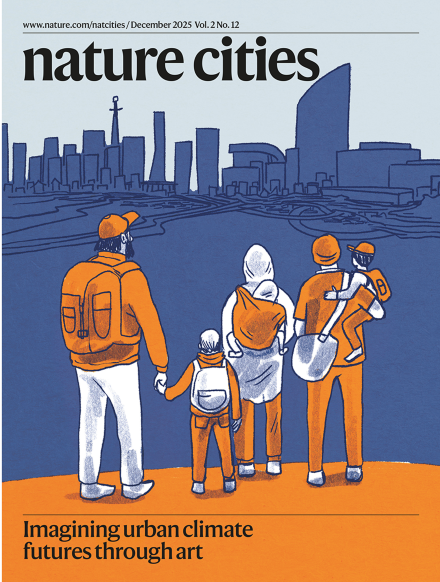
Imagining urban climate futures through art

What does climate adaptation look like in the minds of those shaping our cities? Lorono and colleagues turn to art to find out, inviting local actors worldwide to imagine their urban futures in the face of climate change. What unfolds is a diverse mosaic of adaptation conceptions, shaped by individual perspectives and local contexts.

See Lorono

Image: Josune Urrutia. Cover design: Lauren Heslop
Editorial

  • Cities remain under pressure, given world events and global change. This issue of Nature Cities highlights ways in which they struggle to find balance, what balance might look like and how cities are wayfinding through this often-surreal terrain.

    Editorial

    Advertisement

Top of page ⤴

Comment & Opinion

  • By seeing cities through the lens of video games, we not only discover how charming virtual worlds are constructed from real urban elements but also glimpse how the virtual might reshape our understanding — and perhaps our design — of the real.

    • Haochen Shi
    World View
  • The authors discuss the challenges of curbing land take and the complexity of achieving the net-zero limit. They call for a shift in perspective beyond the restrictive logic of traditional land-use planning and suggest that the regenerative potential of cities be unleashed.

    • Mathias Jehling
    • Tobias Krüger
    • Diego Rybski
    Comment
  • China’s progress in the improvement of air quality masks a widening gap: its heavily polluted, industrial border cities bear a disproportionate health and economic burden, which demands urgent policy shifts to avoid deepening environmental injustice.

    • Xianmang Xu
    • Peiyu Zhao
    • Jin Wang

    Collections:

    Comment
Top of page ⤴

Research Highlights

Top of page ⤴

Reviews

  • Urban digital twins rely on static sensors and miss dynamic human and socioeconomic dimensions. Integrating anonymized mobile crowd data provides real-time, context-rich insights that improve accuracy, responsiveness and citizen co-creation.

    • Yujie Zhang
    • Yanchuan Yin
    • Guodong Sun
    Review Article
Top of page ⤴

Research

  • Urban blue spaces, such as lakes and rivers, play growing roles in cities but are historically vital for providing food. Focusing on four Indian cities, this study finds diverse blue foraging practices most practiced by elderly women, especially among the most disadvantaged groups.

    • Sukanya Basu
    • Brenda Maria Zoderer
    • Tobias Plieninger
    Article Open Access
  • Car usage and attendant impacts continue to grow as cities expand worldwide. This study finds that European cities, especially medium and large ones, with metros have substantially lower car dependency.

    • Rafael Prieto-Curiel
    Article
  • Cities often manage food waste and wastewater separately, missing recovery synergies. Across 29 cities, urban biowaste flux identifies an ~50 kg of moisture per person per year threshold above which sewer integration lowers the net costs. Optimized city-specific strategies, including integration where beneficial, can cut emissions by up to 69% versus current separate systems.

    • Xu Zou
    • Zi Zhang
    • Guanghao Chen
    Article
  • Cities are engines of innovation and economic growth, but they also struggle with segregation, which works against both. This study finds rings of isolation around US cities and pockets of segregation within them, a pattern persistent over time and intensified since the pandemic.

    • Andrew Renninger
    • Neave O’Clery
    • Elsa Arcaute
    Article Open Access
  • Heatwaves pose a growing threat to cities, and vegetation is often touted as a mitigation option. This study finds that while lawns provide a burst of intense cooling, trees access deeper water and provide moderate but more prolonged relief.

    • Tao Fang
    • Weiting Hu
    • Guo Yu Qiu
    Article
  • Urban heat islands and rising cooling demands highlight the need for sustainable nature-based solutions. A meta-analysis of 373 studies shows nature-based solutions cut daytime temperatures by 2.04 °C and cooling loads by 1.32%, with green infrastructure being the most effective across most climates.

    • Hailu Wei
    • Xiaohang Bai
    • Yilong Han
    Article
  • City parks clearly promote health, but understanding the distribution of healthful park elements and spaces is challenging. This study scored thousands of parks across 35 major cities worldwide and found that North American parks emphasize physical activity, European parks more often promote nature appreciation and centrally located parks tend to better support health-promoting activities.

    • Linus W. Dietz
    • Sanja Šćepanović
    • Daniele Quercia
    Article Open Access
  • Urban climate adaptation is inherently context dependent, shaped by local experiences and realities. Through an art–science collaboration, this study explores how local climate adaptation actors around the world imagine their cities adapting to climate change.

    • Maria Loroño-Leturiondo
    • Marta Olazabal
    • Aiora Zabala
    Article Open Access
  • Railway infrastructure and urban population evolved together in England and Wales from 1831–2021, with scaling relationships gradually converging toward proportionality. Expansion periods supported smaller cities whereas contractions concentrated growth in larger centers.

    • Zhenhua Chen
    • Alexis Litvine
    • Leigh Shaw-Taylor
    Article
Top of page ⤴

I and the City

  • After studying in and travelling through the metropolises of southern China, PhD student Zehua Pang observes the transformation of his hometown of Xuzhou, a medium-sized northern city that is redefining itself on its own terms.

    • Zehua Pang
    I and the City
Top of page ⤴

Search

Quick links