
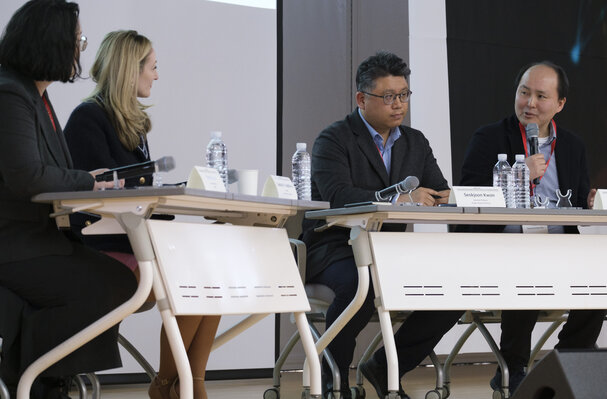
Taehyun Jung (right) speaks during a panel discussion at Nature Index Live at KAIST in South Korea with (left to right) Dasom Lee, Cassidy Sugimoto and Seokjoon Kwon. Credit: SeongGwang Kim, Seung Hyun Kim, KAIST
Boosting international research collaboration often needs a policy and funding drive from governments and other agencies rather than simply leaving it to grow organically between researchers, a Nature Index event has heard.
The view was one put forward during a debate on whether collaboration is best supported in a ‘top-down’ or ‘bottom-up’ way, with opinion divided on whether a focus on researcher autonomy or direction from above, accompanied by funding, was most effective.
“We’ve seen this time and again — when funding agencies provide resources to incentivize behaviour, scholars respond,” information scientist Cassidy Sugimoto, from the Georgia Institute of Technology in Atlanta, said during a panel discussion at the Nature Index Live event at the Korea Advanced Institute of Science and Technology (KAIST), in Daejeon, South Korea, on February 5.
“Expecting it to happen organically and from the bottom up — that will happen later. But you have to have a catalyst for changing behaviour,” Sugimoto added. “You’re not going to shift direction without a massive policy shift that’s supported by resources.”
Sugimoto used the experience of the United States, where nanoscience research only really took off in the early 2000s. The launch of the US National Nanotechnology Initiative saw federal funding for nanoscience and nanotechnology almost double from US$270 million in 2000 to almost $500 million in 2001, and attracted many researchers to the field.
“The National Science Foundation said they were going to fund nanoscience research, and overnight there were hundreds of nanoscience researchers — they responded to a funding call,” said Sugimoto.
She added that the COVID-19 pandemic is another example of how funding policies passed down by governments, funding bodies and institutions can influence researchers to change their focus and priorities to maximize the impact of their work. “If you see a certain trend, the way to reverse trends is to incentivize other behaviours,” said Sugimoto.
Taehyun Jung, who specializes in science, technology and innovation policy at Hanyang University in Seoul, told the event, which was focused on South Korean research policy, that he prefers the more autonomous approach to research collaboration, led by researchers, but backed by funding.
“The Korean government has a top-down — institutional rather than individual — approach, with large projects rather than many small projects. I’m against it. Successful and effective collaboration should be autonomous and individual,” said Jung.
He said South Korea’s science initiatives should also give more flexibility to researchers who want to spend time at overseas institutions — “not just for a few weeks, but for a few months” — and said the norm at many South Korean universities of not allowing researchers to hold multiple affiliations may limit their ability to collaborate effectively.
Seokjoon Kwon, a chemical and polymer engineer at Sungkyunkwan University, in Seoul, agreed that researchers should be allowed to take a spontaneous and autonomous approach to collaborations, especially in the basic sciences. But he said there are some areas — such as technology areas that come with national security risks — that should have some kind of intervention by the South Korean government. “So, we can have a combination of policies”, both top-down and bottom-up, said Kwon.
The panel also discussed the regions in which researchers should be looking for international collaborations. Jung said it was important for South Korea to strengthen its collaborations with “geographically proximate countries” such as Japan, China, and other Asian nations. Data presented earlier at the event by Sugimoto, and also by Nature Index, highlighted the strong opportunities that other Asian countries might present as research partners, in addition to South Korea maintaining its close ties to the United States.
But Sugimoto said countries should also think about the focus of their collaborations. She pointed out that multisectoral partnerships — for example, between universities and industry — were underutilized in basic science but were becoming increasingly relevant due to the amount of basic research being done in the corporate sector.
“As of this year, in the United States, there is larger R&D expenditure in basic research in industry, rather than in higher education. We’re seeing a privatization of basic research across the United States,” she said.
She added that “many people are responding in panic” to this shift and often cited 20th-century figures like Vannevar Bush — a driving force behind the creation of the National Science Foundation — who they say wanted “basic science to be pure and unadulterated and to happen in higher education”.
“But we’re moving into a new era, where commercialization is at the forefront,” Sugimoto emphasized.
As a result, she said academics now needed to look to international industry and corporations for research partnerships in basic science, as well as overseas academic institutions. “We have to start thinking outside the silos of our sector to think about how we can more relevantly entangle with those sorts of industries,” she said.
