
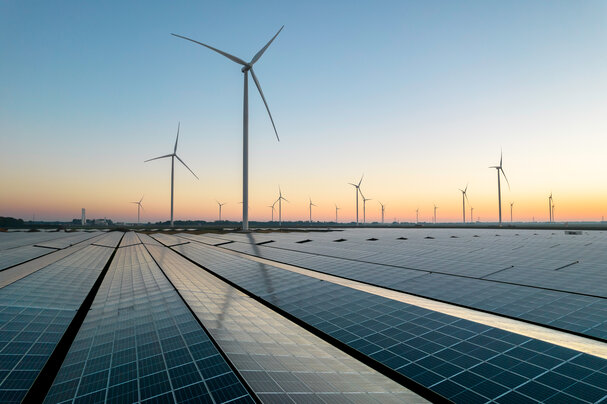
Solar panels and wind turbines in the Netherlands. Credit: Daniel Bosma/Getty
One institution has ploughed tens of billions of dollars into green-energy research over the past decade, according to a new analysis.
Figures from the Digital Science Dimensions database, extracted by the Nature Research Intelligence team, show that European Commission-funded grants on affordable and clean energy research were worth US$27.4 billion between 2015 and 2024. This is more than $20 billion higher than the next largest amount in the database, Germany’s Federal Ministry for Economic Affairs and Climate Action ($5.4 billion).
Funding data in Dimensions are not comprehensive. Figures from China-based institutions, for instance, are incomplete. But the data indicate that the European Commission’s funding on clean-energy research has picked up sharply since 2021.
Between 2015 and 2019, the commission was investing around $1.4 billion to $1.8 billion a year in grants for science related to the United Nations Sustainable Development Goal (UN SDG) 7 (Affordable and Clean Energy). This rose to around $2.5 billion in 2020, further increased to $3.2 billion in 2022, and was $6.3 billion in 2024.
One potential factor driving this rapid increase is that the commission’s main research programme changed from Horizon 2020 (which ran from 2014 to 2020) to Horizon Europe (which started in 2021 and runs until 2027).
As well as having a larger budget of about €94 billion (compared with almost €80 billion for Horizon 2020), Horizon Europe introduced five ‘mission’ areas to align funding with wider European Union goals. One mission focuses on ‘adaptation to climate change’, while another aims to deliver 100 ‘climate-neutral and smart cities’ by 2030.
One key aim of the missions is to use funding to encourage collaboration between research institutions and other organizations and groups — both in the public and private sector — to ‘create real and lasting impact’ in the areas targeted.
The European Commission’s funding in this area is also very large because it is a huge international organization with a major research programme. Funding on clean-energy research from the United States, for instance, is broken down into various federal agencies, including the Office of Basic Energy Sciences and the Advanced Research Projects Agency.
The United Kingdom also has a large funding footprint in the database for SDG7 research; its Engineering and Physical Sciences Research Council funded almost 4,000 grants worth $2.6 billion from 2015 to 2024 . Norway, which has a much smaller research sector, funded about 1,900 grants worth $1.4 billion through its Research Council.
Power transfers
The average amount per grant varies considerably between funders. The European Commission’s 6,455 grants were worth about $4.3 million each, on average, and the US Office for Basic Energy Sciences’ 992 grants had an average value of $2.4 million. At the other end of the scale, the National Natural Science Foundation of China funded more than 17,600 grants over the period, but at an average of about $90,000 each (the China data also only cover up to 2020).
The leading recipient for funding into affordable and clean energy according to the Dimensions data is Germany’s Fraunhofer Society, which received a share of almost 700 grants from 2015 to 2024 that were worth almost $5 billion in total (the data do not break down how much individual institutions received from grants that went to multiple organizations).
Among individual universities, the Technical University of Denmark, in Kongens Lyngby, was associated with the most funding for SDG7-related research in the last decade, being named on 344 grants worth a total of $1.6 billion.
Engineering attracted the most funding for projects related to SDG7, according to the Dimensions analysis. Almost 86,000 grants were associated with the topic between 2015 and 2024, worth a total of $50.6 billion.
This was far more than any other field of research, with chemical sciences ($13.3 billion in grants), built environment and design ($11.9 billion) and information and computing sciences ($11.1 billion) next on the list.
