
When Google Scholar releases its annual update of the most highly cited academic publications for the past five years, the same heavy hitting papers tend to dominate, due to the way citations accumulate over time.
For this analysis, therefore, we’re focusing on the most highly cited papers that were published in 2023 by the top ten journals and conference proceedings, to identify research that has made a rapid impact.
According to Google, its rankings for 2024 cover articles published between 2019 and 2023, inclusive, and orders articles according to their citations as of July 2024. Journals and conferences are ranked based on the h5-index — a metric for describing the general citation impact of articles published in the journal or conference in the last five years.
"YOLOv7: Trainable Bag-of-Freebies Sets New State-of-the-Art for Real-Time Object Detectors"
Proceedings of the IEEE/CVF Conference on Computer Vision and Pattern Recognition
5,772 citations
Real-time object detectors are a crucial component of many artificial intelligence (AI)-based systems — such as autonomous driving vehicles, robotics and medical image analysis systems — and can process and analyse visual data almost instantly.
YOLOv7 is the latest version of the YOLO (You Only Look Once) family of real-time object detectors, and it is significantly faster and more accurate than previous iterations, computer scientist Chien-Yao Wang from the Institute of Information Science, Academia Sinica, in Taiwan, and his co-authors write in this paper.
Key to YOLOv7’s efficiency is the ‘trainable bag-of-freebies’ approach that Wang and his colleagues took to enhance the model’s performance without increasing the training cost.
Referred to as “some of the tricks we used in training” by the authors, the approach includes batch normalization, which is like giving the model a quick reset after each step to ensure that the data are clean.
The paper is among the 10 most-cited papers published by Proceedings of the IEEE/CVF Conference on Computer Vision and Pattern Recognition in the past five years, according to Google Scholar.
"InstructBLIP: towards general-purpose vision-language models with instruction tuning"
Proceedings of the 37th International Conference on Neural Information Processing Systems
2,086 citations
This paper explores the improvement of vision-language models: AI that can read and generate both images and text. The researchers, most of whom were from US cloud-based software company, Salesforce, created InstructBLIP, which builds on an earlier model called BLIP-2, to understand and follow specific instructions when analyzing images more quickly and accurately. A key upgrade, they say, is that InstructBLIP incorporates zero-shot learning, which means it can complete new tasks without needing additional training.
The model, which is open-source, can be used for a variety of tasks including complex image generation — for example using prompts such as “create an image of a cozy nook in a treehouse at night with warm lighting” — and image captioning. It can answer questions about the composition of an image and generate detailed descriptions of it, which could make it valuable in fields such as healthcare and medical research.
The paper is the 30th ranked paper in Neural Information Processing Systems for the period 2019–23.
"Lecanemab in Early Alzheimer’s Disease"
New England Journal of Medicine
2,035 citations
Pharmaceutical companies Biogen, in Cambridge, Massachusetts, and Eisai, in Tokyo, released the full clinical results of their Alzheimer’s disease drug candidate lecanemab in this paper, including how it was shown to slow the decline in memory and thinking skills compared to a placebo over 18 months.
Since the paper’s release, the US Food and Drug Administration approved lecanemab as a treatment for Alzheimer’s disease in January 2023 — at the time only the second Alzheimer’s drug to qualify. In August last year, UK healthcare regulator, the National Institute for Health and Care Excellence, said in draft guidance that lecanemab would not be made available on the government-funded National Health Service “because the benefits are too small to justify the high cost”, Nature reported at the time.
With just over 2,000 citations, the paper has garnered a lot of attention both inside and outside the academic community. But it can’t compete with the New England Journal of Medicine’s top-cited papers for the period 2019-23: the top five, according to Google Scholar, all published in 2020 and all about COVID-19, range from roughly 12,000 to more than 32,000 citations each.
"DreamBooth: Fine Tuning Text-to-Image Diffusion Models for Subject-Driven Generation"
Proceedings of the IEEE/CVF Conference on Computer Vision and Pattern Recognition
1,502 citations
In this paper, the authors describe how a new technique called Dreambooth can produce realistic images based on just a few pictures of a specific subject. The technique is based on an existing generative AI model called Stable Diffusion, and allows the AI to create new images of the subject in various settings and poses, maintaining key features while placing them in different scenes. The paper is authored by a team from Google Research, in Mountain View, California,
This is one of two AI techniques based on diffusion models in this list. For comparison, DreamBooth focuses on generating two-dimensional images of specific subjects, while DreamFusion, mentioned below, extends the capabilities of diffusion models to create three-dimensional models from text descriptions.
This paper is the second from Proceedings of the IEEE/CVF Conference on Computer Vision and Pattern Recognition in this list – a demonstration of how impactful AI papers have become in the past few years.
"Hallmarks of aging: An expanding universe"
1,479 citations
Led by Carlos Lopez-Otin, a biochemist at the University of Oviedo in Spain, this paper proposes 12 key factors that contribute to ageing — building on the nine factors identified by the team a decade earlier. Covering several molecular, cellular and systemic processes, the factors include genomic instability, telomere attrition and mitochondrial dysfunction as key drivers of cellular aging and damage.
The paper describes these factors as interconnected with each other, as well as with the hallmarks of health that Lopez-Otin and his co-authors proposed in 2021, and says they could be used by researchers to better understand age-related conditions, as well as how to potentially slow or reverse some aspects of the ageing process.
The paper is the 29th most-cited paper published in Cell from 2019 to 2023, 16 of which are related to COVID-19, according to Google Scholar.
"Evolutionary-scale prediction of atomic-level protein structure with a language model"
1,300 citations
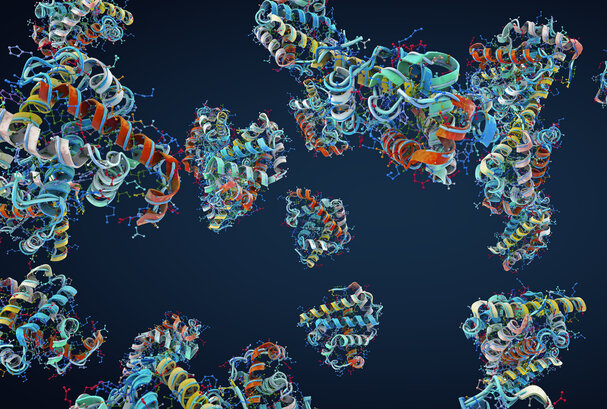
Led by Zeming Lin, from US technology company Meta's Fundamental AI Research team, in New York, the paper describes a new method to predict the 3D structure of proteins, based only on their amino-acid sequences. The team built on the principles of AlphaFold, an AI protein-structure prediction tool created by DeepMind, to develop ESMFold, which they used to produce a huge database of structural predictions for more than 600 million proteins from bacteria, viruses and other microorganisms.
Alexander Rives, former lead of Meta AI’s now-disbanded protein team, said that ESMFold isn’t quite as accurate as AlphaFold, but it is about 60 times faster at predicting structures for short sequences, according to a Nature news report. The tool could be used to study biology’s ‘dark matter’ – unknown or poorly understood genetic sequences.
The paper falls just outside the top 50 most-cited papers in Science over the past five years, as listed by Google Scholar.
"DreamFusion: Text-to-3D using 2D Diffusion"
International Conference on Learning Representations
1,254 citations
Being able to easily generate 3D assets and models could make video-game, film and virtual-reality creation more efficient and accessible. In this paper, authors led by Ben Poole, a research scientist at AI company, DeepMind, in London (which is now run by Google), presented DreamFusion, an AI system that can create 3D models from text descriptions. Like DreamBooth, DreamFusion leverages a diffusion model in various ways to build out an asset in three dimensions, such as estimating its density and what it would look like at various angles and with various light sources.
According to a blog post by ARK Investment Management, an asset management company in Florida, the development of DreamFusion reduced the cost of generating a single 3D asset by 94% in just 9 months, after accounting for the kind of graphics processor needed to run it.
The paper has been referenced by three patent applications (two international, one in the United States), including one submitted by Poole and colleagues.
