
Credit: Harvepino/Getty
Australia’s Share in the Nature Index is falling, but its internationally collaborative output has increased, according to analyses done for the Nature Index 2024 Australia supplement, released last week.
In 2023, Australia’s international article count (articles that include at least one Australian author and international collaborator) was 3,052, up from 2,978 in 2022. This represents 86.8% of the total articles for 2023 and 84.3% for 2022.
This is higher than all of the 10 leading countries in the Nature Index. The top 10 country with the highest international article percentage is Switzerland, at 86.4% (see "Cross-border collaborations").
When broken down by subject area, Australia’s physical sciences output had the greatest percentage of international articles, at 89.8%, followed by biological sciences, at 88.3%. Chemistry had the lowest international article percentage, at 83.2%. These percentages were all higher than the leading countries in the Nature Index.
This is not the case for the Earth and environmental sciences and health sciences, where Australia’s international article percentages of 87.4 and 86.5, respectively, are lower than several top-10 countries.
The chart below shows Australia's internationally collaborative article percentage in the Nature Index for all subjects combined, compared with the leading ten countries.
Publishing partners
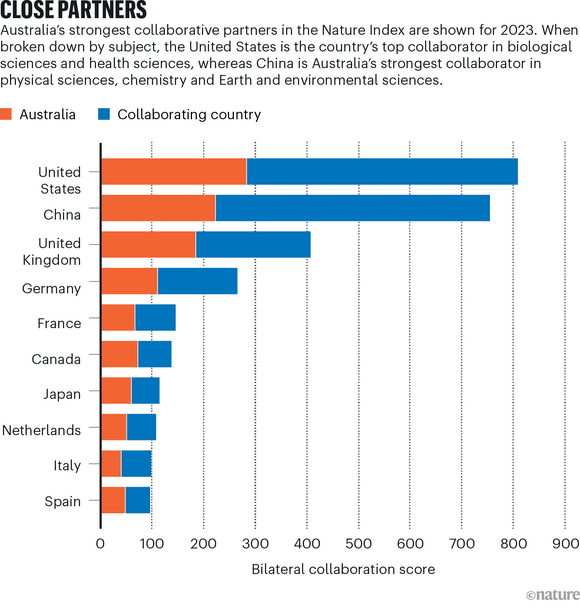
The United States has been Australia’s leading international research collaborator in the Nature Index since its launch in 2015. The bilateral collaboration score (BCS) between the two countries — the sum of Shares on the papers to which both have contributed — for natural sciences output has remained fairly consistent over the past nine years, decreasing by 1.2% between 2015 and 2023.
With China, Australia’s second strongest collaborative partner, the two countries’ BCS in natural sciences increased by 209% between 2015 and 2023. This is by far the largest increase among Australia’s ten leading collaborative partners for the period.
Source: Nature Index
Subject strengths
Australia’s Share in biological sciences is the highest among the subject areas tracked by the Index, at 27.3% of its total Share in the Index, followed by health sciences (26.3%), chemistry (24.1%), physical sciences (23.7%) and Earth and environmental sciences (16.3%) (percentages don’t add up to 100% because articles in the Nature Index may be assigned to more than one subject area).
Physical sciences is the only subject that Australia increased its adjusted Share in between 2022 and 2023 (adjusted Share allows for yearly changes in article numbers). This could reflect shifting government priorities in research, but it’s too soon to tell if recent funding initiatives have resulted in more papers.
In 2022, the Australia Research Council, one of the country’s most significant independent funding bodies, awarded 143 biological science projects more than AUS$73 million in funding. Sixty-two physical science projects were awarded a share of just over AUS$30 million. In 2023, by comparison, physical science projects received AUS$145 million split between 57 projects. Biological scientists received AUS$133 million between 157 projects.
In May 2023, the government announced the launch of a AUS$1 billion National Quantum Strategy, a project to boost the country’s quantum technologies through research and development.
