Thank you for visiting nature.com. You are using a browser version with limited support for CSS. To obtain
the best experience, we recommend you use a more up to date browser (or turn off compatibility mode in
Internet Explorer). In the meantime, to ensure continued support, we are displaying the site without styles
and JavaScript.
Swarm intelligence - Collective motions from biology to robotic
Submission status
Closed
Submission deadline
Swarm behavior is a phenomenon observed in nature where flocks of birds, schools of fish, and swarms of insects exhibit coordinated movement. Each entity interacts with its surroundings and other individuals without any centralized control to display complex and intelligent behavior. The key to swarm intelligence lies in the continuous collection of information from each individual that is then integrated to get feedback. Researchers are working on bridging the gap between biological systems and artificial agents by studying collective motions from cells to robots. One of the goals is to create adaptable, efficient, and robust robotic swarms capable of performing diverse tasks in various environments.
Complex collective behaviors emerging from individual-environment interactions
Active matter theories to understand collective dynamics
Self-organization in nature such as ant colonies, bacteria, bird flocks, fish schools, and other social organisms
Swarm robotics including colloidal systems, miniature robots, drones, and modular robotic systems
Bio-inspired multi-robot systems tackling complex tasks beyond individual capabilities
All the submissions will be subject to the same peer review process and editorial standard as regular Nature Communications, Communications Physics, Communications Engineering, and Scientific Reports.
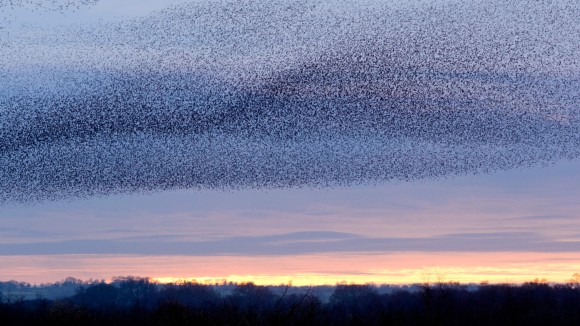
The collective dynamics of active swarms such as bird flocks and fish schools emerge from the complex, and often competing, interaction involving alignment, cohesion and collision avoidance. The authors propose a minimal flocking model with vison-based steering interactions, revealing a unique transition from order to disorder reminiscent of a Berezinskii-Kosterlitz-Thouless transition, which could enhance understanding of rapid flock responses in biological systems.
Decision-making in multi-agent systems often involves control goals that break reciprocity. Here, authors derive a field theory for such interactions, revealing nonreciprocal couplings that generate diverse collective behaviors through simple manipulations.
Cooperative transport in ants inspires applications in robotic swarms yet poses a challenge in decentralized control. The authors designed a robotic swarm where cooperative transport emerges spontaneously through mechanical interactions alone, offering an embodied route for swarm intelligence.
The Swarm Cooperation Model (SCM), governing the balance between social interactions, cognitive stimuli and stochastic fluctuations leads an agent swarm to accomplish complex tasks, such as the optimization of multimodal functions or the localization of a contaminant source.
Microorganisms inspire AI-driven microrobots through their evolved navigation in complex fluids. Authors demonstrate AI-enabled chemotaxis in robotic swimmers using hierarchical reinforcement learning under partial observability.
Autonomous regulation of microscale active particles remains challenging due to the dominance of thermal fluctuations and environmental perturbations at low Reynolds numbers. Here, the authors demonstrate that counterbalancing non-equilibrium fluxes generated by thermo-phoretic repulsion and thermo-osmotic flows enables robust self-regulated orientational polarization of colloidal active particles, establishing a quantitative framework for emergent self-organization in colloidal active matter systems.
To understand and design interactions between individual entities giving origin to different dynamical collective behaviors is one of the current challenges in active matter. Here we show that a bean-shaped swarm is spontaneously formed from a mixture of particles with perception-dependent motility and opposite misaligned visual-like perception.
Understanding the bacteria-phage competition is crucial for horizontal gene transfer and treatment of antibiotic-resistant bacterial infections. This work investigates the interaction between common rod-shaped bacteria such as Escherichia coli or Pseudomonas aeruginosa and lytic phages to provide insights into their proliferating active dynamics in 2D and 3D environments.
The study explores the role of inhibitory signals in decision-making as inspired by honeybee house-hunting, focusing on how these signals influence collective behaviour and decision accuracy. The authors find that non-linear inhibitory responses enhance consensus and speed up deliberation compared to linear responses, albeit at the cost of reduced accuracy in selecting the best option.
The study of self-organisation of pedestrian movement at crossing is important for the design of strategies facilitating pedestrian flow in crowded areas and the mitigation of crowd-related accidents. The authors study the motion of pedestrians using a model inspired from active matter systems finding interesting phases of three interacting streams of agents, including jamming, and the emergence of a vortex state.
Collective motion in nature, such as flocking or turning, arises from local interactions between individuals, but vision-based mechanisms often struggle to capture critical neighbor movements. This study demonstrates that body orientation change (BOC) as a visual cue enhances coordination in fish schools and robotic swarms, improving collective responses.
Populations of swarming coupled oscillators with inhomogeneous natural frequencies and chirality are relevant for active matter systems and micro-robotics. The authors model and analyze a variety of their self-organized behaviors that mimic natural and artificial micro-scale collective systems.
Bird flocks are known to adjust the orientation and speed of individual birds giving rise to correlations that extend across very large groups. The authors show that marginal control provides an explanation of scale-free correlations of speed fluctuations in natural bird flocks of any sizes.
Active matter is a non-equilibrium system exhibiting collective behaviour and can be used to describe a wide range of biological phenomena from groups of cells to flocks of birds. Here, the authors develop a minimal model for studying the collective behaviours of polar and disordered active materials.
Understanding the interaction of active matter with the random environment is relevant to the navigation of living entities within disordered media. This study introduces a minimal model of active particles that are repelled by both each other and the randomly distributed obstacles to reveal new chiral modes of collective patterns as a function of the quenched noise due to the stochastic nature of the environment.
This commentary explores how collective intelligence arises from local interactions in animal groups and how these principles inform the design of swarm robotic systems, addressing the challenge of achieving robust, responsive, and scalable collective behaviors without centralized control.
Animals are often thought to follow simple alignment rules, but this study explores how collective behavior could instead emerge from neural ring-attractor networks encoding allocentric and egocentric bearings. The results show that group motion arises spontaneously when allocentric bearings are used, with rapid switching between the two representations further boosting coordination.
The combination of modular tangible interfaces and constrained optimization control enables users to operate shape-changing robots by matching their morphology and ensuring safety, allowing adaptation to different environments and application areas.
Inspired by microorganisms navigating environments via adaptive body deformations, this work explores how decentralized coordination of modular body parts facilitates self-propulsion in artificial microswimmers. Using tiny neural networks and genetic algorithms, the authors develop robust and adaptable swimming strategies effective across swimmer morphologies.
Swarming bacteria are self-propelled cells that move on surfaces in large groups that resemble flocks. However, in bacteria, isolated individuals cannot move, which differentiates them from other active systems. Here, the authors show that local reduction in water temporarily traps solitary cells, which also affects the arrangement of the flagella.
Enzymatic nanomotors exhibit collective behaviour in fuel-rich environments, forming swarms with enhanced propulsion and coverage. This study investigates the factors affecting swarm movement, revealing that solutal buoyancy drives their motion, with potential biomedical applications like targeted drug delivery.
Controlling microrobot movement in blood vessels is vital for medical treatments but is challenging due to red blood cells. This study combines simulations, experiments, and machine learning to demonstrate how hematocrit levels and robot geometry affect its locomotion characteristics in blood
Understanding the decentralized self-organization in animal groups helps design swarm robotics, yet the underlying mechanism remains elusive. Xiao et al. analyze collective motions of three large bird-flocking datasets and translate their findings to guide evacuation of a swarm of miniature robots in confinement.
It is known that spatially localized interactions can give rise to self-organized collective motion. Here, by studying pairwise interactions in juvenile zebrafish, authors reveal the role of reciprocal temporal coupling and find that temporal coordination considerably improves spatial responsiveness, such as reacting to changes in the direction of motion of a partner.
Active matter systems, such as zebrafish groups, demonstrate similar collective dynamics to assemblies of particles, or interacting agents. The authors show that majority of dynamics patterns seen in large zebrafish groups are exhibited by a minimal group of three fish.
Some active matter systems as they evolve, can be characterized by spatially varying density, with some regions that are dense and immobile, and other regions with lower density that accommodate most mobile particles. The authors show that this phenomenon can also be observed as an effect of the social interactions between fire ants.
Torsion pendulums are versatile tools for exploring complex systems, including those out of equilibrium. The authors investigate macroscopic selfpropelled rod-like robots, revealing non-Markovian dynamics and exponentially correlated noise, with implications for understanding active matter and testing fluctuation theorems in dense particle assemblies.
Insect–computer hybrid robots offer promise for navigating complex terrain. Here, the authors developed a vision-guided robotic system to automatically assemble hybrid robots with custom electrodes, enabling scalable production while maintaining effective locomotion control
Creating modular robots that can adapt to various tasks and construct temporary structures remains a challenge. The authors designed and tested lightweight, deformable, untethered robots capable of effective locomotion, versatile manipulation, and rotorcraft-assisted 3D assembly.
Cyborg insects combine living insects with miniature electronic controllers, offering several advantages over conventional robots. Here, the authors propose an algorithm that can navigate a swarm of cyborgs from the start to a predetermined goal in an unknown sandy terrain in the presence of obstacles and hills.
The authors introduce the concepts of Robo-Matter and Robot-Matter duality, using magnetic spinner micro-robots. A wide range of functionalities and applications beyond the capability of both traditional inert and active materials is enabled.
Microbot collectives can cooperate to accomplish complex tasks that are difficult for a single individual. Here, the authors report magnetic and light-driven ant microbot collectives that are capable of reconfiguring multiple assembled architectures.
Achieving shape assembly behaviour in robot swarms with adaptability and efficiency is challenging. Here, Sun et. al. propose a strategy based on an adapted mean-shift algorithm, thus realizing complex shape assembly tasks such as shape regeneration, cargo transportation, and environment exploration.
The authors introduce a 3D terrestrial robotic swarm equipped with a snail-inspired two-mode connection system for self-reconfigurability and mobility in unstructured environments.
Reaching group consensus without a leader can be jeopardized by even a minimal number of self-willed individuals. This study shows that, when individuals use inhibitory signals, a stable consensus is guaranteed, thus suggesting an answer to the longstanding question of why inhibition is widespread in natural systems of collective decision making.
Salman, Garzón Ramos and Birattari report a strategy to automatically design stigmergy-based collective behaviours for robot swarms. This approach is demonstrated through simulations and real-robot experiments, encompassing a diverse range of four distinct tasks.
Swarms of drones can collaborate to sense the environment. Nathan and coworkers propose a collective sensing strategy to improve tracking ability in densely forested areas, where targets can be occluded. The results pave the way to more accurate and sophisticated applications for detection of targets in complex environments.
Abdel-Rahman and colleagues introduce a discrete modular material-robot system that is capable of serial, recursive (making more robots), and hierarchical (making larger robots) assembly. This is accomplished by discretizing the construction into a feedstock of simple primitive building blocks combined with an algorithm to plan the optimal construction path and assemble the building blocks into functional units and swarms.