
Thank you for visiting nature.com. You are using a browser version with limited support for CSS. To obtain the best experience, we recommend you use a more up to date browser (or turn off compatibility mode in Internet Explorer). In the meantime, to ensure continued support, we are displaying the site without styles and JavaScript.

Volume 3 Issue 11, November 2025

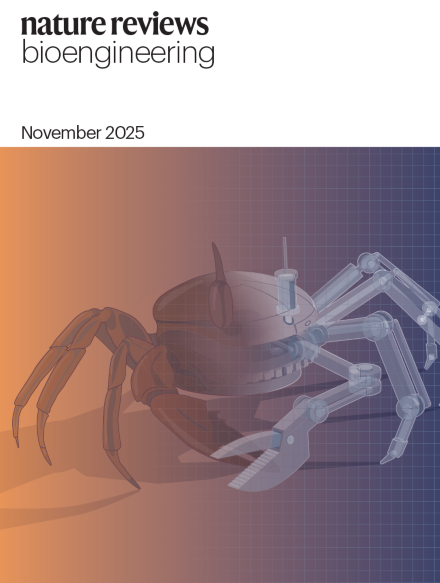
Nature’s energy-efficient movement strategies offer insights for designing resilient autonomous robots with low energy consumption. By analyzing how animals and plants move across terrain, soil, underwater and air, bioinspired principles can be identified to expand the operativity of robots. See Barbara Mazzolai et al

Cover image: Simon Bradbrook
Editorial

  • Nature has spent billions of years evolving the most efficient and effective solutions to complex problems, from navigation and energy harvesting to visual processing and biodegradation. Bioinspired engineering draws on these strategies to design adaptive, efficient and sustainable technologies, particularly in fields such as robotics, materials science and medical device engineering.

    Editorial

    Advertisement

Top of page ⤴

Comment

  • Bio-inspired path integration and neural mapping enable robots to navigate autonomously in global positioning system (GPS)-denied environments such as disaster zones, space and deep oceans.

    • Chandan Sheikder
    • Weimin Zhang
    • Yichang Liu
    Comment
  • Soft robots, such as silicone pneumatic networks or tendon actuated fingers, can be built at low cost and feature human-centered designs. The accessibility and real-life applications of soft robots make them ideal for educational outreach programs aimed at encouraging students to pursue biorobotics careers.

    • Holly M. Golecki
    Comment
  • Base and prime editors extend the therapeutic scope of genome editing. Experience from CRISPR clinical trials offers a roadmap for their translation, from manufacturing and quality control to clinical trial design and regulatory assessment.

    • Christian L. Flugel
    • Amaia Cadinanos-Garai
    • Mohamed Abou-el-Enein
    Comment
Top of page ⤴

Down to Business

  • Bacteria can be engineered to metabolize inflammation by-products for the treatment of inflammation-mediated diseases. We created a spin-off company to translate bioengineered Escherichia coli Nissle into a live therapeutic product, navigating translational, regulatory and biotech mindset challenges. Here, I provide some generalizable insights into academic entrepreneurship.

    • Deanna L. Gibson
    Down to Business
Top of page ⤴

Research Highlights

  • An article in Nature Communications reports bioprinted trophoblast organoids as models of early placental development.

    • Christine-Maria Horejs
    Research Highlight
Top of page ⤴

Reviews

  • Living organisms surpass robots in durability and adaptability. This Review explores animal and plant energy-saving strategies to inspire resilient, low-energy robots and emphasizes the cost of transport as a key metric in relation to the durability of various movement modalities.

    • Barbara Mazzolai
    • Emanuela Del Dottore
    • Cecilia Laschi
    Review Article
  • The historically independent evolution of bioinspired and biointegrated vision is increasingly showing a trend of convergence. This Review discusses each technological framework emphasizing visual devices that mimic the structures of the natural eyes and the information-processing capabilities of biological visual systems.

    • Yifei Yang
    • Yifei Wang
    • Yang Chai
    Review Article
  • Organic afterglow luminescence imaging detects photons that are being slowly released from chemical defects after the light source is turned off, enabling autofluorescence-free in vivo imaging with a high signal-to-background ratio. This Review discusses the mechanisms underlying organic afterglow luminescence, outlining organic afterglow probe design and optimization and highlighting key biomedical applications.

    • Liangyou Zhao
    • Qingqing Miao
    Review Article
  • Compared with traditional fluorophores, aggregation-induced emission luminogens (AIEgens) offer enhanced fluorescence in aggregated states, large Stokes shifts and excellent photostability. This Review discusses the biomedical applications of AIEgens, such as cell imaging, in vivo bioimaging, phototheranostics and in vitro diagnosis of human clinical samples, as well as their route to in vivo clinical translation.

    • Dingyuan Yan
    • Dong Wang
    • Ben Zhong Tang
    Review Article
Top of page ⤴

Search

Quick links